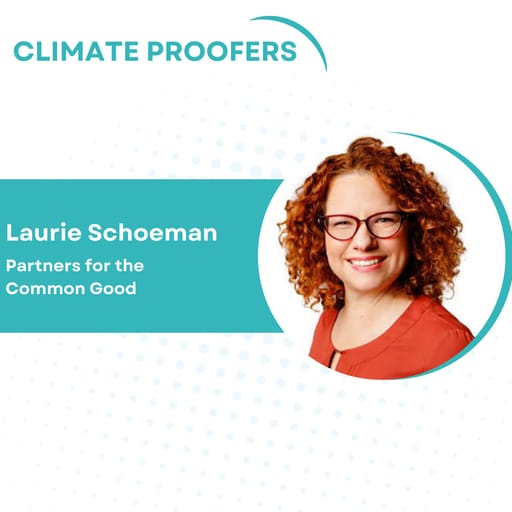
Transcript 0:00 [upbeat music] Hi, everyone, and welcome to Climate Proofers, the show all about those on the front lines of climate adaptation, finance, tech, and policy. 0:13 I'm Louis Woodall, editor of the Climate Proof newsletter, which you can read at www.climateproof.news. It's a big, big day in the short history of Climate Proofers because today marks the 50th episode of the pod. 0:26 Over the last year, I've had the privilege and pleasure of speaking to some of the brightest minds in adaptation and sharing their stories with all of you. 0:33 From the lofty heights of Wall Street to the smallest towns in Scotland, there are smart, passionate people seemingly everywhere working to climate proof our world. 0:41 And at a time when optimism about the future seems in short supply, their energy and drive gives me hope. And I'm not the only one who seems to be benefiting. 0:48 The pod has garnered almost 10,000 downloads to date, with more folks tuning in to every new episode. Thanks for the incredible support. And rest assured, I have no plans to hang up the headphones anytime soon. 0:59 There'll be plenty of Climate Proofers to come. 1:01 Of course, putting on a good show takes time and money, so today I'm getting my begging in early and asking those listeners who are not yet Climate Proof members and want to support my work to consider upgrading by heading over to climateproof.news/upgrade. 1:15 My new member shout-out today goes to Daniel Abrahams, who I met at the Adapt Unbound conference the other week. Daniel served at USAID and is working on a new project I think is really exciting. 1:26 Hopefully, there'll be more to share on that front soon. Thanks for becoming a member, Daniel. And remember, you can join him by going to climateproof.news/upgrade. 1:34 Today's special 50th episode interviewee is a true-blue climate resilience champion, Laurie Schumann. Laurie has a long and storied career across climate resilience, housing policy, and sustainable investment. 1:46 Until very recently, she served in the Biden administration, first as an advisor on climate risk and resilience, and later on housing. 1:52 Now, she's at a community development financial institution called Partners for the Common Good, where she's working to bring capital to low-income communities. 2:00 Today, we talk about the adaptation successes and shortcomings of the Biden White House, discuss the durability of the federal adaptation agenda under Trump, and get into Laurie's important work advising on the rebuilding of Los Angeles following this January's wildfires. 2:14 It's a wide-ranging, thought-provoking episode with someone whose knowledge of the US adaptation space has few equals. I trust you'll enjoy listening to the convo as much as I enjoyed having it. 2:24 First, though, a roundup of the top adaptation and resilience stories from last week. 2:29 In finance, a new report from the Global Network Convergence finds that climate adaptation and mitigation made up for almost half of all blended finance transactions last year, accounting for over $11 billion in total. 2:40 Blended finance transactions are those that mix public and private capital, where public, or sometimes philanthropic capital, is used to de-risk investments for private investors. 2:49 The format is popular as a way of channeling finance to risky adaptation projects throughout the developing world. 2:55 While the upward trend in climate finance deals is a positive, Convergence is doubtful volumes will grow this year. 3:00 This is because the public providers of capital are retreating from the space, notably USAID, which has been gutted by the Trump administration, and the UK's Foreign Commonwealth and Development Office, or FCDO. 3:11 In policy, UN-convened experts have drawn up a list of 490 potential climate adaptation indicators out of an initial tangle of more than 9,000, an important step toward a universal scorecard that could help with progress towards the global goal on adaptation. 3:26 This is an important, though often overlooked, plank of the 2015 Paris Agreement. The indicators are organized across seven themes and four cross-cutting dimensions. 3:35 Infrastructure and human settlements dominate the list with 99 indicators, reflecting the massive effort needed to harden roads, bridges, and power grids. 3:43 The leanest cluster, made up of 18 indicators, covers impact, vulnerability, and risk assessment. 3:48 Once finalized, the indicators could help structure countries' national adaptation plans and unlock public and private finance for specific adaptation efforts. 3:57 They could also cascade down to the sub-national and regional levels, making it easier to identify local adaptation needs and signal to private and public investors where innovations should be prioritized. 4:07 The indicators will now be scrutinized by parties at the Bonn Climate Conference in June. A final set of indicators are supposed to be approved at COP30 in Brazil this November. 4:16 And in tech, an AI model from Microsoft is able to predict extreme weather and atmospheric events faster and more accurately than traditional forecasting systems, according to a new paper in the journal Nature. 4:27 The tech could make climate hazard warnings cheaper and more accessible to vulnerable populations. 4:32 The AI model, Aurora, is trained on over one million hours of data and can be fine-tuned to predict not just the weather, but air pollution, ocean waves, tropical cyclone paths, and more. 4:42 For medium-range weather forecasts, the kind that people rely on in their weather apps, Aurora was able to beat current numerical and AI approaches at the city and town scale across 91% of targets. All right. 4:54 That's it for this week's roundup. Now on to my chat with Laurie. [upbeat music] Hi, Laurie. Where are you calling from today, and what do you do? I am currently in Takoma Park, which is right outside of Washington, DC. 5:08 I am currently the chief investment and impact officer for Partners for the Common Good, which is a national community development finance institution. Thanks for joining us today, Laurie. 5:18 It's a real pleasure to have you here. 5:20 Now, before you were at Partners for the Common Good, you served under the Biden administration, serving first as senior advisor for climate risk and resilience, then as a senior housing policy advisor. 5:31 And before that, you've had a long and storied career in housing and urban planning and community engagement. 5:36 So I want to get into all that over the course of this conversation, but I'd like to start with that most recent line item in your resume, your tenure with the Biden administration. 5:45 And I'd like to ask, where do you see climate adaptation resilience efforts really pick up speed in those four years under President Biden? And in what areas do you think not enough action was taken? 5:55 So I had a very unique and interesting role at the White House because I was focused, you know, as you mentioned in the first year, on trying to understand how we couldReally advance the area around climate risk reduction, which is really looking at the consequences of climate change how, you know, climate change shows up in terms of warming seas, floods, fires, and how we would, as a nation, be able to protect our critical assets like housing, infrastructure, business from these threats. 6:29 And it's often a space that does not get as much attention as what we call the causes of climate change, which is the emissions and slowing down global warming arena. 6:40 And, you know, I've been working in the climate risk space my entire life, or we call it mitigation space, because we need to work in tandem and collectively. 6:50 But I think that that space has often gotten a lot more attention in large part because I think that the community that promotes mitigation has done a great job of identifying how to build projects, how to fund and finance this work. 7:05 It's a much more mature environment. And unfortunately, the climate risk and resilience environment does not get as much air time. 7:13 And one of the things we were trying to do is get it more air time, even within the administration. 7:18 And so in the time I spent as the advisor on climate resilience, we set forward a really critical and ambitious roadmap for the nation to tackle the issues around climate resilience. 7:32 It's called the Climate Resilience Framework. It was the first framework of its kind put out by the White House, by the president, and it essentially tried to guide all the agencies to step forward in a big way. 7:47 It's also worth mentioning President Biden and Vice President Harris had incredible commitment to this space. Neither of them are strangers to the issues around climate risk. 7:58 Vice President Harris worked deeply on insurance issues in California. 8:02 And, you know, one of the critical pieces was trying to make sure that at the highest level of our executive office, we had set forward this ambition. So that was really critical. 8:13 And I think that while it has been buried now by the current administration, it still becomes a bit of a North Star. 8:20 One of the things I was proud about during that time is we asked the question when we were putting that forward, how are we gonna finance this work? 8:28 So with some real deep partners, we were able to pull together foundations that have been leading on community development and climate resilience, like Kresge, like Packard, to have them c- step forward and commit to funding this work. 8:42 And I was really proud of that because we can't continue to just focus on policy and programmatic interventions. We've got to think about how we finance this work. 8:52 So that was really wonderful, and I think that there was a lot of ambition around how do we make sure that we create enabling mechanisms for folks to invest in communities, but I think we could have done more. 9:04 We could have created a little bit more of an enabling environment for private sector participation in climate resilience and risk reduction, for sure. 9:13 I think that, again, we did a lot of good work on the emissions piece and bringing together tables like the Invest in Our Future table, which is a catalytic philanthropy commitment to invest in emissions reduction. 9:25 I would have liked to do the same for risk and resilience. I also think that, you know, some of the regulations that we placed on funding became prohibitively difficult for folks to work with. 9:38 We needed to move the money out much quickly. Um, and I think our value sometimes kind of slows us down at times. I think we need to be thinking about how does the private sector advance and expedite work. 9:51 And I've been in the private sector. I've, I've developed projects. I developed an off-grid building in San Francisco, and I know how hard it is to get de- deals done and projects developed. And, like, 10:02 additional regulations only slow you down, and when you're in a world where the climate is changing so rapidly and sensibilities on the ground are changing so rapidly, you've got to move quickly. 10:13 I think we could have done a lot more on the climate risk and resilience arena in terms of getting more private sector investment, getting more investment into the communities, reducing some of the red tape that we put forward in terms of some of our programs. 10:27 When I was a senior housing advisor, it was a natural course for me because I've been working in housing much of my professional life. 10:34 And to me, one of the most significant impacts of a climate event, like a hurricane, a f- a flood, a fire, is the impact to our shelter supply and our housing. 10:45 And we know that we're at a tipping point in terms of how much housing we need to just house our nation. We're seven million units short for affordable housing. Just to say that alone is a crisis. 10:59 And of those units, many of them are in floodways, they're in fire areas, so we've got to protect this critical, critical asset. 11:05 And so ensuring we have a climate lens to protect those assets from the consequences of climate change was really a, a very powerful remit for me. We cannot afford to lose any more houses to climate risk. 11:20 So together, those two themes and those two equities, which is what we sort of refer to them at within the White House, were really powerful. And before I left, 11:30 there was a lot of work we were doing to support communities that were recovering from disasters that still need a lot of support, like Selma, Alabama, 11:41 that got struck by tornadoes in '22, and now they're still cleaning up. Or Lahaina, which is a community that is still recovering from the fires that wreaked havoc over the communities. 11:53 And so many communities around the nation that President Biden had committed to-And we were online to support in a very deep way before we left the White House. So the work is far from done. 12:05 Indeed, and there's even more work to be done now that the current administration is tearing up so much of what you and your team did in terms of spreading the gospel of climate risk management and resilience throughout government and the private sector. 12:15 President Trump's administration has already gutted USAID, it's taken a hammer to NOAA, it's gutting FEMA. 12:22 So a lot of the institutional capacity of the federal government to support climate risk management and resilience is already gone. 12:29 But I'm wondering to what extent the, the work you did will withstand this administration's attacks. 12:35 You and others in the Biden administration put together a number of policies and strategies addressing climate resilience, including the Climate Resilience Framework, the Climate Resilience Game Changers, Investment Manual, and there were a number of federal agency-level adaptation plans that were put into practice. 12:49 So I'm wondering, how sticky do you think the things you did will prove to be, and what knowledges and best practice do you think will have an afterlife beyond the current attack by the federal government? 12:59 So the, the, the real truth is those documents were developed by an entire community of agency leaders informed by conversations we had with state leaders, city leaders, practitioners, investors. 13:17 We worked to make sure we were able to capture the sentiment and ambition from across the nation, whether we were talking to a f- you know, Republican of West Virginia, Democrat, Conservative. 13:30 We spoke with hundreds of stakeholders from around the country to inform those documents. And so those documents are a reflection of the nation's ambition. 13:41 They are not just a bringing down from the high set of commandments. 13:46 They are truly infused with the sentiment and ambition of so many folks that are on the front lines of climate risk, and I'm not talking about folks just in New York City or California. 13:57 I spoke with a lot of Republican leaders across the nation that were concerned about rising insurance costs, that were concerned about what to tell their constituents if they cannot repair a flood levee. 14:11 So to me, this is a very bipartisan issue. In fact, during the first Trump administration, I advised many folks within the administration at FEMA, at the agencies, and even at the White House on this issue. 14:22 So I am convinced this is a national issue, a national priority, and it does not know politics. And so those documents were very much informed by the nation. 14:31 Yes, it's important to remember that the fancy PDFs of the reports and strategies you put together that are hosted online, they're the culmination of the process, right? 14:40 Behind them, there's this whole process of bringing together people, sharing best practices, and doing all that work that is probably more material in terms of building long-term resilience and embedding the idea of resilience into agencies and government action. 14:53 So it's good to know that there are people in government who are aware of those learnings and people now outside of the federal government who may be working at a state level or the local level who are taking those learnings into their own context and building resilience at different levels too. 15:05 I just wanna point out something too. You asked before, like, what could we have done better at the White House? So we could have been better communicators about this work. 15:14 We could have actually said, "Hey, here are the folks we spoke to. Here are the farmers in the middle of Idaho struggling to keep their crops going because of the water supply shortage. 15:25 Here are the, you know, individuals impacted by these issues." I think more plain speak, more emotion in the correspondence. 15:34 I think we did a great job of putting out fact sheets, but we could have done a much better job of getting communication out and getting it to people on the ground. That would've gone a long way. Yes. 15:46 Well, you're kind of seeing that now, actually, the media writing stories about communities affected by the withdrawal of FEMA's Building Resilient Infrastructure Communities grants, right? 15:57 So there's these very powerful stories about farmers losing USDA grants and climate data that they were getting, individual small business owners who are losing out because some of these FEMA grants aren't coming their way. 16:08 So now we're getting the stories of the negative, but yes, the arguments for the positive, the benefits of resilience, they could have been made a little bit more, a little more s- a little more strongly. 16:17 And, you know, when we 16:19 find ourselves in a position where we're back in the White House, one of the first recommendations I'm gonna make is we need to bring in communication professionals that are really able to translate what policies affect and what changes and work we're doing affects people on the ground in a real way from day one. 16:39 From day one, we need that. Yes. 16:42 Well, Climate Proof exists partly to kinda spread the good word about [chuckles] resilience and adaptation, and I feel like we are building this ecosystem of communications around adaptation resilience, but there still seems to be a challenge kind of breaking through. 16:54 And I did wanna ask, though, at the moment it seems the Trump administration is pushing back against climate. Climate being understood as the mitigation piece, right? Lowering emissions, decarbonizing the economy. 17:05 There doesn't seem to be as much pushback against adaptation resilience that I've seen. 17:09 There are some programs, of course, that are being cut that have effects, but you are hearing, like, from Republican senators, Republican congressmen, and even members of the administration sporadically talk about the importance of adaptation resilience, not using the term climate change, but talking about these themes. 17:24 So from a communication standpoint, from a political standpoint, do you see adaptation resilience having a little bit more protection than mitigation on this front? 17:32 One of the facts of the matter is the current president, President Trump, is a real estate guy. 17:40 He comes from building, and he comes from the world of insurance, and he comes from the world of construction, and he comes from the world of operations and management, and that's where his father comes from, right? 17:53 Many of us that have been in the development world and construction world understand what it means when you lose a property and you lose rental income, or you lose the ability to generate revenue 'cause your commercialBusinesses have to move out 'cause there was a flood. 18:08 And so when we look at climate risks or the consequences of climate risks, and you can just say flood, fire, wind. 18:15 You talk about risk, and you say these are the material risks to a business, to an economy, to a nation's ability to generate GDP. And so it is a near term, here and now experience that people are feeling in a real way. 18:31 So this, in my work with folks from across the country, again, regardless of political stripe, we all agree rising insurance is not a good idea. 18:41 We all agree that when insurance disappears and you can't build housing, that's not good. 18:46 My friends at the National Associative- Association of Home Builders would agree, if you can't get insurance, you can't build, and then there's no jobs. 18:54 We could all agree that it's not good when a mother and her children lose their home because they've been flooded out and they've nowhere to go. 19:01 In a tactical way, it's not good when homes are burned in Los Angeles and we can't get tax revenue income from those homes, and I mean a lot of tax revenue is lost 'cause 16,000 homes are lost. 19:13 That's not good for the economy. I don't think there's a person or a politician in this nation that would disagree with me on those points. 19:21 And so the challenge before us is to try to put our feelings and our emotions aside [chuckles] on the climate question and whether it is an issue or not, and let's deal with the realities before us, which is storm season starts in T minus 30. 19:40 Let's put our emotions and our politics behind us, and I think that I am convinced if you put me in a room with friends from the more conservative stripes, I would be able to get agreement on this. 19:53 If Moses had said during the plagues, 19:57 "You know, we're gonna stay put, but we're not gonna do anything to protect our, our, our firstborn son or our communities from locusts or blight," like, he would be thrown out of office. 20:08 So I think the question before us is how do we protect ourselves and protect our nation? I don't think that we would get any disagreement from a politician on that. Yeah. 20:18 So if the first duty of government is to protect its people, then climate risks definitely fall under the list of things that are a threat to the people, and political leadership and the ability to move people with you on a policy is easy to do when you have the argument that, "Look, if we don't do something, we're gonna get washed away, we're gonna get burnt away, et cetera." 20:36 So I, I really take on board your point there. 20:38 Um, you mentioned the LA wildfires, and I wanna move to that topic now because along with many of you, you have many hats, obviously, and, and one of them is that you were appointed to the independent Blue Ribbon Commission on Climate Action and Fire Safe Recovery. 20:52 Now, this is intended to support a more resilient and sustainable recovery from that disaster, the LA fires, and the preliminary recommendations from that committee came out earlier this month. 21:01 So I was wondering if you could walk us through the highlights and tell us a little bit more about that, that commission. Absolutely, and I'll say I'm not a carpetbagger in California. 21:10 I lived in California for over a decade, and I worked very deeply across the state. One of the 21:17 most powerful experiences I had was working deeply in communities that were trying to protect themselves from fires and floods, 21:26 drought, and, you know, it was a real, a, a, a land of extremes, if you will, where there's so much big environment out there, and there's so much, um, risk and, like in the investment space, the higher the risk, the more the value you wanna pull out, right? 21:42 In California, such high-risk zones, but such beautiful and incredibly special areas. 21:49 And so when the fires happened, we started seeing various leadership mobilizing different groups to deal with the recovery, and one of the big questions many of us asked was: How do we make sure that California will be positioned in this recovery for a future when events come, like a fire, they can be managed much more strategically? 22:12 And, you know, we don't even wanna get to that spot, but we do know it's a major risk we need to manage. 22:17 Thankfully, District Supervisor Horvath stood forward and said, you know, "We need to make sure that there's someone in the room talking about incorporating resiliency into our rebuilding and adaptation." 22:28 And that led to the creation of the Blue Ribbon. 22:31 And the Blue Ribbon is a very unique experience because we're all thinking not about just the immediate aftermath and the cleanup and the immediate recovery, but how do we embed in the DNA of the recovery a long-term eye towards adaptation? 22:45 And so it's a really big remit. We've got leaders from all over the city and county. We've got leaders who've run water and power, insurance leaders, and we're literally taking a holistic 22:59 and comprehensive view of the land that we're working on, the region, the infrastructure, and identifying how do we manage this recovery in a way that's gonna generate resilience. 23:10 And so one of the, uh, immediate recommendations, and "The LA Times" covered this, is the development of a rebuilding authority that ensures that what happens is gonna be good for the county and the region going forward. 23:27 And we know what we need to do in terms of fire-wise building. We've got our standards through the Insurance Institute for Health and Safety. 23:35 We've got best practices in terms of how do you build in a way that's resilient. We know what fire escaping looks like and what flammable plants, highly flammable plants look like. 23:46 So we're taking all of this into consideration. We're also looking at how do we deal with our housing. How do we build housing so that it's going to be resilient to the future? 23:55 It's a really exciting moment, but it's really daunting because you know what? We don't know when the federal money is gonna come. 24:02 So one of the challenges we have right now is as funders step forward, as financiers step forward to invest in this work-In most cases, that money comes through in the form of loans, but without what we call takeout, 24:17 which would be the federal dollars, it's a lot more challenging to think about how to we repay the loans or pay for this work. So that's a challenge we're dealing with. 24:27 Our hope is to spur the conversation and advance this work in a real meaningful way, and that this will become a model for the rest of the state and maybe becomes a model for many areas around the nation that are dealing with risk and recovery. 24:41 And when we have a body of individuals like the Blue Ribbon committed to thinking about resilience, it's so helpful 24:49 to help advance recovery and resilience, and we can point to lots of ways that these efforts have actually yielded real results. 24:56 Yes, because one challenge with doing anything in the US is the multiple levels of government and governance involved, right? I mean, LA County and California itself is a good example of this. 25:07 You have county level, you have city level, you have state level, you have federal level. 25:11 And trying to coordinate all the various stakeholders and understanding, as you said, like, where the money and power and influence flows is important. 25:19 And I'm wondering to what extent Blue Ribbon Commissions like this can help kinda cut through some of that bureaucratic noise. 25:25 And by having this sort of balanced group of professionals who speak with authority and aren't sort of beholden to anybody, they are able to put forward a message that is... 25:35 that can be more readily embraced by different levels of government. 25:38 I mean, of course, there'll always still be issues in terms of how these different levels relate to each other, and there's political considerations as well. But you mentioned you seem to see this as a useful model. 25:47 So yeah, is- is something you're gonna be supporting going forward, and what other areas of the US, what are examples of sort of adaptation governance that you can point to? So I 25:58 grew up in New Jersey, a state with, like, so many counties and so many jurisdictions. I think we have something like seven hundred jurisdictions in New Jersey alone. 26:11 And so to get anything done in a real way, like, you ultimately would have to go [chuckles] to the governor's office to find out if they could, like, move the needle a bit, and I kinda grew up with that sensibility. 26:23 I, I got started in kinda advocacy when I was very young, and I used to always ask the question, like, "Who's on first?" in a particular policy. 26:33 Like, if there's three towns that are controlling one plot of land, like, who's on first? And that's been with me my whole life. How do you get to the place you wanna be quickest and fastest? 26:48 And I'm a big fan of reducing red tape, so that's why I bring that into this conversation. I think it's imperative that we reduce red tape everywhere we go. 26:57 And so with recovery, often the ways I've seen recovery work really well and embellishing and em- embedding value-driven recovery like resilience work well, is when you have a strong leader that is able to mandate and require and push in advance for some- something to be done. 27:18 So during Superstorm Sandy, you know, Mayor Bloomberg was a really big champion of resiliency work and climate adaptation and environmental sustainability, and that carried through to the recovery. 27:33 In Puerto Rico, we had... When Governor Rosselló was there, he was a very big champion of this work, and then it carried through. 27:43 In Houston, Mayor Turner was a very big champion of recovery, and he most certainly carried that through to his work. 27:52 And even in LA, Mayor Garcetti was a huge champion of resilience, and that carried through the agencies. So what I'm saying is, like, you do need a champion. You need a leader. 28:01 And in lieu of having a political leader of that kind, you need a body that can then help you embed values into the recovery, and I think that this reconstruction authority is really an important concept. 28:16 I think our Blue Ribbon Task Force is a starting point. Because if we're gonna get anything done, you need someone who's kind of, like, at the top of the food chain who's able to push it forward. 28:27 And I mean, in my days at the White House, I can't tell you how many times we would use the excuse, "Well, you know, the President would really like this done." 28:35 Even if you didn't know what you were talking about, it helps to have someone that you can invoke at the top of the food chain that says, "This is what needs to be done." 28:43 I'm not saying that a great leader theory is a good thing, especially considering where we are right now. 28:49 I'm saying a great leader is a good thing, and a leader that has a moral compass, a leader that cares about their people and who has... you know, who cares about the environment is a good thing. 29:00 Now, when it's not a good thing and when you don't have leadership like that, everything falls apart. 'Cause I really naturally believe people wanna do the right thing, and when they... 29:08 and when you have leadership that does not embed those values in their administration or their community, everything falls apart, and we can see that time and time again. People start to walk away. 29:18 People start to retract. People start to move away. They don't wanna be associated with that. 29:24 And I think President Biden really did a great job of marshaling support, marshaling goodwill, and as a result, he was able to guide us forward. And that's what you need in recovery. You need a moral compass. 29:35 You need a North Star. You need that leadership. I agree. I feel you need... There's two pillars, right? 29:41 You need the political leadership, someone who's got the bully pulpit who can marshal disparate actors together, right? 29:46 I do think, though, you do need these sort of cross-community groups as well, though, to kinda be places where debate happens 'cause I feel one danger of adaptation resilience measures and public policy is that if you impa- if it feels like these measures are imposed on communities, there can be backlash, right? 30:02 I'm here in New York. There's been a long-running saga about the East Side Resiliency Project, right? Very important. I'm in Battery Park City now, and there's lots of community engagement over the resiliency work here. 30:12 But the fear is, is that if you don't bring the community along, then it seems to be all right, this one leader, this, this kind of high and mighty group in their ivory tower are telling us what our land has to look like and what our s- town should look like. 30:23 So I think you need the political leadership, but you also do need that community buy-in, otherwise you get a backlash, right? 30:27 And you've seen this in transition politics as well.Well, I wanna say, I mean, that particular project, the East Side Resiliency Project, it, it, at some point it did have community consensus. 30:38 It was a community design project through Re-Rebuild by Design. But as money started to fade away and fade in, it changed. And one of the mistakes there was the communities were not brought forward. 30:53 And so, you know, it is critical that communities are in the mix, that advisors are in the mix at every step of the way, which is why the Blue Ribbon Commission is so important. 31:02 'Cause what we're doing is we're saying, "Here's a group of professionals dedicated to LA's recovery, and here are our recommendat- here are our recommendations." 31:11 A leader that I would honor would take those recommendations seriously and carry what they could carry forward and make sure to execute. A leader is as good as their team, right? 31:23 And I would also say a political leader is as good as their relationship with their community. These incidents are very personal, so a good leader seeks to get counsel from their community leaders. 31:36 That's what a good leader does. 31:37 A good leader reflects the ambition of their community, and which is why I'm so proud of our climate resilience framework that we put out of the White House, 'cause it does reflect the values of our community members. 31:48 'Cause it's tiring to keep protesting. We're, we're at a place right now where, you know, it... 31:54 We are h- coming up on storm season, and so many of our systems that were built to support us with community input in mind have been totally dismantled. Yes. 32:04 And so who is going to be marshaling sensible responses that are community centric, you know, in the aftermath of these disasters if those institutions have been brought down and there isn't that sort of adhesion that can bring people together to co- carve out resilience solutions? 32:21 Even in districts that are in support of our current administration are not getting a seat at the table. Mm. Right? So this has been a very clear message from day one, which is 32:37 there is no feedback loop. There is zero feedback loop. So when one of the things I'm concerned about is when we do have a hurricane, 32:50 and it has been c- made clear that the states should be the first and last stop for dealing with those experiences, and disaster declarations are going to be limited. 33:01 In fact, if you're in a area that receives a lot of snow, you are not gonna be eligible even for a disaster declaration this year. That is true. That has come forward on an executive order that many folks did not see. 33:13 The administration has made it clear that there is gonna be limited appetite for declaring any disasters, and the states need to be dealing with it basically on their own with very little support from the federal government. 33:25 And I think that's really scary [clears throat] because, you know, states are not built to deal with disasters. They don't have the money now. They don't have the capacity. 33:38 They don't have the federal partners to turn to for the rainy day funds. And I will say this, the erosion of agencies like HUD, like USDA, 33:50 y- we can go down the list, all of those agencies built the resilience of the communities and the states to be strong. 33:58 Whether you talk about getting subsidy for school lunches, whether you talk about getting housing vouchers, all of the ingredients that the federal government puts forward through the agencies, 34:09 they build a strong immune system for the states, and now those have been dismantled too. So the states are really wrestling with questions like, how are we gonna take care of our housing subsidies? 34:18 How are we gonna deal with the loss of the revenue that we were getting from the federal government? So it's a double whammy, and so that's gonna show up in a big way when the storms start to come. 34:30 One more thing on disaster response and recovery. 34:34 Is there a tension between wanting to rebuild as quickly as possible, which you are seeing in LA, and building in a way that is resilient and reduces the risk of a similar event happening down the line? 34:46 We've seen Governor Newsom in California, you know, expedite rebuilding and, and suspending or streamlining certain permitting rules. 34:54 But it feels to me like maybe making a re- more resilient LA, a more resilient city anywhere in the US after disaster might take a bit longer, and that's intention with the desire that everybody has to get back to normal as much as possible, to, "I want my house exactly as it was before the fire, before the flood. 35:10 I want it back. What, you're gonna... It's gonna take me six more months and 10,000 more dollars to make it more resilient?" Absolutely. "No, I want it now." Absolutely. So I wanna honor that tension. 35:19 That tension is very real. For the families that have been displaced from their homes in, in LA, they still have to send their children to school. They still have to go to their job. 35:29 They still have to take care of their family and friends. And now, now they've lost everything. They've lost their home. They've lost their generational wealth. And guess what? They still have a mortgage to pay, right? 35:42 There's no forbearance other than a couple months on your mortgage payments. The mail keeps coming. 35:48 So of course we n- gotta rebuild the homes immediately, and it's also important to rebuild those homes because the tax revenue is based on those. 35:58 When you can't pay your mortgage, you can't pay your tax bill, and then the city suffers, right? And the city's already suffering. 36:05 So there's always this tension between building 'em back quickly or waiting a couple more months and building back with resilience in mind. And so we're aware of that, and I... it's a really hard place to be in. 36:17 Here are a couple solutions. We know what works when rebuilding a house or a community in terms of fire-wise construction. 36:27 We need to think about having those specifications and having that training done to our building inspectors, to our communities in advance of the events. 36:37 I know that's not gonna take care of Los Angeles at this very minute.But when building, when designing, when architecting these new institutions and these new assets, 36:47 there is no reason why we can't build to current building code, which does have an embedded protection in it. So building to current code gets you much more protection than not. 36:58 And so that's the first and foremost lowest hanging issue is always build to current building code, 'cause building code works, and many communities do not build to current code. 37:09 States haven't adopted it, maybe they don't have to build to code, but that should be the first and foremost thing we need to do. Going above and beyond that will take time. 37:18 So the good news is we do have systems in place that we can incorporate right now, today, to build back better. 37:26 Um, a lot of the issue with fire risk is about landscaping and community-wide systems, and those systems we know that we need a reservoir that works. We know that it needs to be full of water. 37:38 We know that we should be eradicating very flammable invasives, like some chaparral and eucalyptus, right? We know those right now. We need someone asking questions when we're rebuilding, are we doing the right thing? 37:53 So for me, the rebuilding authority is important because that... there could be a delegate from that authority at every step of the way when the community's rebuilding. 38:03 So I don't think all is lost, and I think we have a lot more going for us than we actually recognize. But someone has to be in the room to say, "Have we thought about this?" I built a lot of buildings. 38:14 Um, I built an environmental education center in San Francisco, and when we were building, we had a fire department representative with us at every course of the way, asking questions about what kind of plants we were putting into the living roof. 38:29 Were they flammable or not? Have we thought about this? Have we thought about that? So we need, I call it like a sherpa, kind of an owner's rep for resiliency that needs to be in the mix. Yes. 38:40 That really resonates because I feel like there's a lot of IP out there, intellectual property, like what needs to be done, what can be done, what works. 38:47 Your years of evidence of, of some of these mit- risk mitigation measures like defensible space when it comes to wildfires, stronger roofs when it comes to hail risk. 38:55 It's all there, but yes, all that knowledge is not deployed where it needs to be at the right time, and having these sherpas, these all translators, who have all this knowledge and actually stand there and understand how to apply it to a particular context is so important. 39:07 And I suppose you have emergency managers who kind of do that in the immediate aftermath of the disaster, but I feel like we need this whole army of resilience consultants or resilience sherpas to do that as well, and that makes you think that actually that might be an industry we see grow a great deal in the US if... 39:21 as you see federal government retreat from resilience. Here's the thing, and I'm really im- I think this is really important. I have a great deal of respect for contractors and the trades. 39:33 I think it is so critical that we work with our trades partners and our unions to build up this capability so that they can be emboldened to ask these questions. 39:41 Now, the reality is the architects and designers deliver designs to the trades. They are hired by a developer or a owner. So it has to start with the owner or the consumer. 39:55 The end consumer has to say, "We wanna build to resilience standard because we care about the insurability of our home, we care about the longevity of the home," et cetera. 40:06 Their bank needs to be saying to them, "You gotta be thinking about this 'cause we need to make sure you're whole too," so I'm just gonna say that as a, as a critical aside. 40:16 So then they hire their architects and designers, and they have to submit that ambition to the architects and designers who then build plans that get carried to the trades. 40:26 There's a lot that's lost in translation along that way, 40:30 and so I think the critical piece that I think about a lot is how do we carry this ambition through the entire life cycle of the project so that the trades understand it, the architecture and designer understands it, the consumer understands it, and the bank understands that this is something we need to carry through. 40:46 And I mean, I work closely with a lot of trades in the work I've done over the years, and we've got brilliant carpenters and electricians and plumbers that would be real team members with this work. 40:59 But we have to also bring everyone along and say, "This is not gonna be a point in which it, it disables you from doing work. This is actually gonna help you do your work better." 41:14 We don't wanna lose jobs in this mix, right? So I think there's often this blame game that goes on, like if you do resilience, you're gonna lose the ability to build housing or jobs. It's not true. 41:24 It's completely not true. You're building a better project and a better product. 41:29 So I think that when I mention this life cycle and this chain of command, I think it's important that we do look at the brass tacks to building projects and making sure they're resilient. Yes. 41:39 There's all these different actors. This, this big network that comes together to create something. S- you know, it could be one house, it could be a whole community, and they all need to be informed. 41:48 They all need to be thinking about resilience through that process, but it means slightly different things to different folks. 41:54 And this is why standards are so important, and you talk, say, a common language that can be put across. A- absolutely. 41:59 And the regulators carry those standards out, or your inspector comes to your site and carries out that standard. They're the one who says, "Yep. It's built to Fortified. We're good." Okay. 42:09 Now finally, I wanna turn to your current role. So you are serving as chief investment and impact officer for Partners for the Common Good, which is a community development financial institution, or CDFI. 42:20 Can you explain for listeners what CDFIs are and why they are important to financing community-level resilience? Absolutely. 42:27 So community development financial institutions were started around about 30 years ago, if not longer, spurred on by the need for communities to get 42:37 financial capital that is what we call pa- a little bit more patient, lower cost-A little bit more flexible or concessionary. 42:46 So a lot of communities around the country that wanna build housing or wanna build schools often lack the 42:55 ability to access capital markets because a lot of times you have to be very well, sort of well and formally organized to be able to access those capital markets. 43:10 Often the interest for capital products is a little bit higher. I'm not gonna go into the true... 43:17 Like, the history of the CDFI movement is very much rooted in responding to the damaging policies that were very much present in the US in the '30s and '40s, where communities were redlined from getting access to capital and, and banks. 43:36 And so a lot of these communities, many of which are Black and brown communities, lower income communities, were not able to access the capital markets. 43:44 And so as a result of that, a community-driven financial system was emerged, spurred on by religious institutions, to address this gap and fulfill the needs of communities that were trying to build housing and schools by offering what we call, you know, a more patient, lower cost of capital. 44:06 And so over the years, as communities' demand for housing and demand for schools and demand for institutional support grew, so did the CDFI networks. 44:16 So CDFI are also supported through the Community Reinvestment Act, which was policy and legislation that was created to address the disparities within the communities that had been redlined, that had been unbanked. 44:29 And so as a result of CRA, banks, traditional banks are obliged to meet that regulation and provide capital to CDFIs. And so we, what we do is we lend money to communities for housing and institutions 44:46 at a lower cost of capital. So while a bank may charge 7%, we would charge 3% or 2%. While a bank offers, you know, a one-year term or 10-year term on a particular product, we would offer a 15 or a 30-year term. 45:00 We off- offer more technical assistance, et cetera. And we get a whole variety of resources in to do this work. 45:06 What this means is that a lot of communities that need support have CDFIs on the ground to be sort of that tugboat to them to help them bring these projects to completion. 45:19 It's an exciting moment for the CDFI industry because we've gotten hundreds of CDFIs around the country responding to the needs of the day. 45:28 The thing I would also offer is a lot of the federal funds that have gone away from different communities, uh, these communities still need help, so they're turning to CDFIs to get support for housing or a variety of services. 45:40 So it's really exciting, and what I'm doing is trying to raise capital for us and others to be able to advance the support for the communities that need help in housing, in schools, et cetera. 45:53 There's a lot of focus right now on helping Los Angeles recover, and so there may be some opportunities for CDFIs to play a strong role in helping housing get rebuilt. But I love the religious component of this work. 46:06 I love the fact that- Hmm... there's been a lot of religious support for CDFIs, and I think that gives me real hope. And now that we have an American pope, I hope that we can really double down on- Mm-hmm... 46:18 our commitment to supporting the most vulnerable among us and bringing capital to the communities that need us the most. That is what has made our nation great and continues to make our nation amazing. 46:32 And, um, you know, I look forward to a world in which we will be able to have the necessary resources in our states, in our cities, and that the federal role continues to be strong. 46:45 But, you know, that after the next four years, we come away with a stronger network at the state and local level, and that we would be able to be more resilient as a nation given what we're dealing with right now. 46:58 I think this will only make us stronger and build our muscle. 47:01 It's interesting what you said there about an American pope because when we talk about leadership and the idea that there are those figures who could provide moral leadership, right? And they should... 47:12 If they can turn some of their attention to the importance of climate adaptation resilience, that might help to spur action, spur community engagement in these issues. 47:22 Is that what you see the role of, of folks like our new Pope Leo as? Absolutely. You know, Pope Francis was a huge champion of the poor. 47:30 He was also a champion of reducing climate change and protecting communities because he recognized that often it is the poorest of our community, the most low income, that are impacted the most when there's a disaster. 47:45 And I see that in my work, and this is why he made the connection between poverty and climate change in such a real way. 47:51 And I truly hope that Pope Leo will carry this forward in a big way and that he will continue to make the connections that the most vulnerable among us are often impacted the most by risk. 48:02 And so I'm looking forward to a decade or two where we will have the moral competence we need to double down on this work, and that will even move our current administration to be thinking a little bit more holistically and a little bit more proactively about supporting our communities that are deeply at risk from climate change and also at the same time are deeply vulnerable because of their economic condition. 48:28 So I see hope. Hmm. And I feel we need leaders at all levels of society, right, pushing for myriad issues that are of importance, but especially climate adaptation resilience. 48:39 And I think you're seeing that, that the times make the leaders, right? And I think you'll, you'll start to see that at the local level in the US. 48:46 You'll start seeing it in places in Europe, and, and hopefully we'll also see it, uh, from the Vatican as well. So I feel like we shouldn't be waiting for leaders. 48:53 We should be kind of forging leaders ourselves in this time. And one thing I'll say is I am very hopeful. Mark Carney has been a great champion and leader on climate risk. 49:02 Uh, and him plus Pope, Pope Leo, we've got a pretty good... And all of our communities and leaders emerging across the nation, um, I, I have great hope in the next couple years. Yeah. Well, I'm glad to hear that. 49:15 I'm glad to hear you've got hope. And I think, Lori, you're, as I said at the top, like, you are helping to marshal people together as well, giving them information, helping them, uh, to stay active in the space. 49:23 So thank you for that, and continue i- in your role of leadership, uh, in the resilience space in the US. I feel all people are very grateful to you for that. Thank you, Louis, and thank you for giving us a voice. 49:33 Thank you. Hopefully we'll do this again sometime. Climate Proofers is a Climate Proof Media production. It is produced and presented by me, Louis Woodall. 49:42 Subscribe to the Climate Proof newsletter by going to climateproof.news/subscribe. And to learn more about the publication, feel free to reach out directly using our LinkedIn page. Goodbye for now. [outro music]