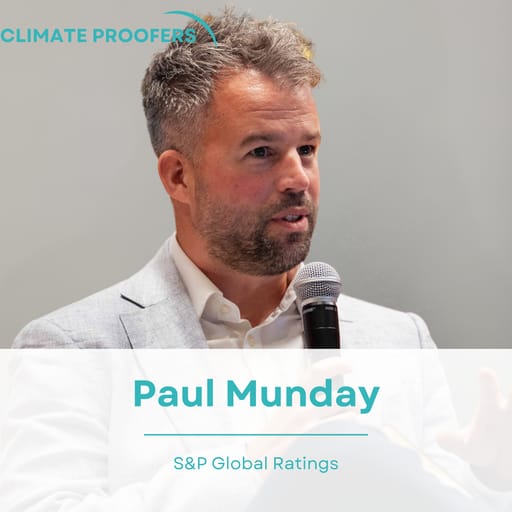
Transcript 0:00 [upbeat music] Hi, everyone, and welcome to Climate Proofers, the show all about those on the front lines of adaptation finance, tech, and policy. 0:12 I'm Louis Woodhill, the editor of Climate Proof, which you can read at www.climateproof.news. It seems everywhere you turn, there's news of another company taking a beating from climate hazards. 0:24 Last year's Los Angeles wildfires took huge lumps out of insurers, including Allstate and State Farm. 0:29 Also in twenty-twenty-five, severe storms loaded burdensome recovery costs onto the utilities CenterPoint Energy and CMS Energy Corporations, among others. Even chocolate makers are struggling. 0:40 Last summer, Mondelez International, which owns chocolate snack brands Cadbury, Oreo, Milka, and Toblerone, reported a slump in sales volumes due to a heatwave in Europe. 0:50 Faced with mounting climate risks, you'd think corporates would be racing to put bold, well-thought-out adaptation plans out into the world to reassure investors. Recent analysis, though, suggests this isn't the case. 1:01 Today, I'm joined for the second time by Dr. Paul Munday, a director at S&P Global Ratings and the company's global adaptation and resilience specialist. 1:09 He returns to the pod to share the findings of his latest research on corporate adaptation plans, research that shows while there has been an increase in adaptation plan disclosure, big gaps still remain, especially on adaptation targets, monitoring frameworks, and metrics for tracking progress. 1:24 We also get into why it is that despite rising climate risks, credit rating agencies are yet to take actions on vulnerable companies. 1:32 Notably, S&P itself has not yet taken a rating action on a European corporate based on physical risk, so far at least. This all makes for a chunky interview with plenty to engage all you adaptation heads out there. 1:43 I trust you find it as enlightening as I did. Before we get started, a little update on March's membership drive. A big, big thank you to all those who upgraded to become paying members last month. 1:53 We're now at two hundred and sixty-nine members, short of our three hundred-member target, but not by too much. 1:58 So you can help us get there this month by upgrading at www.climateproof.news/upgrade, which will give you access to additional in-depth features, data dashboards, and more. 2:10 Okay, in a minute, my conversation with Paul, but first a roundup of last week's top adaptation and resilience stories. 2:15 [whooshing sound] In finance, the Green Climate Fund approved nine hundred and sixty million for adaptation and mitigation projects, pushing its total portfolio past twenty billion. 2:24 The world's largest dedicated climate fund said nearly half of the money, four hundred and forty-one million dollars, would flow to Africa, headlined by a two hundred and fifty million dollar World Bank program to expand resilient energy access across twenty-one countries in Eastern and Southern Africa. 2:39 Eight of the eighteen Green Lip projects are adaptation only, with the adaptation share representing fifty-six percent in grant equivalent terms. 2:46 These include an effort to strengthen Chad's adaptation of land, ecosystems, and smallholder farmers, a climate risk protection shield for Zambia bringing better insurance to a hundred and forty thousand farming households, and an initiative to strengthen the climate resilience of the Peruvian Amazon, backed by the World Wildlife Fund. 3:03 [whooshing sound] In policy, the US Forest Service will shutter fifty-seven research stations under a reorganization plan published last week, likely undermining the agency's work to monitor climate-driven threats to the nation's forests. 3:15 Under the plan, the agency's research division will be consolidated at a new headquarters in Fort Collins, Colorado, with field researchers shuffled to other state offices. 3:23 The Forest Service's headquarters will also move to Salt Lake City in Utah from Washington. 3:28 The shakeup could hobble efforts to understand how wildfires, invasive species, droughts, and other climate-driven hazards affect important natural ecosystems, The New York Times reports. 3:37 Several current agency employees who spoke to The Times said they expected many colleagues would rather leave the agency than switch jobs or relocate. 3:45 [whooshing sound] And in tech, agricultural technology startups have a new champion in the Climate Emergency's Resilience Lab, a new program supporting adaptive crop solutions. 3:53 Set up by venture creator Deep Science Ventures and nonprofit Renaissance Philanthropy, the lab is backing three technical pillars in ag tech. One, forecasted biological priming. Two, environment responsive protectants. 4:05 And three, rapid breeding tools. The partners argue that genetic engineering for crop resilience is approaching its limits and want to push the ag tech field in a different direction. 4:14 [whooshing sound] Right, that's it for this week's news roundup. Now onto my conversation with Paul. [upbeat music] Hi, Paul. Where are you calling from today, and what do you do? Hey, Louis. 4:24 I'm calling from London, and I'm the global adaptation and resilience specialist at S&P Global Ratings. Now, you should be no stranger to old hands to climate proofers. 4:34 You were one of my first guests actually back in twenty-twenty-four, and we spoke back then about this pioneering research you had done with your team on corporate adaptation plans, uh, that was called Risky Business. 4:47 Good, good title for the report. And now you've come back with a new report called Mercury Rising. 4:52 So I want to know a little bit about what's changed in the-- that two and a bit year period since the first analysis, why you've done this analysis again, and what we can learn about the progress corporates have made on adaptation planning over the last few years. 5:05 So going back to Risky Business, that was an analysis of corporate adaptation plans, which found only twenty percent of companies had these plans in place, and few had near-term implementation timelines. 5:17 From my memory, most companies that had adaptation plans were kind of looking out beyond the ten-year horizon for actually doing something to deal with climate physical risk. 5:26 Now, with Mercury Rising, you are using a different data set and you're using a slightly different analysis. Can you tell us what the latest report tells us about the progress made or not made on adaptation planning? 5:35 Yeah, sure. So we, we did that, that report a couple of years ago now, and, um, really the idea then was to do a kind of a global study looking at how corporates are making progress or not on adaptation. 5:46 And you're right, it was actually about twenty-one percent of companies of about six and a half thousand companies, um, from, from memory that, that had disclosed an adaptation plan. 5:54 And as you say, varying amounts of, of kind of intention to deliver kind of implementation of those plans over, over time. And there, of course, were sectoral differences. 6:03 We've kind of leveraged, um, the-- some of the same data sets, so the, the kind of corporate sustainability assessment, the CSA, which is, is kind of-Hosted by another, um, division of S&P. 6:14 And we have seen through that, that kind of twenty twenty-five, um, reporting that the number of disclosures has almost doubled. 6:21 So it's about forty-three percent, depending on how you kinda cut the population now, versus that kinda twenty-one percent. So the number of disclosures has increased. 6:30 Now, that's since twenty twenty-two, that's about twenty-one percent. Twenty twenty-four was about thirty-five percent, and so now forty-three. So it has, has gone up. 6:39 One of the purposes of this report was not only to kind of look at the res- the amount of responses to that type of survey, but also to kind of go in to understand a bit more about the quality, if you like, of those plans. 6:49 You know, what, what kind of components of adaptation planning are companies really doing? And by that I mean, are they leveraging kind of multiple climate scenarios and time points in their climate risk analysis? 7:01 What type of qualitative or quantitative physical risk assessment are they doing? 7:07 By that I mean, are they using kind of asset level up information or are they doing, you know, stakeholder-led consultations or, or something else? 7:14 And then also, are they, are they setting metrics and targets for adaptation? Are they costing the measures that are needed? Are they capturing those costs in their financial plans? 7:23 So that was really what we were trying to do with this piece, to try and say, "Okay, well, we think there's progress being made on adaptation," which clearly with the number of disclosures going up, there probably, probably is, but, but how precisely is that being achieved? 7:37 And we decided really on this piece to kind of focus on European corporates. 7:39 And one of the reasons for that as well as is because we know that based on that Risky Business research, European corporates, um, seem to have been making more progress vis-a-vis other, other global regions, so it seemed like a natural place to, to start. 7:52 And, and also we decided to focus on some of the kind of better rated, i.e. those investment grade companies that we rate. 7:59 i.e., so we can look at kind of in inverted commas, the best companies in, in Europe and just try and understand how they, that as a group, are making progress on adaptation. 8:09 I can, can tell you some of the findings from, from that kind of analysis. Absolutely. I wanna get into that, but m- maybe just first, like, why do you think... 8:17 What drivers mean that European corporates are moving ahead on adaptation planning? Good question. 8:22 So I think one of the findings from Risky Business that I think still holds true is that where there are, you know, stronger or more strict environmental legislation and disclosure, that tended to increase the proportion of disclosures within global regions. 8:37 So Europe was particularly kind of strong in, in that regard. 8:41 I think also we, we kinda found in that piece as well that bigger, lar- so larger companies tended also to be making more progress, and I think we, we determined in that piece that was probably because they had more resources to kind of throw at the problem, both, you know, financial and also kind of human resources as well. 8:58 And also, I think many of those companies in, in Europe had, had also had, had historic experience of physical risks. 9:06 And I think where awareness that the climate literature is quite clear that entities in- have experience of the impacts from physical risk and climate shocks, they tend to have, um, made more progress to kind of addressing those exposures. 9:19 So that was, that was really kind of the main, the main driver in selecting that kind of group of European corporates. 9:25 And I'd like to drill down into some of the more granular data points you found from the Mercury Rising report. 9:31 But first of all, I appreciate the focus on quality of disclosures r- rather than just kind of quantity, and I think I found, and I'm sure you've seen as well, like there are i- increased indications of companies using the right magic words like adaptation or resilience in their reports, talking about physical risk. 9:46 There's some understanding from the, uh, dissemination from the policy world that, uh, corporates have to get on board with this, but that doesn't translate to actually these reports, these disclosures being useful. 9:56 So can you tell us a little bit about what you're looking for now that you think is an indication of a good quality adaptation report? 10:01 Like what are the metrics or particular statements or particular disclosures that you're looking for? It hasn't really changed since the Risky Business report. 10:07 So in that report, we, we kind of outlined a number of components, uh, i.e. features of adaptation plans that, that we would look for. 10:14 So I, I mentioned just about whether an entity is using multiple climate scenarios, time points, whether they've identified the adaptation measures that may be needed, they costed those measures, they've incorporated them into their financial plans, whether they, um, set metrics and targets for adaptation, whether they've got a monitoring and evaluation framework in place, um, et cetera. 10:33 All of those things in combination, i.e. 10:36 if, if an entity is able to demonstrate more of those components, that would be indicative, in our view, of, of an entity that's more likely to kinda ride out some of these, these shocks and recover from shocks should they, should they materialize. 10:50 Now that's... I should say that those kind of components that I just described, that's not something that we've necessarily kind of come up with. 10:55 There's, there's quite a bit of literature in this space that describes the types of things to look for in, in kind of adaptation plans. So there's ISO guidance for companies, so ISO fourteen thousand and ninety. 11:07 There's a, a separate piece looking specifically at climate risk assessments, so fourteen thousand and ninety-one. You can look it up. 11:13 And there's a separate version for governments and local communities, fourteen thousand and ninety-two. Uh, and there's also been some- That just came out recently, didn't it? Yeah, yeah, yeah. Exactly. And there... 11:22 and there's also some, some other guidance that have been released for corporates specifically. 11:25 So the WBCSD's guidance that released in twenty twenty-five, which also kind of sets some, some guardrails around the types of things to include. 11:33 So they're really kind of baked into those types of standards, codes, and, and guidance that are, are otherwise kind of available. 11:40 And I, and I think I would say that there is a kind of an emerging consensus if you look at that literature around what you typically look for, and those are the things that I've mentioned, but there also is a, a kind of disaggregation between the components that are probably, I guess, more advanced, you could say, than, than, than others, and it, it, it takes a bit more effort and thought to deliver on them. 11:59 So developing metrics and targets, for example, for adaptation, we know is really difficult. 12:03 And in, and indeed, to be able to kind of identify those metrics and targets where they are in place, and to be able to compare them across assets or project types is very, is very challenging and, and a need for you to develop monitoring and evaluation frameworks for adaptation, which is why in this report, we found that, that none of the companies in our seventy or so sample were able to, um, to demonstrate those components. 12:24 So none of them showed that there's more kind of advanced components of adaptation plan analyses, and actually I think the reality is-For this group of seventy of European investment-grade corporates and also kind of companies more generally, they seem to be at the stage of kind of having done a, a kind of a physical risk assessment. 12:40 Some have taken that forward and costed measures. Very few have taken it forward and, and integrated those costs into their, into their financial plans, which of course would be credit relevant. 12:51 And very, very few, if any, have developed metrics and targets, et cetera, as I've described. So there, there's a... 12:58 I think it's important when we're talking about the adaptation investments that might be required to actually level set a little bit and just say, "Look, this is, this is probably where most companies are," having done that, that kind of, uh, that assessment of physical risk and to understand what's most material to their, their operations. 13:14 Yes, I think there needs to be a frank conversation about the marginal value of increasingly complex or in-depth adaptation planning for, for certain corporates, right? 13:24 If there's not a regulatory stick, what is the impetus for companies to disclose more and more about their adaptation planning? 13:31 It could be because, yes, it's a, it could help protect revenue or avoid losses down the line. Perhaps it could help inform future revenue opportunities or, or business lines. 13:40 Or it may be that the sector to which a company belongs is just known to be more vulnerable to, to climate risk, and investors and stakeholders will just be looking for some evidence that, okay, yeah, you've done a physical risk assess-assessment, but we know you're vulnerable anyway, so can you tell us what you're actually doing? 13:56 And this comes to the, the, uh, some of this kind of sectoral analysis you did. 14:00 I know from the Mercury Rising report that it was chemicals companies and consumer products companies that seem to be above average in terms of their adaptation preparedness. 14:09 So can you explain why you think that is, and what, what patterns are you picking up that explains why some sectors are leading, some sectors are lagging? Yeah, no. Good que-good question. 14:19 And, and I would say as well, just in response to your, your kind of previous point, I think that many companies don't know that they're doing adaptation. 14:25 I think adaptation is a kind of a term as well, and this has been discussed, I think, in other forums. 14:29 It's kind of a, a bit of a, an IPCC type term, and it might not be a familiar type of term for many companies, even though they're doing adaptation. 14:36 So, you know, we can think about adaptation as companies that are working on improving water resilience or, you know, water quality or looking at smart agriculture or providing kind of tools and services and products that identify exposures to physical risks. 14:52 I think a lot of entities don't realize they're, they're doing that, which is why, um, these kind of disclosure standards like C-CSRD and others that, um, are kind of encouraging companies to, to improve the kind of quality of their disclosures on adaptation are really kind of forcing their hands to, to think about and contextualize what they're doing in the context of adaptation action. 15:11 In the context of your other question around sectoral kind of differences, yeah, there are some differences, and I think we've, in this Mercury Rising report, uh, just on, on European corporates and also in another piece we did, Ripple Effect, that was looking at the, the, the exposures that sectors inherit from physical risks. 15:29 We really found that it was those companies in sectors that have direct exposure to physical risks tended to have, be making more progress and tend to have been having kind of more awareness and to have plans and rather to have shorter implementation timelines. 15:46 And, you know, chemicals is probably a good example in the, in the context of those types of companies, you know, really having s-stronger or kind of outsized exposure to kind of water supply issues. 15:57 A-and therefore, you know, they're in many ways have, have been kind of forced or to take action and/or have been, uh, seen historical kind of impact. 16:04 So the short answer is, where there's direct exposure, I think that's driving some of the, the kind of greater sectoral differences. I mentioned also earlier about kind of larger companies. 16:14 That's definitely seems to be a common theme, um, in, in, in our analysis again, as well as those that are investment grade that we found in our risky business piece. 16:23 I think also there, there seems to be kind of emerging evidence as well that, you know, companies are making kind of more progress where there's maybe kind of greater scrutiny of their operations. 16:33 So you know, larger companies particularly may be taking action to try and reduce, you know, and avoid reputational risks as well. So it's a bit of a hedge, um, against, um, those sorts of things. 16:44 So it's still like, you know, the essence of adaptation. It kind of matters what you are and where you are. So there's absolutely, um, variation within sector and by company and across assets as well. 16:55 But generally speaking, we did find that chemicals companies, real estate, et cetera, seem to be making a bit more, bit more progress. Yes. 17:02 I wanted to dig in on what might be a divergence, though, in practices, and I'm glad you mentioned the real estate sector because your research shows that they had the highest disclosure rate, but are actually the least likely to take action within the next decade, with only nineteen percent of real estate companies targeting implementation in the next ten years. 17:21 So this is quite an interesting divergence for me is that, yes, you might see grea-greater disclosure, but if that disclosure is not actually pointing to tangible actions that take place in the near term, does that suggest that those companies are kind of like going through the motions and they're not put real thought into financing adaptation, actually implementing adaptation? 17:38 Is that a kind of divide we're starting to see now between people who can say the right things and say the right things in quantity and actually saying the things that show tangible action is gonna be taken in the short term? 17:47 Yeah. So I, I think the real estate example is quite interesting because I think you're right, nineteen percent say that they will implement within ten years. 17:54 Now, that compares to about twenty-nine percent across about fourteen hundred or so companies. So it's, there seems to be a bit of a difference. 18:01 Now, we don't go into the weeds to understand why that might be the case, that there could be, of course, nuance on a, you know, on a company basis, i.e., they don't, they're not seeing those, those kind of exposures, those impacts play out at the moment 'cause the kind of global, um, the global data set which is picking up maybe, um, entities with assets that are in coastal locations, for example. 18:20 So that, that could be explaining some of it. 18:22 For, you know, real estate, the big focus, you know, i-in the last few years, of course, has, has really been on transition-related risk and trying to reduce emissions and to improve those kind of credentials. 18:34 So I think adaptation and, and resilience has always been, been a part of that. But it's, it's probably played second fiddle in some cases. 18:42 So yeah, we need to look into a bit more depth, I think, to understand precisely what's going, what's going on there.My mind can't help going towards the AI and data center theme, right, where you have these grand announcements of we're gonna spend eighty billion over the next ten years [chuckles] to do X, Y, and Z, right? 18:57 And it's like, oh, that's a big number. That's exciting. And a company might say, "Yes, we have a comprehensive adaptation plan, which means in fifteen years' time, we will be X, Y, Z," [chuckles] you know? 19:06 And there's a question for me whether that is evidence of companies understanding the need to wink, nudge, nudge the market on adaptation, but maybe not putting in place the actual necessary planning and infrastructure to go ahead and implement. 19:19 And we've seen in the last few months a number of these, like, billion-dollar investments in AI kind of likely quietly shift, shift to the side, and I wonder if the same thing could happen with adaptation. 19:26 Well, I think, look, I mean, I can't speak for kind of h- the decisions that companies make, but I think that, you know, the reality at, at the moment as well is, you know, companies are making decision, uh, uh, decisions rather at the same time that there are many competing objectives around supply chain issues and geo-geopolitics, et cetera. 19:43 So, and many of those are kind of a more immediate or rather are viewed to be a more immediate threat to their operations and, and are causing immediate disruption. 19:51 So, you know, invariably, companies have to make decisions. That, that may mean that the, the impact from physical risk can be, can be pushed out a bit further. 19:59 But I think it's certainly in the, you know, the conversations that, that I'm having and, and, and with others in this space, and probably that you're having as well, that it, it seems that the physical risks are, you know, are here to stay and adaptation is increasingly being seen as a, an opportunity to try and build resilience to these, these kind of worsening climate shocks. 20:18 Okay. 20:19 I wanna turn now to what physical risk exposure and adaptation planning can actually mean tangibly to these investment grade companies and other companies that are kind of issuing debt into the market because I know in the report that S&P Global has yet to take a rating action on a European corporate driven by physical climate risk. 20:37 And over here in the States, this has become kind of a live issue, uh, 'cause there's a sense of disbelief almost that certain exposed municipalities or corporates haven't actually seen a big rating downgrade [chuckles] in spite of what appears to be really debilitating vulnerability to climate driven extremes. 20:51 So it's just there's this great example of Corpus Christi, a municipality in Texas over here, which is going through a severe water crisis. 20:58 And there's been a lot of discussions and papers written about, okay, well, what does this mean for Corpus Christi's municipal rating? Uh, what does it mean for the corporates that are based in Corpus Christi? 21:07 And I actually had a conversation with somebody in the rating industry about this and learned a lot about how the exposure to a climate emergency can actually be ameliorated, at least in the short term, by kind of fast implement sticking plaster solutions. 21:19 So in the case of Corpus Christi, there are rules that allow corporates to kind of drill for their own water if they need to, or there's the capability to bring in kind of mobile desalination plants if necessary, right? 21:30 So these are kind of short-term fixes which you might not think are good for the long term, but actually from a credit point of view might actually prevent the creditworthiness of a municipality or corporate that's facing water scarcity from taking a hit in terms of seeing their rating go down. 21:44 So that's just an interesting story that I think kind of highlights the discrepancy between popular perceptions of climate risk and actually what it means for credit. 21:50 And I wonder if you could, like, share your views on this, this tension and get into why physical risk may not be showing up in credit ratings yet. Yeah, absolutely. It's a question, um, you know, I get a lot. 22:00 Um, I'm not a credit analyst, I should say, so I maybe should've said that in my intro. 22:05 I sit in a research team, but I work with credit analysts and, and also our sustainable finance analysts as a subject matter expert effectively to try and bring greater clarity to how we think about physical risk and adaptation in the context of our credit analysis, but also our second party opinions. 22:19 You know, that said, I can kind of speak to this topic, and I should say just to kind of a slight correction to your question, ratings actions, you know, due to physical risks, they, they do remain limited. 22:32 And we did a piece late last year, I think it was, that looked across all of our rated universes globally, all sectors, and we found about one percent of all ratings were due to physical risks. 22:44 And there are of course kind of sectors and geographies that kind of received more of those. So, you know, that's across corporates, infrastructure, financial services, and US public finance. 22:52 So there are actions due to physical risks that are taking place. 22:56 But in our analysis here of European corporates, you know, we have just as a couple some examples, we have made previously some revisions or rather a revision to a rating outlook of a, a port operator in, in kind of LATAM. 23:09 That was due to kind of steep drops in kind of volumes due to climate events. 23:13 We've changed the outlook on, uh, an above rail operator out in Australasia a few years ago, again, due to kind of more frequent physical risks being one of those factors. 23:23 And, and then also in, back in twenty twenty-one, if you, if you can remember back that far, um, winter storm, uh, winter storm Uri, um, and there was also kind of pervasive drought conditions in California, that led to a kind of a widespread group of rating actions, largely in our kind of energy and utility subsectors of cor- of corporates and US public finance. 23:42 So the point I'm trying to make is we have taken those actions in certain asset classes and in certain geographies where we have visibility of kind of impacts. 23:50 Um, but so far in, in this kind of European corporate context, it hasn't been the case. And, you know, I would also kind of say that, you know, we've credit ratings, not, not climate ratings. 24:00 There are many moving parts to a, to a credit rating. It m- may be that companies have a particular amount of headroom or liquidity. They've got insurance. 24:09 They may have other, um, financial resources to try and, um, ride out many of these, these shocks that otherwise would lead to, um, or could lead rather to an impact on our credit worthiness. 24:20 So we, we, we look at as part of our credit rating processes the exposure to climate hazards and entities. 24:25 We, we kind of weigh up what companies are, are doing about this in, in the context of their long-term adaptation plans and how that kind of weighs on their credit fundamentals. 24:34 And, you know, of course in, in many cases, reality is that those kind of adaptation investments can require qui-quite large upfront CapEx, which ultimately can, can weigh on credit quality. 24:46 But there also, there are, um, opportunities from these types of investments and many companies already benefiting from doing adaptation. 24:53 And I mentioned some of the, the examples earlier around kind of water resilience and s-supply type issues and, uh, around smart agriculture, et cetera. 25:00 So, yeah, there are demonstrable returns on investment for, for adaptation, but it becomes more of a challenge in, in, in some of these kind of larger kind of CapEx heavy fixed asset type investments, which has to be weighed against all of the other fundamentals in our credit analysis.I feel there's a tension between those of us in the climate space who know that climate change is driving more frequent and intense extreme weather events. 25:26 We know that exposure's greater because we're building houses and our supply chains are kind of spreading into high-risk areas. 25:33 And I suppose there's sometimes a desire amongst these circles for rating agencies to take more drastic action to reflect real physical risk and growing physical risk because that will send a signal to the market that, oh goodness, we actually have to price this properly. 25:46 And there's plenty of debates out whether climate risk is being priced correctly or not in, in financial markets, and that debate's [chuckles] never gonna end. 25:52 But having spoken to professionals at rating agencies and taking into account that you're not on the ratings side, it is clear that there are so many different factors and influences that go into a rating decision. 26:03 There are so many reasons why a company may be facing a lot of climate risk, but is still actually from a credit perspective, see this pretty rosy because actually they have implemented adaptation actions. 26:14 I think there's still, despite th-this being like ten, fifteen years on from the beginning of kind of like climate and financial institution and climate and corporate kind of movement, there's still a hope or sense that maybe rating agencies should be a bit more activist, and they're the ones who will actually be the kind of pioneers who help drive this massive reprice. 26:29 Well, well, I, yeah, I don't think that's necessarily the, uh, the responsibility of, of credit rating agencies. 26:36 We produce credit ratings, um, you know, against a set of publicly available methodologies and criteria, and they, they combine and bring together a number of different types of analyses and data points and, and look where we have visibility and certainty about the returns on investment of these types of, um, measures. 26:54 Um, but also, you know, where, knowing where, how, and when those types of impacts can play out and actually what that's gonna cost. If we've got, if you've got certainty, that's, that's in the analysis. 27:04 The reality for, for physical risks, um, you know, and adaptation, like I mentioned in this report around our kind of progress that we're seeing am- amongst this, this group, is that those data points aren't necessarily available. 27:16 Um, and the, the disclosure requirements are, uh, and will likely help to, you know, improve the transparency of those types of data points. 27:25 And of course, those would be, you know, leveraged by the likes of us and other financial market participants. 27:31 But I think the reality is there is still quite a lot of uncertainty about precisely, you know, the exposures, how they're gonna materialize, how they're gonna crystallize, where and when, how, what the impacts might be, what they might cost, what the success of those adaptation measures might, might be, and also those re- those returns in some cases, like I mentioned. 27:49 So, you know, solving, solving that piece and providing the data that supports, you know, better transparency and analysis of those aspects absolutely would be, you know, beneficial in the context of a financial analysis. 28:01 Okay. And sticking with the financial world, to finish off, can you explain what investors that want to step up their adaptation engagement efforts, what should they be asking corporates to do and report? 28:12 Do you think investors should use adaptation planning information to inform their allocation decisions? Good question. So I, you know, of course, I can't advise inve- investors on what they should do. 28:23 I can't be influencing capital flows. That's a big, that's a big- Great power comes great responsibility. [laughs]... big no-no. But I can... Well, look, nor do I know. 28:30 But no, I think, uh, there is, as I mentioned earlier, there is kind of guidance that exists and, and codes and standards around, you know, what you may expect to see, um, in the context of, um, of an adaptation plan. 28:43 Um, and I mentioned the ISO guidance, the kind of BSI, British Standards Institute and, and also other kind of emerging kind of industry standards and, and guidance that's available. 28:51 And, and, you know, that can help you ask kind of questions about, um, what those plans should contain. But fundamentally, really you're asking kind of two things, you know. What are you exposed to, 29:01 and what are you doing about it? And of course, how much is that gonna cost? That, that, that's really what it boils down to. 29:07 And we can get into metrics and targets and all those nuances, but really that, those are the two things. What you're exposed to most materially. What are you doing about it? 29:15 Typically, you know, when, when we have kind of, um, interactions with management teams and ministers of finance and those sorts of things, that's really kind of what it boils down to. 29:24 Um, and it's, I should say also, it's, you know, pretty clear that we can't protect everything from kind of worsening climate hazards. You know, there needs to be a, a more kind of pragmatic approach. 29:36 And, you know, there are limits to adaptation in terms of the finances and resources that you can throw at the, the problem as well. And, and therefore kind of prioritization, um, is key. 29:43 And I think, you know, what we're... One way to kind of 29:47 help with that, I mean, we talk about climate data and the proliferation of kind of climate information that's, you know, emerged particularly over the last kind of five years or so, and really that, that kind of exposure data is a, is a great kind of foundation for understanding, you know, where climate hazards are at the moment, where they're expected to kind of worsen, where those areas of kind of concentrated e-exposure, outsized exposure might be. 30:11 And therefore, you know, that can help you think about where you might want to kind of prioritize those investments, like where those kind of opportunities might be, where the demand for adaptation kind of tools, services, products, et cetera might be. 30:24 Um, and that's, that's kind of one way that I've been hearing, you know, and seeing in conversa- and hearing in conversations with, with folk about how to kind of view this kind of adaptation piece as a, as a potential opportunity, prioritizing kind of where things are likely to get worse and focusing effort there. 30:40 Yes, I do think we're at the start of a re- a regime shift where we're gonna start taking physical risk data and especially forecast data more seriously and incorporating them more regularly into corporate planning and financial institution decision-making. 30:53 Like, we do that with expectations of what, uh, central banks are gonna do with interest rates, right? 30:57 And it, I imagine, like we just, it seems so natural now, but there must have been a time where only a few companies were actually doing that and, you know, some companies are doing it with greater sophistication than others, and now it's kind of automatic. 31:05 And you see the repricing happening instantly as soon as decisions on, on interest rates change. 31:10 And I'm wondering whether we're nearly at that point because of the advances in data collection, because of the advances in modeling, we're gonna start treating physical risk data-As, as highly credible and highly valuable for decision making. 31:21 And that's when we'll start seeing a, a more interesting divergence in pricing of climate risk across companies and across jurisdictions. That's my hope. 31:28 I might be wrong, but I do feel like reports like yours and data like yours is showing that's the case. It could be. 31:33 I mean, I think that, you know, we, we've talked already about the kind of disclosure piece and, you know, the, the kind of EU CSRD. 31:39 You know, we view it could improve the quality of companies' adaptation resilience plans. 31:43 You know, companies are kind of looking at delivering, disclosing more consistent kind of audited metrics for climate risk and resilience, and of course, you know, as a result, that, that's, that's helpful on a comparison basis. 31:55 But, but also we've, you know, seen a stepping back in some instances of, of kind of sustainability reporting rules, and that's meaning that many fewer companies are being brought into that process. 32:07 Um, and that, that's also a challenge, 'cause I think those disclosures can of course be quite, quite helpful, particularly, you know, in, in our, in our analysis and, and other, other folks' analysis as well. 32:16 I mean, that said, I do, I do still think that, um, the kind of disclosures, standards like, um, the Global Reporting Initiative, the GRI, will really still be, still be quite, um, quite important. 32:27 You know, investors are always seeking kind of more information, more data, being able to compare, compare off, um, uh, entities and, and kind of what they're doing about physical risks. 32:36 So I think that kind of rollback, um, I still think there's, there's likely to be kind of a, a push to, to improve those disclosures, the extent to which they're useful. 32:45 Um, hopefully our, our kind of report here has gone some way into trying to, to kind of allude to the quality of those disclosures and, and, and the type of information that might be available. 32:55 And I think it's quite clear that progress is being made, but in, in, in many cases, it's kind of nascent for most sectors. And yes, there's definitely been a proliferation of analysis of adaptation plans, right? 33:05 You're not the only, uh, acronym-heavy company to be doing this. 33:09 MSCI came out with a interesting report looking at companies in developed and developing worlds and what they're doing on adaptation, but also where they could show, uh, revenue generating opportunities from selling adaptation goods and services. 33:20 They use a different analysis to you. I've even been able to provide code, my own analysis of, of 10K reports and earnings calls now. 33:27 And, uh, I think it's great that we have lots of different ways to approach this and, and get data without actually having to have it in structured format. 33:34 But I do agree the disclosures help because, uh, then you have a framework, uh, in which to kind of operationalize data instead of going, "Oh, this data point is interesting, this data point is interesting," and kind of hobbling something together that might actually not provide something useful to you as, as an investor. 33:47 But I do think we're gonna see a greater volume of research analysis of adaptation plans going forward, which I welcome 'cause [laughs] I'm a content guy and I need to... more, more stuff to write about in this space. 33:57 But I do turn to folks like you, Paul, because you've been in this area for a long time and the analysis you and the team put together is of very high quality, very high, uh, detail. 34:06 And just to finish off, can I ask what we can expect for you, from you and the team for, for the rest of the year on the adaptation front? Good question. Um, thanks for the opportunity for coming on. 34:14 I wanna say much of the same, but by that I, but by that I mean, you know, more kind of analysis of, um, progress on, on adaptation. 34:22 You know, deep- deeper dives across asset classes and geographies, but also continuing the kind of theme that I've developed over the years of, of kind of deep dives into sectors, and particularly with a focus on those sectors that are kind of more sensitive to, to physical risks. 34:36 So yeah, more, more to come. Um, got a lot to do, but, uh, yeah, we'll continue, um, we'll continue, um, putting this out there and hopefully you, you, you and the audience find it useful. 34:45 Yes, you're the good type of busy, just like me, I find. [laughs] And it's great that we've got so much to get our teeth into and, and people seem to want it as well. 34:52 So I encourage all, all my listeners to keep following, uh, what Paul and the team is doing. I'll have a link to your LinkedIn profile in the show notes so people can keep track for you themselves. 34:59 Paul, always great to have you on. Look forward to talking to you again soon, but for now, thank you and have a great rest of your week. Thanks so much. Take care. 35:06 [upbeat music] Climate Proofers is a Climate Proof Media production. It is produced and presented by me, Louis Woodall. Subscribe to the Climate Proof newsletter by going to climateproof.news/subscribe. 35:18 And to learn more about the publication, feel free to reach out directly using our LinkedIn page. Goodbye for now. [upbeat music]