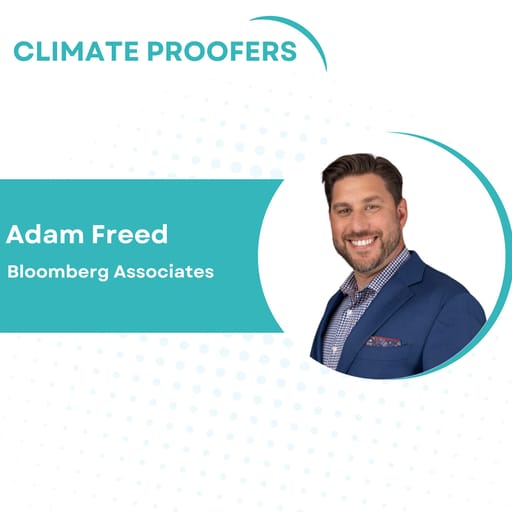
Transcript 0:00 [upbeat music] Hi, everyone, and welcome to Climate Proofers, the show all about those on the front lines of climate adaptation and resilience. 0:13 I'm Louis Woodall, editor of the Climate Proof newsletter, which you can read at climateproof.news. Question, who should a city mayor call when climate risks are getting the better of them? 0:23 The answer just might be Bloomberg Associates, a pro bono consultancy for city leaders made up of experts with a wealth of experience in municipal government and dealing with climate issues. 0:33 This McKinsey for mayors is helping to green the city of Milan through the planting of three million trees, has drafted a shade plan for Phoenix, Arizona, and worked with the city of Los Angeles to develop its first ever comprehensive sustainability roadmap. 0:47 Today, I chat with Adam Freed, a principal at Bloomberg Associates, to learn more about the group's work and to better understand the climate risks and opportunities linked with urban environments. 0:57 We also touch on the importance of reforming governance and governing arrangements to speed the delivery of adaptation and resilience at the city level, the kind of nerdy but important work that's needed to accelerate climate proofing action. 1:10 Before we get to the conversation, a reminder that Climate Proofers and the Climate Proof newsletter are subscriber supported productions. 1:17 Listeners like you can help support my coverage by heading over to climateproof.news/upgrade and becoming premium subscribers for the low price of $5 a month or $50 a year. 1:28 Okay, in a moment, my chat with Adam, but first, let's round up some of last week's adaptation and resilience stories. 1:33 [swoosh] In finance, the UN's climate chief has said that COP29 must be the, quote, "stand and deliver COP when it comes to climate finance." 1:41 Speaking at the Brookings Institution, Simon Steele, UN Climate Change Executive Secretary, stressed the importance of scaling up public and private finance for climate goals. 1:50 His comments come less than a month before the start of COP29 in Baku, where a new collective quantified goal on climate finance will be hammered out to replace the $100 billion per year goal that expires at the end of this year. 2:01 Steele also pressed the World Bank and IMF to ramp up their provision of climate finance. 2:06 Quote, "We must see further signals that the World Bank and the IMF are committed to ensuring developing countries have funds and the fiscal space for climate action and investment, not devastating debts and sky-high costs of capital." 2:18 [swoosh] In policy, the UN Biodiversity Summit, known as COP16, kicked off on October the 21st in Cali, Colombia. 2:25 Over the next two weeks, delegates from almost 200 countries will debate how to operationalize the Global Biodiversity Framework, which was agreed two years ago in Montreal. 2:34 What's agreed in Colombia could have important knock-on effects for global climate adaptation and resilience efforts. 2:39 For example, the national biodiversity strategies and action plans expected from countries are supposed to spell out how governments will conserve nature and protect ecosystems, which act as important buffers against climate risks. 2:50 However, as of October 18th, only 31 out of 195 countries had filed such plans with the UN Biodiversity Secretariat. 2:58 [swoosh] And in tech, the Biden administration announced $2 billion in investments to harden the US power grid against extreme weather events. 3:05 The Department of Energy said last Thursday that the financing will support 38 projects in 42 states. Altogether, these will update more than 950 miles of power lines and add grid-enhancing technologies to 650 miles. 3:19 Among the projects are programs to better safeguard Arizona Public Service Company from wildfire risks, improve the storm resilience of North Carolina's Randolph Electric Membership Corporation, and fortify the infrastructure of Entergy Texas to withstand extreme weather events. 3:33 [swoosh] Right, that's it for this week's roundup. Now on to my conversation with Adam. [upbeat music] Hi, Adam. Where are you calling from today, and what do you do? My name's Adam Freed. 3:43 I'm a principal at an organization called Bloomberg Associates, where I lead our sustainability practice, and I am calling in from New York City in Manhattan. Thanks for reaching out, Adam, by the way. 3:53 I didn't know much about Bloomberg Associates and the great work you're doing on climate resilience in the urban context, so I'm really grateful we got to meet, and I'm glad to have the conversation today. 4:04 So my, my first question is about what your role is at Bloomberg Associates in terms of providing support to cities that are trying to build resilience, and I was wondering if you could also tell us why cities are so susceptible to climate risks and why there is such a mass of NGOs, alliances, and accelerators focusing on this topic right now. 4:22 Um, I'm glad you're starting with the, with the easy short questions. So Bloomberg Associates, we're a pro bono 100% free consulting service. 4:30 We're part of Bloomberg Philanthropies and former New York City Mayor Mike Bloomberg's philanthropic endeavors. We work directly with mayors and their senior leadership. 4:38 Our only mission is to improve the quality of life for the residents in the cities that we're working with. I think someone once coined us as a, a McKinsey for mayors, except we're free. 4:46 We really work deeply with the mayors and their senior staff to build their capacity to help diagnose problems and deliver, you know, concrete solutions. 4:54 And, you know, I previously led New York City's sustainability efforts when Mike was mayor, so served five years, uh, in the administration overseeing PlaNYC, which was our long-term sustainability plan, and creating and implementing the city's first climate adaptation program. 5:09 So this work is, is very much close to my heart. 5:12 The, the question that you started off with of why cities are susceptible, I really view that as, as three key factors that are, are driving that in terms of their exposure and vulnerability to climate risks. 5:23 One, it, it's location. Um, 65% of cities over two and a half million people are coastal, and globally, about two-thirds of mega cities are on the coast. 5:32 And, you know, historically, cities were developed around ports and the confluence of rivers for transportation, economic activity, and trade, so this shouldn't come as a surprise. 5:40 Um, and then you also compare with that one in four cities around the world are located in water-scarce areas, so it's not just too much water when the floods come, but it can be too little water when it comes to the risk of drought. 5:51 The second factor is design. In many cases, cities are functioning as they were designed to do. 5:57 Um, we know we need to acknowledge that cities were not designed for the size, the climate, or the functions that are needed today. 6:04 A- and just thinking about a couple concrete examples of this.The London sewer system, which was a, a marvel of engineering, um, was built in the late 1800s to accommodate twice the size of London's population at that time, so about 4.3, 4.5 million people. 6:20 London is double that size right now. Even what was over-engineered by Victorian standards just isn't designed for, for the pressures that it's under today. Um, and, you know, you think about the design of New York City. 6:30 You know, we've experienced a foot of sea level rise over the past century. For a city with 520 miles of coastal areas, that's projected to increase by more than five feet, additional feet by 2100. 6:42 So, you know, our cities simply weren't designed to deal with the risks we have today. 6:47 Um, and then compounding on that and I think really driving that is the speed of change that we're seeing when it comes to climate change. 6:53 You know, the frequency and intensity of extremes events driven by climate change. This year, Phoenix had more than 100 consecutive days over 100 degrees Fahrenheit. 7:02 It had 61 days over 110 degrees Fahrenheit that resulted in more than 600 heat-related deaths to the regions. They're just not designed to deal with that rapid change and shift in the environmental baselines. 7:16 You know, if we go back to London and think about their sewer system, in July of 2021, parts of the city received more than 41 millimeters of rain in one day. That's about the monthly average for July. 7:27 You know, those highly localized storms were so intense that they've been coined water bombs because of the devastating impact that they had. So we, we really need to rethink the way that 7:38 cities are designed and, and functioning to address those risks. 7:42 Now, your, your, your other question about why do we see a mass of NGOs flooding into the space thinking about resilience, focusing on cities, um, I'd say first and foremost, refer to my previous answer of, of the risk that cities are under and their susceptibility, and I think we have a, a much greater recognition of that. 7:58 You know, that cities are on the forefront and the front lines of climate change, but also that they're the drivers of solutions. 8:04 So if you wanna have impact, if you wanna see change occurring, cities are where that's happening. 8:09 And, and I think in one of your previous podcast episodes, Jay Cohen, you know, talked about u-unavoidable opportunity of adaptation. And, and I very much agree with that perspective. 8:19 I'd also add to that, that climate change posos- uh, poses an unavoidable reality and necessity as well because cities need to take that action. 8:27 And in many ways, mayors are, are the great pragmatists around the world and also our first responders. 8:33 Um, I often quote New York City former mayor, uh, La Guardia, who said, "There's no Democratic or Republican way to pick up the garbage." 8:40 Residents simply expect mayors to deliver, and NGOs and others are recognizing that, that mayors are really delivering on adaptation action. But they need help. 8:49 And, and I think there, there are three key ways and areas that NGOs, others, um, are really rushing in and private companies to help cities in, in where they need that support. 8:59 One is around the science so that cities can understand what change is happening. Two is around the solutions to help cities understand what to do and, and what they can do. And three is 9:11 to help unders- cities understand how they can scale and deploy those solutions faster, which, which includes funding, policy, partnership, as well as political will. So there's this interesting duality with cities. 9:23 After listening to what you, you say, I'm thinking like how cities are by nature maybe des- they're designed in ways that are susceptible to climate risk, right? They are dense. They are built up. 9:35 As you said, they are located in geographies that are vulnerable to climate risks. But those same kind of vulnerabilities are what make cities economic engines- Yeah... 9:43 for example, and great places for networking and community building. 9:47 And it just makes me think about how cities can be useful laboratories for climate adaptation because they also have this density, these network effects, this massive agglomeration of talent and wealth in small areas. 9:58 You can actually use cities as fascinating laboratories for ideas and, and see if they work and then scale across oth- other regions. So is, is that also why you think cities are focused? 10:09 Because they are these wonderful hubs of innovation as well? Yeah. Look, I... The messiness of cities is, is what we love. 10:15 Um, you know, they're, they're complex, fast-paced, dynamic being, and, and that's what drives people there. 10:20 That's what helps foster the innovation, and we've seen throughout time, cities are constantly reinventing themselves. 10:26 You know, whether it's because they're facing population surges or growth, whether it's to be more economically competitive, whether it's because of technology, and if you think about post-industrial revolution cities versus pre-industrial revolution cities, they look very different. 10:39 You know, change is in the very nature of what cities are. 10:42 And, and if they don't change, um, I think [chuckles] that's a really good lesson for us to look at from the history where, where you've seen societies or, or cultures and cities fail to change. 10:52 They don't thrive, a- and they end up losing out. And whether they don't exist today or they're not the economic engine that they used to be, there's a real risk in, in not evolving and changing. 11:02 Yeah, cities rise and cities fall. And I feel like in today's age, though, when people get tired of a city or believe it's not up to scratch, they, they're more likely to, to move. 11:11 Some cities seem to, to defy this because they are inventing themselves, because they do have the r- the kind of natural advantages that make them such attractive places for people to go. 11:20 So I'm thinking of New York, I'm thinking of Rome, I'm thinking of, of London here. 11:24 Do you see this co- conversation about climate migration, cities trying to compete on being climate havens, as determining which cities rise and fall over the next few years? 11:34 I, I s- yeah, look, I, I think climate is going to be driving a lot of decisions and trajectories around growth, whether it's population migration, and we're already seeing displacement of populations as, uh, climate events occur and people are, are forced to move either temporarily or permanently. 11:51 Um, we're seeing capital flows change as well as that. Um, so absolutely, I, I think climate will be driving the trajectory of cities for a long time and, and, and national economies as well. 12:02 I, I do think there's a risk of thinking, well, cliven- havens, uh, as we've seen over the past year, there are very few places in the world that are safe. 12:10 Y- you're a very coastal city.You can face massive storms and, and, and we've already seen that during the most active hurricane season projected in the US in a long time heat waves, droughts, wildfires, uh, torrential downpours, tornadoes in the US. 12:24 We have dorados, which are these fast-moving, very heavy thunderstorms that are actually, uh, responsible for more economic damage every year than any other natural hazard in the US where you wanna move based on what risks you're willing to take can be really complicated. 12:41 And, and I think anyone who thinks that there's a place on the planet that's safe from the impacts of climate change fundamentally misunderstands the nature of the risks that we're facing. Okay. 12:51 Let's get to brass tacks then. So can you tell us how Bloomberg Associates works with city agencies, elected officials, and communities to actually initiate and scale climate solutions? 13:00 Uh, as I was saying earlier, Bloomberg Associates, we're a pro bono consulting service, so we work with cities, um, and really work closely with mayors and their senior staff to try to deliver large scale change. 13:12 And, and that's in their capacity, their culture, their programs and policies, as well as their delivery. Um, I, I think there are three hallmarks to how we approach that work. 13:23 Uh, and most of the staff here have worked in local government. Many came from the Bloomberg administration in New York City, um, but from city governments around the world. 13:31 So we've been in the shoes of the people that we're working with and, and dealt with many of the challenges that they have to deal with in the, in the day-to-day environments in which they're working. 13:40 So one, we follow the data to help our cities really take a data-driven approach to diagnose problems and develop solutions. 13:49 And for adaptation, this includes quantifying risks that they may be facing, helping them define and identify vulnerable populations, and ultimately prioritize their interventions because no city has enough capital, enough capacity to do everything that's necessary to fully mitigate risks. 14:04 So thinking about where you start first based on the priorities often anchored around vulnerable populations. 14:11 Second, you know, we break down silos within government because the 19th and 20th century organizational structures of cities aren't set up to deal with the broad far reaching nature of the problems we face today. 14:24 Uh, it-it's no longer simply an issue of what can our transportation department do? What can our parks department to do? 14:30 Uh, we're working on a plan in Phoenix, Arizona, which as I mentioned, is the hottest city in North America, and also the fastest growing city to really prioritize tree and shade cover in the city to help the most vulnerable populations who need to be outside the most, to give them thermal comfort and protect them from the extreme heat they're facing. 14:52 That effort includes 26 different city departments and offices who all touch different parts of that. So it gets incredibly complex and, and we really help break those down. 15:01 And I'd say the, the third thing that we focus on is, is helping cities engage partners outside of local government for the service delivery and implementation of solutions. 15:11 Because the scale of change that's needed within cities is just far too big for cities to do on their own. 15:18 Yes, cities are these messy, complex entities as you mentioned, and es-especially in the US you have these multiple levels of government that overlap and determine like what cities can and can't do and determine what monies cities can and cannot make use of. 15:34 Uh, so it sounds like there is a lot of joining up that needs to be done, and lots of connections that need to be done across different levels of government. 15:41 And I'm wondering because of this messiness, like what barriers, uh, or challenges have you encountered, uh, that are common across some of the cities you are working with and, and what can we do about those barriers? 15:51 Yeah. And, and, and before we jump to the, the barriers, I, I wanna stress you, you're a hundred percent right on the messiness and complexity of cities in, in the US and in many other places. 16:00 You know, cities are creatures of the state and national governments. All of the powers devolved to them, but from other parties. 16:07 Um, so that level of collaboration's needed, but there's a huge opportunity as well for cities to be market makers for big ideas. 16:15 And, and you alluded to this, that they've been driving innovation, they've been the test bed for a lot of things and, and cities do have a lot of powers. 16:23 You know, their policy and building codes, their funding, zoning other incentives to make it easier to deploy adaptation strategies and products. 16:32 Um, and also they have ways to make it harder to keep doing the dumb things that, that are increasing risk, uh, you know, building in waterfront areas without having strong protections for flood mitigation, doing large roadways and parking lots with asphalt that exacerbate the heat island. 16:47 Um, I do look at the barriers that are in cities, but I also think about the tremendous opportunities for cities to be leveraged to create the right environment to deploy solutions at scale. 16:56 But to get back to your question about, you know, the barriers there, there are a number of barriers in place, particularly when you think about the legacy infrastructure and urban form that needs to be retrofitted, that that's a huge undertaking. 17:11 And as I said earlier, our cities are functioning the way they were designed. 17:14 In many cities, inequities are, are hardwired into the urban form from redlining and other investment decisions that directed critical needs away from lower income communities or communities of color. 17:26 The urban heat island in the US is racism that you can see from space. Now, it, it's not by accident that non-white communities can be 20 degrees Fahrenheit hotter than other areas of the city. It is by design. 17:38 It's not by accident that certain neighborhoods flood in cities and don't have sewer systems or other ways, uh, of dealing with intense rainfall. It is by design. 17:47 It's not by accident that wastewater treatment plants and other industrial facilities are in lower income, non-white communities. 17:54 That is by design and, and it's going to be expensive and complicated to undo those deliberate decisions that were made in the past. 18:03 Um, the second barrier which you alluded to in, in the previous conversation is government silos. 18:08 You know, when we were trying to do green stormwater infrastructure for the first time in New York City, the biggest innovation and, and the biggest barrier wasn't understanding the science behind how to design it. 18:18 It was getting an agreement and an MOU signed between our Department of Transportation, which owned and managed the streets-The Department of Environmental Protection, which was responsible for funding stormwater infrastructure and trying to manage our sewer system, and they had the incentive to keep it out of the sewer system, and the Parks Department, which knew how to maintain and care for planted materials. 18:41 That was the innovation that was needed to unlock the opportunity that's now a multi-billion dollar green stormwater infrastructure program in New York. 18:48 But the obstacle was getting agencies to work together and think about how to align their incentives and their budget lines to unlock that opportunity. You know, a third big area I think is institutional inertia. 19:00 It, it's simply easier to keep doing what's been done in the past, and many of the incentives are aligned to keep doing that. 19:08 Mayor of Helsinki talks about the fact that he views every action in Helsinki as a climate action. And he talks about that, that they bring this climate lens to their work and are thinking about the solutions. 19:19 I think that's true whether it's intentional or not. 19:22 And our investments and policies are either reducing risks or exacerbating it in cities, and we need to change the status quo to make sure that we're really focused on reducing risks. 19:34 And then that comes from the fourth area, which is the political will to take action. 19:38 A-and that necessitates public recognition of risk and the opportunities presented by addressing it, as well as the willingness for political leaders to do things that may seem unpopular or expensive, but are absolutely critical to secure the future of cities and protect residents today, because climate change is not a future risk, it is here and now. 19:59 And then, you know, the fifth barrier, and I, I think in many ways the most important one, is that we need new models to scale. You know, the solutions of how we address climate risks exist. 20:09 We're not waiting for new technology. You know, tech and AI will help deploy it faster and, and can make those solutions better. But in many ways, we know what we need to do. We don't know how to deploy it at scale. 20:21 We don't know how to get private developers to be embedding it into their projects. We don't know how to unlock financing and bring that to new areas, and that's where a lot of the innovation is needed. 20:32 Yes, a lot of what you're saying does seem to come back to the nitty-gritty of governance, community engagement, figuring out ways to get over bureau-bureaucratic hurdles or, as you said, institutional inertia. 20:45 And I'm wondering like what systems of governance or systems of government even we should be exploring to help crack this code and ensure that adaptation does scale. 20:56 I'm thinking about how in some cities you have like participatory budgeting where you get communities involved. 21:01 Citizens assemblies I know are popular in certain parts of Europe when it comes to coming up with adaptation and resilience plans, and there are lots of other ways in which you can engage citizens in the creation of adaptation. 21:13 But you also seem to need to have a form of government policy where you're communicating, "This is gonna be a costly thing to adapt or to build resilience, but here are the benefits." 21:22 It also seems to me to be a communications challenge that governments have yet to really crack. Uh, so what do you think about this? 21:28 What do you think about how governance should be addressed, changed to scale adaptation? Yeah, you know, it, it, it is all of those things a-and more. 21:38 It's certainly a communication issue, um, and getting people to recognize and understand their risk. 21:44 Wh-when you think about, you know, how we talk about flood risk in the US, a lot of our building codes and zoning codes are around the one in a hundred year flood, and many people are surprised when multiple one in a hundred year floods happen in a five-year period. 21:56 They say, "Wait, it w- it happened once. I'm safe, right?" 21:59 If you think about that understanding of risk, that means there's a one in three chance over a thirty-year period that a flood is going to occur, and that happens to be the lifespan of a traditional mortgage for a home. 22:11 I think if we talked about risk differently and had people understand it's not a one in a hundred risk, it's a one in three within your lifespan of your investment that you're gonna face a flood of a certain level, that people would start making different decisions. 22:24 So, you know, part of the challenge is I, I think as humans, we're not hardwired to value avoided loss. Part of it is we do a really bad job of communicating about it, and, and part of it is it's not a zero SIM game. 22:36 You know, we talk about adaptation as expensive or needing investment, but there's a huge cost that comes with not taking those action from the flood damage that occurs, from the economic activity that, uh, you know, is lost from the supply chains that are broken, from obviously the human health risks and deaths that can occur. 22:56 So there's a huge cost for not taking those actions that is not part of the equation that we need to figure out a better way of talking about. So I think you're absolutely right on that and how we communicate about it. 23:07 Um, there's also the huge opportunity that comes with it, and in many ways it makes a better city. 23:13 You know, if you have more tree canopy coverage, if you have, uh, more common areas that people can convene in when there's a heat wave, if you have more resilient systems so that you don't have power outages, if you have a better, more flexible public transit system so people can get around, all those things when you talked about earlier, you know, where people are gonna be moving in the future, I don't think they're gonna simply be moving to places that don't have climate risks because there's no place on the planet that won't. 23:40 They're gonna be moving to places that have a high quality of life, good public infrastructure, resilient infrastructure. Those are all things that adaptation helps build out. 23:50 So I, I do wanna lean into to that opportunity as well. And then there, there are two other governance issues that I think we need to fix. One is within cities, we need, you know, more cross-functional bodies. 24:01 So in New York, I led an office, the Office of Long Term Planning and Sustainability, that was really spearheading a lot of the innovation and implementation of our long-term strategic plan, but we worked with more than twenty-five city agencies who are delivering it on the ground. 24:15 Our, our parks department, our department of transportation, our police department, Department of Education, Department of Health and Mental Hygiene, all those are critical partners in delivering-The sustainability agenda for the Bloomberg administration. 24:28 So we need those, and, and there's been kind of an evolution of chief sustainability officers and then chief resilience officers. Now many cities have chief heat officers. 24:37 I think the one risk you need to try to avoid is, is not having different silos where, where you have now people who are focusing on these issues and, and recognizing the interconnectedness of all that, but really leveraging the power of the, the total city and municipal body to take action on these issues. 24:55 And then zooming out of scale, you know, a lot of the risks we face and a lot of the infrastructure that's impacted by climate change is at a metropolitan or regional scale. 25:04 And, and their cities just don't have the powers and the ability to affect change on their own. So as you were talking about earlier, needing those partnerships. 25:13 So you think about New York City where, where we both live, you know, the Metropolitan Transit Authority, which runs our mass transit system, you know, spans three or four different counties. 25:24 Uh, and we also have to deal with New Jersey Transit, and the Port Authority runs a path train. You know, all of our energy comes from a, a statewide network. 25:32 We're now running a new cable up the Hudson, uh, River that's gonna connect to hydro in Canada, you know, making sure that system is resilient to climate change, ensuring that we can get a flow of power in so when heat waves occur or other challenges ah, happen, and we can have a steady supply of energy. 25:47 You know, that happens at a state level where we have a public service commission that, you know, affects the rates and, and approves investments in our energy infrastructure that are critical. Water supplies. 25:59 You know, cities occupy about one percent of the surface area on the planet, but draw their water from twenty percent of it, and they need to have huge partnerships and think about how they relate not just to state-level governments, but rural communities, uh, and farmers in agricultural areas that are operating in the areas they draw their watersheds. 26:20 We, we do need a fundamental rethinking about where powers lie and where the solutions exist and trying to better align the incentives between the two. 26:29 I'd like to ask briefly about financing as well, because there was a State of Cities climate finance report that came out recently from the Climate Policy Initiative, and that showed that adaptation flows to cities were about ten billion dollars, uh, over the last two years or so, uh, which is a drop in the ocean. 26:49 And recently, New York City's chief climate officer said at a conference that he would be in favor of a dedicated revenue stream for resilience because at the moment, his hands are tied in terms of what money he can use for what purposes, right? 27:02 And he doesn't have enough to invest, he believes, in coastal resilience. So I'm wondering what financing models you've seen that could work to help close this adaptation finance gap and also draw in private investment. 27:13 Yeah, and, and I think that is such a critical piece. There, there is no climate solution without climate finance. 27:19 Last year's adaptational gap report found that our global adaptation needs are about ten to eighteen times bigger than current international public finance flows. 27:28 That puts us at a gap of, you know, somewhere between two hundred to, to three hundred and fifty billion dollars a year. 27:34 And I love that you're zooming in on New York, and, and Rich talked about the chief climate officer, you know, needing money for coastal resilience. 27:41 We also need, and the estimate is, uh, we need about thirty billion dollars for New York City just to protect us against the two inches of rain that could occur in over an hour, uh, in those rainstorms that happen. 27:53 Good news is we currently spend about a billion dollars a year on surface water flooding. 27:57 Bad news is it would take us thirty years at that pace to solve our surface water flooding challenges, and we know it's only gonna get worse over time. If you go and talk to investors, they will say, "The money's there. 28:07 We just need the projects." If you go and you talk to a city, the city says, "We have all these projects. We need to connect to the capital." 28:13 We need to, you know, work with private investors to understand there's a different risk profile to large-scale distributed projects that happen within cities, and there may be an intermediary mechanism that's created to bundle projects, bringing in philanthropy and, and other, you know, layers of capital that can de-risk projects, thinking about how we prepare project facilities, um, to be able to bring that into the pipeline to deploy private capital. 28:39 And I, I think there are a couple of early signs of where that's being done very creatively, that Washington, DC has tradable stormwater credits, and that's really catalyzed a large market to invest in natural infrastructure to reduce flood risks in the city and also bringing parks and other amenities to lower-income disadvantaged communities that have a whole host of other issues about poor park access and urban heat island and flooding and air quality. 29:09 Um, so creating those market mechanisms are a really critical way of doing that. 29:14 I previously also led a, a global water program at The Nature Conservancy, and there we were working with cities around the world to create water funds, and that was leveraging, in some cases, most cases, voluntary payments from private actors that could be paired with public finance to do conservation in urban watersheds to help provide clean, safe, and reliable water supplies for urban areas and the businesses that were there. 29:41 And my favorite was actually in Nairobi, where the hydro operator was recognizing that landslides and sediment from heavy rainfall in agricultural areas outside of the city were causing more sediment to come into the hydro facility, which was increasing their capacity to store water there, which would allow them to produce more power. 30:02 And by the way, when that sediment came in, it was also clogging water intakes for the water supply system, so there were days of the year that Nairobi had to shut down water supply and not provide it to certain residents around the city who were desperately in need of that. 30:16 Pooling money from them, other investors, and the water utility, we were able to go and work with farmers to shear their hillsides, to think about other ways to reduce runoff that happened from heavy rainfall.All that had an immediate payback for the hydro provider that could pr- now provide more steady electricity. 30:36 It had a huge payback for the companies who relied on the power and the water for their operation, and a huge payback for the city that now had safer, more reliable water supply systems. 30:45 So finding ways to blend those different interests and financing streams is absolutely critical to be able to deploy solutions at scale. 30:53 It is hard to do, but you know, political leadership at the city level on the policy side, on the regulatory side, have a lot of levers to create and catalyze those marketplaces to enable private capital to flow in. 31:08 I love all these examples. That really sh- goes to show how there is potential to do large scale adaptation projects by getting broad backing from different sectors, right? 31:18 That Nairobi example is particularly instructive. And I do wonder whether there is a case to be made for big cities, uh, that are set with climate risk. 31:28 Again, think of New York here, where you could make the case for a dedicated levy, a dedicated tax for resilience. 31:34 But then say, "Look, through this resilience tax, we are actually investing in the city in a way that ensures that the value of properties will go up faster or at least not be affected negatively by increasing storm damage or coastal surge." 31:48 And there's a way to say, "This is not a tax, this is more like an investment or an insurance premium." 31:52 And talking about like cross silo alliances, you can also see situations where cities can talk to insurers and say, "Look, we're doing XYZ. 32:01 Can that affect the premium rates that you charge for commercial real estate holders, home-ho-homeowners, et cetera?" So I do think there are ways to make the case for greater public finance adaptation. 32:12 If you can say to the people who are paying that, "Look, you are getting benefits in terms of your personal assets, your private assets also being protected." And, and I a hundred percent agree. We, we need... 32:22 You know, the biggest challenge that I face when I'm talking with, with cities that we work with, and this is in Latin America, this is in North America, this is in Europe, um, you know, the work I was doing in Africa previously, all around the world, there's often a fundamental misunderstanding between funding and financing. 32:38 And cities say, "We need financing for our adaptation projects." And I'll say, "Great. Where's your revenue stream? What's the payback for this?" 32:46 Because often what they're talking about is they need funding, which is a government grant that you just pay back as typical debt or you don't have to pay back. 32:54 And that's where things, you know, like what Rich's proposing in New York of a dedicated revenue stream, if you have a dedicated revenue stream, you can bond that out. 33:02 You can get upfront capital, you can deploy things much, much faster. 33:06 We're seeing that with energy efficiency and ESCOs where you can say, "We anticipate a certain amount of savings every year, therefore we're gonna save a portion of that and be able to bond that out to get the energy efficiency investments today that will generate the savings." 33:20 You know, we did that, uh, in New York City when we wanted to expand the number seven line, uh, on Hudson Yards, a massive multi-billion dollar project where we said, by expanding our subway line, we're inducing value in creating new tax revenue. 33:35 We're gonna take a portion of that tax revenue and rather than going into the general fund, we'll put it into a lockbox and, and that will allow us to pay back bonds to expand the subway system. 33:45 We can absolutely do that with adaptation as well. We're going to create value by creating protection. It does take good communication, it does take political coalitions. 33:55 It does take political will to do that, but we need to have money spent against the solutions that are being deployed. That's public money and it's private money. 34:04 And, and cities really can play a catalytic role in creating the markets to be able to do that. 34:09 Yes, don't sleep on financial engineering and its ability to conjure up upfront investments that can be used to, to harden cities from climate shocks as long as there is, yes, cash flows down the line that will, will justify that financing. 34:22 Exactly. I suppose that's why there is so much focus on financing mechanisms and different products and instruments that can enable this. 34:29 From financial engineering to tech and AI engineering, I'm interested in your thoughts on how high tech advances can be used to scale resilience in urban areas, uh, bring new ways of working, bring new data insights that can help with, uh, these resilience challenges that cities face. 34:46 Because I've spoken to Michael Jacobs at IBM recently, who's working on an accelerator to scale up, uh, AI solutions for city resilience. There's some exciting things that he's getting up to. 34:59 I'm wondering what you're seeing and what you think the potential of AI in particular is to help, uh, speed up climate resilience. 35:04 You know, I-- as I said earlier, I think the solutions we need are here today in many cases. That not all of them, but, um, we know what the solutions are. 35:15 We know how they can be deployed, figuring out how to do that at scale and figuring out how to better target those and speed up that pace is where that gap often exists. 35:25 And, and I do see tech and AI layering on to the common sense solutions that exist today as being a critical way to do that. 35:32 And I, I think we've already seen a couple of really exciting ways that's happening in places and companies. Um, and so to use examples, green roofs have been around for a long time. 35:42 The idea of putting planted materials, um, other cisterns and catchment areas on rooftops to hold back water before it gets deployed into a sewer system. 35:51 So it just gives you a little excess capacity when you have heavy rainfall. 35:54 Uh, there's a great company Wavin, that in the Netherlands and now moving into the US, is using technology to create a dynamic system that utility can actually turn on and off green roofs and the catchment systems on the rooftops so they can dynamically hold the water back or deploy it in a rainfall. 36:13 And that creates a huge distributed system and an amenity on rooftops that they now have these green seating areas that can be open for recreation that allows the utility to store water in a, in a much more thoughtful way. 36:26 Um, you're seeing demand response management that's being deployed. 36:29 You know, if you have a Nest in your home and that's connected to the Wi-Fi-You have a way for your utility if you opt into a program to turn down your air conditioning on a hot day that may stop a brownout or a blackout or other infrastructure failures that can smooth out the demand when we face heat waves and, and have, you know, energy shortages or crises. 36:48 Um, that's all tech-enabled solution companies like Resilia that are essentially virtual power plants because they can, rather than creating more power, reduce the consumption that's occurring to create capacity on the system. 37:00 Um, you're seeing places and companies like Pano, which is a system that can look for and identify using AI wildfires and allow first responders and others to see them when they start over vast amounts of areas and share that information across jurisdiction. 37:18 Wildfires and forests don't stop between counties or city lines or fire districts, so how do you have a way that you can allow communication back and forth and have a shared system, um, is a really exciting opportunity to better manage against increasing risks. 37:37 Um, and then things that are-- they're coming up with risk mapping. Just how do you take that enormous amount of information that's out there and make us smarter with it? 37:45 Places like First Street, which is I think one of the, the most advanced at mapping and communicating about risks in the US, uh, they're now gonna be incorporated into Zillow. 37:56 So as you go and look, "Do I wanna buy a house?" 37:59 The flood score is gonna be there, but they're doing that for wildfires, for air quality, for heat waves, the, the local governments, investors, developers, builders, residents, first responders, all sorts of government agencies can better understand what risk is. 38:12 That amount of information, the ability to synthesize it and display it in a meaningful way simply wasn't available five years ago, much less ten or twenty years ago. 38:21 And then thinking about as well systems that can allow real-time information on flooding, on temperatures, on wildfires, on storms are gonna be absolutely critical for cities to manage. I think that's key. 38:32 We live in a world of scarce resources. 38:35 We need to allocate those resources efficiently, and tech and AI and risk mapping solutions can help us identify in advance which areas may be most vulnerable and which should be prioritized for hard tech upgrades, uh, or resilience measures. 38:49 And also, yeah, when you think about risks li-like London and how it experienced wildfires and, and heat emergencies throughout the summer of twenty twenty-two, you can imagine a world where better data and analytics would have helped pre-position resources effectively before the, the crisis struck, right? 39:05 And would have enabled faster response by emergency services, et cetera. 39:08 So sometimes I hear investors and policymakers bemoan the focus on software solutions, high-tech solutions that don't involve physical changes to the infrastructure, right? 39:20 But re-in reality, scarce resources, you need to know where to put money to be most effective and where to put resources to be most effective. 39:28 And that's why I think there's such an excitement about AI and high-tech solutions to risk mapping, to hazard model training, et cetera. 39:37 Yeah, Louis, you're, you're a hundred percent right, and I, I think, you know, I've always viewed sustainability as efficiency. 39:42 How do we correct for inefficiencies that are occurring, whether you call them externalities or whatnot? 39:46 And I think when it comes to resilience, we need to be much more thoughtful and efficient with our resources to address those highest risks. 39:54 And, you know, a great example of this is work we're doing with the Greater London Authority and Mayor Khan in London, where, you know, he said, "I know we face climate risks. 40:03 Can you help me figure out where we face the greatest exposure to risk in the city and have the highest concentration of vulnerable populations?" 40:11 In working with his team, we created climate risk maps that, you know, overlay over a dozen metrics to hone in into the places in the city that are most exposed to heat waves, most exposed to surface flooding, and have the highest concentration of vulnerable populations and characteristics in the built environment, like low amount of tree cover, high amount of pavement, a high incidence to flooding that, you know, can be some of those solutions to solve those problems. 40:39 Those are publicly available maps now. We've trained over three thousand people within London and, and actually broader, uh, within the UK who are interested in that approach. 40:48 That's now driving funding decisions, it's driving planning decisions. It's being used to communicate risk, uh, to residents. 40:55 Having that data and information and, and having a platform that's making it publicly available and, and dynamic to be uploaded as things change is critically important to make sure that we're really making climate-informed decisions and able to target our resources to the most vulnerable populations who are being impacted by climate today. 41:14 Wonderful. Okay, Adam, you've been very generous with your time, and ti-- I want to wrap things up now. 41:19 But before we go, I wanted to ask what projects over the next six months, twelve months do you have your eye on, are you excited about? 41:27 It'd be good to get a sense at a high level what the kind of strategic priorities for you and Bloomberg Associates may be in the arena of, uh, resilience. 41:34 Oh, that I, I, I sit in a very fortunate place where I'm excited about all my work. 41:38 Um, I think two that, that pop out in particular, uh, one that I alluded to earlier, we're working with Mayor Gallego in the city of Phoenix to develop their first-ever citywide shade plan, uh, called Shade Phoenix. 41:50 It'll be released in November. 41:52 And that is really looking at how do they harness all the efforts of not only the twenty-six departments we're working with but also community organizations, community actors to target shade in the city where vulnerable populations spend a lot of their time outside. 42:09 One of the goals in that plan is to ensure that, you know, all bus stops in the city have shade where it's physically possible to do so. 42:15 They're really targeting resources to provide benefits to people in the hottest city in the US. 42:20 Uh, we're working with another client, uh, in Europe to figure out how can they accelerate deployment of the green infrastructure, looking at different revenue models, taking the lessons from Washington, DC, taking lessons from Detroit, taking lessons from Philadelphia, where people are charged based on the amount of impervious air in their property, which creates an incentive for them to reduce that and a revenue stream to deploy green infrastructure and other solutions to reduce flooding. 42:47 So thinking about how do we take a North American model and apply it to Europe and other jurisdictions, those types of things get me really excited about the, the replication and redeployment of proven solutions that work and making them happen faster. 43:00 Nothing like job satisfaction, eh? It sounds like you've got a lot on and you're looking forward to it all. Absolutely. You know, I, I often joke that working in climate is good job security. 43:10 The scale of the change that's needed and the risks are both only increasing, so, uh, there's a lot of, a lot of work to be done. Brilliant. Well, I'll let you get back on with that work. 43:19 Adam, thank you so much for your time today. Really appreciate you talking us through your work, and I love all those examples you provided of different cities that are engaging in that adaptation. 43:28 That's really helpful to myself and I'm sure to our listeners. My pleasure. Thanks so much for having me, Louis. [upbeat music] Climate Proovers is a Climate Proof Media production. 43:36 It is produced and presented by me, Louis Woodall. Subscribe to the Climate Proof newsletter by going to climateproof.news/subscribe. 43:44 And to learn more about the publication, feel free to reach out directly using our LinkedIn page. Goodbye for now. [upbeat music]