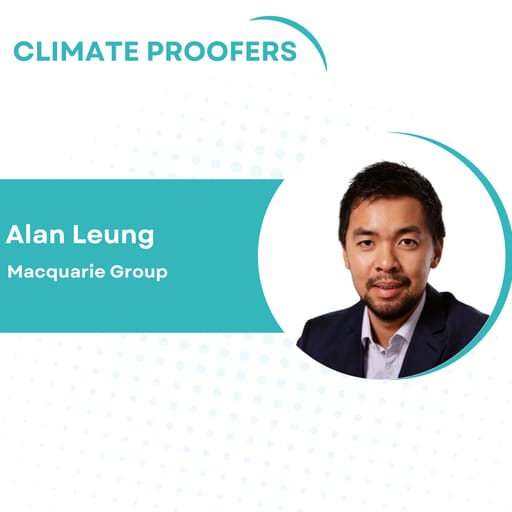
Transcript 0:00 [upbeat music] Hi everyone, and welcome to Climate Proofers, the show all about those on the front lines of climate adaptation and resilience. 0:12 I'm Louis Woodall, editor of the Climate Proof newsletter, which you can read at climateproof.news. Climate change is transforming geopolitics. 0:20 Intolerable temperatures and extreme weather shocks are triggering so-called climate migrations and undermining water and resource security at key friction points around the world. 0:30 These pressures could exacerbate or even catalyze future conflicts between nations. 0:35 To talk about all this, today we're joined by Alan Leung, who heads up the Threat Intelligence program at Macquarie Group, a global financial institution. 0:43 He also writes an informative newsletter on the intersection of climate risk and security over on Substack called Securing Our Climate. 0:50 Alan unpacks the many ways climate change is stoking global tensions and how it could transform the flow of people, capital, and conflict. 0:57 We also touch on how companies and financial institutions are approaching the challenges climate change poses to their operational security. 1:04 Before we get to the conversation, a reminder that Climate Proofers and the Climate Proof newsletter are subscriber-supported productions. 1:10 Listeners like you can help support my coverage by heading over to climateproof.news/upgrade and becoming premium subscribers. Okay, in a moment, my chat with Alan. 1:20 But first, let's round up some of last week's adaptation and resilience stories. 1:24 [whoosh] In finance, the US Federal Emergency Management Agency, FEMA, does not have enough funds to last through hurricane season, according to Alejandro Mayorkas, the Homeland Security Secretary. 1:35 Speaking to reporters last Wednesday, Mayorkas said that while the agency is meeting immediate needs in the wake of Hurricane Helene, quote, "FEMA does not have the funds to make it through the season." 1:44 Right now, Florida is bracing for Hurricane Milton, a Category 5 storm, which is on course to hammer the Sunshine State later this week. 1:52 While it is unclear what the human and financial fallout from the storm will be, there is a possibility that FEMA will need more capital to effectively address its impacts. 1:59 On September twenty-fifth, Congress passed the stopgap spending bill to prevent the federal government from shutting down, and this included twenty billion dollars to replenish FEMA's disaster relief fund. 2:09 However, some lawmakers fear the agency may still suffer a funding shortfall. 2:13 On October the first, a bipartisan group of senators published a letter stating that Congress must act to meet the unmet needs in our states and address the scope and scale of destruction experienced by our constituents. 2:23 [whoosh] In policy, environment ministers from the G20 economies promised to push back against the idea that adaptation is too expensive following a meeting in Rio de Janeiro last week. 2:34 They also pledged to keep climate adaptation high on the G20 agenda, recognizing that, quote, "The costs of inaction are far greater than the costs of mitigation and adaptation." 2:43 In addition, the minister said they would explore ways to increase adaptation financing. This may include development of a dedicated framework or a platform for private investment. 2:52 [whoosh] And in tech, Adaptive Insurance is the new kid on the block in the burgeoning parametric insurance space, launching last week with a product that pays out to businesses suffering from power outages. 3:02 The US-based company uses an AI-powered platform to measure the duration of outages and ascertain whether a policy payout should be triggered. 3:10 The company joins other startups, including Rick and Arbol, in offering parametric insurance solutions as a form of climate resilience. [whoosh] Right, that's it for this week's roundup. 3:20 Now on to my conversation with Alan. [upbeat music] Hi, Alan. Where are you calling from today, and what do you do? Hey, Louis. Nice to be with you today. I'm calling in from London. 3:32 I work in Macquarie Group, which is a globally diversified financial services firm, and I head up the threat intelligence team within our corporate security function. Thanks for being with us today, Alan. 3:42 I met you in person at a climate adaptation conference event in New York earlier this year. We had a good dinner together, lots of good chats. Yeah. And I'm thrilled you could be on the podcast today. 3:51 And hopefully we'll be together soon in London or in New York again. My first question is about your own personal journey into the climate adaptation space. 3:59 You have years of experience working at Macquarie Group, building up its geopolitical and security unit. Can you talk about how climate adaptation filters into your work and how you came to climate adaptation yourself? 4:10 Yeah, absolutely. I head up the threat intelligence program here at Macquarie Group. 4:14 What that entails is we look at our global footprint, whether it's our people, our offices, our investment portfolio, broadly speaking, and the markets that we are active in. 4:26 And then we look at the global environment, broadly speaking, of geopolitics, all kinds of security threats, political risks, and things of that nature, and we help our internal businesses understand the what, so what, and the now what. 4:40 What that means is we look through the universe of the possibilities of things that can be a risk to our business and our operations. 4:49 We help them understand what it is that they're looking at, what does it mean for them at different layers of their organization, whether it's tactical or strategic, and then help them to understand where there are opportunities for mitigation, whether that is in incident management or in crisis planning, whether that is in thinking about the investment activities that they're engaged in and how they can translate our actionable intelligence into better c- risk base and commercial outcomes. 5:19 What that means on a day-to-day basis is I work with a small team as part of our broader global security or corporate security function to scan the world really for macro geopolitical risks. 5:32 Now, how that translates and starts to flow back into the space that you and your listeners are much more probably interested in and working on is, really during the pandemic, I had a bit of an epiphany myself when I had a lot of time s- sitting at home remotely working, and I came across the, obviously, the IPCC AR6 report and started looking through that. 5:54 And what became very apparent to me is that when we look ahead in our little corner of risk as practitioners, there are several kind of major big picture trends happening. 6:06 One is AI, the adoption of it and the risks thereof.The second one is related to that, which is cyber, which is well already underway, thinking about how cyber risks really influence and impact everything that we do. 6:17 We're such an interconnected world these days. And the third one is climate change. It's one... 6:22 And, and I highlight these three because they're so impactful at a macro level, at a nat- at, at the global level, at a national level, at a local level, whether you are an individual citizen, a member of a community, whether you're an investor, you are an employee at a company, whether you are running a charity, whether you are a government leader at all levels, it's everywhere. 6:46 You can't get away from it. It's like glitter or sand, [chuckles] you know, you can't get away from it. It's always stuck in your shoe, and it is a thematic that you have to take, y- that you can't run away from. 6:58 And with all the... 6:59 With the physical impacts becoming more and more apparent, it's something that us in the private sector security world and also in the geopolitical world that we're coming to grips with and trying to understand really two things. 7:14 Where is that impact coming from? Where is the change? And then second, really at an enterprise or at a professional as a trade level, how's our practice as practitioners changing? 7:26 What is the risk manager of today doing versus the security, uh, or operational risk manager in twenty-thirty, in twenty-forty? What do they need to think about? What do they have to actually problem solve for? 7:38 Whether it's things like process change, training, governance, or adopting solutions. And what kinds of technologies do future risk managers need to actually be able to manage the risk that they're being asked to? 7:53 And my kind of strong belief here is that we as an-- we as a kind of a, a risk industry are in the very early stages of coming to grips about what it really means for us, and what are the technologies and the solutions that we need. 8:08 You know, we're solving the problems for today, and when I would argue sometimes yesterday, but are we thinking about and beginning to solve for the problems of the future? 8:17 And, and I'd say future very generously, I mean, next year's problems and problems from five years from now, things that need longer term investment and thinking. 8:26 There's a lot of opportunity there, and I think as it applies to back to our space, when we think about how do we begin to mitigate geopolitical risk? 8:34 How do we begin to mitigate security risks, which is the threat to people safety, life safety, uh, whether that's in an enterprise context, whether that's in the non-profit charity context, how do you actually go and, you know, mitigate those challenges? 8:51 I think that's a notion that is expressed, but maybe not nearly expressed enough. So that's been the beginning of my journey to explore, read, learn. 8:58 That's why I created my newsletter, Securing Our Climate, and that's why I've been talking to a lot of people inside, you know, industry, whether it's on the startup front, whether it's on the thought leadership front like yourself, Louis, or it's on the kind of... 9:10 Or whether it's on the funder front as well. These are big themes that you're grappling with, geopolitics, security, threat intelligence, and I'm interested in the intersection of these with climate change. 9:21 So from your experience and from your observations, is climate change more an exacerbator of existing tensions and, and risk factors, or is it also a catalyst? 9:32 So I'm thinking here, a catalyst could be a climate-related disaster that causes a, a mass migration or causes a breakdown in infrastructure in a certain area, and that directly leads to risks. 9:42 Uh, and climate change being an exacerbator is in terms of increased temperatures or chronic risks like sea level rise, adding to existing issues like inequality or border disputes, et cetera. 9:53 So I'm wondering about your thoughts on climate change as an exacerbator versus being a catalyst. It's a great question, Louis. 10:00 I think we need to apply a little bit of what I call systems thinking into the relationship between geopolitics/security, military affairs, and the physical part, the physical risks and impacts of climate change. 10:15 I think a lot's been written about how in, in a, you know, in terms of the downside risks, however, that in my view, prejudges what those impacts are. 10:25 Because we're thinking from a, it's too hot, it's too cold, it's too wet, it's too dry. What we have laid out from an exposure perspective is can't deal with it, right? 10:35 We're, we're going through the effects of Hurricane Helene right now, and we see these pictures, and we associate with climate impacts. 10:41 We associate it with insecurity, the loss of life, the loss of livelihoods, emergency services frantically scrambling to, to basically deal with the carnage and try to begin recovery. 10:53 But I think the way that, that I have looked at, you know, this problem set is starting off with geopolitical risks, right? 11:01 And geopolitical risks, as I look at it, is the political, economic, security, and social risks that can impact, and I'm gonna put this... 11:08 I'm gonna put a corporate lens to it, that impact our organization as companies, technologies, nations, groups interact at a global level. 11:16 So to put it another way, it's the rules of the road for the world that underpin the international system that drives the outcomes for the flow of power, data, people and talent, goods, capital, et cetera. 11:31 So the financial system is underpinned by geopolitics. Now, climate change and its vari- manifestations, whether it's the physical risk side, whether it's transition risk, the impacts sit on top of that. 11:45 Because at the end of the day, we're concerned about what the impacts on human systems are and what human-driven or human-created influence systems deal with that particular problem. 11:55 We worry about political stability and human security. We worry about natural security infrastructure. 12:00 We worry about environmental degradation, loss of biodiversity, pollution, extreme weather events, and things like that. Because, you know, people have governments to run. They have wars to fight. 12:10 They have communities prot- to protect. They have bottom lines to look after.That's why it matters to us. 12:16 So I think for many, it creates pretty severe downside risks to how we currently exist today, how we operate today, how we generate revenue today. 12:26 But obviously, it also creates a lot of opportunities, um, as well, whether it's about responding to what is happening or that the physical impacts of climate change can be positive changes for certain parts of the world. 12:39 For instance, Canada, Russia, the Nordics, they may see longer growing seasons, and they may see increases in crop yield. 12:47 They may see some benefits of inbound migration as climate migrants move to those areas that are considered more resilient to, let's say, coastal communities and, and cities. 12:59 So you may have down in the-- later in a century, potential revival in what we used to-- we were called Rust Belt cities in the United States. 13:06 Those are potential possibilities there too, and you have people, you know, in policy circles or academia already thinking about it. 13:12 So the-- there are winners and losers at a national level from an international system level. 13:18 I think it's about unpacking what that is that is at the intersection of climate and conflict and also climate and geopolitics. 13:26 So to answer your question, climate change is another discrete risk that can disrupt what we call existing flow of how the international system works. 13:35 It is both a catalyst and a disruptor, but it also can, can be an enabler as well, depending on how unified or fragmented the international system is. 13:46 Are there any regions or risks related to climate that you're particularly keeping note of, uh, through your work that you think are particularly volatile or, or ripe for ignition, let's say? Hmm. 13:59 I don't think we're on the cusp of a geopolitical crisis that can be attributed by some kind of physical impact by climate change. 14:09 But that doesn't mean that what's valid today as an assessment will be valid in twenty-thirty, in twenty-forty, which is well within the lifetimes of many people today, which can be well within the investment horizon for a number of investors out there, including people who are looking at long-lived assets, you know, infrastructure especially. 14:31 So I think it's useful to draw out and say, "What do we think the world may look like in twenty-forty?" And then we work backwards to say, "What are the key problems we can actually potentially solve? 14:41 And therefore, what are the key risks we should be really worried about and maybe prioritize amongst all of them?" And I think there are a few. 14:49 I, I'll, I'll-- I think I'd break them down between physical and what I call people and actor-driven kinds of risks that would, in, in the context of climate geopolitics, could be up at night. 15:02 I think the first one is when things are too hot, extreme heat. 15:06 Uh, I think by twenty-forty, you may have almost four billion people around the world that experience, that experience some kind of major heatwave over the calendar year. 15:13 That's tw-- That would be twelve times more than a historical average up to the early 2000s. 15:17 And four hundred million of those people, many of them in the Middle East, parts of Latin America, Sub-Saharan Africa, and definitely South Asia, can be exposed to temperatures exceeding a workability or even a survivability threshold. 15:30 So that is going to become a bigger and bigger problem as time goes on. 15:35 And when we think about people leaving those areas and migrating to maybe other cities in that-- in their countries and regions where potentially may be suffering from these kind of same climatic conditions, especially when we think about cities as urban heat islands, 15:52 we-- those cities would be under even greater strain from an infrastructure perspective, from a trying to keep cool perspective. 15:59 And when we know that in many cities, uh, and there's a number of studies showing this, is that certain kinds of crime rises as heat indexes climb. 16:08 So you're a-also putting pressure on, uh, law enforcement and public security infrastructure in these cities. 16:16 We can look at cities like Karachi and Delhi and Tehran and Dubai and Mumbai as examples of those kinds of cities that may begin to fall under that particular kind of that scope going forward. 16:30 So extreme heat, I think, is one area of concern where there is a pathway to negative security and safety outcomes in the real world in the next decade or so. The next one is food security. 16:43 I think it's always been a national security concern for countries, but however, in this globalized world, our global trade, it doesn't sometimes come up in public discourse or mainstream discourse as often. 16:53 But if we think about as emissions rise, yields and color content may fall by ten to fifty percent, 17:00 and that we as an international kind of community are relying on maybe about only about half a dozen major bread baskets in terms of crop growing areas. One of them is Ukraine, which is currently in a war with Russia. 17:13 And what if more than one of them is quote-unquote knocked out of commission for a few months because of warfare, because of extreme heat leading to failed crops? 17:22 That would trigger a massive crisis, not just in the commodity markets, but also in equities markets. 17:27 There could be a financial contagion as we see volatility, extreme volatility in grain prices can be a catalyst for civil unrest like in North Africa during the Arab Spring. 17:36 If we see more crop failures in the US, China, Brazil, Argentina, India, Ukraine, what happens in that future state where we are in a world where we continue to be fragmented geopolitically, where we have regional wars? 17:53 Twenty-twenty-three w-had more localized and regional conflicts by count than at any other point since World War II. So we have more wars now than ever. 18:04 And if that trend persists, then the physical risks of climate change are going to be potential drivers, exacerbators. 18:13 They may not cause-War, they may not cause conflict, but they get-- can definitely be a catalyst where it becomes a straw that breaks the, the, you know, metaphorical camel's back that tips a society, a community that has tensions into some kind of conflict, or it can tip a system that is on edge. 18:32 The third and fourth ones I want to point out is water stress, uh, and insecurity. I know you had John Robinson, uh, from Mazarin on recently. 18:40 His focus on the water vertical I think is very key just because from a security and geographical practitioner perspective, that you can't live without water for really more than three or four days before dying. 18:52 So people will fight and have fought over water over the centuries, and water is weaponized. 18:58 For instance, in the Ukraine war, damages to key dams, the polluting of, uh, water aquifers underneath Ukrainian, uh, soil from just diminutions and the da- and, and the damage of, of war, that's gonna have some lasting impacts into the agricultural productivity of that country for decades to come, no matter, kinda what resolution that they have in that particular war. 19:20 And, and historically, you have organizations like the Taliban destroying wells in communities, and the list goes on. So water can be weaponized in these communities. 19:28 The exact kinds of infrastructure and the tools needed to collect information on water management, the resources communities rely on for water security are often the things that are damaged or destroyed in the course of war. 19:43 So water stress is, is gonna be exacerbated and could be a negative feedback loop with conflict. And then with kinda human responses to the physical risks of climate change, you touched on migration. 19:54 That is one of the biggest areas, definitely from a charity side of things, about their concern around the longer-term impacts of climate change. The International Migration Organization, uh, issued a report back in May. 20:06 It was their annual report. Obviously, in twenty twenty-three, two hundred eighty-one million internal migrants, a hundred seventy million of them just are-- were, were displaced forcibly. 20:15 That's a record high since they've started counting. And the World Bank estimates by twenty fifty, over two million people may move due to climate change impacts. 20:23 And internal movements can start as early as the end of this decade, really, in some of those cli-climate vulnerable places like parts of South America, like water-stressed areas like Peru, Colombia, parts of Brazil, uh, Bolivia, et cetera. 20:36 That places further strain on urban infrastructures. 20:38 If you remember from the better part of a year ago, you had a massive typhoon that hit northwestern Myanmar, and that exacerbated the Ro- the Rohingya, um, crisis there, where it put even greater infrastructure burdens and security burdens on the Bangladeshi government, uh, which is playing host to over a million of those refugees over the border from Myanmar. 21:01 So what happens if we see more of those, right? Where is that international support gonna come from? What does it mean for the, you know, international community writ large? What does climate finance do? 21:11 And then one final thing I found real interesting is also that thinking about the financial, um, power of migrants, which is that for the first time in twenty twenty-three, migrant remittances surpassed FDI in boosting the GDPs of lower and middle income countries. 21:26 And that's six hundred and fifty percent growth to over eight hundred billion US dollars since two thousand, and three quarters of that went to lower middle income countries. 21:35 So climate change, if we have more climate migrants, it's gonna massively disrupt that cycle, and that could have unpredictable impacts for those lower and middle income countries that are recipients of those remittances. 21:49 If we see deterioration and breakdown of traditional and legal political institutions, the breakdown of social bonds, the things that make a community and the things that make a society secure because there is rule by law, there is a way of doing things that works for that society, migration, especially forced migration, and also repeated impacts from physical risks can really damage those. 22:16 If we see that happening in, you know, low-lying countries, lower income countries, then we can begin to really visualize, not even imagine, but we can begin to project basically a lot of the countries with lesser adaptive capabilities, which are also unfortunately some of the most conflict-disrupted countries becoming even less capable of adapting to climate change and h- and having even lesser capability to adapt. 22:42 Yeah, that's fascinating. I think you really touched on how climate risks can disrupt the systems that underpin modern society and the flow of capital and people and conflict indeed around the world. 22:56 I suppose I am interested to know, like to what extent in the next decades or so, growing climate risks, growing competition for resources, water scarcity, these sort of things could lead to more friction points that might not exist today. 23:08 Um, thanks, Louis. It's, it's, it's not really a positive conversation there either. 23:13 On the one hand, I think if we believe in the power of international institutions, the power of supranational institutions like, uh, the United Nations or NATO or the, the body that supports the, the COP series of conferences, is that there's a belief there, an underlying belief that this is a global scale problem, it's existential, and we need globally coordinated, globally driven solutions. 23:43 And I think that's absolutely necessary if we want to see the outcomes that we have talked about and avoiding the worst case scenarios that are borne out by papers like IPCC AR6 and are discussed over and over again in traditional media. 24:02 I think where there's an opportunity to maybe refine the, the trajectories of that kind of work is understanding where exactly what you pointed out is the trajectory of global geopoliticsGoing forward, at least for the next decade or so. 24:18 If we think about where there are straining points, I think we start with the macro environment, which is you have great power competition between the US and China, and then with bodies like the EU, Russia, and then to a somewhat lesser extent from a real power perspective, the likes of the BRICS, the rest of the BRICS countries like India, Brazil, rising mid-tier powers. 24:39 And the dynamism of that and how that plays out, climate will be one aspect of that, whether it's competition through... 24:47 on critical minerals, critical supply chains, industrial policy, how they adapt their militaries to improve their force readiness and capabilities to continue to have a war fighting capability as we go out into the twenty-thirties, twenty-forties, and twenty-fifties will be significant challenges for them, and each of those kind of major countries or blocs are at varying stages of understanding the problem set and developing policy or doctrine and also investing in the right kinds of technologies and infrastructure to deal with that. 25:20 So I think that's one aspect of where the touch points are is that I think climate can be layered over great power politics, and it's another area of competition and potential cooperation as well between allies and economic partners. 25:34 So I think that'll be a very fascinating space to look more closely at, and already there are a lot of academics and politicians looking at that space. 25:41 When we think about geographies, the Notre Dame University has an index where it measures, it's called ND-GAIN. 25:48 It measures each country's kind of climate vulnerability from an adaptation perspective as well as adaptive ca-capacity, and it goes through a number of metrics around political institutions, infrastructure, things like that. 25:59 And it's unfortunate to see that there are a lot of unfortunate usual suspects at the bottom of that ranking. 26:05 The bottom twenty countries are more or less countries that are also, um, you know, either have poor or non-existent or highly repressive political institutions and/or are under military conflict. 26:16 Those countries, I, I, I think would continue to be hotspots in the twenties and thir- and fortys, uh, unfortunately, with or without the, um, the factoring of climate change. 26:25 But I think climate change's impact are not gonna improve those situations at all. 26:29 If anything, uh, a number of those countries are in those kinds of temperate zones and also subtropical zones where the physical impact of climate change will be exacerbated in many ways, whether it's volatility in water availability, in monsoon and rain cycles, and also more and more days of extreme heat. 26:49 So I think in those places, the Horn of Africa, um, parts of the Middle East, parts of West Africa, and then potentially parts of Southeast Asia and Nor- and parts of Latin America could continue to be geopolitical and security hotspots for years to come. 27:04 One area that I think maybe isn't talked about so much but could be an emerging space for competition geopolitically and tensions is the Arctic. 27:13 With the physical impacts climate change, the polar ice caps are melting, and I think there's a lot of estimations that by twenty-thirty we can have year-round navigation through many parts of the Arctic, if not actually going over the pole itself for parts of the year. 27:28 And the Arctic is already an area of competition dating back to the Cold War between the United States and at, at that point, the Soviet Union. 27:35 Now Russia is-- has aggressively built out their infrastructure along the Arctic. They're looking to... They're building LNG infrastructure at Arctic ports. 27:43 They have reinforced and also double, double down on military investments on icebreaking ships and also war fighting capabilities out there as well. 27:53 The United States and kind of NATO are a little bit lagging behind that. So I think the Arctic will be an interesting place to keep an eye out for when we think about geopolitical competition. 28:02 In terms of what it means for the, uh, climate adaptation world, I think I'm no-not as quite clear about what that is. 28:09 But unfortunately, when political actors look at where opportunities and risks are, uh, from a national security perspective, I, I would suspect strongly that Arctic will be one, uh, because it will have such a potentially major impact on the flows of global trade, um, going forward. 28:27 Yes, the natural resources, the navigation capabilities that are opened up by Arctic warming are well documented and I think, yes, could be a source of conflict and competition going forward for sure. 28:38 I believe China's also involved in more Arctic exploration as well. Mm-hmm. Okay. I, I wanna zoom in now. 28:45 We've done a broad brushstroke picture of climate risk and geopolitics, but I wanna talk a little bit about how climate risk intersects with operational risk and how it can affect the operational capacities of, of financial institutions like Macquarie and of the digital and physical networks that underpin the financial systems. 29:03 Sure. I, I think there's a few angles to that. I think the first one is thinking about the, a financial institution's supply chain and also its value chain as well. 29:13 Every financial institution is underpinned by a global digital infrastructure, data centers, cloud platforms, and the like. 29:22 I think understanding where the physical risks impact that infrastructure and how to build resilience around that, whether that's an operational procedure perspective, whether that's governance, whether that's investment in, in terms of being smart about locations, choice of vendor, and also physical upgrades to some of the infrastructure, I think those are questions that are asked and also being worked on. 29:45 When we think about other kinds of impacts, it could be things such as where is your workforce located? Where are the physical locations of your office? 29:53 Are they in locations that are gonna be at greater risk from periodic flooding? Are the offices and locations that are gonna ex-experience higher levels or more days of extreme heat going forward? 30:05 If any part of your workforce needs to spend a lot of time outdoors, for instance, insurance, insurance adjusters spend a lot of time going from property, how are you gonna get... 30:13 how are you gonna do that more smartly if you're gonna be out in the sun in fort- forty degrees Celsius weather with a eighty percent AHI? And that's, I'm not sure that's survivable [laughs] or, or not going forward. 30:23 Thinking about those kind of problems are really, it's really brass tacks, and those are the kind of questions to think about is where are my people?Where are my operations? How are they connected? 30:35 And where are they-- where is that exposure? 30:37 And where is it vulnerable to the kind of second and third order effects of the physical risks, a big storm, more, more frequent storms, more severe flooding, more extreme heat waves, higher temperatures or higher-- a greater flux in temperatures. 30:54 And then working with that against where you map out your value chain and your overall exposure. That's the starting point to having a, a good resilient kind of risk management approach. 31:06 I think when, when once you come to that kind of mapping, then we're talking about things such as scenario planning, incident and crisis management, training, having the right talent in-house as well to be able to maybe with backgrounds in environmental science and climate science and, you know, international politics and things of that nature, to actually understand and be able to interpret these risks, apply those-- apply that insight for the organization so that it can be progressive and proactive in anticipating these potential changes and also ensuring that investment and risk management decisions that can em-- that have a touch point with these physical risks are actually being dealt with, uh, in, in a, in a holistic and proactive way. 31:51 Wonderful. And I'm wondering what you've seen in terms of companies engaging with the physical risk of climate change as pertains to their operations, right? 32:01 Because we have seen through TCFD reports, ISB reports, all manner of climate reports, that companies are getting to grips with their physical risks. 32:11 And we have indeed seen stress tests conducted at certain financial institutions to gauge their resilience to hurricanes, floods, et cetera, how they could affect their data centers, how they could affect their main offices. 32:21 What's your observations been over the last few years in terms of financial institutions getting to grips with their physical risks? I think it's come a long way, um, from what I can, from what I can see. 32:31 And, you know, and, and if you read the, uh, financial reports or sustainability reports of a number of, of organizations, including Macquarie's, is that there's been a significant learning curve and a maturation. 32:44 Uh, a number of the kinds of, uh, areas of work that you cited, whether it's TCFD, whether it's stress testing, whether it's, um, looking at your overall resilience strategy, whether it's looking at your overall security, operational security approach, and how that maps against physical risks. 33:00 I think a lot of the activity, maybe some of it more touted about or more trumpeted than others, is happening. 33:06 So I think there's, there is a lot of work happening within financial institutions to come to grips with this and draw up proactive plans. 33:14 In the kind of traditional business continuity, resilience, operational security space, there's always been what is bread and butter, um, for these ki- these types of, you know, functions, whether it's Macquarie, whether it's another financial institution, is that you have teams that do weather monitoring. 33:30 You have teams that monitor whether your data centers are reaching above, above or below various temperature thresholds. 33:38 And there are security and response plans and testing and exercises drawn up for if there's a storm, there's an earthquake, there's a flood, there's an extreme heat wave. What if there's a drought? 33:48 Some of that may be driven by a specific type of crisis or incident specific to that organization. Some of it would be based on a horizon scanning of current risks. Some of that could be regulator driven as well. 34:00 But there is a, a wealth of work that is traditionally part of the core competency of operational security, operational risk functions that may not be so much talked about, but it is part and parcel of the inner machinery of the financial services industry. 34:15 I think one of the things I've seen over the last couple years talking to a lot of people, uh, who do what I do or who do what my colleagues do in this space within the financial service sec- sector and beyond, is that it's thinking about the talent and also thinking about future-proofing what these teams do, and also what does doing operational risk look like five years from now, ten years from now, fifteen years from now. 34:40 I'm not talking about any kind of regulatory kind of change or anything. Um, I don't have any insight into that. 34:45 But when we think about purely from a risk forecasting perspective and applying that risk forecasting fraction to how, what we do and how we do it, there probably is a lot of areas for growth and a lot more work to do for that, uh, talent space, which traditionally draws on government intelligence, law enforcement to, you know, services who then they've done their time in the public sector, and they've come over to the private sector in the financial services and perform somewhat similar roles in terms of security and, and so forth. 35:15 And when we think about what the, what the next generation of talent looks like, are we thinking about the skill sets we need today, or are we thinking about the skill sets we need tomorrow? How do we train people? 35:26 How do we build up people? How do we recruit, um, talent that helps us, helps this particular, uh, part of risks, um, be as future-proof as possible? 35:36 So that's part of what, you know, I'm, I've been trying to do with my newsletter and my conversations with people is to be a bit of a evangelist, uh, around this to say, "This is what's coming up next," in the same way that a lot of people, uh, became very knowledgeable about terrorism after nine eleven and seven seven, and then also over the last decade with cybersecurity as well. 35:57 Like with any other risk practitioner space where, uh, practitioners adapt and change and get smart on, on the new wave of risks that they have to deal with because they are material to that enterprise, climate is the current one, uh, along with AI. 36:15 Those two are going to, I think, keep us busy, uh, for a long time coming. 36:19 So I think it behooves us to also, uh, in, in many ways, get smart, adapt to that in our own way, and also begin to really understand how we need to practically apply, uh, apply the insights that we can gather from understanding these physical risks, um, and sayWithin our solutions toolkit, what's there, what can be improved, what needs to go away, and what needs to be adapted, whether it is changes in process, changes in governance, or changes in the kinds of technology that we bring in-house and apply. 36:50 I wanted to ask you before, before we sign off here, Alan, can you tell us a little bit about your newsletter, Securing Our Climate, who it's written for, what your experience has been writing it, and what the reception has been? 37:02 Yeah. 37:02 So my newsletter, Securing Our Climate, it's on Substack, and the intent really is to bring several disciplines across finance, across risk, security, geopolitics, and climate together under one platform and help to drive some of the conversation I talked about within at least my space within risk to say we're all focused on a mission, which is to sec- to keep our people safe, keep our communities that we serve safe from those kind of impacts of climate change. 37:29 And my thesis is that there is something in it for everyone, investors, startups, institutions, public sector, government, et cetera. 37:37 And what we really need is to connect the dots and understand that when some people get turned off by talking about climate, that when we think about solutions, 37:46 is are we talking past each other or is it a marketing and branding and terminology question? And I think there's really a lot more that binds us and connects us together in these spaces than sets us apart. 38:00 I wanna bring people together in, in the way that, in one way that I can to s- and try to apply my lens on the reality of building buy-in around understanding that climate risk is a problem in the security space and trying to embed in a bit of change, uh, within the industry. 38:15 That's the goal of the newsletter, and hopefully it, it, it can help a couple people, uh, on their journey as well, if it can help spark a few conversations or ideas amongst innovators and investors who haven't thought about security and defense or thought about enterprise risk management from a climate tech space or an, an adaptation sense, then I feel like, um, what I've set out to do is happening. 38:36 Yes, I recommend all my listeners to check out Securing Our Climate. I think it's a wonderful addition to the growing climate adaptation corpus, and I'm looking forward to seeing what, what else you write about. 38:47 Do you have anything on the horizon you'd like to tell our listeners? At the moment, I am thinking about new ideas for what to put in my newsletter. 38:55 As Louis, I mentioned at the top of my call, I'm based in London, and a couple of us in the adaptation space host periodic informal meetups maybe every quarter or so. 39:05 So it's just getting started, so if you, if any of your listeners are based in London or are coming through town and interested, please feel free to reach out to me either through the, my Substack or my LinkedIn, and we need to connect it, and we can, uh, and look forward to hearing what your ideas are and what maybe we can work on some things together. 39:22 Yes, and I'm certainly excited about the ideas of working together, Alan. 39:25 I think there's plenty of places where Climate Proof, Securing Our Climate overlap, and hopefully we can put some more stuff out there for our respective audiences in the near future. 39:33 But for now, thanks very much for your time talking us through climate adaptation, geopolitical risk, operational risk. We covered a whole gamut today. 39:40 So really thank you very much for your time, and we'll see you again soon. Thanks for having me on, Louis. It's been a pleasure. Climate Proofers is a Climate Proof media production. 39:49 It is produced and presented by me, Louis Woodall. Subscribe to the Climate Proof newsletter by going to climateproof.news/subscribe. 39:56 And to learn more about the publication, feel free to reach out directly using our LinkedIn page. Goodbye for now. [upbeat music]