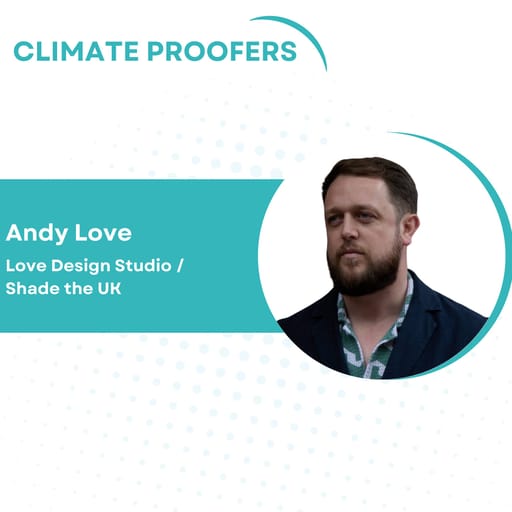
Transcript 0:00 [upbeat music] Hi, everyone, and welcome to Climate Proofers, the show all about those on the front lines of climate adaptation finance, tech, and policy. 0:13 I'm Louis Woodall, editor of the Climate Proof newsletter, which you can read at www.climateproof.news. Is the built environment fit for a rapidly warming world? 0:23 How can we make the places we live and work improve our health and wellbeing, and actually help protect us from rising climate risks instead of exacerbating them? 0:31 And what small changes could provoke big transformations in how buildings are designed and retrofitted to support adaptation and resilience? 0:39 These are big questions, and they're the ones that preoccupy today's guest, Andy Love. 0:43 He's the founder of two pioneering organizations focused on rethinking the built environment for a changing world, Love Design Studio and Shade the UK. 0:51 With Love Design Studio, he leads a team of environmental consultants, designers, engineers, and technicians dedicated to changing the built environment industry's mindset so that sustainable design is embedded throughout every project. 1:04 While with Shade the UK, he's working on addressing the harmful impacts of extreme heat in the UK and driving solutions so that in future no one need die from overheating. 1:12 In our conversation, we chat about the progress made by both organizations towards making Britain more climate resilient, discuss the simple and not so simple design fixes that could make us healthier and happier in the built environment, and go into the theory and promise of a new heat metric as a way to inform would-be residents of a building's heat risk. 1:30 Before we get to the conversation, a reminder that it's the last two weeks of Climate Proof's membership drive. Thanks to all of you who signed up in the last few days. 1:38 We're now just 75 new members short of our 300-member goal. To encourage more of you to make the leap, we're having a flash sale. 1:46 You can now get 20% off an annual subscription until the end of Wednesday, September the 17th. So what are you waiting for? Upgrade today at www.climateproof.news/upgrade. Thanks for the support. Right. 1:59 In a minute, my conversation with Andy, but first, a roundup of last week's top adaptation and resilience stories. 2:05 [whooshing sound] In finance, multilateral development banks steered a record $137 billion to climate goals in 2024, up 10% from the previous year. 2:14 A report by the lenders published last Tuesday also shows that adaptation finance for low and middle income countries rose 6.5% year on year to 26.3 billion. 2:23 However, as a share of total MDB climate finance, adaptation flows made up just 23%, virtually unchanged year on year. 2:31 The biggest chunk of adaptation finance went towards energy, transport, and other built environment and infrastructure, while a near 6 billion slice went to water and wastewater systems. 2:41 Private finance mobilized by MDBs for climate action reached 134 billion last year, up 33% on 2023. 2:49 [whooshing sound] In policy, a UN-convened expert group has agreed on a final set of 100 potential indicators for measuring global progress on climate adaptation two months ahead of crunch talks at the COP 30 summit. 3:00 The list is organized across seven thematic and four cross-cutting dimension targets linked to the global goal on adaptation, a Paris Agreement objective that commits nations to strengthening their resilience and reducing their vulnerability to climate shocks. 3:12 The indicators will next be discussed at a COP meeting in Brazil this November. 3:15 If approved by parties, countries could start using the indicators to track their climate proofing efforts, an important step towards creating a global scorecard. 3:23 [whooshing sound] And in tech, Rainmaker Technologies, a cloud seeding tech startup, is facing pushback from the airline pilots union over its plans to launch flare-carrying drones into the sky. 3:33 According to a report from the outlet TechCrunch, the Airline Pilots Association branded Rainmaker's proposal an extreme safety risk in a submission to the Federal Aviation Administration, and called on the regulator to consider blocking the company's request to roll out the machines unless it complies with stricter safety guidelines. 3:50 In an email to TechCrunch, Rainmaker CEO Augustus Durico responded that the union's concerns related to the public notice of the startup's plans rather than the full non-public information sent to the FAA, which he says includes more information on its safety protocols and risk mitigations. 4:06 Rainmaker's cloud seeding tech is able to induce precipitation in specific areas, which could alleviate water scarcity for farmers and water suppliers, and perhaps even help prevent runaway wildfires. 4:17 [whooshing sound] Okay. That's it for this week's roundup. Now on to my conversation with Andy. [upbeat music] Hi, Andy. Where are you calling from today, and what do you do? Hi, Louis. My name's Andy Love. 4:27 I set up Love Design Studio and Shade the UK, which is both based in the UK. I am calling in from a office space over in London, East London. 4:38 I, uh, work primarily in the built environment sector, as well as research and development sectors. 4:44 Yes, I became familiar with you when I first started Climate Proof actually about a year and a half ago because you were doing some very interesting research with LSE Grantham Institute, which we might get into in, in the course of the interview, and you definitely seem to have been a, a pioneer in addressing heat risks and talking about heat risks in the UK. 5:00 So that's why I wanted to get you on the pod. But first of all, maybe it'd be good to talk a little bit about yourself, your background, and Love Design Studio. Absolutely. 5:09 So my trade is sustainability consultancy in the built environment, and I, previously to setting up my company, Love Design Studio, I had been working with architects, developers, you name it, anything related to buildings around making them more sustainable. 5:26 So that's all the way from trying to reduce the operational carbon of a building through utilizing non-fossil fuel technologies to heat, cool, provide hot water and all those kind of things for buildings, as well as analyze the overheating risk of buildings, looking at air quality, acoustics, anything that kind of is technical with regards to making sure buildings perform to a certain standard. 5:51 That's why I set up Love Design Studio. I felt that we were missing that purpose-led approach, human approach to environmental design. 5:59 Um-And often a lot of consultancies that were born out of COPs and all these different, uh, ESG requirements from developers and policy changes in the UK, it felt that human-led approach to thinking about the environment was missing. 6:15 Love Design Studio is now a 16-strong, uh, company where we have a mix of architects, engineers, consultants, my background's in maths. 6:26 And we continue to work in the built environment sector, but we work in environmental planning services, we work with developers directly, we help businesses with their own sustainability credentials, and a lot of our work revolves around adaptation, mitigation, and making sure vulnerable people are protected during warm weather. 6:45 There's a few things you said there that kind of are of interest to me. 6:47 First of all, you- your background in math, because [chuckles] most of the time when I speak to folks in this space, they're either from a science background or a l- legal background, actually, is quite interesting, a lot of legal or corporate finance background. 6:58 So math, I'm interested to know how that's kind of framed your, your entry into this space and how that kind of frames how you go about embracing projects and implementing projects. 7:07 I think where I have been able to use my math spr- background the most in this type of work is being able to think about the granular as well as think about the bigger picture. 7:16 And quite often when I'm trying to problem solve, I think of the extremes, and that's what you tend to do in maths. You use the extremes of a problem to help solve a problem. 7:26 For me, it felt like, okay, we, we have a real big problem. Having experienced the, the sector, the environment sector with regards to sustainability, that something was missing. 7:36 We've got this impending issue of heat waves and overheating problems across the UK, and we're not ready in the UK, so how do we solve that? 7:45 And I felt that utilizing my, my math brain felt like that that's quite a big problem. How do we break that down bit by bit? And that's been useful, and it makes the issue less overwhelming. 7:57 Um, but I mean, the actual work we do, maths goes hand in hand. 8:00 For instance, we analyze flow paths of air particles in rooms to understand how to reduce overheating risk within a classroom space, or how do we improve the air quality and reduce the CO2 buildup in a space. 8:14 So I think where I'm now very much involved in vision, strategy, big picture, it comes from a background in getting involved in the microcosm, uh, of our work. That's very interesting, yes. 8:27 The granular approach you have from your math background. I like that idea of also focusing on extremes and working your way backwards from them. 8:34 I think that's kind of the opposite that a lot of, I think, corporate and finance interests do, is like, where are we now and how can we slowly increment ourselves up to a place where we wanna be. 8:42 You know, net zero target setting being a key example of that. 8:45 The other thing you've mentioned is the human-led approach, and that resonates with me because I come into climate adaptation from a financial journalism background. 8:52 I'm very interested in frameworks and behavior in companies to kinda get them to change. 8:57 But you're talking about the impacts of climate change on individuals, so can you tell me how you exemplify that human-led approach in your work? Yeah. 9:04 So I'll start by saying sometimes I can frustrate architects, or have done in the past, where I'm not overly familiar with really famous architects. 9:12 I've never been someone who celebrates the egos of individuals who have created buildings. I'm more excited by the performance of buildings and how they serve people. Mm-hmm. 9:23 I'm less interested in what they look like from a sky view, 'cause no one ever gets to see it. What we should be celebrating more is like, does this building serve what it says it does? 9:31 And does it, does it improve the health and wellbeing, comfort, experience of those that use it? 9:37 And that is completely lost in our sector, and that, that's something that I had been thinking about when I first set up, um, the company. 9:45 Now, I mean, we're, we've only been going for a little while, but we are in a bit of a transition stage ourselves. 9:50 We'll come onto it in a bit more detail, the work with London School of Economics and other institutions and local authorities we've been working on, is making sure that we validate our work technically, you know, that maths background. 10:01 Utilizing our software tools, 3D modeling- Mm-hmm... and analyze in our cities and towns from satellite images. 10:07 But making sure we ground that by actually talking to people from a qualitative perspective and understanding the nuances of people's experience on the ground. 10:15 One such project we worked on in the Holborn neighborhood area, where we analyzed the microclimate of the whole of this space through our software tools to try and find hotspots so that we could, uh, provide adaptation strategies. 10:31 Now, if you only use software tools sitting in your office doing desktop research, yes, you'll find hotspots, but you might not necessarily know exactly what's happening on the ground. 10:41 And actually, when we went round, took photos, and investigated the whole of the Holborn area, we realized that there were nooks and crannies of this space that were being utilized by vulnerable people, homeless, and we might have found hotspots to provide adaptation strategies from our work sitting in the office. 10:58 But, um, realizing that when we went down there on site, no one was actually utilizing that space, and would've been a waste of money if we spent loads of money on adapting it. 11:08 And I've just seen this in, from my experience, we force-feed people what they should do with building design rather than just asking them what they need and letting things grow organically as a space or community as well, and that's something that I like to focus on. 11:24 That's a great example of a data gathering project to understand more about a built environment's response to escalating climate risks. 11:33 I was wondering now if you could speak to a project where you've actually revealed how smart design practices, building retrofits, and the like can enhance the resilience of buildings and neighborhoods. 11:43 So one such project we worked on in Islington, uh, was a research and development project with the London School of Economics and Grantham Institute. 11:52 It was a project that, um, looked at developing a overheating index for buildings, both residential and non-residential, that would explain whether a building is ready or future fit for climate change. 12:07 The idea is that you have, at the moment-For any building that's sold or leased in the UK, you have to provide an energy performance certificate. So why can't we do something similar but for overheating risk? 12:20 Again, the idea being that when people are buying or leasing a property, that is probably the time in which people are most likely to retrofit a building, and this would give some incentive to those landlords, building owners, to improve the adaptation measures of a property when they know that they have to provide a certificate to explain whether it is... 12:41 whether it overheats or not. 12:42 In that project, we were able to balance carrying out thermal modeling, overheating analysis with talking to people, taking photos, interviewing those who are most vulnerable in the community, plus stakeholder engagement with the council architects and other key stakeholders in Islington. 13:00 So it was a real opportunity to provide a pilot study of this idea in a concentrated area, and now we're looking at ways to scale that up UK-wide and possibly even further. 13:11 So as part of this research, there was this kind of conclusion that a heat metric would be useful, like, like this kind of certification you mentioned for energy efficiency. 13:21 So can you tell me why you think that would be, uh, really effective in terms of change behavior of both landlords and tenants and indeed policymakers? 13:29 So I've seen firsthand that, um, big policy change makes big difference. 13:35 In the UK, energy performance certificates need to be a C rating for residential buildings, as well as non-domestic buildings would need to be an EPC B rating. 13:46 And because of this shift in policy, we had so many landlords call up Love Design Studio being like, "Help, we need to... We're about to refurbish our building. 13:55 Um, we need to get it to a B rating, but it's got gas boilers. It's currently coming out on F. What do we need to do?" 14:00 Now, these people were definitely not interested in doing this for planetary reasons or to reduce the energy bills for future tenants. It was because they had to. It was the stick rather than the carrot. 14:13 So it did get me thinking, well, why can't we use this method for trying to adapt buildings so that they no longer overheat? 14:22 Because we know that pretty much every building in this, in this country that does not have air con, in some form, most likely overheated during that July 2022 heatwave. 14:34 And it means that there is lack of equity across the UK when it comes to the summer, where people who are most vulnerable or most susceptible to heat stress and other related conditions are not able to enjoy spaces and buildings in the same way that others can. 14:51 So as I mentioned previously, the time in which people are most likely to spend money to retrofit a building or adapt a building is when they need to sell it on or when they're gonna buy it, 15:02 and that is at the point when you normally need to have an EPC. 15:05 So if there's a certificate that you have to produce as well that explains whether you're building or the building you're moving into is gonna overheat, that's the point at which people will actually spend money to do something about it. 15:17 And what needs to happen to make this metric reality? What... Is it a policy change has to happen at the government level? Is it local authorities? 15:25 Is it getting the approval or consensus of landlord associations, building associations, et cetera? Yes. 15:32 So it has to come from government level, and we, we, we're not a lobbyist company, but we would help support the government in thinking about these types of decisions, and it needs a lot more research across the UK to understand if this is the right approach. 15:48 We need to have buy-in from landlords. We need buy-in from all different organizations beforehand, otherwise it could create friction, and it might not last, and it could create political upheaval. 16:00 So the next step is rather than just this pilot study that we've done, do a UK-wide insight market research piece to make sure that we are doing the right thing. 16:10 There needs to be more analysis of existing buildings, better understanding if this is something that we can scale up beyond the UK as well, 'cause if it's in the, the UK initiative, maybe there's potential for us to be leading on this. 16:22 Yes, I can imagine the stakeholder management here is where things could get very tricky 'cause you're not only talking about a big change at the governmental level, but you're also talking about a very powerful interest group, which is landlords. 16:34 And one thing I... comes to mind, anytime you start talking about putting new requirements on buildings, certification regimes, et cetera, is that it might affect the price of a home. 16:42 If you get a bad metric for energy efficiency, it can affect the price of a home. If you get a bad metric for heat, then maybe that will affect the price of the home as well. 16:49 So I imagine that will be a hurdle that you'll have to overcome. Exactly. We need to not just push this through. We need to understand that and not overly complicate a system which is already complicated. 17:01 There are huge benefits of a landlord or bui- building owner to explain to someone who's buying it that this is a really thermally comfortable space, and there's opportunity for it to be a marketing tool as well to provide extra value on top of what it already, uh, costs potentially. 17:19 The insurance industry are gonna b- play a big part in this, I imagine. 17:24 And actually, I see firsthand some organizations, I won't say their names, but they are thinking about this kind of stuff already and are producing products to help not just building owners but events companies during heatwaves. 17:37 And if you could prove that your building is unlikely to overheat or unlikely to flood, then your, your premium will come down, and so it should. 17:48 So there's also that balance of, well, if we bring this along, it, it, it might help reduce the overall cost of your building in the long term from home insurance products. Yeah. It's really interesting. 18:00 And again, that helps reframe this as an opportunity for-Insurers, building managers, event spaces, right? 18:06 It's like if you can upgrade and adapt your property, then actually you become a go-to venue in the summer months where it's gonna be hot. So that's really interesting to me. 18:14 Just before we shift gears, you mentioned air conditioning, and then so it seems to have been the last few weeks of silly season [chuckles] in the media. A lot of discussion about ACs in Europe, right? 18:23 I live in the States, and I do love having my AC. It's brilliant, and I know it's still relatively a novelty in the UK and Europe. What, what's your thinking on the AC debate? 18:32 Should we just full on embrace it, or are there actually smarter ways to cool our homes? Yeah. 18:37 I should start by saying, and I've got to be careful 'cause it's an ongoing project, but we're doing some big research work at the moment understanding the cooling demand of the whole of London, and we recognize as an industry that, um, our infrastructure in the UK and London may not be able to cope with the pressures of everyone switching on their air con all at the same time. 19:01 So first of all, we've got to try our very best to adapt spaces to either, A, not need air con in the first place, um, and B, if we do need air con, to reduce the demand of that. Now, our organization is not... 19:15 I keep saying we're not fundamentalists. 19:17 We understand that air con exists, and especially for vulnerable people, we wouldn't wanna stop those from being able to retrofit their building or their space to make sure it's firmly comfortable through cooling. 19:29 But there are massive things that need to change. There's infrastructure changes that need to happen. There needs to be policy changes. 19:36 There needs to be a cultural shift in how we design and understand buildings, um, ahead of us just installing air con. It, it won't work. 19:46 Now, the policy shifts are things like actually in some, in some local authorities in London, they 19:54 f- fully restrict you putting in air con unless you've gone through a cooling hierarchy to indicate that you've gone through every hoop possible from a passive perspective, putting in shade, um, blocking the sun, having cross ventilation, putting mechanical ventilation ahead of putting air con. 20:11 And for vulnerable people, that's quite tricky 'cause it may be very expensive to go through planning hoops. 20:16 So from a policy perspective, we need to change planning policies to make it easier to install passive measures to reduce, uh, cooling demand. 20:27 That means that heritage needs to reduce its power, or at least allow sustainability to keep up with heritage policy. 20:34 For instance, a lot of people are scared to put anything on their facade of their building 'cause they feel like they have to go through expensive planning requirements. It has... 20:44 Heritage has power because we're worried about what our neighbors think if we put in shutters on our windows, and it doesn't look similar to the, um, to our neighbor, or even awnings. 20:53 Um, and there's big things, like I say, about the overheating index as well, like big policy shift, which tries to really promote the idea of improving buildings and spaces. 21:03 A cultural shift because we still, in the UK, do not know how to deal with the heat. We are very bad at putting on sun cream still. We are very bad at staying indoors when it's very hot outside. 21:16 We have no real policies in our workers' rights around upper limit thresholds in the workplace. Probably needs to change. 21:25 For instance, Love Design Studio, we've got our too hot to work overheating policy, which sets out what the thresholds are in our office space and hybrid working. In warmer climates they're used to the warm weather. 21:36 They shift the time in which you start work and finish work. There's a longer lunchtime period and a relaxation of clothing and things like that, which we're still a bit behind in. 21:45 Then there's a cultural shift in how we operate our buildings. We might leave windows open when it's hotter outside than it is inside, rather than block out that sun. 21:54 Um, I could speak for hours on the poor design of architecture that's happened in the UK. 21:59 I call it an architectural crisis, um, where we have windows that primarily open outwards, which don't allow for shutters or, or external shade. 22:08 We've got floor to ceiling high glazing, single aspect flats that have been built in their masses, especially in our cities, and typically around train stations where it might be a bit noisy and you can't open your window. 22:19 So there, there's lots of things that, that, that need to change. Yeah. 22:22 So we're really interested to see the outcome of that report because, yes, ACs are a very attractive and simple solution, but the infrastructure that's necessary to make them happen, and also, as you said, it's... 22:33 there's a hierarchy of cooling, and you don't have to necessarily jump straight to ACs in order to get, um, a, a more comfortable living arrangement. 22:42 And since we're on cooling now, it'd be great to turn to Shade the UK, the sister company of Love Design Studios. 22:48 Can you tell me a little about the projects that Shade the UK is doing and why prioritizing Shade as a cooling solution is so interesting to you versus other types of solutions? 22:57 So Sha- Shade the UK is a community interest company, and we're all about adapting the built environment and public spaces to protect vulnerable people during warm periods. 23:08 It started as an advocacy and awareness initiative as part of Love Design Studio that now is a research and development company that is now looking at how we can support organizations that provide solutions. 23:22 We have a mission as part of our theory of change is zero deaths from overheating in the UK. 23:28 And Shade the UK will work with and collaborate with different organizations to accelerate ourselves and our country to, to that mission. 23:37 Some of the research and development projects we've carried out and are carrying out are heavily linked with our Love Design Studio work. 23:44 One is a UKRI-funded project with the Met Office Environment Agency, where we're looking at the economic benefits of adaptation measures, which, uh, is a large part missing in the UK, is actually understanding what were the huge benefits economically from, from adapting buildings and spaces. 24:04 All the way down to kind of more entry-level adaptation guides that we've prepared that are free to, to download, where we've-Did some work with the British Red Cross where we've got the adaptation guide for homes, which sits on our website, and we are continuing to work with local authorities, um, the GLA and C40 on some projects in the future. 24:24 And we generally just help support organization. We call it the Robin Hood method or Robin Hood- Mm-hmm... 24:30 model, where we work with organizations that can afford it so that we can provide advice and guidance to those that can't afford it. 24:38 And we hope to work more with schools, housing associations, care home providers, hospitals, all sorts, as much as possible. 24:46 And Shade UK will go through a lot of different evolutions of what it is because the mission is the, is the CEO. 24:53 And we will likely become, over the next five, 10 years, I see us becoming more of an organization that helps support, support the UK during heat waves in all its forms. 25:03 And what are the barriers to increasing the amount of shaded space in urban areas and public spaces in the UK? 25:10 I actually spoke to a couple of companies who are kind of developing, like, shade tech solutions, and one of them was saying, again, planning permission's one issue. 25:18 The structure of buildings in the UK is not totally amenable to shade outcroppings. 25:22 And also when it comes to public space, people can get very pernickety about the using up of public space for what they may see as unsightly apparatuses that provide shade. 25:31 I'm interested to know what you think the barriers are to increasing shade in the UK. And, and shade is a massive part of this conversation. 25:37 We also see ventilation and green infrastructure and, and clothing and behavioral change as part of the equation as well. 25:46 But shutters and awnings and blocking the sun from hitting something is probably your key thing that needs to happen. But heat doesn't just come from the sun, it also comes from the things that are inside spaces as well. 25:57 So it's incredibly important that we understand it's not just about shade, but it is a huge part of the equation. 26:02 In terms of barriers, again, it comes back down to big policy that needs to change, especially on planning and heritage. Heritage has too much power, like I said earlier. 26:13 Um, I see it firsthand where I work with design teams for a planning project where the new residential block goes up or refurbishment is happening, and the architect might want to put in shutters, and then they're told it's a conservation area, and they can't. 26:26 And when you find out why you can't, you realize that it's someone who sits in the council or a consultant that they've hired who says no, um, ra- and it's quite subjective, and it's because, again, we, we just give that too much power. 26:40 Now, if our buildings and spaces no longer serve what they're supposed to do or not serve the people that live in those spaces, then what is the point of heritage? What is the point of that building in the first place? 26:52 So I think we need to have a strip down of that, those policies around heritage and conservation, uh, where it's needed. 26:59 Barriers as well is that the architect sector or for architects need to be designing buildings, thinking about how they're used, making sure that you're using environmental principles, thinking about the site layout, um, making sure we have cross ventilation, making sure that we use something called thermal mass. 27:17 Um, making sure that we have shade within the designs and really championing and showing some leadership on this issue. 27:23 And I'm seeing the change in that, but I've spoken to a lot of big architect firms over the last year or so who feel a little bit embarrassed about what they've built in the last 10 years 'cause they know that they're now being retrofitted with cooling. 27:36 Um, so I, I am, I am seeing a shift there as well. But we do need architects to lead the charge in this because they are the ones who are designing spaces and retrofitting them. 27:48 There just needs to be a massive shift in our understanding of this issue as well. So if you, if you did give me a, a million or £10 million, I'd probably spend a large chunk of that on a PR campaign, actually. Yes. 27:59 Awareness communication seems to be a big part of keeping people safe when it comes to heat-related risks. Well, I am interested in what are the technical or quick fix solutions that could be implemented. 28:12 You know, I'd be interested to know, like, what you're seeing at the cutting edge of kind of cooling tech or building approaches that can actually enhance cooling. 28:20 I mean, I, I really want to promote the simple things, but obviously simple can also be tech. 28:26 But if we could have clip-on shade that was less than 100 quid that we could put on our windows, take off our windows, rather than spending that three grand on a installation, I think that, that will help. 28:37 And we're seeing that, and we're seeing innovation through companies seeing that there's, there's gonna be some products out there that we hope kind of break the mold and make it more accessible and affordable for keeping cool. 28:50 Um, something that I find quite interesting and I'm actively involved in is, is understanding phase change materials. There are... 28:57 That could be a cooling mat or surface that has a coolant in it or a phase change material, which means that when heat touches that surface or material, it extracts the heat from whatever is touching it at quite a rapid rate and can cool down a body or a surface or a space quite quickly. 29:15 So I was speaking to a, an organization this week actually on a panel that has typically been used for keeping batteries cool, um, with this technology. 29:27 They're now thinking about how we can turn this into, um, something that is stuck on a wall or a ceiling or a floor, um, so that it can quite rapidly take heat from whatever's touching it and dump it elsewhere. 29:41 A bit like air conditioning, but more passive. I think there, there, there are also techs that already exist but aren't being applied in this area. Cooling mats for pets, for instance. 29:51 Maybe we can find it in our hearts to use those for humans as well. Maybe something that sits underneath to keep cool quite quickly when you get into your bed. 30:00 But I think there's probably a lot more that needs to happen, and we're not quite seeing it there yet in terms of innovation and tech that is affordable.For the masses. 30:07 It does seem amazing that some of these solutions interventions can be quite low tech and quick to install. 30:12 I mean, I spoke earlier this year with the founder of Stay Shaded, who is working on kind of stick-on awnings to make it easier to kind of create shade in, in existing buildings. 30:21 And then I wrote just the other day about the National Rail using technology from this company, Flint Engineering. 30:28 They are deploying their solution to signal cabinets around the UK which control the, the direction of trains, right? Direct trains where to go. 30:37 And these things can overheat massively, but the simple solution is like a thermal paste attached to like a panel that they put on top of this cabinet. 30:44 It can re- markedly reduce the internal temperature of these cabinets. And it's not, you know, it's not using fancy electronics. 30:52 It's ma- it's largely passive, and, uh, it's amazing how intense the cooling can be without having to like suck in loads of energy from the grid. Yeah. 31:01 And there, there might be ways of utilizing that heat because rather than just dumping it outside, which can cause extra issues, maybe that heat can be taken, like say, phase change material or, and then dumped into a hot water tank to preheat your, your shower. 31:16 So there's things can be done to think about things holistically. And yeah, Stay Shaded, that's, that's an organization that I'm aware of. 31:22 I think it's these kinds of, uh, individuals, entrepreneurs, and people in the background are trying to solve these problems, and it's just how do we, how do we accelerate that before, before summer next year? 31:34 Because we, we as an organization, Shade UK, really wanna help promote these innovators as well. 31:39 Well, it's interesting on this side of the Atlantic, you have a number of venture capital funds, private equity funds who are starting to focus on adaptation, and a number of them are looking at extreme heat as the kind of vertical in adaptation they want to address. 31:50 Because here in the States, it is a massive issue in large numbers of large parts of the country, right? 31:56 So there does seem to be a lot of interest in investing in extreme heat solutions, but I think, again, we want to make sure that the bias is not just towards these cool high-tech ones that are attractive to Silicon Valley folks, but also to these kind of simpler, quicker to implement and cheaper solutions. 32:10 May not be the sexiest, but they can actually get the job done. Yeah. I mean, if you're out and about, a hat, very good. Um- [laughs] That great technology, the hat. Yeah. Yes. [laughs] Um, we're, we're, um... 32:21 We wanna bring back the parasol. Um- Yes. I started seeing those actually in, in New York, actually. A number of people are having them. Yeah. We, we, we, we wanna help promote that. 32:31 Um- My wife loves a parasol, so this- Oh, wow. Yeah... she'd happily use that. That'd be great to talk to her. 32:35 I think we, we're all about trying to keep things simple, and we, we also know that, you know, countries are ahead of us. 32:41 It's like the Nordics have had heat pumps for forever, and we felt like heat pump was suddenly this new technology. It's not. It's not. It's the same with shade and all these, these tech. 32:50 It's like, well, no, the, the Egyptians knew when they were building their buildings to, to create thick walls made of stone and, and small windows that have cross ventilation because they knew, they knew... 33:02 They might not have known, might not have been able to study it to the extent that we do. 33:05 But, um, this stuff already exists, and we can learn from other countries, other cultures and, and history to make sure that we don't over-invent, overcomplicate, over-engineer, and provide simple solutions and affordable solutions for people. 33:21 Okay. Now I wanna look to the future and what you've got on tap for Love Design Studios and also for Shade the UK. 33:28 Can you tell us a little bit about this manifesto for change for 2026 that you're working on with Love Design Studio? What's the purpose of that, and how do you hope it will shape your agenda in the next year or so? 33:38 Um, so, uh, we've, we've been going for five years. We've been working across lots of different environmental services at Love Design Studio. 33:46 And given our experience in the team, and we've got quite a wide variance of different experiences and expertise. 33:51 We have got a good ear to the ground and understanding what the problems are in our industry, which are stopping us to becoming more sustainable as a country. 34:01 And we see that a few impending things that might not be achieved by a government without the support of the private sector. 34:10 So as part of our manifesto for change, we found that Love Design Studio could help with four particular areas. 34:18 First one being adaptation, which we call Love Adaptation, to strengthen our links with Shade the UK and ensure that we are local authorities, organizations, institutions on their pathway to adaptation and climate resilience. 34:31 There's Love Retrofit, where we realize that the targets for meeting net zero carbon will unlikely be met by the built environment sector given the slow uptake of non-fossil fuels. 34:43 In particular, we at Love Design Studio are gonna try and accelerate the industry to making sure that energy performance certificates are at least a B rating, 'cause at the moment it's still over 80% of buildings, especially non-domestic buildings, uh, will not meet the 2030 target of being a B rating. 35:02 So we're gonna help out with that and help government and local authorities with that. 35:06 Third area is Love Zero Waste, so we do a lot of work in the fit-out and refurbishment sector, and we still know that that sector is not doing as well as it can do with refurbishments nearly happening every two to five years of buildings, especially offices, and a lot of that going to waste. 35:23 So we're looking into that as part of our, um, work. 35:27 And then the final one is air quality, Love Air Quality, where, again, with some of the work we do, and it's, we've not spoken about it too much today, but we're gonna help campaign so that people understand that there are air quality problems in our buildings and there's lack of awareness around the poor performance of especially homes in the UK when it comes to air quality. 35:48 We only ever think about really the air quality of the roads coming into our buildings, and we tend to close windows to keep that, uh, the particular matter and the NOx emissions from coming in. 36:00 But it turns out our own cookers, our own VSCs of all the materials inside and our CO2 buildup is also impacting children and people who live in spaces as well. 36:10 So as part of this, our manifesto for change is promotingAnd advocating across these four particular areas to government, local authorities to try and have cultural shifts across these four issues. 36:23 Finally, on your Manifesto for Change, you are having these conversations, public conversations, and trying to get as much feedback as possible. 36:31 So can you tell me about that approach, why it's important to you to kind of garner as much external advice and interest in your strategy as it is to kind of develop this internally? 36:41 So we sit on the consultancy side, so we advise lots of different organizations. We are fairly low in the pecking order of decision-making for when buildings are designed. We sit in the design team. So it... 36:55 To make real change, we need to be making sure that we are allowing and working and talking with decision-makers. 37:02 So for instance, in our most recent talk about Love Zero Waste, we had invited British Land and a contractor called Third Way as part of this conversation, um, to ensure that we are collectively and in collaboration trying to shift the dial when it comes to trying to have a zero waste industry. 37:25 And we need to do that by lots of different ways, which is build a better network so that we can all share our knowledge in that area, as well as create things like this, our podcasts and talks and things that are downloadable. 37:38 We're very much a video society now, and whereas before, especially in the build environment, is we're ri- it's rife that we have these panels that are shut off to 20 or 30 people who are invited to them. 37:50 We, we now have the opportunity to share more information at scale across the globe by utilizing YouTube or, or podcasts on Spotify. Um, and that's why it feels important for us to use those methods. 38:05 Yes, and I think when it comes to a number of climate hazards that might be foreign to the UK or foreign to parts of North America, but they're not entirely foreign to other parts of the world. 38:13 It's good to be able to draw in expertise from these other locations that have had to deal with extreme heat or have had to deal with flooding or poor air quality or waste issues. 38:22 I think casting the net wider can actually help speed up some of the innovations we need in developed, so-called developed countries that might actually be taking the [laughs] wrong approach at the moment. 38:31 You know, we don't wanna keep reinventing the wheel. 38:33 We've got some countries or regions that are doing, has been doing things for years and, um, we have an opportunity to accelerate our understanding in today's climate, given the opportunity to sh- share knowledge at such a rapid rate over the internet. 38:49 And very finally, can you tell us of one thing you're excited to get done or excited to see happen before the end of this year? Yes. It's our five-year anniversary, so we're gonna have a big party. 38:58 So, um, really looking forward to that. But otherwise, from a work perspective, yeah, we've got this talk series that we're doing across the four months where we are helping define our Manifesto for Change. 39:10 We'll be re- released in 2026, which will talk about all the various, um, things that we're gonna put to the industry that need to change and how we need to do it. Um, I'm looking forward to releasing that come January. 39:23 Wonderful. And I look forward to reading it, and I'll be sure to let the Climate Proof readers know where to find it when it comes out. It'll make for engaging read, I'm sure. 39:31 For now, thank you so much, Andy, for your time, for telling us about Love Design Studio, telling us about Shade the UK, telling us about heat risk in the UK. 39:38 You're at the forefront of some really exciting work, and I do encourage everybody who's listening to take a look at Love Design Studio and Shade the UK to get an understanding of how to really do this climate adaptation thing. 39:48 I really think you're a inspiration on this front. For now, thanks so much, Andy. Have a great rest of your week. Thank you. [upbeat music] Climate Proofers is a Climate Proof Media production. 39:59 It is produced and presented by me, Louis Woodall. Subscribe to the Climate Proof newsletter by going to climateproof.news/subscribe. 40:06 And to learn more about the publication, feel free to reach out directly using our LinkedIn page. Goodbye for now. [upbeat music]