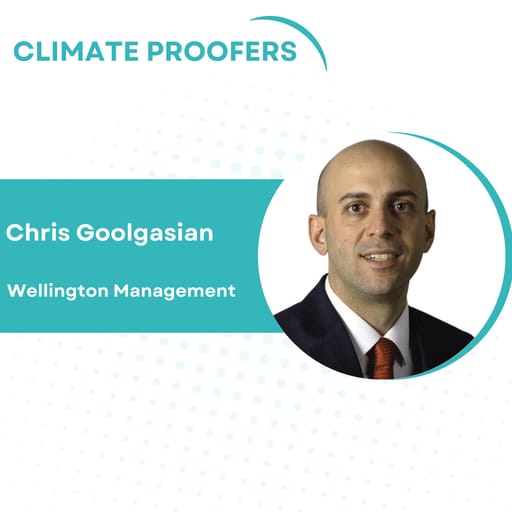
Transcript 0:00 [upbeat music] Hi everyone, and welcome to Climate Proofers, the show all about those on the front lines of climate adaptation and resilience. 0:13 I'm Louis Woodhill, editor of the Climate Proof newsletter, which you can read at climateproof.news. Adaptation is an economic imperative. 0:21 Even if we dramatically reduce greenhouse gas emissions tomorrow, the pollution that's in the atmosphere today will mean extreme weather events get worse, and climatic changes will transform vast regions of the globe. 0:32 These changes threaten homes, businesses, and governments. But on the flip side, they promise opportunities to those companies providing goods and services for the shifting reality and to the investors who buy into them. 0:43 Wellington Management, one of the world's largest independent investment management firms, is alert to this epoch-making opportunity. 0:50 With one point two trillion dollars in assets under management and all kinds of pension funds, endowments, and insurers in its client roster, Wellington has the reach and credibility to mainstream adaptation investment. 1:01 Here to talk about it today is Chris Gulgasian, Wellington's Director of Climate Research. 1:05 We discuss Wellington's approach to adaptation-focused stock picking, discuss the conceptual and practical challenges with identifying appropriate investments, and dig into some of the climate mega trends he thinks will reshape the economy over the coming decades. 1:18 Before we get to the conversation, a reminder that Climate Proofers and the Climate Proof newsletter are subscriber-supported productions. 1:25 You can support my coverage and help the publication to grow by heading over to climateproof.news/upgrade and becoming premium subscribers. 1:32 And if you're feeling really generous, please consider choosing a super proofer membership, which comes with additional goodies like free gift subscriptions, access to monthly roundtables on adaptation technology, and more. 1:43 All right. In a moment, my conversation with Chris. But first, let's round up some of last week's adaptation and resilience stories. 1:49 [whooshing] In finance, the fate of millions of dollars in global adaptation and resilience investments hangs in the balance as President Trump and his ally, Elon Musk, the world's richest man, take steps to illegally shutter USAID, America's overseas development agency. 2:04 Over the weekend, Musk called USAID a criminal organization and said on his propaganda platform, X, that Trump had signed off on it being shut down. 2:13 However, on Monday, Secretary of State Marco Rubio said he had been made acting administrator of USAID, and US officials told CBS News that the agency would be merged with the State Department. 2:24 Last year, USAID invested sixty-one million dollars directly into adaptation and resilience projects, and had, in concert with the State Department, implemented a climate mitigation or adaptation strategy with sixty-six countries. 2:36 The agency also oversaw former President Biden's cross-department public-private prepare initiative, which mobilized thirty billion dollars for adaptation and resilience worldwide in twenty twenty-three. 2:47 The attack on USAID follows a ninety-day freeze on all foreign aid ordered by President Trump on January twentieth, which is already worsening humanitarian crises around the world and forcing climate adaptation and resilience projects to grind to a halt. 2:58 [whooshing] In policy, the New Zealand government said it would introduce legislation this year to set up an adaptation framework for the country. 3:05 This framework aims to lower the long-term costs of climate proofing New Zealand while maintaining, quote, "efficient housing and insurance markets." 3:13 It should also give people the ability and incentive to take risk-reducing measures where they can. Insurers welcome the commitment. 3:19 Chris Farrelly, head of the Insurance Council of New Zealand, said, "Research shows every dollar invested in adaptation brings substantial economic benefits. 3:27 By addressing these risks now, New Zealand can avoid the higher costs associated with future climate-related disasters." 3:33 [whooshing] And in tech, an AI startup called Heritable Agriculture launched with a mission to help build more climate-resilient food systems. 3:40 The company, which got its start at the Alphabet moonshot factory, or X, has an AI-powered platform that can identify new ways to breed plants so that they perform better in climate-stressed environments. 3:50 It offers agriculture clients three key services: one, identifying important crop genes, two, designing edits to particular genes, and three, forecasting plant performance in specific contexts. 4:02 Heritable secured financing from FTW Ventures, Mythos Ventures, and SVG Ventures. [whooshing] Right. That's it for this week's roundup. Now on to my conversation with Chris. [gentle music] Hi, Chris. 4:14 Where are you calling from today, and what do you do? Hi, Louis. Pleasure to be here. 4:18 I'm, uh, in Boston with Wellington, and I am the, uh, head of climate research and also run a strategy that involves, uh, climate resilience stocks. Thanks for being here today. 4:29 I heard you speak at an event at Climate Week, uh, NYC, uh, with the GARI Group, the Global Adaptation Resilience Investment group, and you said some very interesting things about adaptation as an investment theme, which is why I wanted to get you on the pod. 4:42 So first of all, I'd like to ask about how you and Wellington understand adaptation as an investment topic. What is and isn't an adaptation play in your book? Sure. It's a great question. 4:52 A-and just language-wise, 'cause I'll probably use the terms, uh, interchangeably, we think resilience and adaptation are highly linked and often interchangeable, so we'll, we'll use those two terms. 5:03 But to answer your question, we categorize it as seven physical risks that are highly connected to a warming climate, and so that means more frequency and, and higher magnitude of these events happening. 5:17 Those seven risks are heat, drought, wildfire, hurricanes, flood, water scarcity, and sea level rise. So in our language and in our investing, when we say climate resilience or climate adaptation, 5:34 we're talking about stocks related to one of those seven physical risks. And to be clear, you're operating in the public equity space, right? 5:43 So when you're talking about adaptation as investment theme, we're talking about public equities, not private markets, not debt. What's the sort of universe you're dealing with? Yeah. 5:49 So for the strategy that I manage, we're talking specifically about public equity. Across Wellington, there are other asset classes involved in climate investing, including venture, fixed income, many others. 6:01 But for what I do specifically, it's public equity.So I'm interested in how you came up with this seven physical risk hazards taxonomy because different actors have different ways of understanding adaptation. 6:13 And we know, for example, that resilience and adaptation can cut across sectors and cut across hazards as well. 6:18 So maybe you could expand a little bit on why you decided to go on this kind of hazard specific route rather than looking at how climate risk can impact ecosystems or financial institutions or real estate, which is another way that some institutions have looked at this theme. 6:31 Yes, great question. So the, the origin story here is that, uh, we have a scientific partnership with an organization called the Woodwell Climate Research Center. 6:41 And about five years ago when we started that partnership, we were going back and forth brainstorming about the future of climate risks, extreme weather, and the capital markets. 6:52 And I asked the president at the time of Woodwell, you know, "What do you think the most underpriced aspect of climate change is?" And without blinking an eye, he said, "Oh, Chris, we have to adapt." 7:04 And I said, "What do you mean by that?" 7:06 And he said, "Well, you know, transition renewables, wind, solar, EVs, batteries, those things are all pretty well known, uh, but what's less well known is the damage, higher frequency, higher magnitude coming from heat waves, floods, hurricanes, wildfires, et cetera." 7:25 And in his view, society, industry, governments had not really prepared for that in the same way that they had already been preparing, if you will, for transition technologies. 7:37 So when we had that conversation, it, it's-- it occurred to me that that likely means a lot of capital in the future is gonna be needed for these areas, and that led us to study the areas where the capital would be spent. 7:51 And the seven risks come from the fact that these seven perils, if you will, heat, drought, wildfire, hurricanes, flood, water scarcity, and sea level rise, have a direct connection to a warming climate, and that connection increases the frequency of those events and increases the magnitude of them. 8:10 I say that because that is not true of earthquakes and volcanoes for two examples, uh, which are currently not thought to have any climate relationship. They're still thought to be random. 8:21 So when you say what's included and excluded, we're trying to exclude random events that go on in the world and include events that, from an investment perspective, we expect to have higher frequency, higher magnitude over time because they are linked to a warming climate. 8:37 As for, you know, sectoral impacts industry, you mentioned real estate, uh, physical climate risk likely touches all parts of the economy, various asset classes and sectors. 8:51 And so we didn't really start with the sectors and the industries. We started with the perils and then know that they're likely gonna impact all the sectors, asset classes and industries. 9:03 Okay, so this peril focused approach then, how does this translate to picking and choosing investments? Are you looking at companies that are providing services and goods to protect against these perils? 9:14 Let's get into like the kind of the nitty-gritty of how you go about selecting equities. 9:18 Yeah, that's really the work of the last five years, and I think, you know, pretty novel approach to what you have to do to find these companies. 9:26 So we set out to find companies that are gonna have a big and positive relationship to these climate events, meaning they have services, products that people are gonna need to become more resilient to adapt. 9:40 The way that we set out to do that is to have it be material to those companies' results. 9:45 And in our materiality framework, that means, you know, we're trying to get at least fifty percent of a company's revenue to be involved in either heat adaptation or flood adaptation or hurricane or wildfire resilience. 10:00 So that's the, the high level goal is at least fifty percent of a company's revenue is related to one of these perils in a service or a product. 10:09 And again, that is much different than what the industry has developed over time around climate. The industry has tended to focus on renewables, wind, solar, EV. 10:17 Nothing wrong with any of that, but that's in a different lane, if you will, of what's typically called transition investing. And what we're trying to do is adaptation and resilience investing. 10:28 So the first stop is, uh, fifty percent revenue threshold. The way we find these companies is a combination of things. 10:37 We have a great internal network of Wellington investors across sectors across the globe, and they share ideas. We pick their brains. We have kind of like a all-point bulletin. 10:49 People know we're always looking for adaptation stocks. And so, you know, roughly these things break down in a third, a third, a third. Uh, a number of the companies have come from the internal Wellington network. 11:02 A number of companies have come from what's called NLP, natural language processing, where we are using keyword searches to go through earnings transcripts, ten K's, investor decks, looking for terms around, say, water or drought, flood, and then we follow up with the company afterwards if we have some hits on that. 11:27 And then the third way is what I would just write up to be, you know, creativity, uh, which is we have a team focused on this strategy. We are constantly brainstorming, reading 11:42 variety sources of research that have nothing to do with Wall Street and interacting with the scientists at Woodwell. And, you know, that's a hard thing to capture and define. But I-I'll just give you an example. 11:55 So, you know, generators are a pretty well-known product for homeowners to become more resilient to storms and outages. 12:04 And then the creative side to us is, well, what might be another essential backup service into the homeThat people would adopt over time. 12:14 And through a lot of research that came to us, people may need a second source of water into the home. And then we find a company who has water delivery into the home. We do a bunch of research on that. 12:26 It meets the fifty percent, it has the fundamentals, good management team, et cetera, et cetera, that you would want. And then a company like that enters into our portfolio as well. 12:37 So that last group I would say is kind of a mix of creativity and research. That sounds like the fun stuff to me as well, right? Right? Yeah. Yeah. 12:45 Like, kind of looking at these broad trends and trying to kind of cascade back into actual companies that exist today or companies that could pivot into providing services that cater to these perils or resisting these perils in the future. 12:59 And I wanna get- Yes... into some of those big structural themes a little bit later. 13:02 But it's interesting you say you have these three buckets, 'cause I was wondering, when you look at companies today, you look at their reports, you look at the earnings transcripts, and I myself, I look at S&P five hundred earning transcripts o- on a frequent basis to kind of pick out where a executive has spoken about wildfire risk or where they've actually used the word adapt and resilience. 13:18 And actually, when it comes to those words, very few executives are using terms like adapt and resilience. You have a very wide language used to describe what I would call adaptation resilience activities. 13:29 So I'm wondering, is it quite noisy out there in terms of where you're trying to get signal from public disclosures? Is it difficult? And what signals have you found to be the most reliable? 13:37 And is there any real substitute though for the sort of high touch work that you're doing in terms of engaging with companies, leveraging your network? 13:45 Do you think there's a way to kind of systematize this without having to do all this handshaking and Zoom interviews with executives? Yeah. Not, not yet. It's a great question. Not yet. 13:54 Uh, maybe AI will figure everything out, but not yet. Uh, it is a lot of reading, it is a lot of meeting with CEOs, CFOs, and it is a lot of probing on questions that they really haven't answered before. 14:08 And to your point, you know, I would say for the bulk of the stocks that we own, the company themselves don't know that they are resilience plays. And then we are kind of alerting them to that fact. 14:19 We're saying, "Look, you actually have a secular tailwind that's gonna benefit your business." That could be wildfire, that could be floods, that could be drought. 14:28 And a lot of times these companies are industrials and they have a long history. They may be, you know, a hundred year company headquartered out of Wisconsin or Michigan or North Carolina. 14:40 And, you know, they have a very good business. They have market share. They have continuity management team. And, you know, they're typically not climate change experts. It's not their job, right? 14:52 And so you're often, in a way, partnering with them. We share a lot of research with them and we- we're trying to, in a way, help them understand there is this big tailwind for your business. 15:04 You know, you think your business is largely US, but there's gonna be this big problem in Western Europe or somewhere else. Have you thought about growing and penetrating that market too? 15:14 And we've been pretty successful having those engagements with management teams and then seeing them report later on that they've penetrated these other markets, doing a lot of different stuff on their disclosures and their investor presentations than they were previously about extreme weather events helping to drive their business and how they're capitalizing on it. 15:36 So it's a, it's a pretty nascent area in which you're kind of filling a role as a somewhat educator to them at the same time as being an investor in them. I quite enjoy that. 15:49 The management teams are super receptive to it. They're, they're good people, you know, running good businesses and now you're telling them, "Plus you've got this extra possible tailwind." 15:59 Besides industrials, what other sectors are you seeing adaptation companies spring up or adaptation companies exist? Sure. 16:06 So benchmark categorization and industry categorization of stocks is well known to be a bit inefficient. Uh, oftentimes you can have two competing companies in different sectors when they're doing the exact same thing. 16:20 There was a case where we had two pest control companies. One was in, uh, consumer and one was in industrials, right? So I, I'll leave the vagaries of, uh, sectors and industry classifications to another day. 16:35 But the point is that there can be companies outside of industrials and, you know, in our case, a couple of those companies have tended to be in what you might say is consumer business, 16:47 where the residential person is the buyer of the product or the service rather than, you know, industrial company buying something from another industrial company. And, 16:59 you know, that kind of lines up with the way we break down revenue. So we have... You know, most people that run a fund think about the sectors that they have. 17:06 Like, I have this much in tech and this much in healthcare, blah, blah, blah, right? The way we think about it is what are the sources of revenue into the companies that we invest in? And there's four sources. 17:17 It could be from the government, government buying products and services, be that muni or federal. It could be industrial companies. It could be individual consumers, so what we call that residential. 17:31 And it could be commercial, which would be, you know, large buildings like I'm in right now. Those four areas, if you will, 17:39 not exactly, but are roughly twenty-five, twenty-five, twenty-five, and twenty-five of our total revenue. They're about evenly split. 17:45 So when we think about the stocks that we own, we're trying to find companies that sell into governments, sell into residential, sell into industrial. And not all of them do all of those things. 17:57 A pest control company might just sell into a consumer, if you will, whereas an engineering company might largely just be doing business with governments and commercial and industrial owners. 18:10 So our sector breakdown in traditional sense is significantly in the industrial sector.There's also consumer-related companies, there's some agricultural-related companies, as you might imagine. 18:26 But I don't get too hung up on what sector they're in as much as I get hung up on what's their source of revenue. 18:33 So that's on, you know, what I would call offense, which is like the stocks that we own that are trying to solve these problems. 18:39 On defense, which are the other multi-thousands of companies who are gonna be impacted by climate, physical risks. You're exactly correct. The disclosure for those companies is usually pretty light. 18:53 Uh, words like resilience and adaptation are not often used. That has started to change. We do 18:59 a couple of thousand of ratings on individual stocks and their physical risks, and those ratings are largely based on disclosure plus the location of their assets. 19:13 And we, we use the location of their assets in a mapping tool that we've built. It's a geospatial tool where you can see the future, if you will, the forecasted future 19:26 of hurricanes or floods or heat waves, and then look at all the locations of a company's physical plants, manufacturing sites, et cetera, and you're trying to gauge, you know, does this company have a lot of sites that are in the line of fire, if you will. 19:42 And so on that line, which you might say is defense, the disclosure certainly five years ago was very weak, you know, might have been a one out of ten. 19:52 I would say it's moved to three or four out of ten, so it has improved. There's been a lot of work on that by some companies, uh, but it still has a long way to go, to your point. So this is interesting. 20:03 You do this mapping, you do this risk ratings in-house and with Woodwell. You don't outsource this analysis to one of the many data vendors out there who are providing physical risk analysis. That's correct. 20:14 Um, and, you know, I, I won't judge those vendors. 20:17 I, I would just say when we partnered with Woodwell, we looked at about a dozen other entities that were forming or formed at the time with physical risk reporting tools, insights, et cetera. 20:30 And to just make a, a blanket statement about the collection of them, the problem with going to one of them is you are taking their assumptions. 20:38 And the assumptions in extreme weather and climate modeling are the whole thing. It's-- That's everything. It's not like there's five other things. The assumptions are the thing. 20:48 So, you know, with Woodwell and a science partnership, we have basically a say in the assumptions, and obviously we're not the experts, they are, but we fully understand what is in the drought forecast, the heat forecast, hurricane forecast, 21:03 the wildfire forecast. And when you take, you know, vendor X's projections, you are taking their assumptions. And they might be great assumptions. They might not be. Um, but oftentimes you don't know what they are. 21:15 You certainly didn't have a say in them. And then sometimes getting the company to even share with you what they are is, is another hurdle. So, uh, Wellington is a deep research-focused company. 21:26 It's very rare for us to really take anyone's assumptions, uh, on anything, and so we, we were probably weren't gonna make an exception here. Yes, I think there's-- that's interesting. 21:36 There's been concerns about some data providers being black boxes, and you don't understand the assumptions. And I think it's interesting in adaptation resilience world, it's a more amorphous space. 21:46 There are different interpretations. 21:47 So I'm not gonna say, like, one person's guess is as good as anyone else's, but I think there is more scope to define a thesis and execute on it using your own assumptions, your own data, your own research than there is maybe in other investment strategies. 22:01 And actually, I do wanna ask, I'm not sure how much oversight, uh, engagement you have with the kind of climate transition side of things, but what are the similarities and differences when it comes to putting together an adaptation portfolio and investigating companies for their adaptation benefits or plays versus mitigation companies, right? 22:17 I imagine it's more complicated on the adaptation side because there are various different factors and there's various different revenue streams that could contribute to a company being adaptation V a mitigation company. 22:27 Yeah. Another great question. The-- I just wanna go back to your earlier question on mapping. 22:32 So Woodwell, you know, speculated to us early on that there would be an arms race on mapping tools as there was more competition entering space, and that likely the way those competitors would differentiate themselves is on what's called downscaling and resolution, which is bringing the projected risk, say that's fire or hurricanes or flood or heat, down to a more and more local location. 22:58 So that's called downscaling. That's the resolution. And you can imagine that in a competitive market, you know, vendors are always trying to differentiate themselves. 23:07 So if I could tell you I could predict something down to one meter and somebody else was saying, you know, a hundred meters, then suddenly I have a perceived advantage. 23:15 But in actuality, that may not be true because some of these things are not meant to be downscaled down to that level. So, you know, there again is an issue with, um, not owning the assumptions. 23:27 On your second point, transition investing versus adaptation investing, obviously, they're both hard. It's very hard to outperform in the market. So we'll leave that one, uh, to, to be pretty obvious. 23:41 But in the structure of your question, which I think is more about is it more difficult to identify and make decisions about adaptation stocks versus transition stocks, I think that that's true. 23:55 And the reason is, you know, dates back to a little bit where we started at the beginning of this call. Transition companies are well identified. They know how they are measured, you know. 24:05 So if you're an EV battery maker, uh, a wind turbine maker, solar panel maker, you know what the market is looking for. 24:13 It's your production in those products, it's your sales, it's your margins, it's the size of the TAM over time. And then the whole marketplace is looking for those things, and that's what moves those stocks, right? 24:24 So that is a pretty well-defined and structuredUniverse, if you will. Adaptation is not that. 24:31 For all the reasons we said before, the companies are typically not disclosing the drivers of their business along the lines of the revenue that they get from heat or from droughts or floods. 24:45 And so then you have to ask a lot of questions, you have to use different forms of analysis, you have to think about their marketplace changing from the climate events. And so I think that that's more difficult, yes. 25:01 Probably will become a bit more standardized over time. You mentioned Gary at the beginning of the call. 25:07 I think they've done great work with MSCI, uh, to try and create more structure around a universe of adaptation names that that universe has a lower threshold of revenue. 25:20 I think the background on that structure is also interesting. 25:24 You know, they have some money from Bezos, and from what I understand, it's really he wants the world to have a framework because then more money would get allocated toward these type of companies. 25:36 And that is a good understanding of how the capital markets work, right? 25:40 When you have benchmarks and structure, then the investors have more of a landscape that they're used to, and then the money tends to move into those companies. So I appreciate the, the thought behind that. 25:53 I find it interesting you were saying you're kind of bringing awareness of climate adaptation as a theme to companies themselves, right? 26:00 Companies that providing goods and services like, like water supply, backup generators, you know, insulation, et cetera. 26:07 These companies may not have been aware that they were climate adaptation companies, but you're helping to bring awareness to them. 26:13 I'm wondering on the other side, how are you finding willing asset owners to invest in this adaptation strategy? Is it a tough sell? Is there education needed? 26:21 And what factors do you think could make adaptation a, an easier sell to these big asset owners down the line? 26:27 Yeah, you know, when, when you're part of a category being created, then you spend a lot of your early time educating. And educating is not easy. I should have learned my lesson because I've done this a few other times. 26:40 You can spend a lot of years in the, in the education campaign before it's realized, but, you know, this is a, a well worth it endeavor to do that. 26:50 So I, I have not minded the hundreds of meetings per year of education and the interactions with large sovereign plans and country level government plans and pensions and private investors are fantastic. 27:03 I mean, people want to learn, they want to understand. There's a general recognition that this is a growing problem. And so I, I appreciate all of those meetings. But, you know, education's hard. 27:14 I think we are now past the part of the education process that is, I would loosely define as like, "What do you mean?" And now has moved to, "Well, is it big enough?" And that's the question we get most often now. 27:30 And we actually wrote a paper at the end of last year, it's out now, just tackling the size question because it was coming up so often. 27:38 And it's almost like you're moving through the, you know, seven stages of grief here, which is like the first thing was acceptance, adaptation, n-now I understand what it is, and the second one is still a little pushback, but, but will it be a big enough area to invest in? 27:53 And when people ask that question, they're often... their baseline is often that transition spending will be much bigger than adaptation spending. That's the genesis of that question. 28:05 And I think that that's likely wrong, uh, and it's likely wrong by magnitudes. We have the scientists on our side for this point. We have third party academic studies on this point. 28:22 We have logic on this point. Let me hit the last two, studies and logic. So the studies are that adaptation spending could be multiples more than transition spending. One study of that is six times more by twenty fifty. 28:39 So something like thirty-eight trillion versus six trillion. Again, we're largely talking about heat, drought, wildfire, hurricanes, flood. 28:46 So not that transition is bigger than adaptation, but that adaptation is bigger than transition by multiples. Okay? And then logic, which I really focus on in the paper. 28:58 I think from a logic perspective, just intuition, no academic studies or anything else needed, it stands to reason that repairing something and recovering from something over time is gonna be more expensive than improving technology. 29:15 Improving technology gets more efficient, it gets scale, and that's largely what we're talking about on transition side, right? EVs and batteries and wind and solar will keep getting better. 29:25 They'll get better while they get cheaper. Recovering from a climate event is not going to get better. It's not a thing. You don't get more efficient at recovery. 29:36 Recovering from those events isn't gonna follow a technology curve, right? Where we're gonna get better results at a lower cost over time. 29:45 These events are more and more costly, and they don't benefit from any scale or technology curve. The, the insurance tables are out from the last two years. 29:57 In both of the last two years, the US has approached thirty individual events of more than a billion dollars of damage. These are all-time highs. 30:09 And the cumulative amount of those events, each of the last two years approaching six hundred billion dollars. Okay? The renewable spend in the US last year, so again, think about wind, solar, was about half of that. 30:24 So even just using logic of the last two years, the damage of eventsHas been greater than the spend on transition. 30:32 I take your point about the cost curve of disaster recovery not shifting, but there is a lot of emphasis on risk mitigation and solutions, uh, tools that can help to reduce the, the actual dollar amount that is required to recover from disasters. 30:49 I'm interested in, in your observation of the market, what the kind of pipeline of companies is, uh, for adaptation solutions. You're focused on public equities, right? 30:57 But, you know, private equities become public equities down the line, and we arguably, because of the size of this market, you, you mentioned we're gonna need more... a more great supply of companies. 31:08 And it seems to me there's still more supply of early stage transition companies than adaptation companies. 31:13 So I'm wondering if startup world isn't providing sufficient adaptation solutions, what kinds of companies are, and what can we do to kind of spur the right type of solutions? 31:21 And by right type of solutions, I'm meaning s- startups that are actually providing kind of physical infrastructure or hardware to protect communities rather than, uh, SaaS companies and tech companies, which are very important, but ultimately we need a lot of companies and solutions that actually do stuff on the ground to protect communities. 31:38 So what are your thoughts there? Yeah, you are, you are spot on. So I have a seat, uh, on investment committee, uh, at Wellington, where I get to see early stage startup climate companies come through the firm. 31:51 And, you know, it's like a nine to one ratio of they are transition focused startups, not adaptation resilience. They're largely all SaaS focused, to your point. 32:03 This is because this group of entrepreneurs has grown up on software scale unicorns, and so they're all trying to repeat that in the climate space. 32:12 I would say almost all of them that I've met are highly passionate people about climate change and about trying to find solutions, so it's not that they're, you know, solely chasing unicorn status. 32:22 They have, uh, societal interest in mind, but they have landed on SaaS and software as the, as the mechanism there, and that's a weakness in the system we have right now for what problems are coming. 32:40 You know, we have a, a short code in the strategy. We say we're looking for companies that are largely outdoor, dirty, or wet, and that's the opposite of everything that's in your phone, right? 32:53 Everything in your phone is internal, inside, sometimes in a, you know, pretend universe. 32:58 I, I, I don't wanna overly focus on California, but, you know, what's going on with the wildfires and trying to manage them and defeat them and help people is all going on outside. The phone isn't addressing this. 33:12 And so, you know, from... If I could snap my fingers, I would say to the startup world, like, we need solutions that aren't SaaS and software enabled. We need to build some things. We need boxes that sit outside, 33:28 you know, these are their HVAC systems and generators. We need things that address storm damage and floods. I haven't seen a company coming through with a better pipe. 33:38 You know, there's no one out there trying to build a better pipe. Maybe there are. They'll, they'll call in after this podcast, but, like, I haven't seen them, right? 33:45 They're trying to build more software enabled mechanisms. So I don't know how we'd spur that. 33:50 Now, I know capitalism works, so as these events keep worsening and nobody comes through with solutions, smart entrepreneurs will put their heads together and say, "Well, let's come up with a solution for that," right? 34:03 And so maybe it's just time. Maybe we need, unfortunately, more events, and then more entrepreneurs go in the garage and try to address those events. X of that, I don't know what spurs it. 34:15 On the public equity side, as I mentioned before, the large majority of stocks we own are industrials and, you know, to intersect with outdoor, dirty, and wet, they are often in that space, right? 34:28 These are engineering firms, dredging firms, HVAC companies, companies that make impact resistant glass, and so they've naturally been outdoor, dirty, and wet, and that's why we've gravitated toward them. 34:41 Some of the innovation will come from them, and they will also likely be the buyers of some startups as they come through. But there's definitely a gap. There is definitely a gap relative to transition. 34:53 I'm wondering on the one hand, some of these adaptation solutions that you're talking about, A, they can be capital intensive to get started and time consuming, right? 35:02 Uh, building a better pipe, it, it sounds like there's a, a universe of plumbers out there who'd have ideas, but actually doing prototyping, getting partners to try them out, passing inspections, you know, making sure that your invention fits building codes, et cetera. 35:16 That's a, a lot of hassle, a lot of money, and I suppose maybe not the most inspiring thing if you're a would-be entrepreneur to go through that. I think that's one challenge. 35:24 And then, yes, I suppose the sort of underlying infrastructure support we have in US and in Europe over the last few years, this big upswing in government support, state support for transition companies, right? 35:37 Tax credits, R&D, uh, investments, fellowships, universities, and I don't see the same thing happening at the same scale on adaptation. 35:44 But I really do think government has a role to play here i- in terms of spurring the ecosystem, and I would... interested to know if you agree with that. I do. 35:52 You know, th- there's an occasional contest sponsored by X agency. There was one on wildfire sensors a few years ago. I was quite interested in that one. 36:01 And there could certainly be grants and stimulus and other ways to alert the entrepreneurs of the world, "Hey, there's some money available here 36:11 if you go down this other lane with your creativity, ingenuity, work ethic, and try to find solutions." So I definitely think government supported incentives would help. Uh, I don't see a ton of them around. 36:23 A- again, I've seen a couple of examples, uh, but that would certainly help. Okay. 36:28 Now, I wanna finish by talking about some of the big structural changes that worsening climate change could bring about to the economy and how investors and how companies might adapt to them. 36:40 This links back to that third bucket-That you mentioned earlier, the kind of research and speculation. 36:45 So I'd be interested if you could tell us some of your macro ideas about how the economy might change in response to climate risks evolving. Yes. Thank you for the question. 36:54 So, you know, we, we write out, probably have a, a dozen of them now, long-term, one-sentence predictions. And, you know, it's very hard to get something down to one sentence. 37:05 You really have to think about it, uh, to synthesize that- Yeah. You're telling me as a journalist. 37:09 [chuckles] You know, as the, as the Roosevelt quote goes, "This letter would have been shorter had I more time to write it." 37:15 And so the, the reason for that, for those one-sentence predictions is we're trying to encapsulate everything we've learned from the science, turn it into an investment observation, and then back into the stocks from there. 37:30 Now, not all of them will be right, obviously, but that's the game of investing. So I'll give you a couple of them just so you, you, you better understand what we're talking about here. So 37:42 one one-sentence prediction is that somewhere in the world, HVACs will be subsidized. HVAC meaning air conditioning. 37:50 That really hasn't happened in the past, but the excessive heat waves are and will be so severe that in countries that are under-penetrated on air conditioning, their governments are gonna have to do something to protect the citizenry. 38:05 Governments cannot have deaths on their doorstep that could have been prevented. Heat waves can drive significant deaths for seniors and younger children. We have seen that the last few years grow. 38:19 You have countries with low single-digit penetration of air conditioning, like India, with extremely high temperature problems that are also growing. 38:30 You know, Fahrenheit temperatures last couple of years in some regions, a hundred and twenty-five degrees. Five percent, six percent air conditioning penetration in the country. 38:40 So, you know, we have forgotten because most of what happens in developed markets now is through tax incentives, basically. But, you know, throughout government structures 38:51 in history, there have been handouts of physical things to the people. And I'm not saying they're gonna go around and hand you an air conditioner. 39:02 It might be a ticket or a tax credit or some type of rebate to get one, but I think that that's gonna happen. And you only need to look at COVID to 39:14 grasp what a government will do to protect its people when there's a significant health risk, which is to say, we will spend any money necessary when there's a significant health risk to the people. 39:26 And heat represents that. And one more add-on there. 39:31 Right before the election, uh, President-elect Trump said that if elected, he would provide a tax deduction for generators, and that is an example of what I'm saying is likely gonna happen with air conditioning. 39:44 And did you see a, a, a bump in generator stocks after that announcement? Yeah. The main play on generators had a small bump around that time. 39:52 But, you know, news events like that are, are, are pretty fluid because there's a lot of other key drivers of a company like that, including the storm activity. Maybe I'll give you two more. 40:02 So one is that water will have a price on it. When you say that out loud, sounds kind of obvious, except that it's not a thing. And, you know, you can't name another commodity where we don't know the price of it. 40:17 In fact, we know the price of, you know, ethereal cryptocurrencies which aren't even real commodities, and we know their prices, and yet we don't know the price of water. 40:28 So people only see the price of water through their local water bill or buying a case of water at the store, but there is no regional or universal price of water. 40:39 And by the way, I don't think there's gonna be a universal price of water like there is of oil because water is very regional. But there could certainly be regional prices of water. 40:48 And the reason that you want a price of water 40:53 is because once it's better understood how much it costs, then the efficiency and the reuse and the savings will increase because we will become more alert to how much it costs. And the idea here is that droughts, 41:10 uh, water scarcity, plus population growth and a higher, uh, growth of middle class, middle class uses much more water than emerging class, all will drive up the price of water to multiples of what it is today. Yeah. 41:26 If you average the US water bill across the country, it's like half of one penny a gallon. It's very hard to know what the right price of water is, but I'm pretty sure half of one penny a gallon is not it. 41:39 And the way that you can say that is when water is shipped in and tanked in to crisis areas, that is the real price of water. So when farmers need to have water shipped in, when a city needs to have water shipped in, 41:54 that is the real price of water. And that price of water, obviously, again, it varies by situation, but it is not half a cent a penny. So I think water will have a price on it. And last thing on the long list of 42:09 predictions is that wastewater is going to be a major, major focus of the world. 42:17 And the way that you know that this is true, the, the short code, if you will, is that it has already been rebranded as reclaimed water, especially in US regulatory and government circles where you read these long reports. 42:32 All of a sudden, you know, maybe three or four or five years ago, I started to notice this trend of wastewater. It was almost like find and replace happened. Wastewater was taken out, reclaimed water was put in. 42:42 And the reason for that is quite clear.It's that we're trying to rebrand something that's very, you know, gross to think about, and reclaimed water sounds nicer than wastewater. Why is it being rebranded? 42:57 Because they're telling you the use of it is gonna become very important. So to get people more accustomed to using it, we probably need to rebrand it. 43:09 And that again, is a result of drought and water scarcity, and if you can't suddenly snap your fingers and increase the supply of water, then you have to reuse the water that is already available. 43:21 Wastewater is already available. It just needs to be treated carefully and can be used in any number of ways before you even get to the point of reusing it for drinking. 43:33 But that is also on the table and, and is the case in some countries, has been proposed in some areas here as well. But before you get to that, you can get the crops and a million other things you can do with it. 43:46 So wastewater, I think is, is another good example of long-term prediction. 43:50 It makes me think of the scrap metal business, right, and how that can have cyclical ups and downs, but it's always been lucrative, um, for those who are trying to get hold of materials at a lower price than like the newly minted, newly smelted metals. 44:03 So reclaimed water, yes, I understand the terminology, uh, being changed to make it more attractive, but there are, as you said, there are multiple gradations, multiple ways in which reclaimed water could be used, which are valuable and cheaper perhaps than using fresh water, especially if there is a price o- on fresh water that comes in. 44:20 So I find that very compelling. And Chris, where can people read more about, uh, your adaptation thesis? 44:25 I mean, I, I'm sure you've got some stuff you have to keep secret and safe for your clients, but it'd be interesting to know for my listeners where they can find more of your research. Yeah. 44:33 So we have a, a really good section of Wellington website on sustainability and climate investing. A number of our papers on adaptation are listed there. 44:42 We have some of our own, uh, internal broadcasts and other media in there as well, and we touch on some of these topics, so I'd certainly invite people to check out, uh, Wellington's website. Wonderful. 44:54 And I'll be keeping a close eye on developments at Wellington. 44:57 I think you are one of the organizations on the cutting edge of adaptation resilience as an investment theme, and so I'll be keeping track of, of what you're doing and seeing who kind of follows in your footsteps. 45:07 I, I think we're due this theme becoming of great importance because sadly, uh, the scale of the crises we're seeing in the developed world as well as the developing world. 45:16 So thank you for your research, and thanks for being on the pod today, Chris. Louis, thank you, uh, so much. 45:21 You know, I've, I've listened actually to a number of your podcasts and I think you're exactly in the right space today, so thanks for all you do as well. 45:28 [upbeat music] Climate Proofers is a Climate Proof media production. It is produced and presented by me, Louis Woodall. Subscribe to the Climate Proof newsletter by going to climateproof.news/subscribe. 45:39 And to learn more about the publication, feel free to reach out directly using our LinkedIn page. Goodbye for now. [upbeat music]