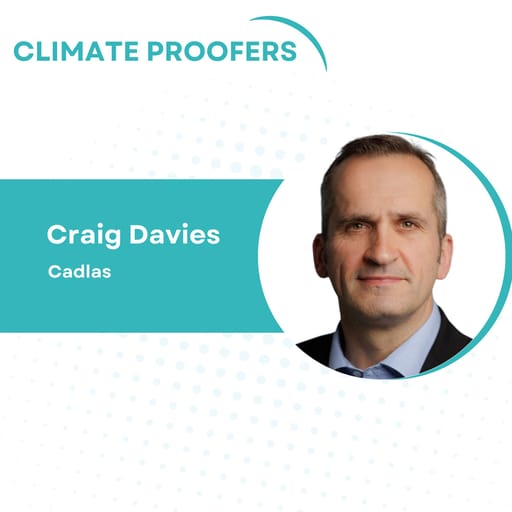
Transcript 0:00 [upbeat music] Hi, everyone, and welcome to Climate Proofers, the show all about those on the front lines of climate adaptation and resilience, finance, tech, and policy. 0:13 I'm Louis Woodall, editor of the Climate Proof newsletter, which you can read at climateproof.news. 0:19 Today, I'm joined by Craig Davis, the CEO of Cadlas, a technical advisory with a mission to help shift capital towards building a climate resilient future. 0:29 Craig discusses the financial regulatory landscape and how adaptation and resilience concerns fit in, or don't, as the case may be. 0:37 Before we get started, just a note that Climate Proofers and the Climate Proof newsletter are subscriber supported productions. 0:43 Listeners like you can help keep the lights on and support even more great content by heading to climateproof.news/upgrade. You'll get two newsletters a week, access to exclusive data dashboards, and special reports. 0:57 Thank you for the support. Okay, in a minute, my interview with Craig. But first, let's round up some of last week's adaptation and resilience stories. [swoosh] "Better late than never?" 1:07 Last week, the Organisation for Economic Cooperation and Development revealed that in twenty twenty-two, rich countries finally surpassed the goal of providing a hundred billion dollars in climate finance a year to developing nations. 1:20 Rich countries were supposed to hit that goal in twenty twenty under an agreement struck at the UN Climate Change Conference in Copenhagen way back in two thousand and nine. 1:29 However, they fell short of the a hundred billion dollars in both twenty twenty and twenty twenty-one. 1:34 In twenty twenty-two, though, the OECD says rich countries supplied almost a hundred and sixteen billion in climate finance. 1:42 Behind the year-on-year surge was an increase in finance provided by public, private, and multilateral sources. 1:47 Notably, year-on-year climate finance attributable to private sources surged fifty-two percent, though this was from a low base. How much of the a hundred and sixteen billion went towards adaptation? Not enough. 2:00 The OECD says adaptation finance amounted to thirty-two billion, growing only eight billion year on year. 2:07 Furthermore, only a fraction of adaptation finance, some three point one billion, came from private sources, and much of this was attributable to just a handful of projects. 2:17 The latest figures from the OECD serve as the backdrop for discussions on the new collective quantified goal on climate finance, which is primed to be a hot topic at COP twenty-nine in Azerbaijan later this year. 2:29 [swoosh] In policy, all eyes are on Bonn, Germany this week for SB sixty, the UN Climate Change Conference that traditionally prepares the ground for the annual COP summits. 2:39 There's lots for the more than six thousand delegates to sink their teeth into. 2:43 One big piece of work is figuring out what the new collective quantified goal on climate finance should look like, who should contribute to it, and the respective role of private and public sector entities in delivering the agreed on amount. 2:56 But there's also plenty to do in the adaptation space. 2:59 At Bonn, delegates have a chance to flesh out the UAE Framework for Global Climate Resilience, which is a blueprint for enhancing adaptive capacity, strengthening resilience, and reducing vulnerability to climate change at the country level. 3:13 Part of this framework is about setting adaptation targets and establishing systems for monitoring countries' progress toward them. 3:20 However, the framework, although adopted at COP twenty-eight last year, lacks details, specifically when it comes to what resources should be made available to implement it. 3:29 Efforts will also be made at Bonn to spur greater take-up of national adaptation plans by countries and to find ways to improve them. At present, only fifty-seven developing countries have these plans in place. 3:41 The Bonn conference runs until June thirteenth. 3:43 [swoosh] And in tech, this week I'm spotlighting a cool pavement pilot that took place in a Los Angeles neighborhood, which revealed that special reflective paint can lead to significant reductions in surface and ambient air temperatures. 3:56 The findings suggest cool pavements could make a meaningful contribution to city-level efforts to combat extreme heat. 4:03 The LA project was run by GAF, a roofing and waterproofing manufacturer, in partnership with a group of local nonprofits and community groups. 4:12 Special reflective paint developed by GAF was applied to near sixty thousand square meters of pavement in the Pacoima neighborhood. 4:20 The paint reflects more solar radiation back into the atmosphere, meaning less heat is retained by the pavement. 4:26 A network of sensors and weather stations relayed information on the effectiveness of the paint over a twelve-month period. Now, the findings suggest the cooling effect was substantial. 4:36 They showed ambient air temperatures were up to one point nine Celsius lower during a September twenty twenty-two heatwave, and that on hot summer days, air temperatures came in one point four to two point eight degrees lower, depending on the measurement system used, and surface temperatures nine point two to twelve point two degrees lower. 4:54 Next on the agenda, a test of GAF's cool roofing technology in the Pacoima neighborhood. [swoosh] Right, that's it for this week's roundup. Now on to our interview. 5:04 [upbeat music] We're joined today by Craig Davis from Cadlas. Craig, where are you calling from today, and what do you do? Hello, Louis. I'm calling from Cardiff in the UK today. So I'm the CEO of Cadlas. 5:16 Um, we're a consulting firm. We focus on climate resilience financing. Um, I'm pleased to be able to speak to you today. Glad to have you here. 5:24 So we wanna talk a little bit about adaptation and resilience finance in the regulatory space. 5:30 We've seen a lot of action from standard setters, financial institutions, and public bodies like the UN on adaptation and resilience, A&R, financing. 5:38 But we haven't seen much from financial regulators, and I wanna know why you think this is. 5:43 Well, I think that's right, and it's quite striking to see the difference in the level of activity, for example, uh, with respect to the number of voluntary frameworks and guidance products that have been, um, issued over the past, uh, few months even. 5:56 Now, I think that's a good thing, and that's a good sign. It's a good sign that there's much more market awareness of the subject of adaptation and resilienceUm, and much more interest in doing something about it. 6:08 And I think we should take that as being a positive. It is striking though, um, that we don't see so much movement on the regulatory side, particularly in relation to adaptation and resilience as an investment theme. 6:20 We do see some regulatory action in other areas. 6:22 In fact, there's quite a good track record, for example, on the mainstreaming of physical climate risk into, uh, financial supervision, into, um, financial risk disclosure. 6:32 And we've seen over the past sort of, uh, half a decade or so, um, quite a range of initiatives like the TCFD and now the International Sustainability Standards Board, the ISSB, and a number of financial supervisors really doing great work to integrate physical climate risk disclosure, um, into that broader picture of, uh, climate-related financial disclosures, for example, in financial supervision. 6:55 Um, but that's on the risk side. We don't see so much in terms of the framing of adaptation and resilience as an investment theme, as a reason to invest. What are the reasons for that? 7:05 It could be, for example, a chicken and egg question that is the market ready yet? 7:10 Is adaptation and resilience a mature enough theme yet to merit being treated in this way, to merit being defined as an adaptation, as an investment theme? 7:19 Um, I think though it is possibly time to start having that conversation. We always hear regulators and supervisors saying that they aim to be forward-looking, um, that they aim to be ahead of the market. 7:30 This could be a case where that needs to come into play and to start having that conversation about what would an adaptation and resilience investment theme look like? How would it be defined? 7:40 We know, for example, from talking to many market players, that there is a sense in many quarters that this isn't a theme that's well-defined or understood well enough. 7:49 Investors find it to be quite wide-ranging, quite nebulous. Um, what are the boundaries around it? What is adaptation? What isn't adaptation? How do we define it? 7:58 So it is definitely time to start thinking about having this conversation and start thinking about what might need to happen to give those clearer definitions that are widely understood across the market as to what adaptation and resilience investment is. 8:12 Thanks for that. I'm thinking about this in the sequencing, uh, uh, that financial regulators have to undertake, right? So I feel like focusing on risk is, is important, right? 8:21 They need to ensure the safety and soundness of financial institutions, so it makes sense that they're looking at physical risk. 8:26 And you kind of need to have a good conception of physical risk before you start building on adaptation and, and resilience requirements. And I'm also wondering, though, is it dangerous... 8:37 not dangerous, but is it potentially problematic if financial regulators start to put in requirements about how businesses should go about incorporating adaptation resilience? 8:47 Because that's almost like telling them how to do business strategy, and we know that regulators try and shy away from stuff that seems to be influencing how businesses actually behave. 8:55 What's your, what's your thoughts there? Well, let's start with the risk point of view. I mean, I think, as I say, it's really... 9:01 it's been an important development to see the mainstreaming of physical climate risk into financial disclosure and supervision and all the things I mentioned a little earlier. 9:08 Um, there is, however, maybe something to be aware of here of an unintended consequence that by having the focus so heavily on risk, um, we're providing investors and markets with information on reasons not to invest because of physical climate change impacts. 9:24 We're not providing any re- any information or signals on, on reasons to invest. 9:29 And one of the potential issues there in terms of unintended consequences is this, um, issue of what some call capital flight, that by flagging very heavily, um, the vulnerabilities and risks that certain geographies, certain sectors have, that may have an unintended consequence of, you know, driving investment, driving capital away from where it's most needed in terms of, uh, building resilience. 9:53 So for example, um, raising the cost of capital for climate vulnerable sovereigns, for example. Now, that is something that, you know, needs to be considered. Uh, we can see opposing things going on there. 10:03 There is a natural need for financial supervisors to focus on financial stability and, and to focus on having transparent understanding of where the risk lies in the financial system. 10:13 Um, but if the, uh, flip side of that is the, um, threat, if you like, that this may have unintended consequences in terms of severely disadvantaging certain geographies, certain economies, and even certain sectors of the economy. 10:27 Um, so there is a reason to think beyond the risk side. I don't necessarily think that we are or that we should be giving directions to investors in where to invest. 10:38 I think what we are talking about is providing definitions of what is a- an adaptation and resilience investment and what isn't. 10:46 I think it's a sense of providing that fuller set of market information, and what we see in terms of the sorts of information flows, um, related to physical climate and adaptation and resilience in the financial system is that they're very limited. 10:58 Uh, there's very little information out there, um, and what information there is tends to be that risk-based information. We're not thinking about... We're not talking here about telling investors what to do. 11:08 We're talking about providing a broader framework for giving them the kind of information they need to make well-informed decisions. 11:14 Can I ask what you'd like to see specifically from financial regulators in terms of adaptation resilience space? 11:20 This might be in terms of how they could augment existing requirements or standards or, or totally new standards. I mean, there are, there are several different schools of thought on this. 11:29 There's one school of thought which is more a kind of laissez-faire school of thought, which is, "Look, you know, this is an incipient market. This is early days. 11:37 Please don't start burdening us with, you know, uh, burdensome regulations, and please don't start boxing us in. 11:43 Please don't start reducing, uh, and limiting the, the, the market of investable activities and assets that we can call adaptation. Please let us work this out for ourselves." 11:53 There's that kind of school of thought which is arguing quite strongly against having regulation, against having definitions. 11:59 And then there's another school of thought which is, "Well, actually, you know, we do need to have some kind of common understanding of what we're all talking about here. 12:06 We do need to have some kind of, uh, common references, common definitions for what adaptation and resilience finance is." 12:12 And it's quite interesting when you talk with different people, and I-I can think of conversations I've been having over the past month.Where you hear these very different, you know, points of view. 12:21 Um, I think it's quite interesting to sort of break that down a bit in terms of different parts of the market, different types of investors, different types of financial institutions. 12:30 For example, when it comes to things like private equity and venture capital, there's a desire to have that kind of freedom, you know, to assess freely, uh, to not be bound in by definitions. 12:40 And this is really important for innovation because, you know, when it comes to adaptation and resilience, we need innovation. 12:46 We need to be able to finance things that haven't been thought of before and to not be boxed in by definitions and to not be boxed in by sort of limitations on what may be considered to be adaptation and resilience. 12:58 But we also need to scale, as the other sort of side of the market is the sort of debt market, fixed income, institutional investors, um, which is, you know, in a sense is, is, is a much sort of bigger volume of capital than, than, than the equity side. 13:11 And on that side, we hear a different set of issues being raised. It's more about, well, we haven't got time to do deep bespoke analysis of individual investors like maybe an equity investor does. 13:22 You know, we, we, we need to have some sort of pre-digested, pre-prepared information that enables us to make, you know, more, um, more lighter touch decisions or more rapid decisions on what we want in our portfolio and wh- what we want to invest in. 13:36 So I think we hear these different voices from different segments of the market. So to bring this back to your question, I don't think there's a need to rush. I don't think there's a... We're not asking for regulation. 13:44 I don't think there's a need to ask for regulation, uh, immediately. But I think there does need to be a conversation because I think there is a gap. There is a real gap on adaptation and resilience. 13:54 It hasn't really been brought to the fore. There has been some work done going beyond the risk side, for example, sustainable finance taxonomies. The EU taxonomy, for example, does include an adaptation taxonomy. 14:06 Um, it's been there for s- some time now, since, uh, since about twenty nineteen, twenty twenty. Um, it- its use though is more limited, if you like, to the kind of do no significant harm, a kind of safeguard function. 14:17 So the role it's playing is essentially ensuring that mitigation investments, for example, do no significant harm to adaptation objectives. 14:26 It's not been promoted very heavily as being something that can be used to define sustainable finance products principally on the benefit of their contribution towards adaptation. We've not seen so much of that at all. 14:38 Reasons for that, I think we've still got this kind of unfortunate sort of thinking around a zero-sum game between mitigation and adaptation. 14:46 You know, that if we're financing adaptation, then somehow that's mitigation's loss. 14:50 This is really unfortunate, and this is a, a conversation that needs to be addressed, and it also needs to be addressed in the kind of regulatory space. 14:58 In the EU sustainable finance framework, for example, there's a very heavy tilt towards mitigation. 15:04 Adaptation is way back in the background in this and not brought to the fore, and I think we need to have this conversation around balancing these things out. It's not a zero-sum game. 15:14 You know, it's not a question that if we invest in adaptation, if we commit capital to adaptation, that we're somehow, uh, going against the drive towards decarbonization. We've got to put that false dichotomy to bed. 15:27 But at, at the same time, we're already seeing some sort of, um, some work being done by, uh, in the regulatory space that, um, is helping to advance things. 15:37 So for example, we've got the UK's green taxonomy, which of course has been delayed, but I think we're, um, very much looking forward to seeing how that tackles adaptation. 15:46 Um, also in the UK, we've recently seen the Transition Pathway Task Force issue specific guidance on, um, adaptation within transition plans, and of course, there is a discussion about whether the TPT eventually becomes mandatory in the UK. 15:59 So we, we do see some sort of entry points in terms of how this can be done. 16:03 But I think, again, on the i- investment side, we don't see so much happening, and that's a question that I think it would be interesting to look into. 16:11 So there's a big discussion at the moment as you, as you know, well on, on, um, investment labels and ESG labels. 16:17 The UK is developing its sustainability disclosure regulation, the SDR, with its, uh, with its various set of, um, investment labels, and there's a big discussion in the EU at the moment about revising the SFDR and whether that will result in a labeling regime or not. 16:33 Do we ever hear of adaptation and resilience in the discussion around investment labels and investment themes? And no, we don't. Is it time to start having a conversation about that? Possibly. 16:44 I mean, we do now see a number of commercial financial institutions of various types, equity investors, commercial banks, and others, um, developing adaptation and resilience flavored funds. So again, what do we do? 17:01 Do we take the laissez-faire approach and say, "Let a thousand flowers bloom. Let anybody call anything adaptation and resilience"? Or do we say, "Hang on a minute, you know, this... Something's beginning to emerge here. 17:12 We're beginning to see some kind of traction in the market. We're beginning to see much greater awareness." 17:17 Is it so crazy to start talking about having a conversation about how you define adaptation and resilience as an investment theme? 17:25 And if we're beginning to see a specific kind of products and funds being given the, the name adaptation and resilience, i- is it time to start thinking about what this, what these words mean in the context of investments? 17:38 Absolutely. 17:38 I think you hit the nail on the head there about, well, if the market is going in this direction, regulators generally seem to have to follow the market, but they don't want to be lagging so much that they allow, uh, all sorts of potential fraudulent, uh, uh, products to come to market. 17:53 And one thing you said earlier that kind of grabbed my attention is there, there needs to be space for there to be innovation in, in a- adaptation and resilience financing. 18:01 I mean, the dark side of innovation can be greenwashing, right? And having spoken to a few market participants, there is a bit of concern that, okay, yes, we say we have an adapt- adaptation fund. 18:10 We invest in coastal resilience, for example. 18:13 But then in a few years' time, if it turns out that these investments actually don't provide the pro- the protection we thought they would, uh, then do we get blamed because we had an adaptation fund that actually didn't do what it said on the tin? 18:24 And it's very hard to kind of sayUh, before the event, whether this protection, this adaptation measure will actually be effective, right? 18:31 And so I can understand the reticence, uh, for some investors to actually go full steam ahead with, uh, uh, ANR financing products. 18:38 But I can see regulators kind of being interested in that greenwashing issue because they've shown interest in that greenwashing issue already in the mitigation space. 18:45 So I wonder if that will be a focus, uh, and when you talk about fund labeling regimes, I can definitely see this being something that, um, regulators to, to get to grips with. Yeah. 18:54 I have a problem with that word green. Um, I think it's a very imprecise term that's bandied around in, in, in quite different ways. I mean, often when people say green, they mean low carbon. 19:05 But then why don't we use more precise terminology? I can think of various cases of, um, misunderstandings over adaptation and resilience in relation to the term green. 19:19 Now, when you've had, uh, for example, green finance investments or in some cases green bonds, for example, that have included adaptation and resilience investments 19:29 included on the basis that they're deemed as being investments that are contributing towards adaptation and resilience goals, but then some observers objecting to them being given that green title because, well, they're not mitigation investments, and to be a green investment, you have to be a mitigation investment. 19:45 I think we've got a sort of imprecision in the language that we're using. It's probably too late to change this now because this language is so embedded into the way the market works. 19:52 But if we could turn back time, it might be helpful to have really much more precise labels, you know, around what we're talking about, not this kind of catchall green, which sometimes is about mitigation only. 20:03 Sometimes it's about broader environmental considerations, including nature, for example. 20:07 Um, but it can cause quite a bit of confusion by trying to sort of shoehorn adaptation and resilience into these existing labels that I think not everybody has the same understanding of. 20:17 No, absolutely, and I think that's the incentives behind all this, this fund labeling effort, right? 20:22 Uh, but I also think when you talk about trying to scale finance, you do need sort of simple, uh, labels, right, to make people think, "Okay, yeah, this is, uh, a product I can allocate to because that checks the box for me in terms of my, yeah, climate friendly investment," right? 20:37 There's these labels act as heuristics to translate all the complexity of adaptation, resilience, mitigation into something that can be quickly grasped and invested in. 20:46 So I understand why the language is there, but I, I agree that it applied to the ANR context, it may be somewhat misleading. 20:54 Um, I want to talk about that a little bit more actually, about the mitigation lessons we can get from the efforts by regulators to address decarbonization. 21:01 Because I don't know about you, but where I'm sitting is looking at what's going on in the adaptation resilience space is kind of redolent of what was going on in the early TCFD days, right? 21:11 So I'm wondering if that sort of model is something that should be replicated here. Should we... 21:15 Is it right that we start with industry standards that's, like, broad, uh, coalescing around a certain group of standards, and then the regulators take those standards and embed them in something like the ISSB or in, uh, FCA regulations in the UK or in CSRD in, in EU? 21:30 Do you see, like, how we've done mitigation regulation being replicable for the adaptation resilience space, or can we take some shortcuts? Well, I mean, there are definitely parallels. 21:38 I mean, if you think of that sort of TCFD process that, that you described, and I think, you know, it's a good parallel because, um, if you go back to those days, pre-TCFD days, there were a lot of kind of competing and overlapping frameworks around particularly kind of, you know, carbon related disclosures. 21:56 And what the TCFD did is it, number one, is it sort of convened and curated and s- and steered together these kind of different voluntary frameworks into a more streamlined, um, still voluntary framework, but a more streamlined and coherent framework that had kind of high level sort of regulatory backing. 22:15 I mean, you had the, um, FSB behind it, for example, uh, the Financial Stability Board of the G20. Um, so it had kind of vi- very kind of high level ownership, if you like. But if you remember the TCFD, it was voluntary. 22:27 Yeah. So there was kind of a gentle process there of saying, "Well, okay, everybody, let's start. Let's not have all these overlapping voluntary frameworks. 22:34 Let's try and sort of bring them together into a more overarching voluntary framework." 22:39 And there was, for a few years, this quite, you know, sort of, um, quite a loud debate about, um, voluntary versus mandatory, and the mandatory argument basically won, you know. 22:48 And TCFD recommendations started to be and are continued to be, you know, increasingly, um, made mandatory in, in countries around the world or rolled into the ISSB, which countries are now beginning to adopt, for example. 23:00 Um, so there's a, there's a parallel process that it, it could be interesting to look at there. Um, but I think there are other sorts of, um, processes too. 23:12 I mean, TCFD was, as, as we all know, was, was very much about, um, climate related financial risks and, and opportunities. But I think there's other work elsewhere on taxonomy development that we could look at. 23:24 Um, we now see a number of, uh, cli- adaptation and resilience taxonomies being developed at the moment. 23:31 That itself is a really interesting, um, uh, phenomenon that we now have multiple, um, adaptation and resilience taxonomies being developed. 23:41 They're being developed maybe for different purposes, different use cases, uh, and not-- there's not necessarily a problem in having these multiple taxonomies as long as we clearly understood how they're interoperable and how their different applications and use cases, um, relate to each other. 23:56 Um, so I think the TCFD is one example, but I think there are also other examples that we can look at. 24:01 I mean, if you look at nature, for example, how the meteoric rise of nature, uh, over the last number of years, I mean, I think that's also something that's worth looking at. 24:10 Um, I can remember, you know, not that long ago, the idea that we could somehow create a TCFD for nature seemed like a far-fetched idea. 24:18 And very, very quickly that changed, and it became very, very mainstream, very, very fast. So I think nature is an example that we can sort of relearn the TCFD process. 24:28 We can learn the lessons from it and accelerate action.Yeah, I agree, and I think the TNFD is a good example of taking the lessons of a previous framework and accelerating them. 24:37 I do feel like the focus is again on disclosure and data gathering, and there's a lot of conversations about, okay, we need data, we need data, we need data before we actually do anything. 24:46 And I understand from a regulatory perspective, like the realm of disclosure is where they can be most active and most effective. 24:52 And that kind of makes you wonder, though, in the adaptation resilience space, and we're talking about, you know, safeguarding people, livelihoods, uh, regions from climate risks. 25:00 Regulators may be one tool, but actually this is something that, uh, you kind of need lawmakers to get more involved, uh, and regulators can kind of do stuff around the edges. 25:08 And I wonder what you think about that because I, I sometimes think we try and make the financial regulators do too much when actually lawmakers should be taking the brunt. 25:16 Well, I think I agree with your last point there. 25:17 I mean, I, I think there has been, you know, a bit of an overdependency that somehow we think that financial regulators and central banks can have superpowers and can do just about anything, um, that, that, that, that we decide is a, is a priority for society. 25:33 So I think, you know, it, it, it's a valid point. 25:36 Um, and also, you know, where are the boundaries of central banks', uh, remits and responsibilities and duties and, you know, I mean, some people would argue that and do argue that even climate is, you know, questionable in terms of being in a central bank's remit. 25:51 Now, I think that com-- that's been put to bed now, but there was a time when this was a question that was being asked. So it's a fair point. 25:58 Um, I think you're right about this is not something that could be borne upon the shoulders of financial, um, supervisors and regulators alone. 26:06 Um, and I think you're absolutely right too that there is such an important role for policymakers and other types of regulators, not financial regulators. So for example, think about, um, buildings. 26:18 Yeah, think about buildings regulations. I mean, we see in some countries, the Netherlands is a really interesting case, really interesting work on embedding climate resilience into building regulations, for example. 26:29 Obviously, the Netherlands, flooding is the main consideration. 26:32 Um, so-- and there's absolutely a role there for, um, other types of, you know, non-financial regulators, uh, to play a role in ensuring that the right standards, the right requirements, the right assessment processes are in place for all kinds of economic activities. 26:48 I think there's potentially a, a really interesting sort of interface, if you like, though, between the financial system and, and th-these other forms of non-financial, uh, regulation. 26:59 So, you know, and again, I'm going to cite the Netherlands as being an interesting example of this because there's, there's a lot of really interesting collaborative work between the Dutch financial sector and, you know, Dutch government and, and, and at, at national and sub-national levels on working together on common definitions to ensure that, for example, built-- resilience building standards and certifications are recognized by the financial industry, uh, when it comes to financing them, when it comes to insuring them, for example. 27:28 So I think there is a lot of cross conversations that need to be had. 27:32 I like that point about it's all well and good having a, a label or, or certification for, for a building or an asset, but it has to be recognized within certain regulation or recognized by the financial industry to be actually operationalized, right? 27:44 And I think about in the EU, banks have to report their residential mortgages by energy certificate, right? So that's how they're trying to bring transition, climate transition risk considerations into banks financing. 27:57 And you can see the same sort of approach working when it comes to like, yes, resilience certifications or adaptation, uh, certifications. 28:04 So I think that's an interesting point that, yes, you have standards over here, you have financial regulators over there, and actually they need to be aligned so that you can actually drive the change you want to see to climate proof the economy. 28:15 Okay. Final question then. So you, you mentioned this a little bit e-earlier on, but what, what green shoots do you see that financial regulators are starting to take, uh, adaptation resilience into account? 28:25 And one example I can think of is that the, the UK's, uh, Climate Financial Risk Forum, combination of banks and insurers and regulators headed up by the, uh, FCA and PRA. 28:37 I know that they have a working group that looks at adaptation. I'm sure we're gonna see some content from them soon. So that seems to be one area where there's, there's work on the way. 28:45 I was wondering, uh, what other green shoots you see either in the EU, UK, over here in the US. 28:51 So I think there are a number of areas where we see things happening which, uh, give hope, um, which are really interesting in themselves. Uh, one I think is again, taxonomy development for adaptation and resilience. 29:02 So there are a number of, you know, interesting pieces of work going on. Of course, we had the EU taxonomy, and we've talked about that. That was really important. 29:09 And I think it gave a very important signal in terms of embedding adaptation in principle into the sustainable finance architecture of the EU. 29:18 However, it didn't go very far in terms of adaptation, and as you said, it tends-- it tended to place adaptation as being a safeguard measure as opposed to being a sort of, you know, fundamental, uh, means of defining sustainable finance. 29:31 Um, really interesting to see what the UK green taxonomy, uh, how it handles adaptation. Of course, it's under development at the moment. 29:38 It's been delayed, but I think that is potentially an opportunity to build on what the EU taxonomy has done on adaptation and maybe, you know, in the light of the past few years experience and evolving thinking on adaptation and resilience to take things further forwards. 29:53 Um, we also see other taxonomies. I've mentioned that there are a number at the moment. 29:57 We at Catalyst are really pleased to be working on the Climate Bonds Resili-Resilience Taxonomy, which is a taxonomy for adaptation and resilience being developed specifically for, um, the sustainable bonds market. 30:07 Um, that, that's a very, I think, significant exercise in terms of coming up with, um, an influential taxonomy for adaptation and resilience, um, that can be used by a very wide range of investors, not necessarily only in the context of, of bonds. 30:22 And we see other work as well by various organizations developing taxonomies for other purposes, like for example, tracking adaptation finance, including private adaptation finance flows, which at present are, are very poorly understood. 30:34 So I think on the, the, the taxonomy work, and this was all kind of, uh-Pointing towards the direction of coming up with these clearer market definitions of what constitutes an adaptation and resilience investment and how can they be defined and how can they be characterized. 30:50 But I think there are other, um, angles that I think remain to be explored. 30:53 I think, uh, the role or discussion whether there should be a role for adaptation and, uh, resilience in, for example, um, investment labels and ESG labels is something that I think is wide open for discussion at the moment. 31:08 Excellent. Very comprehensive breakdown there, Craig. Appreciate it. 31:11 My last question I ask, uh, all my interviewees is what, what are you personally gonna be working on or planning to, to work on in the next twelve months then? 31:18 What's sort of, uh, in your inbox that you wanna get done this year? Wow. 31:24 Well, we're very fortunate to be working with a really interesting range of financial sector partners and clients over the coming, uh, over the coming [clears throat] months. 31:33 And so over the next year, we, um, are very pleased to be continuing our work with climate bonds on their climate resilience bonds taxonomy, um, that is intended to be launched in its first version, um, towards the second half of this year. 31:47 And we're very much looking forward to seeing, um, how that is taken up by the market, and we're very much, um, uh, looking forward to seeing it being used by investors and issuers a-alike, and to playing a role in, in leveraging some of the, you know, I think it's now four trillion dollar sustainable bonds market a-and orientating some of that investment more in the direction of adaptation and resilience. 32:09 Um, we're working in the field of, uh, investor engagement and stewardship in relation to climate resilience with a number of clients. 32:19 So for example, what can investors do with, uh, investee holdings that are climate vulnerable, exposed to physical climate risks? Now, of course, what can they do beyond divestment? 32:31 I mean, that, that, that's the knee-jerk reaction that, you know... 32:34 I mean, i-if you're investing in a climate vulnerable, uh, in-investee, then that might be the knee-jerk reaction is, "Well, I want to reduce my exposure. I want to get out." 32:43 Um, if there are alternative ways, there are ways of saying, "Well, actually, we as a responsible investor want to engage with this investee. We want to work with this company. 32:51 We want to help them to manage their physical climate risks better. We want them to in-- We want to help them to integrate resilience into their, into their corporate practices and into their business model." 32:59 So that's another area that we'll be looking at. 33:01 And we're doing an awful lot of work on metrics for climate resilience in various ways with a range of different types of financial institutions, and again, working with them to go beyond the risk disclosure and risk assessment. 33:14 It-it's an enormously important starting point, but to build on that by looking at a wider range of information flows, including, you know, um, positive impact on adaptation and resilience that may be needed to inform, um, you know, um, the better quality and quantity of the financing being allocated for adaptation and resilience. 33:34 And you've been working on that metrics side of things with the UN Environmental Program Finances Initiative, right? Yes. Yes. 33:42 There's an interesting report out that I urge all listeners to go, to go read actually about ANI impact metrics, which, uh, Craig, you, you contributed to. 33:49 I found it very interesting, and hopefully, we'll be covering it in more detail in, in the weeks to come. 33:54 Yeah, just to clarify, it was, um, issued by the Adaptation and Resilience Investors Collaborative, which is known as ARIC for short, with U-UNEP FI serving as their secretariat. Thank you. 34:04 Lots of acronyms in adaptation resilience world, as there are in climate education [chuckles] world, so thanks for clearing that up. Okay, Craig, well, thank you so much for your time. 34:12 You obviously have a lot on your in tray, and I appreciate you taking a moment out of your day to, to talk to me and talk to the Climate Proof listeners. Thanks, Louis. All the best. 34:21 [upbeat music] Climate Proofers is a Climate Proof Media production. It is produced and presented by me, Louis Woodall. Subscribe to the Climate Proof newsletter by going to climateproof.news/subscribe. 34:33 And to learn more about the publication, feel free to reach out directly using our LinkedIn page. Tune in next week for another episode. Goodbye. [upbeat music]