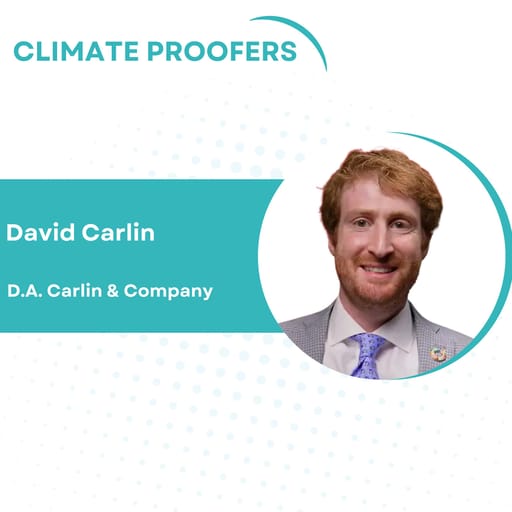
Transcript 0:00 [upbeat music] Hi everyone, and welcome to Climate Proofers, the show all about those on the front lines of climate adaptation and resilience. 0:13 I'm Louis Woodall, editor of the Climate Proof newsletter, which you can read at climateproof.news. On today's episode, I'm joined by the one and only David Carlin. 0:23 David is the founder of DA Carlin & Company, a global sustainability consultancy. He's also the former head of risk at UNEP FI. That's the UN Environment Program Finance Initiative. 0:35 Everyone who's anyone in climate world knows David. 0:37 He was in the trenches at UNEP FI when the first wave of climate risk management and disclosure initiatives broke across the financial sector, developing guidance, hosting convenings, and building tools to help banks and institutional investors get to grips with the challenge of the low carbon transition and worsening extreme weather events. 0:55 Today, in his new role, he is a whirlwind of energy, working to educate and inform sustainability professionals around the world about the latest goings-on in financial regulation and climate related financial policy. 1:06 We talk about the past, present, and future of climate related financial disclosures and whether they've done enough to spur corporate engagement in adaptation and physical risk management. 1:15 Then we get into the changing regulatory landscape with the inauguration of Donald Trump as US president and the countervailing efforts underway in parts of Asia Pacific to promote sustainability reporting. 1:26 David then offers insights from his position as an advisor for a host of climate intelligence startups on what makes for an effective and useful climate risk company. 1:34 Before we get to the conversation, a reminder that Climate Proofers and the Climate Proof newsletter are subscriber supported productions. 1:41 You can support my coverage and help the publication to grow by heading over to climateproof.news/upgrade and becoming premium subscribers. 1:48 If you're feeling really generous, please consider choosing a super proofer membership, which comes with additional goodies like free gift subscriptions, access to monthly roundtables on adaptation technology, and more. 1:59 All right. In a moment, my conversation with David. But first, let's round up some of last week's adaptation and resilience stories. 2:05 [whooshing sound] In finance, the Trump administration has torn up $4 billion in US pledges to the Green Climate Fund, or GCF. 2:12 This is the largest UN-backed financing pool for climate adaptation and clean energy projects. 2:17 Reporting by Politico reveals that Secretary of State Marco Rubio wrote to UN Secretary General António Guterres on January the 27th, rescinding all outstanding pledges to the fund. 2:27 Under President Biden, the US committed $3 billion to the GCF, matching an earlier pledge made under President Obama. 2:34 The US has delivered $2 billion of the promised amounts to date, making $4 billion outstanding, money that the GCF will now have to go without. 2:43 The fund was set up in 2010 and has approved $16 billion in projects to date. By design, the fund has to commit 50% of its financing to adaptation projects. 2:52 [whooshing sound] In policy, New York State is being sued by 22 other states over its Climate Superfund Act, which would force fossil fuel companies to pay into a pool for financing adaptation and resilience projects. 3:03 The states, led by West Virginia, allege the Superfund Act exceeds New York's authority by forcing payments from energy companies no matter where they are based. 3:12 The lawsuit further claims that New York is usurping the federal government's role in regulating emissions. Though in reality, the Climate Fund Act does not place constraints on companies' climate pollution. 3:21 Instead, it charges oil and gas majors based on their historic emissions. The New York act was signed into law by Governor Kathy Hochul in December. 3:29 Starting in 2028, it would raise up to $3 billion a year to finance infrastructure and projects that enhance the climate resilience of the Empire State. 3:37 [whooshing sound] And in tech, Canada is investing $72 million in new microsatellites to upgrade the country's wildfire tracking capabilities. 3:45 The Canadian government tapped Spire Global Canada to construct seven devices that will make up the so-called WildFireSat constellation. 3:52 The company will work with Aurora Tech, a space-based thermal intelligence startup, to develop the wildfire detection payloads that will be attached to the satellites. 4:00 The constellation is slated to launch in 2029 and will be operated by the Canadian Space Agency for a minimum of five years. [whooshing sound] Right, that's all for this week's roundup. 4:09 Now on to my conversation with David. [upbeat music] Hi, David. Where are you calling from today, and what do you do? Hey, Louis. I'm calling in from London, and I am the founder of DA Carlin & Company. 4:23 We're an advisor to governments as well as financial institutions and corporations, helping them navigate the challenges of tomorrow, especially when it comes to sustainability and climate change. And before that, 4:35 I founded UNEP FI's Risk Center and headed up programs on environmental risk for the financial sector. And for those that don't know, the UNEP FI is United Nations Environment Program Finance Initiative. 4:47 Uh, you had a long and storied time working for them, David, and actually that's how I first came to know you when I was first writing about climate risk disclosures and climate related financial risk for banks. 4:58 You've been in this space for a long time, and it's great to see you with DA Carlin & Company spread your wings and, and go beyond just UNEP FI and, and helping governments and businesses around the world. 5:10 Uh, so thrilled to have you here today. 5:12 And I wanna ask, first of all, based on your years of experience working on climate risk in the banking industry and financial sector, how do you think these efforts have advanced adaptation and resilience specifically? 5:25 And do you think UNEP FI and other climate alliances, the Net-Zero Banking Alliance, the, uh, In- Institutional Investors Group Climate Change Initiative, how do you think they've done, and have they done enough to promote adaptation and resilience across the financial industry? 5:40 Yeah. It's such an important question, and I think it's an important one because we've spent a lot of time focusing on net zero and decarbonization. 5:50 And at the same time, there's still a real gap on the adaptation side that needs to be met, and organizations like the UN as well as-The Global Center on Adaptation and others are beginning to put some of the pieces together in terms of the data, in terms of methodologies, the World Bank as well. 6:10 And I think that is really good, and yet it doesn't really get into the same spotlight, say, as a net zero alliance, certainly not in recent weeks as we've seen departures, as we've seen turmoil. 6:22 A lot of this adaptation work is very here and now. Everyone knows about commitments to twenty fifty, but adaptation commitments really needed to be done yesterday. 6:30 We just need to look over to the fires in California to see how devastating these natural, or what I sometimes call unnatural disasters, can really be. 6:41 So there have been initiatives by UNEP FI and other government, and quasi-government organizations to get banks to think about physical risk management, uh, how to quantify it, how to prepare for it. 6:54 I'm just wondering, when you had engagements with banks and nonprofits, et cetera, what do you think they, they still need to understand or, or get a grip on when it comes to, to physical risk? 7:05 Is it the data side, or is it just understanding how climate change can have these effects in the short term, whereas before they might have thought they were only gonna be impacted in the lo- in the long term? 7:17 I, I think you, you've captured two sides of this really well, where I see a, a need for improvement in, in knowledge and, and in skills and, and in practices. 7:27 I, I think the first of those is simply about the understanding of the nature of these risks in the sense that this is really a data challenge, it's an informational challenge, and it's also a, a systems-level approach. 7:42 You have, in many cases, government policies that create perverse incentives that lead people to purchase and, and acquire assets in areas of higher risk. You have volatility as those policies change. 7:54 You have this insurance system that underpins so much of what we do that is kind of, I sometimes joke, like the plumbing. You don't notice it until it's not working. 8:03 And I think there's that part which is just the conceptualization of what this is, and I think people have been perhaps scared off with this idea of, "I'm not a climate scientist." 8:14 Well, in the same way you might not be a architect or you may not be an engineer if you're going to be doing commercial real estate or residential real estate finance, but you still need to understand certain principles and certain ideas, and I think this fits squarely into that. 8:32 The second part, though, is just the nature of these disruptions, I think are a lot bigger, a lot more interlinked to other parts of the, the business life cycle. 8:44 So people will often say, "Oh, this is what the damages were. This is how many billion-dollar events we had." 8:49 But what they don't really talk about are what the secondary effects are, the business disruption, the changes in the availability and costs of insurance, and the fact that these things are happening right now. 9:01 And so we spend a lot of time kind of stargazing on these scenarios. And while that's important for the future of our species, for the planet, at the end of the day, a category five hurricane could hit Miami next year. 9:14 A massive flood could disrupt and cause huge migration in Bangladesh in a few months' time. Unprecedented fires as the ones we're seeing could happen in Australia or in other places. 9:27 And so the idea is that because physical risk is so spiky, what we're doing is not only are we loading the dice, but there's so much noise in that system that the bad stuff could already come. 9:38 And when you put this into a model, what you see is, okay, in the future we have to be ready. 9:43 But that actually really masks the noise of the present, which means if you're not prepared for the hit now, it's gonna be really hard to recover when something like what we're seeing in Los Angeles happens, like what we're seeing with some of the floods in China last year, that if you're not thinking at the extremes, I think you're really missing the exercise on physical risk. 10:06 I think the language around adaptation, similar to evolution, right? It evokes to me like a slow transformation, a ch- a process by which we slowly become hardened to climate risks. 10:16 But as you said, they're so proximate some of these risks, they're so devastating, and our timelines, our projections are so shot already [chuckles] because we're already seeing these kind of tail impacts from climate risks that we do need to think less about, okay, this long-term planning, but more about what can we do in the immediate term, uh, and what risks might propagate throughout the financial system and real economy if we don't take immediate measures, right? 10:38 So maybe we need a new terminology. 10:41 But I was wondering in the context of your, the work with, with the banking sector, like the UNEP FI Risk Center, that was one of your last, like, flagship projects with UNEP, and I wanted to know what the purpose of that was and what the sort of feedback to that initiative has been, and whether it has helped to, from your understanding, pick up interest in adaptation resilience planning. 11:03 Yeah. So the work of the Risk Center, we, we launched it last year at Davos, and the vision really was to be more of a, a systems thinking 11:14 view when, when it comes to these challenges, rather than a siloed one on climate impacts, on transition, on nature. 11:22 But really to say we need to start putting these pieces together, because otherwise what we're gonna find is, to our great success, we have all made climate disclosures, and to our great detriment, we've lost all of nature. 11:35 Or similarly, we've all signed up to commitments, and nobody has done any preparation on the adaptation side. 11:41 And so realizing that we can't get away from a systemic approach when change occurs, I think that has been really at the heart of it. 11:50 And a lot of this work began with pilots bringing together work on the task force on climate-related financial disclosures with the work of the task force on nature-related financial disclosures, so taking climate and nature together.Considering both the similarities on a governance and strategy side, as well as the key differences. 12:08 And I think the work to date has really been a, a particularly rich vein of resources, not only for institutions that are working directly within the organization and, and the risk center, but that are going beyond it as well. 12:23 So many are seeing the outputs as beneficial. And in some of the work that I've recently been doing with my firm, one of the things that I think has been really valuable is getting those examples of process, of practice. 12:36 A lot of times, like, the key is not waiting till all the data is in, but saying, "With the picture that we have now, it's very much a question of what do we do?" 12:47 And we can continue gathering information, but ultimately, if the car is speeding toward the cliff, what we really need to be thinking about is both how to slam on the brakes and how to turn that wheel to get us back to some safe ground. 12:59 And I think that a lot of these things are showing, you know, this is the operating manual. This is as you're speeding this way, here are the things to begin thinking. 13:07 And in the work I do, the difference now I think is it's a little bit more in the weeds and a little bit more tailored, whereas I think some of the work from the UN is more at a principles level. 13:17 And I think that is good, but does really need to be drilled down and really need to be taken apart to make it relevant. 13:23 So it's, it's great to say these are the types of risks or these are the second order effects one can face, but if those are not gonna be relevant in the place you're discussing, if those aren't going to be able to get through on a policy basis or on a practical basis, then it's essentially just a paper by any other means. 13:42 It doesn't actually bring the change. It doesn't have that guidance effect. So I think there's a lot there, but it, it... it's now to carry that torch forward. Yeah. 13:51 Sometimes I forget how a lot of this is new to financial institutions, to large companies who are used to moving slowly. 13:57 There's thousands of stakeholders involved in any changes you make to, to risk management or investment policy. 14:03 And the need to have case studies, yes, a framework of principles to operate within is important, and I feel a little bit dispirited sometimes when I hear folks saying the focus on sustainability disclosures, the focus on information gathering is all nonsense, it's all not dri- it's not driving progress. 14:20 But people forget, I think, that you need that, as you said, operating system first, and then, yes, you can tailor solutions within those that meet your specific context. 14:30 I want to dig into this because, as you said, you've been working on climate disclosure, regulations and frameworks, and kind of promotion of these frameworks and these reporting rules. 14:40 I'm wondering, like, to what extent do you think these have driven companies and financial institutions to think about adapting to physical risks and exploring adaptation opportunities? 14:47 So I suppose are companies operationalizing what they do in their TCFD reports, in their CDB reports? Are you starting to see that? Because that was the, the theory of change, right? 14:57 As soon as companies had to start reporting and gathering data, they would actually take action based on that data. 15:02 So is that something you're seeing or do we need some more pressures to force companies to really take into account their climate risks and prepare defenses accordingly? Yeah. 15:11 I, I, I really think that there's a theory of change behind that which is not fully borne out by the evidence that we see. 15:18 Information is very much a, a necessary part of good decision-making, but it's not inherently sufficient. 15:26 I might have all the information in the world about the dangers of smoking, but that may not actually influence my decision. And, and similarly, I think with institutions, when their incentives are such, 15:37 information is good, but I think it also can be a crutch of, well, we don't have all the information. I'll tell you, finance is always about imperfect information. 15:46 We wouldn't have risk managers, we wouldn't have any of the need for reserves and even these questions of financial stability if we knew with certainty which policies would pay out, which assets would increase in value, which loans would default. 16:00 And so uncertainty is the inherent state of, of financial markets. What, what I would say though about that theory of change is information needs to be put to use, and I think we're seeing that in certain cases. 16:13 I think you're seeing some savvy investors beginning to realize that there's some information in here that could be of use. You are seeing more policy-based approaches. 16:23 I'm not sure if I would argue they're driven by disclosure or if they're driven by the events around us, so, oh, we're gonna ask some slightly different questions about what the flood risk is, or we're gonna not just go on the outdated flood maps, but we're gonna maybe work with a company to think about this. 16:39 Those are the parts that really excite me. 16:41 I, I would say that when it really comes to these disclosures, we can say we need mandatory disclosures, and we probably do just for the simple reason that the quality of disclosures overall still isn't necessarily decision grade, especially where it needs to be, and that's doubly true for small and medium sized enterprises. 17:00 So how do you do that in a way that is, is cost effective and, and reasonable? But secondly, how do you actually do this in a way that people will pick up and, and use it? 17:09 And I think that suggests another solution, which is not just the regulatory solution, but the market-based solution. 17:15 If you can begin to show that you get better outcomes with better information, people will begin to use that information. And I think that this is the key question that I often ask. 17:26 I'll sometimes call this the analyst test of, if an analyst is looking at a company and they have this report on their desk, one, do they read it? 17:33 But two, if they've read it, does it have any potential to confirm or disconfirm their decision? Otherwise, it's just simply an extraneous piece of information. It's I'm trying to invest in airline stocks. 17:45 It might be really important to know the efficiency of the engines. It might not be so important to know the color of the planes. 17:50 And, and so I think here it's a question of, is a decision useful, but also are market actors benefiting from using it? 17:58 And regulators can push that, but I think it's really a really big push if you wanna do this predominantly off the back of regulation. 18:06 You're gonna really need to start-Playing with incentives, playing with capital, then there's a lot of potential unintended effects. 18:12 So I think we, we also need market actors not just to step up in terms of what they're disclosing, but actually in the application of this, seeing themselves in that two-way sense of we are filers, but we're also users of the information. 18:26 Yes, it's an important distinction, and I realized over time that just because you mandate a reporting on climate risks, you can't mandate that c- certain users take it credibly or action that information unless they can see a clear link between that data that is reported and their own job as analysts, as allocators of capital, right? 18:46 And I think sometimes there's been a credibility deficit, partly because we know a lot of companies find it difficult to quantify or project forward physical risk impacts and traditional risk impacts. 18:57 So sometimes there are no numbers, or sometimes the numbers are so broad as to be unusable, right? And so yes, perhaps an analyst and investment manager disregards them. 19:06 And I think that's why there's gonna be such a focus on quantification and more granular intelligence in order to fine-tune the, the loss estimates and the business interruption impacts of certain risks. 19:16 But I do wonder also whether, yes, the sheer scale and horror of events like the Los Angeles wildfires, like Hurricane Helene, like Storm Boris in Europe, whether that actually helps fix that credibility gap on its own. 19:27 [chuckles] Like regulators have been trying to force people to, to take climate disclosures as seriously as traditional financial disclosures via statute, and it's been difficult, but maybe, yes, reality and market forces are gonna bring the sort of parity of esteem to climate disclosures that we've been looking for. 19:41 And do, do you see that linkage? 19:43 Do you find that clients of yours or contacts of yours are like, "Oh yeah, we didn't really think about these numbers much, but then we saw how terrible Hurricane Helene was, or how terrible the floods in Germany were, and now we're really taking it seriously." 19:54 Is there some linkage between real world events and taking this data more seriously? 19:58 I think that there certainly is in terms of individuals, but it happens in very different ways, and what may be screamingly obvious to one doesn't necessarily register for another. So each of these 20:10 is lighting up the mind of someone somewhere, but it is that view that climate change isn't real until it's happening to you, and that's not particularly a good way to be prepared to be resilient. 20:23 But there is, I think, that reality. 20:26 I, I would say on, on the other side of the discussions around adaptation and the benefits of it, I think that there's a bit of this understanding now that what we're seeing is really near term, and because it's near term, we need to be choosing different paths. 20:46 And the challenge here is I think those that are making that argument most loudly are sustainability folks still, and the people that are the decision makers are not necessarily... 20:56 And this has been, I think, a fundamental problem of sustainable finance for years, but it's that you have sustainable finance analysts and you have financial analysts. 21:04 And the truth is that often those who are looking from a sustainability angle are trying to make a judgment on whether that company is sustainable. 21:12 Maybe they're not giving it an ESG score, but they're saying, "Are they living up to their commitments? Are they doing the things that they said?" And then trying to tie that back on the financial side. 21:23 But if you're not gonna do that with the buy-in of the actual decision makers in the firm, it's gonna be the same problem that vendors have of we have great data on the losses that these stocks are going to make in a two-degree world or in a transitioning world or however, but if you're not gonna buy that, if that's not going to actually get into the operating system of the organization, it's just gonna sit on a page somewhere in a regulatory report. 21:49 And I think what we need to really start to see is no longer sustainability as something that people analyze in and of itself, but as a factor. And I think you're beginning to see this. 22:00 I was talking to a friend who just took over as the head of sustainability at a big private equity firm, and he was saying the team is much smaller than it was, but on the other hand, coming into this role, I'm getting pinged by people all across the business because this is kind of the way cybersecurity was some years ago, or the way other major impacts are that we need to consider, but we also need the spec knowledge. 22:26 We need the skills to do it, and those skills aren't to write the report, those skills aren't to chair the initiative. They're to say, "Okay, on this deal, what's this angle look like? 22:37 I wanna make sure I'm looking at this from all angles." And even for myself, I've had a number of clients reach out from a, "We have this company in our portfolio. We're trying to get a sense of this." 22:47 A couple of years ago it was much more, "We have these companies in our portfolio, we'd really like to get them..." And, and this was in conversations that I was having. 22:55 "We'd really like to get those companies up to speed on their reporting obligations." 23:00 Now it's more, "What can you tell us about how this company is positioned vis-a-vis the transition, vis-a-vis climate change and the effects of physical climate risk?" 23:09 And I think that is a promising sign, but it, it's gonna take a lot more work to continue bridging that gap between sustainability and financial decision making. 23:18 Yes, when it comes to preserving company value or investment value, I can definitely see why you want to do more deeper analysis of how climate related risks can impact assets, disrupt supply chains, impact productivity. 23:31 And I've actually heard an- anecdotally from companies I, I, uh, occasionally work with or communicate with that private markets, private equity firms like you said, they're actually getting more into this maybe than public investors because I suppose they have less scrutiny from outside markets, but also because they're holding positions, they're thinking of allocating large amounts of capital for five to seven, 10 years, right? 23:53 And they're increasingly aware of how these climate shocks are coming on short timelines. They want to know, okay, look at this company, tell me if it's positioned to protect itself against some of these disruptions. 24:02 And if it's not, maybe I'll find a competitor or a peer who might be better, better positioned because it is now driving-... differentiation, I think, amongst investors, at least in the private markets. 24:12 That I think is the absolute right word, differentiation. 24:15 And, and the nice thing about it is it cuts across both those that are looking to find value in a particular sub-sector or industry, but also from a financial services standpoint. 24:27 If you're really thinking about clients in a changing world, where are you going to be strongest on experience? You're probably gonna offer similar rates. 24:36 Your cost of capital if you're a, a big high street bank or a Wall Street bank gonna probably be similar. So a lot of this on the relational side is going to boil down to who can steer the ship best. 24:46 And it's telling when I speak to folks that have a big stewardship role as asset owners and, and occasionally those in banks talking about their major clients, when I ask, "What's the best thing you're doing in terms of supporting the transition?" 24:59 They almost always will talk about the guidance, the resources, the knowledge that they're aiming to transmit to their clients. And on the one hand, that feels like cold comfort. 25:10 Well, we need to be doing a lot more to grow transition finance, but it also really speaks to that fundamental truth that for these organizations, it's not just about picking the winners, it's about being the green bank, not because that sounds good or some people might throw money, but because that expertise is gonna be needed as your real estate developer being required to retrofit buildings in New York. 25:34 You're a auto manufacturer looking to shift into a higher risk area of EVs that you don't have expertise in. Who's gonna manage that better for you? Who's gonna understand those things? 25:44 So to me that, I think that differentiation piece is really promising, both in terms of the selection of potential opportunities and deals, but also in terms of those things coming to you as potential clients. 25:58 And the way you're speaking there, it sounds like the impetus is coming, as you said, from the market, from desire to preserve value, rather than from regulatory pressure or reporting mandates. 26:09 And I wanna just finish this conversation about disclosures by asking your thoughts on the current landscape of sustainability reporting rules, right? 26:18 In Europe, we have a potential reopening of sustainability rules and regulations under this omnibus proposal that would see the corporate sustainability reporting directive, EU taxonomy, 26:29 and corporate sustainability due diligence directive potentially opened up and amended to be simpler. 26:35 In the US, we're likely going to see the scrapping of the Securities and Exchange Commission's climate risk disclosure rule. 26:41 But then in other jurisdictions, Australia, Canada, you have them moving forward with reporter requirements based on international standards. 26:48 So I'm wondering, do you see on the regulatory front, at least the regulatory disclosure front, do you see a bifurcation, again, differentiation happening? 26:56 Do you think it'll become more geographically divided in the future? There's definitely a increasing fragmentation, which is every business' least favorite term probably other than overreach. 27:07 Fragmentation is, I think, the, the thing that is, is hated the most by business. And, and I've always said that business doesn't hate regulation. 27:14 Business hates capricious and unclear regulations because when things are clear, they level the playing field. They take away any disincentives to action, and I think those... that can be a really good thing. 27:28 One of the challenges I think that has been seen in the EU and in other jurisdictions that have really adopted the kind of full suite of sustainability reporting is that it's not entirely clear for institutions how they are to do it well, nor is it entirely clear to them how the regulators will be evaluating these. 27:46 What does good look like in terms of what are you aiming at? 27:50 And I think we're sort of all in this soup of uncertainty on the regulatory side, and I think that goes up to the nth degree when you begin talking about the non-climate elements. 28:01 Not just nature, but thinking about resource efficiency. How are you going to report on these things? 28:06 And I think for many institutions, they're saying, "We just feel that this is so overburdening that by the time we get this stuff together, the problem will have already moved along." 28:16 And in some ways it's hard to not have some degree of sympathy for that. 28:20 On the other hand, I think the positive is that regulation tends to proceed based on the kind of minimum constraint, meaning that even if there's limited regulation in certain places, if somebody has to do more somewhere else, they often will. 28:37 Uh, the story in the US that frequently gets told is about the school textbooks and the Texas Board of Education, and the fact that because Texas buys lots of textbooks, what goes into those textbooks is going to be contingent on what Texas says, not 'cause it's a majority. 28:53 I think you see a similar effect with the rules in California, which in many ways have gone as far, if not further, than much of what the SEC rule was aiming to do. 29:03 I don't think US companies, especially multinationals, will really see a major diminution in their overall reporting obligations. What I think they will see is a bit more confusion. 29:15 Some companies looking at a bit of regulatory arbitrage, but I think overall this sets us back not as much in, "Oh, we don't have to do it," but more in how do we put these pieces together, the kind of correspondence between what is the US company and its EU subsidiary doing? 29:32 How do those pieces form a con- coherent whole? 29:35 Because if you really wanna understand how in trouble a firm is due to climate risk, you need to look at the whole firm, and if those things are gonna be opaque, if they're gonna become less comparable, I think that's the place where it makes the work itself less valuable because it leaves us flying blind on a number of these things. 29:51 My TLDR of this is that I think in some cases, the new administration in the US will be less of a change because of things like California, because of the multinational nature of many big US companies. 30:04 But the lack of leadership, the uncertainty, the potential pullbacks in Europe, I think all of this may lead to a sort of unfinished landscape where you have-People with obligations, but un- lack of clarity about the requirements, lack of clarity about the penalties, lack of clarity about what good looks like, and different jurisdictions where certain things can wait. 30:25 And so you'll begin to struggle with that notion that maybe these pieces don't all sum up because we're doing it under different ways, we're doing it at different times, and I think that will, will certainly weaken the value of, of a lot of this. 30:39 My concern is the kind of weaponization of the regulatory state or the anti-regulatory state, right, and the use of litigation to prevent companies that are headquartered in one jurisdiction but have operations in another jurisdiction having to comply to that other jurisdiction's rules, right? 30:54 There's some indications that might be happening on the tech sector or that's the expectation of the tech sector in the US that Meta and Amazon, uh, and others, they have to comply with tougher EU data privacy rules and, and rules than they have to in the US, and there's some suggestion they want to motivate the US state to fight against those rules. 31:13 And I, I'd wonder if similar moves will be made by US agencies against EU rules on sustainability disclosure, EU rules on, on cli- on climate risk management. 31:23 And I can't see how it would work without reciprocation by the EU or some real transformations in how corporates are structured, multinational corporates are structured. 31:31 But I can see the claims of, "Oh, we can't yet let the EU extra territorially regulate our company, so we're just gonna sign a few laws that prevent that from happening." 31:42 And then you've been this, like, regulatory battle between two large jurisdictions. 31:46 So that's my personal concern, but this is all speculative because we do not know what's coming down the pike, but that's just one theme I'm, I'm keeping my eye on. 31:55 I, I think that there's, there's very justifiable concerns there, that there's a potential for not only a, a political drive here, but also a, a fragmentation in the global order that goes well beyond sustainability disclosures, but really goes into a way of doing business, a worldview. 32:16 A lot of this idea can leave Europe a bit adrift between, say, China, the rest of the developing world, the United States. 32:26 And, and so as a result, some of these rules don't necessarily look as feasible or implementable if you don't have that push from other places. 32:37 At the same time, I, I would be of, of the mind that even if the Democrats had won the US election, I think that many of the European laws would've or ought to have come in for a rethink in terms of can we be more efficient? 32:52 Can we consolidate? The issues that were laid out in the Draghi report about European growth and productivity are still real. That came out in September, and I don't think the conclusions are any less true. 33:04 The difference is, I think now in the US you have someone who may actually really want to twist the knife in. 33:09 So I'm a little less worried about the finger-wagging on initiatives and a bit more worried about these kind of fundamental differences in worldview and, and what limit that holds on actual coherent action because it becomes much harder to tell people, "Well, we're gonna be a high regulation jurisdiction," and somebody is not only going to look at that, but see that as a opportunity for them to potentially take business. 33:37 And so in that more dog-eat-dog world, I think you actually see competition. 33:42 And in a more coherent world, and, and we saw this at the beginning of the Biden administration with international taxation, part of the goal was to say, "It's in no one's interest to have people living in tax havens. 33:54 It's no one's interest to have these things be pushed to the, the lowest common denominator and the, the shadiest enclaves." In th- this case, we have again, it's in no one's interest to have incomplete information. 34:07 It's in no one's interest to have this kind of conflict. But if somebody says, "Hey, I can get better by going to the US," or, "They will shield me," I, I think we really don't know. 34:18 It's, it's, it's a little too early to say what some of these consequences will, will actually be. Yes. 34:24 There are great forces moving, and it's entirely impossible [chuckles] to predict, I think, exactly what the ramifications will be for sustainability rules and reg- regulatory, uh, differentiation. 34:35 But I think it's interesting to speak about. It's gonna be a big theme for all of us going forward. But I wanna move on from disclosures. We could talk about that forever. 34:44 I wanna ask about some of the climate-related financial risk companies that you're aware of or involved in. 34:50 I, I understand you're engaged by a number of them as a board advisor or somewhat or other, uh, for companies like ClimateX, OmniView, Climate Aligned. 34:59 What factors drew you to these startups, and what do you think makes for a, a successful or a promising company in the climate risk management intelligence space? 35:08 I, I've been really fortunate to have both met and connected with a number of, of really great founders over the, the past few years, and continue to do so both as an advisor as well as an angel investor with- within an angel network. 35:24 And to me, what's really exciting is there's so much change happening in this space and there's so many pieces that are key to amplifying it, whether it is the use of artificial intelligence, whether it's the application of things like earth observation, whether it's the development of new methodologies around both risk assessment but also opportunity assessment. 35:48 And I think what we get to is the point that nobody can know all of these things. 35:53 And so what I see is a lot of these companies are, are doing really novel work in taking emerging developments on the technology side and trying to put them to use to give people the tools to make better decisions, whether it be the work that is going on, say, with Climate Aligned thinking about a green issuance and trying to evaluate that and how it fits into a portfolio, ClimateX and the work they're doing-On the risk as well as resilience side from a, a data perspective, OmniView at the SME level of thinking what is the comprehensive set of information that is, is needed both from the SME and by the SME. 36:34 And I think many of the other firms that I work with aim to have an interesting angle, whether that angle is on, as I said, Earth observation, AI, blockchain in certain cases. 36:46 And I think what makes a company a success though is good technology coupled with a, a big problem is great. It's a great starting point. It's a great story at a, a pre-seed stage. 36:58 It really does boil down to execution, and I think that execution comes in the form not just of sales, not just of product development, but really in making it clear in a, in a very genuine and, and impactful way how what you're doing is going to benefit organizations. 37:16 I think what, what we've seen in the last few months with elections and otherwise have shown it is far easier to change people's incentives or to use those incentives than it is to try to change their nature. 37:27 And I think unlike many of the big consensus organizations that I've been part of, much of the work of these startups is not to say, "We're trying to change your mind," but it is saying, "We're trying to change your decisions," but it's doing it through, "Here's actually better value," or, "Here's higher risk that you might not have seen." 37:45 And so it gets to that key question that, that I like to ask of, what would you do differently with this information? And so I think at the heart of these is actionable information. 37:56 I have something that's information but it might not be useful, versus I have something that, oh, thank goodness I saw that road was closed, that way I could avoid getting stuck there and went around. 38:07 That's useful information. Simply knowing how many trees are alongside the road, not super useful. 38:13 And so I think these companies, what makes them effective and what makes any companies in this space, and it's a big space and one where I think there's a lot of synergies, really gets down to that point of 38:25 knowing not only your product, but really how does it drive value and, and how does that value work within the framework of an organization. 38:35 It's very rare that someone is gonna drop everything and switch all of their financial analyst reports to an AI-generated one. It just... It isn't how people think. It isn't how they work. 38:45 When we were talking before the, the start of this podcast, we were talking a little bit about kind of the roles of things like AI, and the point is that people do need to be brought along for the journey, and very often they have the expertise that is needed. 38:59 But I think if we're not operating on that principle, then it's not gonna be as effective. 39:03 So the companies I've seen that do this well really do operate on that principle of bringing people along to make better decisions. Yes, it is the difference between data, knowledge, and wisdom, right? 39:14 And I suppose people want information that helps them make wise decisions, smart decisions, preferably decisions that save money or make money, and I feel there has been this sort of shakeout in the climate risk data space on that front. 39:28 And I wonder if actually the, the drive, the importance of adaptation resilience as we see more climate risk disasters makes it easier for some of these data intelligence companies that can, as you say, show you how vulnerable maybe your supply chains are to a sudden storm in a certain location or to a wildfire like we've seen in California. 39:45 It feels like those companies that have a more adaptation rather than transition focus may have an easier time selling to companies going forward. And I don't know if you've got any thoughts on that, but I also... 39:54 I've always found transition risk to be a harder sell because it is so dependent on policy and unknown unknowns, et cetera. 40:01 Whereas physical risk, we're talking about a physical system here, which is predictable, uh, that is a bit easier to, to sell it to folks. 40:08 I, I think it definitely is, and I think in some cases these disasters do make the case for organizations to really take a harder look at this, to spend more of the time and resources. But I... 40:21 Not to be too pessimistic, but I, I sometimes think that explanation's a little bit simplistic and, and perhaps too rosy in the sense that many of these organizations are really big. 40:32 They have a inherent inertia within them, and that inertia is not just to not move, but to, as the true sense of that term means, to really stay on the same path, whether in motion somewhere or not. 40:46 And so even if this is useful at an individual level, working it through takes a lot more time. It would be nice if we could simply say, "You work with that one," or, "You, this is your problem." 40:58 And yet even solutions that are the best solutions, maybe because of the scale of these organizations, don't always shake themselves out in terms of implementation. 41:08 And this is probably a wider conversation that gets into things like creative destruction, gets into things like the notion of a, a dynamic and evolving space that it becomes harder to do when you're an incumbent. 41:21 It becomes harder to do once you're a established entity. 41:24 And I think that is one of the challenges, that even as amazing solutions, even as new information is coming up, getting it through the organization really is as big of the challenge as coming up with the new insight. 41:36 I wanted to finish by asking, uh, a little bit about DA Carlin & Company, uh, what your plans are for this year, what clients are asking from you this year. And then also, I... 41:46 Like me, you're somewhat of a media entrepreneur, and it'd be great to hear a little bit more about your, your newsletter and your projects on the media front this year, too. 41:54 Thank you so much for the, the opportunity to, to do so, Louis. And so on the, on the client side this year, I think our two really big themes are around capacity building and also around capital mobilization. 42:10 On the capacity building side, it's saying organizations really need to know how to operate in this changed environment, both from a regulatory basis, from a risk basis, and even from an operating model basis. 42:23 And-The work that we really try to do, the focus has been whether it's with the central bank that we'll be working with over the next few weeks, whether it is with a global investor, really empowering the people within the organization to see more clearly and to bring their skills to bear on these various challenges. 42:44 I think that's the really exciting part of what we're trying to do and what we're eager to help our clients do. 42:50 And so really we're trying to be very innovative in the types of training, the types of activities, the organizations, and then the follow-ups to say we're really bringing organizations along. 43:00 We're not gonna just write reports anymore. We're not gonna just do talks, but really bring people along on this journey because I think they are the tip of the spear in changing the organization. 43:11 And so the other big piece on capital mobilization is beginning to, and this is more with some of my academic hats on at, at Cambridge and at King's College, thinking about how the different parts of climate finance really need to fit together, the public side, the private side, how these pieces get mobilized, what the different parties want and need from each other, and then actually doing a bit of this deal assembly. 43:37 We've been brought in by a few different project developers on green projects, some on adaptation, some on the mitigation side, to really help them to raise capital, help them to add value to the projects that they're working on. 43:53 And on the investor side, to give them a bit of a roadmap. You're a family office looking to get into green investments. What is the best things to look at? Where should you go in eyes open? 44:05 So to me, that's a really exciting piece because of that tangibility of actually seeing the money move and getting from theory into practice. 44:12 And then on the, on the point, uh, on the media side, I know you and I are fairly common presences on the various social media platforms, of course across LinkedIn. 44:22 As you mentioned, I started a newsletter, and the focus of that really has been to give people a bit of a digest on what is happening in the sustainable finance world, and w- and we do that every week. 44:32 We also do specific breakdowns of reports, some videos explaining terms in a brief and very accessible way. 44:40 And then on the podcast side, we're still looking ahead to our launch, but I've been really fortunate to be joined by my colleague from the UN, my former colleague, Simon Messenger. 44:50 He and I are working on a podcast called The Big Questions. 44:53 We've been speaking with a number of thought leaders in the sustainability space writ large, as well as exploring topics such as population, exploring things like carbon credits, and really trying to give people, especially those who are maybe less day-to-day in this space, an understanding. 45:13 And even for those who are in this space, we're gonna touch on a lot of topics and really both debate back and forth and really explore where things are heading. 45:21 So it, it really is very future-oriented as the, the name may suggest. So providing some context to these sustainability questions. 45:28 Not, not just zooming in, but zooming out to provide the insights into how policy, demographics, everything can feed into this debate. 45:37 I think that's very useful and needed because I think sometimes we get a bit too siloed and forget about how the things we're trying to achieve in the sustainable finance world and climate risk and regulation world, how they actually matter for the broader society and economy. 45:51 I think that's absolutely right, and I think fitting these things into context, the world is more complex than it's ever been. 45:57 These changes are happening faster, and I think if we can help people to be a bit more prepared, help people to be a bit more ready, I think they will become more resilient and, and become more able to adapt and adjust. 46:09 So that's very much motivating and, and, and driving me here, too. I'm looking forward to listening to it. 46:15 I hope you have a great time producing it, and look, I'm around if you need a, a guest speaker [laughs] to talk about adaptation resilience. Maybe we can collaborate again down the line. 46:26 And for those who are interested in David's Sustainability Digest, you can catch him at davidcarlin.substack.com. I'll also put it in the show notes so people can find it that way. Do check it out. I'm subscribed. 46:36 I find it very useful. I feel like I've got quite a good grasp of what's going on in the world, but there's always at least one piece in your newsletters that I haven't found and I find very useful. 46:45 So really good for those who are in this space to, to sign up to that. Okay. David, thank you so much for your time today. 46:51 Really appreciate you sharing your thoughts, and hopefully we'll be on one of each other's podcasts again soon. 46:57 Really great to, to speak with you and very much looking forward to having you as a guest and, and continuing so many of the good conversations we have around this important topic. 47:07 [upbeat music] Climate Proofers is a Climate Proof Media production. It is produced and presented by me, Louis Woodall. Subscribe to the Climate Proof newsletter by going to climateproof.news/subscribe. 47:18 And to learn more about the publication, feel free to reach out directly using our LinkedIn page. Goodbye for now. [upbeat music]