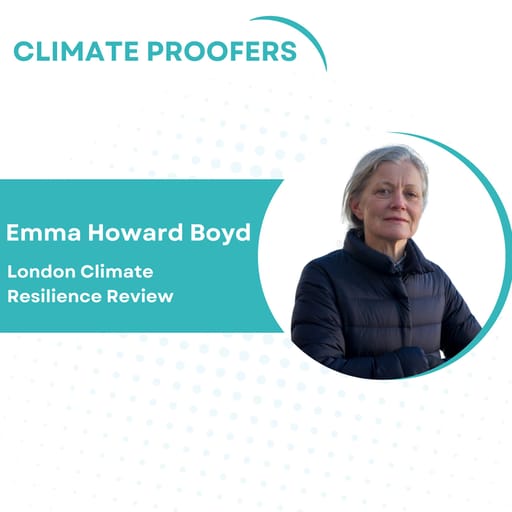
Transcript 0:00 [upbeat music] Hi everyone, and welcome to Climate Proofers, the show all about those on the front lines of climate adaptation and resilience. 0:12 I'm Louis Woodall, editor of the Climate Proof newsletter, which you can read at climateproof.news. 0:18 This week, I'm joined by Emma Howard Boyd, Chair of the London Climate Resilience Review, which was commissioned by Mayor Sadiq Khan and published earlier this year. 0:26 The first of its kind report assesses the UK capital's climate resilience and makes over 50 recommendations on preparing the city for worsening climate shocks. 0:34 Emma also serves as chair of ClientEarth, an environmental charity that takes legal action against those interests that are hurting the climate and nature. 0:42 She has also served on the boards of many other climate and sustainability NGOs, including The Environment Agency and Green Finance Institute. 0:49 Emma discusses what's in the London Climate Resilience Review and why preparing the city for escalating climate risks is, quote, "non-negotiable." 0:57 We go over the triggers for the review, including recent extreme weather events in the capital, and talk about why a heat action plan for London is so important. 1:04 We also discuss how cities and mayors can learn from each other on adaptation and resilience and hone in on the importance of joined-up governance to achieving climate proofing goals. 1:13 Before we get to the conversation, a reminder that Climate Proofers and the Climate Proof newsletter are subscriber supported productions. 1:19 Listeners like you can help support my coverage by heading over to climateproof.news/upgrade and becoming premium subscribers for the low price of $5 a month or $50 a year. 1:29 Okay, in a moment, my chat with Emma, but first, let's round up some of last week's adaptation and resilience stories. 1:34 [whooshing sound] In finance, the Green Climate Fund approved $1 billion in new projects last week, evidencing momentum for climate finance ahead of the COP29 Summit. 1:43 Projects to enhance climate resilience in Angola, Iraq, and Somalia were among 16 approved on October the 25th. This year, the fund has allocated $2.5 billion to 44 new projects. 1:55 The latest slate of investments includes new financing instruments like a debt for climate conversion swap in Barbados. 2:01 Through this mechanism, the Caribbean nation will be able to exchange high interest debt for a lower paying alternative, using the savings to invest in climate resilient infrastructure. 2:10 [whooshing sound] In policy, a legal challenge to the UK government's national adaptation plan was dismissed by a high court judge last Friday, although at least one plaintiff has vowed to fight on. 2:18 Kevin Jordan, Doug Paulley, and Friends of the Earth alleged that the UK's third national adaptation program is unlawful, as it is failing to protect people, property, and infrastructure from escalating climate risks. 2:30 The UK's Independent Climate Change Committee wrote in March that the plan falls far short of what is needed. In a written ruling, High Court Judge Mr. 2:37 Justice Chamberlain rejected the case, claiming there was no error in law. Friends of the Earth said it was considering the judgment and its appeal options. 2:45 [whooshing sound] And in tech, a new climate resilience prize from a top New York City-based climate tech incubator was awarded to InsurTech startup Fora, a company that provides property-level climate risk assessments to help insurers and homeowners reduce their natural disaster risk and identify ways to boost their climate resilience. 3:02 The award comes with a $50,000 check and admission to the ACRE incubator, the longest running climate tech incubator in New York State. Fora beat out four other companies working on climate adaptation solutions. 3:13 They were Aquaria Technologies, Blip Energy, Frontline Gig, and Kind Designs. [whooshing sound] Right, that's it for this week's roundup. Now on to my conversation with Emma. [upbeat music] Hi, Emma. 3:25 Where are you calling from today, and what do you do? Hi, Louis. I am calling you from Bristol in the southwest of the UK, and I have a number of roles. 3:37 The one that we're talking about today is in relation to chairing the London Climate Resilience Review for the Mayor of London, Sadiq Khan. 3:46 And it's a wonderful document that made quite a stir when it was released in July this year. I've gone through it. 3:52 I know a number of other important stakeholders have gone through it, and I wanna talk a little bit about how it was conceived and, and what its purpose is. 3:59 So one of the taglines was that preparing London for worsening climate risks is non-negotiable. So why can't London afford to take a backseat as climate change advances? 4:08 Well, that's a great question, and you're right that one of the phrases that we used when we published the London Climate Resilience Review is that, uh, climate risks are non-negotiable. 4:22 To put this report in its context, in 2021, London experienced surface water flooding, and that led the mayor to organize around the governance structures, those with responsibility for surface water flooding to see what could be done and how to respond in at pace. 4:47 Roll on a year, and we experienced in the UK two days of 40 degrees heat for the first time. 4:57 This was only a handful of months after the Committee on Climate Change published a report which said that we would not expect to see 40-degree heat in the UK for at least a decade to come. 5:16 And then we had these two days, but around it, a whole series of different climate impacts, including prolonged dry weather, uh, so lack of rainfall. 5:30 With the heatwave and increasing heat, we saw pressures on the water system, another impact of climate change, so drought, water scarcity. 5:43 We saw a ring of fire around London in a way that we hadn't seen before, and again, you don't have to go too far in your imagination to see how this combination of prolonged dry weather, water scarcity, fire, extreme heat puts additional pressure on the system. 6:06 And then what often happens to break the weather of the heatwave is extreme rainfall, and with that, surface water flooding. 6:15 The events that we saw put front and center-The real-life experience of climate impacts for London and for Londoners. 6:27 And I think that puts at the heart of this discussion why we need to put as much attention on preparing for climate impacts on adaptation and climate resilience as we do to the reducing emissions, the net zero agenda. 6:47 They have to go hand in hand. That's the adaptation is non-negotiable bit. 6:54 But the other aspect is around understanding the role of nature and nature's recovery as a really important and effective tool for bringing climate resilience and adaptation to cities at the same time as helping reduce emissions. 7:17 Yes. I suppose climate risks were unavoidable if you were in London for the last five years. 7:22 So I suppose that provides political cover or political fuel to actually invest in this assessment of resilience and to harden London against these shocks going forward. 7:32 So I think it's one of those things where the reality of climate change has prompted a greater type of action by policy holders. Would you, would you agree with that? 7:40 I do, but we have to look beyond the impact on individuals from an environmental perspective to the health impacts. 7:52 In the June of last year, we saw a combination of, uh, heat with humidity and a pollen bomb linked to a particular type of tree, so excess pollen in the air. 8:10 And that led to a spike of people admitted to our accident and emergency departments in hospitals in London because of the impact on breathing and those people suffering from asthma. 8:27 So we're seeing these impacts hit from a health perspective. We're also seeing, and there's far greater evidence from around the world, but even in London during our heat wave, we saw impacts on productivity. 8:44 So the economic impacts as our workers suffer from excess heat, as our infrastructure is not fit for purpose for being operated in this, um, degree of... 9:02 as heat and as our systems, uh, come under stress. 9:07 And again, this is why it's not just important for London, but many of the transport services that we have in the UK have London as a hub, so it also impacts other parts of the, the country. 9:24 So we need to make sure that from a policy making, from a governance making perspective, the climate impacts that we're now experiencing are seen from a whole of economy, whole of society impact, and can manifest, um, in m- multiple ways the way that London, Londoners, people living in the UK are now affected. 9:49 So it's not just that these impacts are, are visible in terms of being on front page news, or you've seen the impacts in terms of wildfires outside London or surface water flooding. 9:58 It's also that they are having tangible economic and financial effects, which a city like London, the engine of the UK economy, can't really afford to, to sustain. 10:07 So I wanna get into your recommendations now in the report. 10:11 There were 50 recommendations, and one that stands out, especially given the recent call to action by the UN, is the recommendation that London adopt a heat risk action plan. 10:21 I felt like this was given pride of place, and we know there are m- multiple hazards that London's facing, but can you talk a little bit more about that heat risk action plan and, and why you think it should be given a, a place of importance? 10:32 We put importance on the heat action plan because in all of the evidence, in all of the meetings that we had across different sectors, and we really did in our opening months of the review, put a lot of effort in going and talking with a whole range of different businesses, sectors, communities about what was happening on the, the result... 11:04 on the back of climate change. Extreme heat felt like it was the area where London, Londoners were least well prepared for what we know is beginning to take place. 11:21 And as many individuals working on the extreme he- heat agenda have made very, very clear, it is one of those impacts which is quite silent, can spread quite quickly, can impact health, but also in a way that it is the poorest, the most vulnerable, the elderly, the very young that are most impacted by extreme heat. 11:57 And this felt like an area that, yes, we've only experienced a couple of days over 40 degrees in this country, but everything we're seeing from around the world indicates that we will see more. 12:14 And therefore getting ready to keep London and Londoners thriving through these periods of extreme heat is something that needs to be prioritized. We published the review in two parts. 12:27 We published an interim review in January and the final review after the general election in July earlier this year. 12:37 And I was really pleased that one of the early-Recommendations from our interim review very much inspired by a similar exercise that took place in Paris in October last year was the introduction of Operation Helios, a heat exercise which actually took place in June this year, bringing together, uh, people from across London, businesses, emergency service providers, people working on the health agenda, the arts, the cultural agenda, a whole range of different individuals to play through the steps that need to be-- would need to be taken if London were to experience a week of extreme heat. 13:36 And so I feel confident the mayor has accepted our recommendations that have been made to City Hall and, uh, indeed focusing on heat in particular, and this feels like one area with, um, particularly with the backing of those that are working in the health service sector, where we will see action taken. 14:05 I like how you called heat a, a silent killer because, yes, if there's a flood, uh, you can see where the water's going, you can see where it's affected. Again, it makes for, for very vivid front page news photos, right? 14:16 Whereas heat, yes, a lot of people are suffering from heat in their homes, or they feel up for a walk and then suddenly they get overwhelmed on out-outdoors, but they feel like they can handle it, and they can't. 14:26 So I feel like heat, yes, it is one of those risks that maybe isn't given the salience or there's not the right public awareness of it, and I'm wondering like how governments, local governments can, can increase awareness of this. 14:38 And I know there's been a vogue recently for cities to appoint chief heat officers, for example, and there are a number of like educational campaigns and groups that are trying to refigure the conversation around extreme heat days and educate the public about this not being a chance to lounge out in the sun. 14:53 This is a time to actually be careful, take care of your health, and look after those who are vulnerable. So as part of the heat action plan, what do you think should be done in terms of education? 15:02 Education is a key component of any heat action plan. 15:08 And again, this is where we can learn from other cities, other countries around the world from the simple steps that have been taken to prepare their citizens for extreme heat. 15:26 After all, the, the temperatures that we're talking about that can have massive impacts in London, in the UK, are significantly lower than in other parts of the world. 15:41 But some of those steps which are about educating how best to behave during a heat wave also need to be complemented by some of the longer term decisions that need to be made right now as our country under a new government looks at all of the infra... 16:09 new infrastructure, the new housing, the retrofit fit that is needed in order to fill some of the other policy gaps that our country is aiming for. 16:24 We know that when we're prioritizing energy efficiency and new forms of energy and electricity, we're not always building in a way that builds in that resilience to extreme heat and other, um, ways of getting ready for, um, our changing climate. 16:50 So by 16:52 emphasizing these actions right now for making sure that we are building homes, infrastructure to the right standards of resilience, we will make sure that what is being built today, uh, builds in that resilience as opposed to locks in climate vulnerability. 17:16 So again, this is why we need to be emphasizing climate resilience alongside our plans to, uh, head towards a low carbon net zero future. 17:33 So a heat risk action plan is one of the six key areas where you believe large scale change is needed. 17:40 There's also recommendations on flooding and coordinating stakeholders responding to flooding, uh, accelerating work to understand how different climate risks can interact and cascade.And also recommendations on engaging Londoners on climate risk impact. 17:55 So there's a lot to unpack here, and I'm wondering, now it's up to policymakers to implement these recommendations, right? And as you said, Mayor Sadiq Khan has endorsed this report. 18:05 But I'm wondering, are London's institutions, governing institutions, governance approach properly geared up to deliver on the review? 18:11 And I'm wondering if you have any thoughts on what changes have to happen within city governance to ensure the re- resilience actions are implemented effectively. 18:19 Well, you're asking a really important question here, Louis, and I think this is an aspect of preparing for climate resilience that is often relevant in different cities, different countries around the world. 18:34 Firstly, it's about making sure that we're bringing adaptation into the center of our decision-making, rather than just a subject that sits in a small department in a busy local government or national government structure. 18:57 So I think this is one thing that needs to be changed. 19:03 You, you rightly focus on London's governance, and we have the Greater London Authority and the mayor and his leadership of that, but we also have a setup of over 30 different local governments, local authorities across London. 19:26 And how the central Greater London Authority works with those different councils is absolutely key. 19:36 Another thing that has, uh, recently been announced on the back of the work that was done for our interim review was that the Greater London Authority and London Councils, which brings together all of the different London local authorities and councils into a, a, one collaborative organization, did a joint pitch to the European Union to their Pathways to Resilience program, and were successful in winning that bid for funding and help from that central program to guide London through some of the early thinking about a climate resilience vision. 20:27 And I think in winning this bid, in that strong signal for-- of the GLA and London councils working together, this really does set the framework in a positive way for delivering on the London Climate Resilience Review. 20:46 I think the other thing that has changed with a new central government is the way that our mayors across different combined authorities, including the mayor of London, have been invited into central discussions with government, not just from an environmental and climate change perspective, but meeting with senior ministerial representatives from local government, from Cabinet Office, from the Environment Department, from the Energy Department, and indeed with the Prime Minister. 21:29 And one of the very active discussions of this administration is around devolution of both the powers that are needed to act on some of the climate change agenda and the distribution of, um, money as well. 21:50 So I think this, um, sets the scene in a very positive way. 21:57 If you look at the government's central missions for the economy, for housing, for infrastructure, uh, for, for the National Health Service, uh, there is, um, a real opportunity to bring climate resilience and adaptation into that decision-making and allow that resilience to be built into the investment programs. 22:25 Yes. It's always heartening when policymakers seem to adopt the recommendations or the urgings of stakeholders in the, in the adaptation space. 22:34 Earlier this year, I was keeping track of the EU's adaptation dialogue, and one of the biggest concerns of the attendees who were there, who were policymakers, people who work in climate resilience, was making sure stakeholders at different levels of government were joined up and there was proper communication between these different levels of government. 22:53 And it sounds like, at least in the UK, you have this central government now really bringing in other governments, local governments, city governments to, to 23:00 coordinate, like, a, a whole of, whole of economy, whole, whole scale approach to adaptation, which is heartening to see. 23:08 I'm wondering, though, to what degree are cities like London in an awkward position because they have some tax revenue powers, they have some powers over, uh, their areas of expertise and areas of competence, sorry, but they also are kind of dependent on central governments, dependent on other bodies to, to provide the, the revenues and the services they need. 23:27 So are cities we know are particular targets of climate risks, and they need special attention on resilience. 23:33 But also, do they have the powers they need themselves to actually put into effect the re- the measures to protect themselves from climate shocks? 23:40 I, I think this is where, um, working collaboratively across cities whilst recognizing that the powers and the funding aren't always sitting with the mayor is...Something that still needs a huge amount of work. 24:01 But I think also you can look at the opportunity that exists by taking adaptation and resilience out of its small silo and embedding that across the thinking of the entire combined authority. 24:22 So in London's case, you could look at the small budget that has been secured for adaptation and resilience, or you can look at the overall budget that the mayor does have responsibility for across different organizations, including Transport for London, and understand how best to optimize the way that money is spent whilst taking a view on climate resilience. 25:02 I think one of the other things that a mayor can do is convene all of the relevant parties to making sure that climate resilience is acted upon and delivered. 25:20 And this is something that the mayor has already done around the important subject of surface water flooding. 25:29 And again, by making climate resilience a key priority for the third term of his time as mayor, by embedding it into the thinking around the London Plan, by convening businesses, schools, the health sector, making the most of the work that all of the deputy mayors of London are responsible for in terms of convening. 26:04 You have a really good opportunity of embedding climate resilience across all of these work streams. 26:12 And I think this is where, uh, it is not just relevant for London in terms of how you operate, but how you operate across different cities, different regions, and indeed across central government at, uh, at the same time. 26:29 I used to chair the Environment Agency, and, uh, I came to the end of my term just over two years ago. 26:39 And during that period, the Environment Agency doubled the flood budget for, uh, the second six-year, five-year, six-year period of delivery. 26:53 And whilst that budget was doubled for England to just over five billion, if you look at that money in the context of the overall amount of expenditure on infrastructure, 27:11 and you look at it in a bar chart, it looks like a thin green line of defense. 27:17 And I think this is where we need to go with the climate resilience agenda is way beyond the remit of, um, those that have responsibility for implementing climate resilience to looking at all of those lines of expenditure and where relevant, embedding the steps, the actions that need to take place in order to prepare those, that expenditure, the resulting infrastructure or built environment to what we know is locked in the system. 27:51 And that means reframing the debate so that we understand how important it is to lock in that resilience when you're investing because it will be far cheaper than retrofitting or indeed working through some of the consequences if we end up with a climate disaster as we're seeing in many parts of the world. 28:19 Yes. A whole of government approach, a whole of budget approach to resilience makes perfect sense when you realize how climate impacts can adversely affect all types of society and, and economic life, right? 28:31 Health, uh, transport, etc. Uh, so that makes sense to me. 28:35 One thing that's interesting, though, is that in a government, it's always useful to have champions at the national level, at the regional level to push through specific agendas. 28:44 And I was speaking with Catherine Brown from the Wildlife Trust the other week, and she said it was noticeable back in two thousand and seven, the prime minister at the time very much drove forward flood defense after devastating floods. 28:56 So this is all a way to me saying I think it's right that we have a whole of government approach. But is it also right to have, like, champions at the national and, and local level who really drive resilience? 29:04 I mean, in the UK, we have Emma Hardy, who's the Floods Minister and also Adaptation Minister. So I suppose we have a national figure in the UK. 29:11 But I'm wondering also at the city levels, like this vogue for chief resilience officers, chief heat officers. Do you see that as a, as a worthwhile development and something that can help drive the resilience agenda? 29:20 Absolutely. 29:21 Having somebody who wakes up every day to focus on this is vital and, um, making sure that they have the, uh, tools, they are equipped with the ability to work across many, many different departments, whether it's at that local government level or indeed at that national level. 29:41 But like Catherine Brown, like many others who have been focusing on the climate adaptation agenda here in the UK, there is a growing call for, uh, that responsibility to sit centrallyIn government, and indeed this was referred to in the, uh, current government's manifesto, the need for that centralization of a focus on things like climate resilience. 30:16 One of the recommendations in my review is to give that responsibility to a minister in the cabinet office so that they have the ability to bring together those departments that are leading on some of the missions, whether it's around infrastructure build, whether it's around house building, to make sure that we're not just looking at this through the lens of flood, which is a core part of Defra's remit, the Department of Environment here in the UK, but you're bringing together the different climate impacts because we're now seeing these cycles of weather, and some of our flooding is caused by heat and is the natural end to a heat cycle. 31:15 So we need to be looking at, uh, how we prepare, not just against one climate hazard, but that cycle of hazards that we're now experiencing on a far more regular, um, basis. 31:31 You don't have to go far into other economies to see the massive impact on the economy from the experience of some of these large-scale events. 31:44 We've seen heat waves, flooding, fires across Europe this, um, year. 31:53 Last year in the US, there were 28 billion dollar climate events totaling in ex-excess of 90 billion dollars. 32:06 It'll be interesting to see what the consequences of this year's heat waves, fires, and, uh, hurricanes across the States. 32:18 But the economic impacts of what we are now experiencing mean that, uh, again, embedding climate resilience into the way we are thinking about the long-term decisions that we need to make will be a, a far more affordable way of dealing with climate risks. 32:42 Thank you for that. I think it's the political scientist in me. I did a degree in political science. 32:46 I'm very interested in, like, how power is distributed in societies and how, yes, actually how you drive forward policy changes. 32:54 And sometimes it is you need these national champions or these local champions, uh, and sometimes you need to educate ministers or people of authority at all levels of government. 33:03 And I think in resilience world, we kind of need both. And we need so many different ways of describing it as well. 33:09 And I love the work of some of the environmental groups that are talking about climate resilience in a way that is very, very relevant to your local citizen, talking about the way it is impacting our school rooms. 33:28 Uh, a report that came out in summer about extreme heat and how even at lower temperatures in our classrooms in the UK, children, particularly in the afternoon, are suffering from lack of concentration because the rooms are getting over heated. 33:47 Similarly, the way our sports events, something that is so vital for people of all ages, are suffering from either extreme rainfall, football pitches that are flooded, or indeed getting too hard because of the heat that we are experiencing. 34:07 So making this so relevant to our daily lives and understanding it through that very simple illustration of the difference that we are now experiencing, this is another way of making it very relevant to local politicians and then how it feeds its way through to national government is something that where we need the right kind of climate action. 34:32 And then some of the very simple things that you can do at a community level to make sure in particular we're looking after those people that are most vulnerable to our changing climate. 34:45 Now, I want to circle back to this convening power of mayors because you mentioned C40, which is a, a coalition of mayors dedicated to climate action. There's the Resilient Cities Network. 34:54 And just earlier this year, there was a delegation of mayors that went to the Vatican for a conference on climate action and resilience. 35:01 So it does seem like that mayors are at the forefront here of building resilience nationally. And I'm wondering, from the London Climate Resilience Review's point of view, what lessons are there for other cities? 35:12 What lessons did you bring from other cities into the resilience review? And are there sort of, like, best practices that can be shared across cities? 35:19 Or because they all have different geographies, different government styles, it's difficult to kind of have a one-size-fits-all solution for cities, uh, around the world. 35:30 There is so much to learn from different cities, particularly those that are absolutely at the forefront of the climate emergency. 35:41 And I think, um, during the work that I have done, not just at a, a UK level, but meeting with mayors from different parts of the world, is there is a common call for both powers and money to flow through to that local decision-making level. 36:04 All of this leads me to say that there is, um, much, and I've already heard from other...Countries and other cities, uh, how much they have welcomed the London Climate Resilience Review for setting out how to go about taking some of the steps that are required to build in climate resilience, but also because it does highlight some aspects of where different cities are already leading on specific climate hazards. 36:39 There's also the important recognition that mayors like to compete with other mayors, whether it's within a country or cross-country borders. 36:51 So understanding what's, uh, positive, what's happening differently in cities like Paris or Barcelona is of great interest to the mayor of London. 37:06 Similarly, how the mayors of Birmingham, Manchester, Newcastle, Bristol are engaging on this subject is also relevant, um, within the UK. 37:20 So highlighting what good looks like, how different cities have navig-navigated their way through specifi-specific issues, and, and showing the positive steps that have been undertaken, particularly, uh, if it's looking at different ways of raising money or highlighting policy interventions or practical steps, is a great way of harnessing energy at the mayoral level. 37:55 So one of London's unique strengths is that it is a major financial center, and one of the recommendations in the review is that the city takes steps to enable climate investment. 38:03 And I know this is a big focus at the national level, too. So I'm wondering what actions by private sector entities and the UK government can be taken to better unlock capital for climate resilience. 38:14 One of the key steps is going back to that early point that we touched on, that climate adaptation, climate resilience is non-negotiable. I think that is something that d- does need to be understood loud and clear. 38:29 Often, the adaptation agenda is seen as only adding additional costs. 38:38 So again, we need to get better as economists, as investors at understanding how this whole subject can protect investments for the future. 38:53 And I think this is where we can look at some excellent reports that have been written to make sure that climate adaptation is seen as an opportunity if only it is framed in the right way. 39:12 And here I'm thinking of reports that have been published by Oxford University and the Green Finance Institute, Mission Climate Ready, and then, uh, very recently, earlier this month from the Adaptation Working Group of the Climate Financial Risk Forum led by Cass Bremner of Impax, Ingrid Holmes of the Green Finance Institute, and, uh, with input from Nicola Ranger of Oxford University. 39:47 Their publication, Mobilizing Adaptation Finance to Build Resilience. All of this sets out from an investment perspective some of the very practical things that I talk about in the London Climate Resilience Review. 40:04 The fact that we need technical standards to understand how best to make sure our buildings, our built environment are ready to withstand different climate shocks. 40:17 The fact that we need to be aware that no matter what we do towards achieving net zero, we have decades to come of a changing climate. 40:32 If you understand the framing of adaptation and resilience through a far more positive lens, this can help unlock the funding that is going to be required to make our built environment, our infrastructure investments, our homes ready for a changing climate. 40:53 And I think this, um, reframing of adaptation finance to something that is much more of a, an asset class in its own right of un-understanding how investments will be protected and enhanced will go a long way to unlocking some of the finance that we need to see. 41:18 Yes, a number of the finance practitioners I've had on the podcast, people like Jay Co from the Lightsmith Group, talk about adaptation as an unavoidable opportunity, because, as you said, we have locked in a number of impacts from climate change, and there is gonna be a growing demand for certain services and goods. 41:32 And being able to provide those goods at a lower price point more efficiently will be something the market is after. 41:38 And a little bit of financial engineering and some help from UK's asset management and banking sectors could really help turbocharge these investments. 41:46 So I think it makes sense that London is at the forefront of this and leverages the great academic work that has been done by, by Oxford, by, uh, Cambridge, by a number of other universities and entities that are focusing very strongly on, on climate risk, it seems to me. 41:59 This, uh, whole backdrop, uh, has really changed in the last few years, and I think it is a combination of the, the, the excellent work that is being done, but that backdrop of seeing the, um, impacts of climate change really come to the fore and everything that was perhaps predicted from-Ten, 15, 20 years ago, uh, perhaps at the time of the Stern Review, now being real and evident, and therefore, that urgency of getting things right from a financial perspective has really become a priority action. 42:48 Now finally, to wrap up, Emma, I wanted to ask what's next for you and the London Climate Resilience Review. I've noticed you've done somewhat of a, of a road show, uh, and also a media tour. 42:58 I mean, I'm an example of that, but you've also been, uh, speaking at numerous different media outlets and trying to get the good word out about the London Climate Resilience Review. 43:07 So I'm wondering what, what's next, uh, and what's next for you personally? 43:10 I'm still in the phase of making sure that the review is known about and the actions that are required to be taken understood, not just in London, but across the country. 43:28 So that has been a key priority for me this last couple of months, but will remain a priority for the rest of the year. 43:40 The response from the mayor of London has been published on the Greater London Authority's website, so is there for all to see. 43:51 And I know that there are a number of different organizations at a London level who are interested in understanding the plan for delivery and the speed at which action will be taken. 44:10 I'm extremely encouraged by some of the early action that it has been taken already by City Hall and by London councils, and will be watching with extreme interest over the months to come as to how the recommendations are implemented, and, uh, remain a priority, uh, they were referred to in the mayor's manifesto ahead of the mayor election back in May this year. 44:43 So really keen to hear from colleagues from the GLA how the recommendations continue to be implemented. 44:53 I've worked now on the climate resilience agenda for, uh, at least a decade, um, and will continue to work on the climate resilience agenda, not least through my board role with Climate Resilience for All. 45:10 And I know you had a, an excellent discussion with Cathy Botnam-McLeod recently on your podcast about the global work that, um, Climate Resilience for All has been undertaking. 45:23 And along with my other areas of work, including chairing Client Earth, I will remain focused on the important, and ever-growing important, climate change agenda, but continuing to add my voice for action on climate resilience, which for too long, although that has changed quite dramatically in recent years, been the poor relation of the climate discussion. 45:55 Yes, climate resilience is not a one and done sort of project. It is an evolving body of work, an evolving effort that's gonna have to adapt in, in real time to how climate impacts manifest. 46:06 So I'm sure you'll have much, much work to do, Emma, and you'll be in very great demand. 46:11 And I think it's important, though, to take a moment and, and say thank you for your wonderful work on the London Climate Resilience Review. It's a comprehensive body of work, and it's... 46:19 it must be gratifying to have it endorsed so readily by the mayor of London and actually getting to see it being put into action. I don't think many, uh, government-proposed reports get that sort of take-up so quickly. 46:28 So congratulations to you and your team for putting it together, and thank you so much for taking time to speak with me today. Thank you. 46:34 It's been great to be chatting, and I look forward to perhaps you following up with London in the future to see how they have carried out some of the recommendations. Absolutely, yes. Don't sleep on London. 46:48 Thank you very much, Emma. Have a great rest of your week. Thank you. [upbeat music] Climate Proofers is a Climate Proof media production. It is produced and presented by me, Louis Woodall. 46:58 Subscribe to the Climate Proof newsletter by going to climateproof.news/subscribe. And to learn more about the publication, feel free to reach out directly using our LinkedIn page. Goodbye for now. [upbeat music]