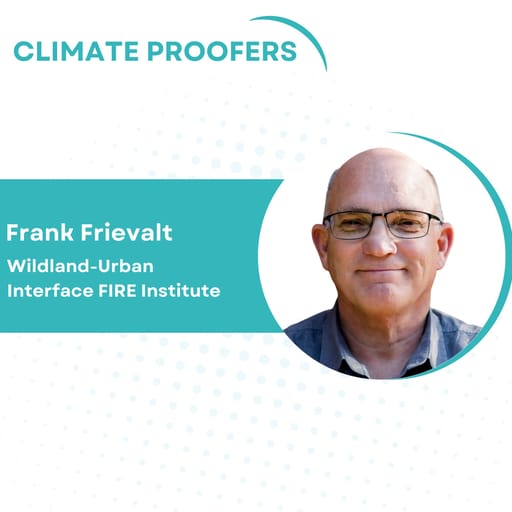
Transcript 0:00 [upbeat music] Hi, everyone, and welcome to Climate Proofers, the show all about those on the front lines of climate adaptation and resilience. 0:12 I'm Louis Woodall, editor of the Climate Proof newsletter, which you can read at climateproof.news. The Los Angeles fires continue to rage. 0:20 As of this recording, over 15,400 properties have been destroyed by the Palisades and Eaton fires, and more than 37,000 acres have been burned. 0:30 At least 27 lives have been lost, while dollar estimates of insured losses range from $20 billion to near $50 billion. 0:37 The cataclysm has underscored, in dramatic fashion, the incredible challenges society faces tackling fire risks in an ever-warming climate. 0:45 While the immediate causes of the multiple blazes in LA County are still being determined, there is plenty to suggest that climate change contributed to their spread and ferocity. 0:54 For example, hydroclimate whiplash, the term given to rapid shifts from very wet conditions to very dry conditions, has become more common since the 1950s because of global warming. 1:05 These conditions set the stage for the latest fires. The ways in which the impacts of fire disasters cascade through our society, economy, and financial system are also becoming more dangerous and disruptive. 1:16 In California, the insurance market was already framed before the LA fires broke out due to growing wildfire risk. 1:22 Now, private carriers, as well as the state's insurer of last resort, known as the Fair Plan, find themselves on the precipice. 1:29 To talk about the evolving nature of fire risks, today I'm joined by Frank Frievalt, director of the Wildland-Urban Interface Fire Institute at Cal Poly. 1:38 The institute looks for solutions to the Wildland-Urban Interface, or WUI, fire problem through research, training, and education. 1:46 For those who don't know, the WUI is the name given to the zone of transition between wildland areas and areas of human development. 1:53 Frank discusses the reasons why wildfires and urban conflagrations, the kind of fire that torched LA, have become more devastating in recent years, and the steps we humans have to take to make them less destructive and deadly. 2:05 He also talks about how fires are transmitting financial risks through a complex chain of insurers, real estate owners, the financial system, and federal government in a way that could bring about a new financial crisis. 2:16 Before we get to the conversation, a reminder that Climate Proof and the Climate Proofers podcast are fully subscriber-supported productions. 2:23 Listeners like you can help support my coverage by heading over to climateproof.news/upgrade and becoming premium subscribers. 2:30 And if you're feeling really generous, please consider choosing a Super Proofer membership, which comes with additional goodies like free gift subscriptions, access to monthly roundtables on adaptation technology, and more. 2:41 All right. In a moment, my conversation with Frank, but first, let's round up some of last week's adaptation and resilience stories. 2:48 [whooshing] In finance, the Biden administration ended on January 20th, bringing to a close an unprecedented period of federal spending on climate adaptation and resilience. 2:57 In one of the last reports from the Biden White House, the administration said bills passed by the 46th president unlocked some $50 billion for climate resilience. 3:06 At least $35 billion had been announced across 7,000 climate proofing projects by the end of Biden's term. 3:13 In the last 51 days of his presidency alone, the federal government allocated over $2 billion to adaptation and resilience, including $223 million for 18 desalination and water recycling projects that could ease drought conditions in eight states, and $121 million for hardening tribes and tribal organizations from climate impacts. 3:33 Newly inaugurated President Trump is making steps to halt, and perhaps redirect, climate financing made available under Biden's two landmark spending bills, the Bipartisan Infrastructure Law and Inflation Reduction Act. 3:44 In an executive order signed on January 20th, the president told federal agencies to, quote, "Immediately pause the disbursement of funds," end quote, appropriated by Congress under the two laws, and review their processes for issuing financing authorized by the legislation. 3:58 [whooshing] In policy, climate advocacy groups are calling on California lawmakers to revive a climate super fund act in the wake of the Los Angeles fires, which would force oil and gas companies to pay into a fund for adaptation and resilience. 4:11 Last year, New York and Vermont passed similar laws. In the Golden State, legislators tried to pass a Polluters Pay Climate Cost Recovery Act last year, but it died in a committee of the state Senate. 4:23 Nicole Gio, California director at Food & Water Watch, said in a January 14th statement, quote, "Big Oil knew fossil fuels were contributing to climate change decades ago, but engaged in a massive disinformation campaign to keep profiting from its pollution. 4:36 Now, Los Angeles is paying in homes, communities, and lives lost. Polluters, not taxpayers, should pay for the cost of these climate disasters and the rebuilding that will follow. 4:46 Governor Newsom and California's elected officials must introduce and pass a robust super fund act that will make polluters pay for their pollution." 4:54 [whooshing] And in tech, Earth observation company ICEYE launched four new synthetic aperture radar, or SAR, satellites last week, enhancing its ability to monitor and map climate-related catastrophes. 5:05 The company has now launched 44 satellites into orbit for itself and its customers since 2018. ICEYE satellites relay near real-time data on events on the Earth's surface, no matter the weather conditions. 5:17 They are capable of yielding insights on everything from the makeup of physical structures to soil conditions and land use changes. 5:22 ICEYE data is used by insurers to gauge their exposure to natural catastrophes, helping streamline the claims process. 5:29 It is also employed by governments and businesses when reacting to disasters like floods and fires, enabling them to respond faster and take steps to reduce damage to infrastructure and disruption to supply chains. 5:39 [whooshing] Right. That's it for this week's roundup. Now, on to my conversation with Frank. [upbeat music] Hi, Frank. Where are you calling from today, and what do you do? Good morning, Louis. 5:51 I am the director of the Wildland-Urban Interface Fire Institute at Cal Poly, San Luis Obispo. It's on the central coast of California. Thanks for being here today. 6:00 It's been a busy week for everybody involved in the world of fire, uh, because of these devastating fires affecting LA County and the LA area. 6:08 And before we get into the meat of the interview, I wanted to ask you, as a fire professional, your immediate impressions of the LA fires, what have they made you think and what have they made you feel?Well, they're both morbidly familiar. 6:21 You know, I've seen this kind of thing more in the last part of my career than the first because things are changing on the ground. But unique in 6:31 that kind of wind speed in that area is certainly above kind of what you'd think of as the envelope. We've had winds like that. I personally have been on ones that, uh, had those gusts up to, like, 140. 6:43 I mean, it's just insane. Um, but it, it's really the scope. 6:48 Concentration of wealth is gonna be an issue, and those, those two things, so the, the scope of the loss, the environmental conditions under which it occurred were all just, you know, above kind of the envelope you would, you would think of. 7:04 This place is known for these kind of winds. There's no big mystery there, but this is well outside the norm. Thank you. 7:12 And yes, there've been lots of analysis, uh, on the causes of the fire itself, how to classify this, uh, and the various factors that potentially made it worse than it otherwise could have been. 7:23 And I'm wondering, you're a professional in this space, 7:26 climate change has a role here, of course, and I want to know how, how you see climate change having contributed to this or at least contributed to the spread and the extent of the damage versus the human development aspect about where we build and how we build. 7:39 No, it's a great point. In my opinion, there are three incremental changes over time that have been building up that have kind of got us to this tipping point. 7:48 I think generally we look at, uh, 2017 and the Camp Fire as, as maybe the hinge point into this new Pyrocene Age, and it's this, it's this confluence of issues. 7:59 But specifically from the climate side, I'm no climate scientist, full disclosure, but the element of it that makes perfect sense to me as a fire practitioner is this concept of vapor pressure deficit. 8:10 This is the difference between the amount of moisture in the air and how much moisture the air can hold. Is, is that correct? Can you explain that for our listeners? Right. 8:19 The simple way I think of it is that if you live anywhere near mountains, you'll notice that as, you know, weather systems come in, even just normal daytime heating depending on where you're at, you'll typically see cloud formation near the crest of mountains. 8:33 And all that means is that it's an indication that two equal air masses, the warmer one can hold more water and vapor suspension before it hits dew point and would condense out. 8:44 And so you'll see these air masses move across the landscape. When they get to a mountain, they have to rise up. Uh, so as it goes up, it has to cool, which is why you then start to see it condense. 8:55 So we, we see this all the time, but when you do that at a global scale and you think of it as a big sponge, it means that sponge can hold more water and suspension than it previously could. 9:07 So your droughts can be more extreme. And when it does finally hit saturation, it's a bigger sponge, and when you squeeze it, a lot more comes out. And so we see these tremendous increases past sort of norms. 9:20 I mean, the, the average might be the same, but the variance off the norm is, is, is deplorable. And so the, the issue with... I mean, it makes the... You know, your fire seasons are extended. 9:30 You have more, a, a wider window of opportunity, and the temperature ranges, the fuels are more susceptible for longer periods of time. 9:37 It explains to me the extremes, too hot, too dry, too wet, too cold, and it explains to me the fire behavior portion between fuels, winds, those types of things. 9:49 So the other two, I think, incremental changes, um, especially in California, but it's true throughout the West, increased density, population density, and this increased development in these fire-dependent landscapes. 10:01 So that whole issue, uh, and most of these fires are human-caused, so they go hand-in-hand, right? And then the third thing is an accumulation of fuels. 10:10 No one of these addresses all of it, but we have in the US since the early 1900s adopted a policy of full suppression. And it made sense at the time, and, and we've gotten remarkably good at it. 10:22 Uh, had the unintended consequence, right? A, a strength overdone becomes a weakness. 10:26 And so in this case, we have in a number of areas an accumulation of fuels that are normally picked up with, uh, higher frequency, low intensity fires. So we have a huge buildup of potential there. 10:39 So the atmosphere's behaving differently. It's affecting the environments in which fires can propagate. 10:45 I'm interested to know, over the course of your career in fire as a fire chief for the Mammoth Lakes Fire Protection District, and now as director of the Wildland-Urban Interface, the WUI, Fire Institute, how have public approaches to fires changed, and are they keeping pace with how fires themselves are changing because of these environmental human development aspects? 11:06 Well, I think for me, and most of my... Well, really all of my fire experience has been on, uh, one side of the Sierra Nevada range or the other. And the first thing I noticed was, you know, the fire behavior. 11:18 We were just seeing increased frequency of what we would call extreme fire behavior anywhere. We've had lead indicators, but we are now on a trend. 11:26 And so I've watched the firefighting go from, uh, more aggressive to more defensive simply because, you know, once you get in those extreme conditions, Mother Nature wins. You, you cannot... 11:39 We call it going direct on a fire when you can engage directly on the fire line, put the flames out, and you're, you know, you're rolling up these flanks. 11:46 And we've had to do a lot more indirect work, working at distance from the fire because it's too intense, and then actually using fire itself to burn out the middle. So we've had to go do a lot more indirect. 11:58 We've incrementally been increasing our capacity to meet that threat, you know, with more aircraft, more crews, um, different types of technology. 12:08 So I think those are, those are probably some of the changes I've seen over, over time. 12:12 What you're saying, when you have these large fires and you have to approach them indirectly, then inevitably that more land has to be taken up in that containment effort, right? 12:20 And large areas have to be cordoned off in order... And, and larger amounts of vegetation have to be destroyed in order to contain the fire and end it.Right. 12:27 And you, and you can understand why it's a bad idea to get in front of the fire. That's where it's the hottest. There's spotting, you know, that goes... 12:33 It doesn't make sense when you're cutting lines if the spotting is going, you know, a half mile ahead of you. Doesn't really work very well. So you have to... 12:41 The cadence of your operations has to respect the fire conditions that you're working in. Now, that's your standard issue wildland fire. 12:49 Now, imagine that happening, imagine there's a community there, and you've only got limited resources, and the priority is the protection of life and property. 12:57 So you're then forced to do the one thing I just said is a really bad idea. [laughs] You're forced to put resources out in front of the fire to protect the lives in that area, and the property in that... 13:08 And this is where the complexity of adding a community in the proximity of a wildfire changes all your tactical priorities and complexities. 13:18 And so that's one of the things that makes the WUI, the Wildland-Urban Interface, this place where communities are built into fire-dependent landscapes, that the tactics and the risks and the complexities skyrocket. 13:34 So yes, because of the proximity of communities, urban communities to these wildfires, the actual way of countering the wildfires is more dangerous for those doing that job then. Yeah. 13:44 Essentially the, the priority is almost... The priorities and tactics don't become fully inverted, but it's close. Okay. I wanna get into the WUI Fire Institute, which you've joined. When did you join? 13:56 Was it two years ago now, three years ago? April will be two years, is when I, I came here as the director. Initially, I, I really balked at coming here. Um, I'm a practitioner by nature. 14:06 I was working in this space for the Western Fire Chiefs Association as a senior policy advisor, and making some progress. 14:12 And I, I have to admit, my initial response was, "Wait a minute, why would I go to an academic institution? I'm trying to get something done." 14:18 But the more I looked at the people that were involved, their strategic intent, and the quality and depth of the faculty, and the more I looked at it, the more I liked it. So I'm now the, uh... 14:31 It's kind of like being a 63-year-old freshman. So you've been director of the WUI Fire Institute for two years. 14:38 Can you talk about the work you've done in that time, and especially efforts to build resilience against fires and the conditions that can contribute to them? 14:46 Well, the first part of this was just kinda getting my bearings, you know, on campus, understanding this new environment. And so the, you know, the first part of it was just to catch up with everybody was, was at. 14:56 You know, kinda solve administrative things, get my bearings. But I brought... I was allowed to bring with me quite a bit of work that I've been doing. And so our mission is pretty simple. 15:04 It's to help create the most fire-resilient communities in the world. And I know that sounds aspirational, but we have solved things like this before. This is not a, a unicorn mission. 15:14 My last assignment was as a fire chief in a, a small mountain community with tremendous wildfire. And we, we had a pretty aggressive program there for, uh, wildfire mitigation and safety. 15:26 And I had some property owners pass an inspection from one of our people on a, it was like a Monday or a Tuesday. 15:32 And before the week was out, they had a non-renewal notice from their insurance carrier for too much wildfire risk. 15:37 Not unsurprisingly, the property owners called the fire chief, the supposed fire expert, and I could not answer the question. 15:44 So I'd done some of this work with disconnects on the structural side of insurance, and the fire worlds, and how we, you know, how we help each other recognize risk and, and bend down losses. 15:56 So I thought, "Well, kind of the same thing. I'll, you know, let's pull out the playbook. We've done that before." It's probably 10 or 12 years prior I had done that. And I realized this was an issue everywhere. 16:06 Um, I have no insurance background. I couldn't spell actuary at the time. Uh, and so what I realized, Louis, is that we were looking at the same physical space and coming to two completely different conclusions. 16:20 It's not that either of us were wrong, but we're looking at the same place through a different lens. The good news is we want the same outcome. Neither of us want it to burn, and we're not competitors. So our... 16:32 You know, most of my time coming here has been trying to integrate... 16:35 What I realized as a local chief is if I just pushed really hard on the mitigations, I'm asking people to do things on their property, their castle, if you will, and that's not why they moved there, and that's not why they built and, you know, adorned their, their property the way they did. 16:52 So someone else could come in later and say, "Hey, this has all gotta come out." And so the fire service will lose that battle every time. 17:01 Um, I could go about two weeks before the phone started ringing to my supervisors, and they were like, "Hey, Frank, pump the brakes. This is causing a lot of angst." 17:09 And so what I realized was just trying to hold up these mitigations with one bookend, the local fire service bookend, was never gonna work. 17:17 And because I realize now the insurance industry and the fire service were not on the same page, but we wanted the same outcome, I needed a partner in that, that they couldn't fire. 17:27 And so when we, when I then reached out to the insurance industry the people were transferring the risk to, I realized we want the same outcome. 17:36 The physics of fire doesn't change, you know, depending on who's looking at it. So if we want the same outcomes, we should probably be looking for the same mitigations. 17:45 And now if they wanna fire me, that's great, but you still have to worry about your non-renewal problem. 17:50 So in my perfect world, we ought to be going to a place where the things that the risk transfer industries need to have confidence to price the risk should be the exact same things we're inspecting for. 18:02 Now we can hold these mitigations up with two bookends, and I think we'll be a lot more successful. 18:07 So that, that's probably the most succinct 80-mile-an-hour drive-by I can give you, that, that we're trying to get that alignment with those two bookends. 18:14 I want to stay on this issue of wildfire mitigation activities and practices, and the challenges, because there has been a number of articles before and after the LA fires about challenges in California, specifically with local authorities trying to get residents to control vegetation around their properties, and put in place some simple hardening measures or risk prevention measures or risk reduction measures that-Are pushed back against because of the sense of this is my property, you can't force me. 18:42 Some academics I've spoken to said because of recent rate rises in insurance in California- Mm-hmm... 18:46 that is st- starting to like tilt things in favor of, okay, maybe I don't wanna cut down this tree in my front yard, but if I do this, maybe I can get a discount on my insurance premium, and that premium is really starting to hurt me right now. 18:59 But again and again, I hear that there is a lack of two-way communicational data from insurers to ho- homeowners and back again, which can actually inform the sort of discounts and create the sort of economic incentives for these wildfire mitigation practices, right? 19:13 You've got... In fact, those are your two levers, right? 19:15 Regulatory, and you actually enforce the regulations, which obviously is a challenge in some places if you get people calling up your boss or calling up politicians saying, "Hey, I don't like this." 19:23 But then the market incentive- Yeah... the economic incentive is a very strong one as well. Okay, I don't wanna do this, but if I do this, I save lots of money. 19:30 So I'm interested in your thoughts on, yes, how do we create the economic incentives to push wildfire mitigation? Just to be clear, I started on this not because I'm trying to solve the insurance world's problems. 19:40 What I realized was solving their problem actually solves my problem because I, I can't do this, we can't do this just from a governance standpoint. 19:48 I like to tell people, we cannot regulate, suppress, or price our way out of what I, I would call the WUI conundrum. We've tried that. We'll need to keep those strategies, but we have to add and make foremost, 20:03 especially for the existing inventory structures, we have to add and make preeminent mitigation. We've tried the pricing signals. We've tried suppression. 20:13 Louis, we arguably have the most complete, robust, broad firefighting force in the world, and we just summarily had our rear ends handed to us. It wasn't through any lack of effort. 20:27 There's just a point at which, you know, all systems kinda get overloaded, and we did. So we can't suppress our way out of this. More, more of everything won't solve it. And we've tried regulation. 20:38 What followed the last series of, of non-renewal moratoriums in California? The market reaction at the conclusion of that moratorium was an exodus. 20:49 And so there's different reasons too why regulation alone won't solve this. So we need to add mitigation to that piece. 20:58 In terms of how does the potential of insurance provide an incentive, the expectation is moving, and I think correctly. Initially people were thinking... 21:11 I mean, if, if, if I came in, Louis, and I told you, "Hey, uh, you, you have a non-renewal letter. 21:15 I'm not gonna, I'm not gonna pick up your contract or, or renew your policy two months from now," you're typically gonna ask two very predictable questions. 21:22 The first one's gonna be, "Hey Frank, nothing's really changed on my property. I'm looking up and down my block. I haven't seen any changes. Why am I no longer insurable?" 21:32 And one of the surprises I had digging into this is that the insurance industry wildfire until fairly recently, as we discussed earlier, you know, urban conflagration levels of loss are relatively new. 21:42 Like I say, I think the hinge point for that's about 2017 at this frequency and scope. And so previous to that, the risk transfer industry, you know, for the wildfire peril, I mean, it was... 21:53 I'd almost say it was probably a rounding error compared to hurricane and flood and those things. 21:57 It was very consistent, very predictable, and if you have a, a very small part of risk financially, it's consistent, it's predictable, you probably don't spend a whole lot of time figuring it out, right? 22:09 As opposed to other ones. 22:11 But when this changed, I believe that the combination of the modelers, the insurers, those three incremental changes, accumulation of fuel, ever-increasing, uh, development in fire dependent landscapes, and, and, uh, vapor pressure deficit, it changed the behavior. 22:28 And they'd been looking at the past to predict pricing in the future. 22:32 Now the future looked altogether different, and if you n- you never had to invest the time to understand the conflagration li- lo- uh, loss sequence in the past, which means they didn't understand it. 22:42 And so if you don't understand the loss sequence, you certainly don't understand how to put value on the mitigations. You don't have any loss history. You don't have any proof of efficacy. 22:53 And so the reason when you ask that first predictable question, well, what changed? In general, we're not yet at a place where people are ready to do the granular modeling at scale at the parcel level. 23:07 They just never had to. So we're learning that skill. And we'll, we'll get there. We're just not there right now. So the real answer is you're just caught up in a large, very, uh, coarse sort of hazard blob, right? 23:21 And so what you do individually, they don't even know how to tell you how it would matter. So after you don't get a satisfactory answer from that, the next question you ask is, "Well, what can I do?" 23:31 For the exact same reasons, it generally ends up turning out to be, "Well look, uh, it doesn't matter what you do." Now if we really... If our strategy, if the, if the risk... 23:42 And I, I, I got this response back from a group of reinsurers several months ago. What you want is you want, you know, your, your clients at scale to hear the messages of mitigation, follow the science, 23:56 take on the responsibility to do the mitigations on your property. That'll reduce the losses, which will reduce the risk, which will bring down availability and affordability. And everybody's like, "Yes," you know? 24:07 "Amen. That's exactly what we want." And then I tell them, "Well, the problem with that is that you're telling each individual it doesn't matter what they do, and yet at the same time you want them all to do it. 24:18 That's not a good strategy." And so the, the incentives have gone from, "Well, hey, I did, I did, uh, $150 worth of mitigation on my property. Where's the $150 break on my policy?" 24:29 I think the conversation has evolved from that to understand, wait, I just need to figure out how to get insurance. And 24:39 unless you own your property outright, it's not a choice.You know, we, we talk about the property owners, but really it's, it's whoever's holding the paper on the land and the property are the owners. 24:51 In general, if, if you've got a loan out, there has to be some form of surety out there. So I think where we're at now, to go back to your original question on alignment and incentives behind mitigations, 25:04 that conversation is, has a moving target on it right now. And eventually we're gonna get to the spot where... Like I, you know, I've been trying to ask questions in other markets, Louis, 25:16 not to be nosy, but I have a lot of experience at the last mile, and I can see where the disconnections are at the point of impact. 25:25 And so part of what I'm doing through the institute is engaging the other markets to find out, "Here's how I see it. Do you think you have exposure here? And if you do have exposure, let's work together. 25:37 If you don't have exposure, great, I'm gonna move on, and if you discover it later, come see me." Sorry, when you say other markets, you mean other insurance markets in the States or worldwide? Well, there's four. 25:49 There's certainly the risk transfer markets, and I- when I say that, you know, admitted markets, the surplus lines, and the reinsurance. A second one is actually lending. 26:01 Uh, I'm sure you're familiar with our, our government-sponsored, uh, entities like Fannie and Freddie Mac. So, you know, I don't know all the details in there. I've had to become a student. 26:13 But, you know, usually within a year or so after you do a mortgage, and they'll bundle those up and buy them, that keeps the market fluid and it provides equity for mortgage-backed securities. 26:26 So they, they buy up these properties, a lot of them in fire dependent landscapes. Wondering how you would get insurance was never an issue. 26:34 In fact, there's always a lender placement clause somewhere in there that says, "Uh, Louis, you don't get to just drop your insurance. If you do, I'll assign you." And so that's kind of been a safety net. 26:43 Well, where do you assign it if nobody's writing the insurance? So there's two inquiries on that side, and we... Are you familiar with the Federal Housing Finance Agency? Or... Yeah. Yes. Yeah. 26:55 I used to be a financial journalist and I had to write about them and, yes, this intricate system of mortgages from private banks being packaged and sold to Fannie and Freddie and, yes, how their paper can help facilitate liquidity throughout the system. 27:07 But yeah, please, I don't know really how it reacts to wildfire. Well- Presumably there could be a lot of risky properties that are being held by, uh, Fannie and Freddie. 27:15 Well, I, you know, I don't pretend to understand all that either. I'm, I'm just saying I'm watching closely. 27:19 But the, the question I pose, because that agency came about after the housing meltdown as, uh, conservators for Fannie and Freddie. And so on that side I feel like there's, there's kind of a dichotomy. 27:32 The risk transfer industry either gets to price the risk it needs to stay in the market and be sustainable or it doesn't. 27:39 And so what I'm watching and, and trying to understand in that market, in the lending market is, if it's the path of the insurers get to price the risk to stay in the market, 27:52 an inquiry out there, an open inquiry is, look, go back in history, when did you see cost of living as a percentage of the mortgage payment? 28:02 When did cost of living get so high as a percentage of the mortgage payment that you started to see delinquencies and defaults? In some places, the insurance payment can start to look a whole lot like a second mortgage. 28:15 So if we only price our way out of this and we don't change any conditions on the ground, we will essentially induce delinquencies and foreclosures at a rate we may not have seen yet. I, I don't know. 28:29 I try to, I try to bracket my work. Panic isn't helpful and neither is denial, and so between those two is where I'm trying to operate. 28:38 So I'm not saying any of this stuff will happen, but hope has never been a, a good strategy in my business. Mm-hmm. And so in this case... So that's, that's option one. 28:47 If they get to price the risk and we don't change conditions on the ground, how far can that go before you can anticipate delinquencies and foreclosures? 28:56 At which point it's not just a banking industry problem, it's a federal problem. 29:01 You won't be just having problems on the response and the recovery side through FEMA, but you're going to have a boatload of exposure on properties for which you, you have 20 and 30 years' worth of ownership and you're relying on an annual process that is in question. 29:20 And so for the people buying mortgage-backed securities, if you're a f- you know, financial advisor, when do you start to tell your clients, "It's getting a little risky over here." 29:28 I don't know any of that, but that's the idea behind that one. The second part is if the insurance industry doesn't get to price the risk, I mean, it's... 29:37 I mean, you have mutual companies that are self-owned, you have some that are, you know, obviously are, are publicly traded. But at the end of the day, it is about is this venture a good financial commitment? 29:48 How does my money work best for me? 29:50 And if the losses in the insurance and the reinsurance industry don't yield the kinds of dividends people are looking for, it seems like, seems like we have a whole stock market about that, right? 30:02 That, you know, people try to move money where it's gonna work the hardest for, get, get good, uh, predictable returns. I don't know how that's gonna shake out, Louis, but it seems like a, a relevant question. 30:11 Some of the academics I spoke to said, yes, pricing alone is not a, a solution and therefore maybe it makes sense for there to be some sort of federal state subsidies for lower income and vulnerable populations, which I suppose still puts the burden on the government, which is already of a burden financially. 30:26 But what do you think about that as a way, allow the market to charge what it needs to, but provide subsidies on the back end, similar to what we did in health insurance, uh, 10 plus years ago. 30:36 Would that be a solution or not? No, I think it has the exact same failure. You just... You're, you're taking a, a kind of a, a longer route to get there, but, but the failure is certain. 30:46 It's for this reason.The conditions that got us here, accumulation of fuels, higher density development, and fire-dependent landscapes, these landscapes have to have fire on them at some return interval, and, and vapor pressure deficit. 30:59 And real quick, let me, let me do a quick segue here. If you look up The Cary Institute, look up Winslow Hansen. They've been doing work on looking backwards at vapor pressure deficit as it correlates to acres burned. 31:10 And when they look back at that history and then project forward, their work would indicate that we're about ready to enter roughly a, a five-decade period where the average, underscore average, acreage loss will be two and a half to three times our peak lived experience. 31:29 My God. Okay. That's worrying. Yes. 31:34 So the reason anytime we're separating through whatever mechanism, even if it's with the best of social intentions, anytime we separate actual risk, physical risk from the pricing of the risk transfer, the r- the risk doesn't go away just because you send it someplace else. 31:51 So if we don't change conditions on the ground, it doesn't matter how we subsidize, if it doesn't result in changes on the ground, because if we don't change those conditions, the outcomes are not only going to continue, not at the same place, but we're ready to go into a place where they're two and a half to three times for decades above our peak lived experience. 32:14 So that's the reason anything, any form, no matter how you put lipstick on it, that separates the risk from the risk pricing, is a failed strategy, in my opinion. So that's the... 32:25 So we talked about the insurance market, we talked about lending a little bit. Oh, and the other thing on lending, at least in the US system, 32:32 you know, figuring out your insurance was almost an afterthought in the purchasing process. 32:38 Now, the banks, before they'll start to consider what you can, you can tolerate as a loan payment, want to see a quote for that property, 32:50 and they're treating that insurance quote as a consideration for how much you can borrow. 32:55 If people can't afford the insurance, their borrowing is dropped, and so the ability to sell your house is s- is constrained by what people can afford. 33:05 So it's not that the value of your house dropped, it's that the, what people can tolerate as a payment has dropped. So I think that's another element on the lending side. All right. So we'll, we'll move on here. 33:15 So it's, it's kind of a combination of the realty and the lending. Now, obviously you can see that the builders are kind of in the same boat. We just finished a project to do an illustration and concept, 33:26 uh, master plan development. 33:28 It's been around for 15 or 20 years, but recently they reached out to the institute because they couldn't finish a phase because they couldn't sell the properties because the buyers couldn't get insurance. 33:40 And this is a community that's a master plan community, so this is stuff fresh out of the ground under the strictest WUI code in the country. 33:49 And if that situation can't be insured, can you imagine what the rest of it looks like? I think the, the modelers and portions of their insurance industry, they're catching up. I want to give them full credit. 34:00 They're ca- they're catching up. But they just can't actually see the risk well enough to know, you know... I mean, insurance industry hates uncertainty, and that's, that's what this is. Okay. So we talked insurance. 34:11 I didn't talk parametrics. We'll kind of leave that one on the outside, but insurance, lending, realty, building. Here's the other one, it's the last one I'm really looking at, is general obligation municipal bonds. 34:25 So in general, the way you service the debt on those is property tax. It's on the full faith and credit of your ability in our system to impose taxes on yourself. 34:37 Now, the, that means you're gonna collect the taxes off the properties that now have two liabilities. The property values are likely to get depressed. And this is true not just for wildfire, right? 34:48 This is other properties that have hurricane damage or wind damage or sea level rise, right? All of those are putting pressures on the value of that. 34:56 So the, the property values themselves may become depressed, which drops your tax income, which affects your revenue to service the debt. 35:06 But the one I'm really waiting to see what happens is when does Moody's and Standard & Poor's, when does it get recognized in the bond ratings that the revenue stream is coming from properties that we're now starting to talk about being either under-insured or uninsurable? 35:23 And when they look at, I'm sure somebody's looking at that, right? If we're entering into a period where we expect this to get much, much worse for five decades, at some point that has to... 35:33 I think those have to connect. Again, not my area, I don't know, but it seems like at some point those have to connect. 35:38 Now, I think that's an important point because if it does, it'll be the first time local government has a direct financial consequence, not from a fire happening. That's kind of theoretical to people. 35:50 But if you're a city manager and I call you up, you know, next Monday, and I'm with a rating agency and you're getting ready to put in a library or a park or whatever, and I say, "Hey, I just want you to know we had to drop your rating because, you know, you've got too much wildfire risk," well now, instead of that city manager or elected officials calling me and saying, "Hey, Frank, 36:10 quit, quit upsetting everybody with all these mitigations," you know, now it's kind of like, "Hey, get your butt out there. This is costing us money." I don't know if that will happen. 36:18 Again, I'm not an expert in any of these areas. I'm just... I mean, the idea behind the fire service is pretty simple. All you do for your entire career is you go to things that weren't supposed to happen. 36:30 And when you get there, you're then organizing chaos. And I think in this case, a lot of this discussion feels like the kinds of discussions I heard before the housing market crash. 36:40 I don't think we realized how integrated the systems were, and I think this one's far more complicated than that one in terms of, of the integrations. Oh, last item too, real quick. Another example of integration. 36:50 Somebody lost their property insurance. They found another-Carrier. They didn't actually have to go to the fair plan, they found another carrier who's more expensive. 37:00 But then they were contacted, it was by Freddie Mac, and they were told, "You can't keep that insurance," because that insurance just got downgraded by S&P 37:11 because they weren't capitalized well enough based on their exposure. So they were a low-quality insurer in the eyes of the rating agency. Exactly. Mm-hmm. So it's not that... Insurance is just... 37:25 Insurance is not the problem, insurance is the signal that there's a problem. But I'm worried that in all of our focus of insurance, and expense, and, "Gosh, what could we have done better?" 37:36 Finger-pointing and all the rest of it, I'm worried that the financial risk contagion can quickly overtake us. We- we're not gonna burn down every community in the country, but when we... 37:47 if we go over that, that, that tipping point for cascading financial consequences, that affects everybody. 37:53 Well, even in the fair plan right now, you're starting to see the articles like, "Oh, yeah, gosh, we're gonna be in an assessment situation. How much of that gets passed through to everybody?" 38:01 Now we're starting to understand, and, and it's a global situation 'cause you have global reinsurance. There is no place to run, you can't be the smartest person in the room. And I guess that's a... 38:12 that's one other thing that's unique about this. Are you familiar with tragedy of the commons? Yes. This is the concept popular in climate financial risk, right? 38:22 That it's in all our interest to reduce the risk, but no one's individual interest to do, right? Yeah. So generally it's the idea you have a common pool resource that nobody owns but everybody has access to. 38:34 So whether it's a, you know, open ocean fishery, public land grazing, could be air sheds, aquifers, you know, pick your example. And if everybody can extract from that, and you don't own it, 38:47 you know, kind of rational economic behavior is that you just keep at it. And as long as you're extracting from it, you're consuming at a rate that it can recover, that works. 38:58 But when you, you know, you go from, you know, six people on a fishing boat each holding a, you know, a, a rod to trawlers by the fleets, you overconsume, and all of us acting individually rationally in the common pool of resource come to the completely irrational result of crashing the system. 39:16 We also... And I haven't figured out quite how to word it, maybe you can help me. I think of risk transfer as a common pool resource. 39:24 Unless you're gonna stop borrowing altogether, there always has to be some form of surety. That's a form of risk transfer. 39:31 And so I think it's, it's a common pool resource, nobody owns it, but it's a neces- you know, it's a, it's, it's a thing that we have out there because we're not bartering directly anymore, right? 39:41 So if that's a common pool of resource, if I look at a community, let's say it's got 100 structures in it, and there's five carriers, 39:48 and all five carriers come in there with a, a sharp eye and a sharp pencil, and they collectively decide to do what's rational for their business. "I'm gonna take the best risks, and I'm not gonna touch the worst ones." 40:00 And everybody does that, and none of this is related to changing conditions on the ground, you're just citing the obvious. The result is the only thing left on the table are the highest possible risks. 40:12 And to cover those, you've sent that into a special risk pool, but that risk pool, if it goes insolvent, comes right back to either the industry and the risk transfer, and they either directly pass that onto customers or it goes to customers directly. 40:27 That's just the financial part. 40:29 But the physics part of this, if there's no mitigation involved, the ones that are the worst risk, if you don't change conditions on the ground, as you have ember cast and fire come in, it stops being a wildfire when you get structure to structure spread. 40:43 And most of the mitigations presently that we're doing think about it at the parcel level. 40:48 They're designed for low duration, low intensity heat flux, mostly ember cast and, you know, maybe a small amount of connective fuels that don't burn that long. 40:58 But when you have a structure burning next to you in a 40, 50, 60, 80, 100 mile an hour wind, 41:04 that envelope of mitigation is completely overcome and you start now the urban conflagration loss sequence as a result of us all being really, really smart and only selecting the best risks for our company. 41:18 So this comes to an... back to an idea I've heard about building community level resilience, right? 41:24 Rather than parcel level measures, which may indeed not be counted for much by insurers because as you said, they don't have the granularity of data anyway to help them with that. 41:34 But h- have you heard much about community-led resilience and community-led risk transfer, like community level insurance policies? 41:39 'Cause this is something that's been pioneered by a few NGOs I'm familiar with, and I'm wondering how relevant it is in your world. Well, again, I, you know, put a caveat on everything I'm saying, right? 41:50 I'm not an insurance expert or any of these other things. But having to become at least a student, um, are you starting to talk about things like parametrics? That's one aspect of it, yeah, parametric insurance. 42:03 I've had a few people on to the podcast talking about that, so we're familiar- Okay... with the idea of parametric insurance. But are communities being able to take out parametric policies? Yes. 42:11 So I've spoken with some of the people about this. I said, "Look, from your perspective, you know, let's say you had, you know, what's its bill? They've got a parametric policy." 42:20 To me, the part that makes the most sense to that, using that as direct payment through to the property owners is gonna get really tricky. 42:28 Imagine if the fires in Southern California, that area had been handled by a parametric policy, and you've got- Mm-hmm... relatively speaking, an affluent Palisades and a less affluent, um, Altadena, 42:42 and the parametric payments come out, do you equally distribute them? Do you distribute them by value? And you could be inside that geographic footprint and have no loss. 42:54 From the delivery point, it looks like a good idea.The social political ramifications of distrib- distribution had better be long solved before you get to that level- Mm-hmm... or you'll have a problem. 43:07 The second one for me in that space is the trigger points for release of funds will run into the same problem. If you don't change conditions on the ground, 43:21 the trigger points for you to achieve a payout will rise over time because the losses will rise over time. Mm-hmm. So it's a different version of a same failed policy, it's just a, it's just a different way to get there. 43:34 If we don't figure out how to stop the losses, any kind of risk transfer vehicle, I don't care what it is, if it's gonna be financially sustainable, has to go up. 43:42 So I'm back to can't suppress price or regulate our way out of it, we have to mitigate our way out. I wanna finish by asking about what new processes, materials, technologies can help with that mitigation side of things. 43:55 Because I look at startups in the adaptation and resilience world, there's a lot of intelligent startups obviously helping with mapping, helping with insurers to do their risk management. 44:04 But on the mitigation side, for homeowners, for communities, I'm wondering what's out there already or what you need to see, you'd like to see being developed to actually help deal with this risk. 44:14 So there's, there's a couple things I'd point at right now. We've got enough science right now to, to drop in some mitigation packages that are solid enough scientifically for us to build on. 44:24 The IBHS Institute for Business and Home Sa- Insurance Institute for Business and Home Safety Wildfire Prepared Home designation. 44:33 They're just about ready to roll out the Wildfire Prepared Neighborhood to get to that community piece, that herd, you know, herd immunity piece. 44:43 A second one is the NIST, is it National Institute for Standards and Technology? I think that's right. They have a Technical Note 2205 called Hazard Mitigation Methodologies. I think that's an excellent resource. 44:57 It's very applied, and you can see how you would use it. And then through some work that we've... 45:04 I, I've had a chance to be involved with a lot of people working hard, we got alignment between something called the Safer from Wildfire guidelines through the California Department of Insurance. 45:15 That mitigation package is not by accident, very similar to the IBHS Wildfire Prepared Home standard. In fact, I'm working on a... I've got a seven state project I'm working on now. 45:25 We're trying to get alignment in each state between the insurance commissioner, the property casualty insurance trades, the state entity most responsible for WUI code, and the State Fire Chiefs Association, which represents local government because this is always a local issue. 45:43 And we're trying to get mitigation alignment so that they don't have my problem when I tell the property owner, "You're good," and the insurance industry says, "I can't touch you anymore." 45:52 So, you know, that's a, that's a pro-... So those are the ones I would point to right now. 45:56 In terms of emerging technology, I think the unique thing about our institute is that we're looking to be the connective tissue between what I see as current excellent research, but it doesn't collect all the things together. 46:09 I'll borrow an example from COVID. We were all really excited as a world when the first vaccine was developed. Yes. But the difference between in a lab demonstrating a vaccine was effective and achieving herd immunity, 46:28 all those other things, those aren't technical in nature. That is politics, finance, logistics, governance, choice architecture, all of it. And so right now I feel like we have these areas of expertise 46:44 all working really, really hard but not integrated, and that's exactly what we're trying to do, um, at the WUI Institute. It's almost like a ventricular fibrillation, right? Your heart is trying as hard as possible. 46:57 It's, it's firing everywhere, but there's no effective heartbeat, and I feel like it's kind of where we are now. We need to get all this stuff aligned so that we can really, you know, have things support each other. 47:08 Do you think the LA wildfires helped move the Overton window somewhat on some of these processes, uh, and on the politics as well? 47:16 Do you think it could open up some solutions or take down some blockers that have caused issues for wildfire mitigation and risk management, or is it too early to say? 47:25 Look, I'll point to a couple of examples that shows we can do... We, we can do it. We've actually solved things like this. I have three ready examples. I don't know if I have time to get into them. 47:32 But oddly enough, one of them is, I'll use the CalPERS pension system as a really good example. When you're done, look up Insurance Institute for Highway Safety, IIHS. 47:44 And when you go on there, you'll find, I think it's About Us and a History, but you wanna get to something called the Milestones. And you're gonna go back and you're gonna look, I think it starts in 1959, 47:54 insurance industry, more cars, faster, more highways, starting to get accidents. Accidents have injuries and death. We have policies that pay that out, unacceptable losses, so we start researching. 48:05 Let's take seat belts, one of the first ones. The initial reaction with seat belts, people didn't want them. "That's... Like, I'm gonna use them on my tractor. Why would I use them in my car? Yeah, that's crazy." 48:16 The builders, you can imagine, "Oh, put us out of business. You know, it's extra steps, it's expense, you know, it's unnecessary." If I remember right, they actually... 48:25 the auto indust- or the insurers actually had to go to Congress to get the law passed to get that. 48:30 But if you go buy a car now, you get about 20 paces inside the showroom floor and there's a small little display table with a clear Plexiglass holder, and it's got all the consumer report stuff in it. 48:40 The whole system has realized people will pay, including the insurers, for safety. There was a time when ABS, anti-lock brake system, was so unique y- you got a little break on your car insurance if you had it. 48:53 We've done this before, but it takes time. This is gonna take us decades. It's gonna outlive any administration, any legislative cycle.Um, we have to lock in for the long term. 49:05 In the US, over a 50-year period following, uh, in a report in our country called America Burning, we dropped our structure fire loss over that period. We went from something like 37% of all calls down to 4%. 49:22 At the same time, we increased our, our annual calls in the nation from something like 11 million to, I think, just short of 40 million. 49:30 So we've got, you know, four times the calls, and we dropped concurrently the actual number of fires, and that was through identification of unacceptable situation, 49:43 money to science, uh, science to policy, policy to regulation, re- drops in losses or frequency. The losses can still be pretty expensive, but the frequency's down. So we can do this, Louis. 49:58 We just have to deci- how many more clicks on the pain wheel do we have to go before we realize legacy approaches aren't going to work? And this is happening without our permission. 50:07 Frank, thank you very much for your time. It's a difficult discussion, [laughs] and you've given me lots of food for thought. I'm trying to leave this without a sense of mounting doom and depression, but... 50:16 And I think you summed it up, like, there are things we can do, it's just, yeah, at what point does human behavior at the collective level get motivated to, to enact these changes? Mm. 50:26 And I, I still think I'm looking for answers there. You're obviously looking for answers. 50:29 And I do think these wildfires, because they've been so devastating and so visual, and widely felt by Americans and around the world, y- I do hope that there will be some catalyst for, for change. 50:40 What we need is hope and a plan. Hope without a plan is a fool's errand. A plan that nobody believes in, nobody will get behind. 50:48 So, you know, my advice to people is let's keep it like I told you, let's keep left of panic and right of denial, and in that space, [clears throat] 50:57 understand that we'll continue to have the losses and they will increase beyond our lived experience by orders of magnitude, and no financial system's gonna survive that. But we can bend this down. 51:09 I took a research team down to, uh, Chile, uh, last year. They had a devastating set of fires. But there was this pocket of about 90 homes that survived. So we wanna go down and dig in there and figure out why. 51:20 So the truth is, we can get to those outcomes. We can go from this one or two miracle homes, or in that case it was a whole community, we can go from these sort of, "Wow, that's miraculous. How did that happen?" 51:32 And we can make that an intentional outcome. We just have to decide if we're going to do it. There's no real mystery here, it's just are we ready to take on the task? We- we're so enamored with evolution, 51:46 we're always looking at it as a spectator in the past, and we just think it's the greatest thing ever. Mm. Well, Louis, it's our turn. We're in the Petri dish. 51:54 [laughs] We're, we're out of our seats, we're on the field, we just have to decide if we're gonna evolve for resilience. But we can do this. No mystery on what has to happen. Wonderful. 52:04 Frank, thank you so much for your time. Best of luck with all your work you're doing at, at the Wooster Institute, and I hope, uh, we can speak together again soon. 52:12 Well, you know where to find me, and thank you so much for taking the time to report on this, because you can touch people at a scope I never will be able to. So thank you for covering the material. 52:22 Climate Proofers is a Climate Proof Media production. It is produced and presented by me, Louis Woodall. Subscribe to the Climate Proof newsletter by going to climateproof.news/subscribe. 52:32 And to learn more about the publication, feel free to reach out directly using our LinkedIn page. Goodbye for now. [outro music]