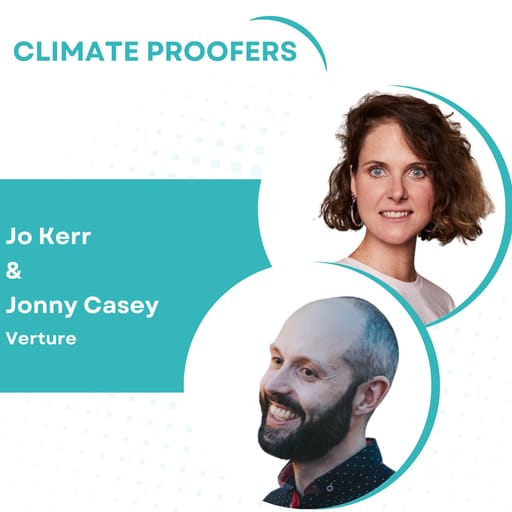
Transcript 0:00 [upbeat music] Hi, everyone, and welcome to Climate Proofers, the show all about those on the front lines of climate adaptation finance, tech, and policy. 0:12 I'm Louis Woodall, editor of the Climate Proof newsletter, which you can read at www.climateproof.news. Scotland is one of my favorite places in the world. It's got it all. 0:23 Outstanding natural beauty, lively cities, ancient castles, and of course, the elixir of life itself, whiskey. It's also got a lot of climate risks and a lot of adapting to do. 0:34 Virture is a Scottish charity working to make the country climate resilient through the power of collaboration, knowledge-sharing, and policy advocacy. 0:41 In today's episode, I speak with Jo Kerr, the charity's CEO, and Jonny Casey, its head of climate-ready leadership. 0:48 We talk about Virture's approach to climate resilience, get into the details of Scotland's climate risk exposure, and go over the many adaptation partnerships the charity believes are key to protecting and preserving the country's natural, economic, and human resources. 1:01 I make some surprising discoveries on the way, from learning about Glasgow's burgeoning space tech industry to how a well-intentioned water vole habitat turned into the poster child for local maladaptation. 1:12 Before we get to all that, though, an update on Climate Proof's membership drive. Listeners may remember that last week I set a challenge of doubling the publication's membership from 150 to 300 by the end of September. 1:24 As of the time of recording, we're up to 155, so that's just 145 [laughs] to go. A big shout-out to Alicia Montoya, who became a member just yesterday. 1:33 She said she did so because she believes in paying for great content, like this podcast, and said Climate Proof is overall top-notch. Thanks, Alicia. I appreciate the kind words. 1:43 If you want to join her in supporting Climate Proof, please head over to www.climateproof.news/upgrade today. Okay, pitch over. 1:52 In a moment, my chat with Jo and Jonny, but first a roundup of the top adaptation and resilience stories. 1:57 [swoosh] In finance, global banking regulators said they would prioritize analysis of extreme weather impacts on financial risks and press ahead with a voluntary climate risk disclosure framework for lenders. 2:07 At a meeting on May 12th, officials overseeing the Basel Committee on Banking Supervision said it would publish guidelines on reporting climate-related financial risks for national authorities to consider. 2:16 A survey by the Financial Stability Board found that as of last year, watchdogs in 21 jurisdictions had made progress on setting climate disclosure requirements. 2:25 Critics assail the committee for choosing to make the disclosure framework voluntary rather than mandatory, saying this could lead to gaps in supervision. 2:31 [swoosh] In policy, Republican lawmakers advanced President Trump's massive tax and spending bill out of the budget committee on Sunday, setting the stage for a full vote of the whole chamber later this week. 2:41 The legislation would undercut a raft of Biden-era measures that support US climate resilience and claw back previously awarded funds for state and community programs that fight pollution and support air and water quality. 2:53 One estimate says that $9.65 billion of yet to be allocated funds authorized by President Biden's Inflation Reduction Act could be repealed. 3:00 Many of the projects these funds would support are for state-level environmental works and programs focused on community-based resilience. 3:06 Other measures would fast-track the breakup of public lands and facilitate their sale to corporations. 3:11 The bill would also rescind coastal restoration funds and nix programs designed to improve indoor and outdoor air quality. 3:17 [swoosh] And in tech, AI-powered Earth observation startup Zupal has exited stealth mode with a $129 million war chest with the aim of mainstreaming enterprise-grade geospatial data that can be analyzed using natural language and other easy-to-use mechanisms. 3:32 The Barcelona-based company, which is partly financed by agencies backed by the Spanish government, counts Microsoft and geospatial software provider Esri among its partners. 3:41 Zupal says it plans to launch a satellite constellation in the near future to improve its Earth data capabilities. [swoosh] All right, that's it for this week's roundup. Now on to my conversation with Jo and Jonny. 3:53 [upbeat music] Hi, Jo. Hi, Jonny. Where are you calling from today, and what do you do? Hi, Louis. Great to be on with you. I'm Jo, Jo Kerr, and I'm the CEO of Virture, the Scottish climate charity. Hi, Louis. 4:08 Great to meet you. I'm Jonny. I'm head of client-ready leadership at Virture, and I'm based here in Edinburgh today. It's great to join you. Thank you both for being here. 4:17 I first became aware of you through one of my first podcast guests, Kit England, so I'm very glad we could finally have this conversation. But since I first discovered you last year, you've gone through some changes. 4:28 Virture used to be called SNIFR, and you've evolved into that brand recently, and I wanna know what it means for your purpose and direction. Yeah. I'll, I'll take that one. So, um, yeah. 4:39 We were called SNIFR for 30 years, and it started out as an acronym, and it made sense as an acronym. 4:46 We worked in Scotland and Northern Ireland, and then the, the work changed and the name stayed without the, the acronym. 4:54 And I think for those in the know who, who knew us already in Scotland, it still kinda made sense, but for people who are new, it didn't quite work, and maybe for obvious reasons [laughs] for your audience who'd not heard of us before. 5:08 When I was getting to know the organization last year and going through the process of applying and then being offered the role, I did mention it to a couple of friends, and a, a surprising majority of people said they thought it was a dog charity. 5:21 So here we are, Scottish [laughs] climate charity with a focus on adaptation, resilience, and justice, and we need a name that when, uh, we're talking to new audiences, they don't think that we work with dogs, as lovely as dogs are. 5:35 And we want a climate resilient future for dogs as well, of course, but not exclusively. So I don't know how much Scots you know, Louis-You familiar with the Scots language? 5:45 I do not have much Scots or Gaelic in my, in memory. Okay. Yeah. So Scot- in Scots, Verture, it's a Scotch word meaning the knot or joint in the straw nearest the ground from which the lowest leaves spring. 6:01 It's quite poetic, isn't it? Not- Oh, it's beautiful. Yes. Yeah. Not quite Robert Burns level, but still quite poetic. 6:08 So I think for us, that, you know, evokes the future that we want to see and the connections that we want to create and the collaborations that we have, that new growth for a better tomorrow. 6:20 So that name really, you know, stuck out to us and feels like the right focus for us going forwards. Um, and we really want to build on the legacy. 6:30 We know that we've done amazing work with Sniffer, and a lot of those focuses continue, but it's really good as we start to shape our new strategy for the coming years to move forward with a new name that hopefully resonates with a lot more people. 6:47 And, you know, we're, we're thinking about our work in Scotland, but we're also thinking about the opportunities for knowledge exchange and how we can connect across the UK and also globally. 6:58 I think the name really positions us to do that as well. Yes. 7:01 It's a very poetic name, the definition and the word itself, so I hope it does bring you a lot more awareness and a lot less confusion around whether you are about climate adaptation or about dogs. 7:12 Can we get into the actual meat and potatoes of what you do then at Verture? What are the products you have on the way? What stakeholders do you engage with? 7:21 What sort of outcomes are you looking for for Scotland and North Britain? Absolutely. 7:25 So our vision is a flourishing and fairer future for all in a changing climate, and that really encapsulates the focus on climate adaptation towards climate resilience and the justice we want to see across that because we recognize that the climate impacts are going to be felt most by those most marginalized in society, so we must embed justice in everything that we do. 7:50 We work across the whole of Scotland, and I like to think about our work on three levels. I will explain it top-down, but you can equally flip the lens and go bottom up. 8:00 So, um, the top-down line would be the national and talking about Adaptation Scotland, which we work on, on behalf of Scottish Government, which I hope that Jonny is the expert in that. We'll get into later. 8:12 Then regionally, you know, these amazing regional adaptation partnerships which are setting us up for action on that level. 8:20 And then more recently, we've moved into deeper work within communities, and it's really important to, when we're talking about engaging people who are the most marginalized, that's often at that community level, and then connecting up. 8:33 We do a lot of education and training, and the, the equity theme really connects across those three layers. 8:41 My background lays in the social sector and most recently in an anti-poverty charity, and I think, um, Verture combines a lot of the values of the social sector with action of the climate sector. 8:53 So that is about ensuring that there's no adaptation without just adaptation, and we've got to have that action that works for everyone. 9:03 And we are moving into that new strategy period, so I think we're thinking about, you know, the work that we do. Adaptation Scotland, we're hoping will really continue. 9:12 Our regional adaptation partnerships and that work, you know, l-love to get into that. You know, that, that will continue. We're thinking about how do we really design and define some new areas as well. 9:24 So it's quite an exciting generative time for us. Fantastic. And I do wanna get into Adaptation Scotland and those community projects, especially in m- little bit more detail. 9:34 But first, just to take a step back, for the audience who are listening in who may not be familiar with Scotland, Scotland's geography, Scotland's climate, Jonny, maybe you could talk a little bit about the climate risks that Scotland faces and the adaptation solutions that could work to, to guard the economy, guard the people from these worsening shocks. 9:52 Thanks, Louis. Yeah. I think Scotland is, you know, facing similar challenges, I guess, to many places across, uh, the Northern Hemisphere especially. But we are starting to see some rapid changes in recent years. 10:07 Um, in three years we've seen an increase of, from, going from 19% more winter rainfall than the mid-century average to 29% more winter rainfall. 10:17 It's a huge change in just three years, and our aging, often Victorian infrastructure just simply isn't able to cope with that significant amount more winter rainfall that we are facing. 10:29 We're also starting to see on the converse side, though, more extreme heat events as well. So we've had record-breaking summers in 2018 and 2022, which smashed all records. 10:41 But we know that by 2050, more likely than not, that's going to be considered a sort of a normal summer, and we're not yet really well prepared enough to be able to cope with those levels and frequency of extreme heat across, particularly across our towns and cities. 10:58 We're also seeing a, an increase in the frequency and severity of storm impacts as well. We've had far more named storms in the last couple of years than we've had over the past 15 years, for example. 11:10 Storm Éowyn back in January of this year, in 2025, had a massive impact, particularly across the south of Scotland, felling thousands of trees, but also knocking out power lines and communications for hundreds and thousands of communities in rural areas who didn't then have power and communications for several days. 11:29 So the impacts of these events are also starting to have really severe knock-on impacts for communities across Scotland as well.Another area that's often overlooked is also in our coasts. 11:42 So the rate of sea level rise in Scotland has tripled in recent years. So we're seeing an, an acceleration of that risk to coastal communities from coastal flood inundation and coastal erosion as well. 11:57 So that poses real challenges for the people and places that live there, um, and also the, the infrastructure and investment that's required there as well. 12:07 Importantly, I think it's, it's, it's worth noting that there are some unique aspects to, to Scotland and the risks that, that we face. 12:13 Um, we have at least 93 inhabited islands in Scotland, and some of the challenges they face are particularly acute. 12:23 We know that when there are storm impacts, there are significant impacts there for them around connectivity. 12:28 You know, ferries canceled, flights canceled, communications lines cut out as well, so they can often feel quite cut off from support and connectivity with others as well. 12:39 Disruptions to supply chains, meaning they can't get vital food goods and medical goods as well during those times. 12:45 And we know that as well in rural places like in the northeast of Scotland and the south, where agriculture is quite a dominant industry, we're now starting to see, as we have done in recent weeks here, an increased frequency and severity of drought. 12:59 Often when I try to talk to people about the, the drought risks in Scotland, [laughs] people laugh in my face or scoff because, you know, we're infamous for being such a wet and rainy country. 13:09 But as we're starting to see from those projections, we're getting a concentration more of that rainfall in the winter periods and far less during other periods now. 13:17 So there's a real challenge for agriculture as well to adapt. So thinking about what we can do to adapt, we're starting to see new sort of industries growing around the sort of adaptation economy. 13:30 So we've seen industries like the horticulture sector starting to respond now by propagating the plants that are required for things like, uh, sustainable urban drainage systems and green roofs. 13:42 Uh, we're also starting to see from the sort of burgeoning space sector in and around Glasgow, new tools and resources as well for things like earth observation technology that can help provide the information and data required for those adaptation actions. 13:58 We're also seeing a real focus around nature connectivity and nature-based solutions, so a real focus on how we can use and harness nature and nature recovery to also deliver adaptation outcomes, so reduced flood risk, you know, in, in cooling of urban areas, uh, reduced storm impacts as well through the use of nature. 14:19 And that's, you know, we're seeing some fantastic examples of that in local parks a-and in the highlands, in peatland areas as well. 14:27 But equally, we're starting to see really strong investment now as well from some of the larger infrastructure operators. 14:33 So across our railways, water network, and our energy sector as well, we're seeing, uh, those larger infrastructure organizations investing in the resilience measures required to ensure that when we do have those more severe impacts, we're far more resilient and can ensure that our operations can continue without having the severe impacts that we saw from the likes of Storm Eowyn. 14:56 And I think a particular point I wanted to touch on in terms of the adaptation opportunity in Scotland is also around the use of things like vacant and derelict land. 15:05 We're starting to see now through things like the national planning framework and other local decisions, different decisions around how we think about and use vacant and derelict land and recognizing the wider values that that can provide for local communities, whether that's in terms of community spaces or in terms of regreening them as well to provide a wider range of benefits and not just think about how we can, you know, put a new building there, thinking about the wider benefits that they can provide as well. 15:33 I love that, talking about the opportunities that could be opened up by a greater awareness of how adaptation happens, how you create a more resilient country. So I'd like to talk about that a little later down the line. 15:45 I am interested to know, are there any particular industries or parts of the Scottish economy that are a near-term or long-term threat of some of these physical risks you spoke about? I mean, Scotland is part of the UK. 15:57 UK's got a large services economy, but there are nuances to the Scottish experience that may be more vulnerable to, to climate risks. 16:03 So I'm interested to know if there's any parts of the economy that are particularly in danger. 16:07 I'm not sure about necessarily being in danger, but we know there are certain industries that are more, or sectors that are more at risk. 16:14 We recently worked with your previous guest, Kit, Kit England as well, to undertake an economic assessment of the climate risks across the Highland region, and we had a particular focus on a number of industries, so around the energy sector, forestry and timber, food and drink, and fisheries as well. 16:33 And that helped us to get a much deeper understanding of the types of risks that those industries face. 16:40 But we're also starting to see, um, that there are some excellent responses being put in place in those sectors as well. 16:46 So we know in the forestry sector they're looking far more now at the, the threats from, uh, the spread of, uh, non-invasive pests and diseases, for example, and non-native plant species that are threatening those forests and putting in the control measures to support that. 17:01 We've recently, through the Adaptation Scotland program, been doing some work with the Scotch whiskey industry as well, one of the iconic sort of industries in Scotland.Supporting them to look at how they can adapt to things like drought and lower water quality or availability, but also ensuring that when barrels are, are maturing in the warehouses, that they can also sort of maintain the right levels of humidity and temperature control as well throughout all seasons. 17:27 So while there are certainly s- you know, some risks to, to particular industries that we've h- done some deep dives on, we know that there are also now, uh, growing measures being put in place to, to respond to them. 17:39 Another area as well is around tourism, wh- which is a, a major part of the Scottish economy, and we're starting to see as well that tourism businesses are recognizing the impacts and recognizing the trends and change, and that some of these severe events aren't just one-off things that they can cope with, but are part of a series, a, a b- a trend of often worsening impacts as well. 18:01 But many are also looking at the sort of innovative solutions that they can take. 18:05 Um, there is a great example of a ski center in the Cairngorms, for example, that now that their sort of winter sports with skiing and snowboarding are almost not viable anymore because of the reduction in snowfall to have many of their slopes open. 18:21 So they've invested in recent years on creating mountain bike trails across the land that they manage, so they could then have revenue streams throughout the summer and autumn periods as well, and then adapting some of the ski lifts to be able to take bikes and things. 18:35 And they've then used some of that revenue to invest in things like snow cannons so that they can maintain some level of operations during the winter as well. 18:45 So I think it's really interesting to see the sort of innovative solutions and recognizing that adaptation isn't always just about, uh, some of these bigger infrastructure investments, but also about how we approach things, doing things differently, and recognizing that we can't protect ourselves from every change, but we can respond to those changes in more positive ways as well. 19:07 Yes, climate risks compel innovation in some degree, right? 19:11 Uh, if certain businesses that can't move their assets, can't move their operations, they're geographically constrained, they have to really reinvent themselves, and the combination of technology, landscaping, in this case, creating these mountain bike trails, expertise from engineering and geology and then climatology, it all comes together to help businesses to adapt and communities to adapt. 19:30 I wanna turn to the nuts and bolts of actually putting adaptation resilience projects in place at Virture. 19:36 Because Scotland is, is its own country, its own government, but it's also part of the UK, which is its own government. You work on the local level. 19:43 There are city governments, local councils, so there's a whole mesh of different authorities and bureaucracies to navigate through. 19:50 And I'm kind of interested to know, as you guys as a nonprofit, as a charity, how you navigate all that and the barriers you found and how you overcome those barriers to bring people together to create these useful adaptation and resilience projects. 20:03 So perhaps, Jo, maybe you wanna start with that one. Yeah. 20:06 I think it's really interesting to think about the nuances and complexities of working with local authorities and working in regional partnerships, and that's a model that we've really developed over the last 12 years since we launched our first regional partnership. 20:21 We work at the regional level because that's where the systems intersect, and we believe that's where a lot of real change can take root, so we're able to bridge the gap between that national policy with the Scottish government and Adaptation Scotland and the local delivery on the ground, and we can get those economies of scale across local authority boundaries, and we see those really interesting collaborations between local authorities, which is amazing. 20:49 We can also look at the knowledge pool and the resources pool that we can bring together when we're making decisions collectively. 20:57 Our role has varied, um, working regional partnerships, and it varies partnership to partnership. 21:04 And excitingly, I think this is a positive thing, there are some regional partnerships in Scotland that we are not part of. Either we were to help them get set up or they've flourished apart from us. 21:15 So certainly we are not protectionist about this model, and we contribute openly, and if it feels like there's a role for us, we will get involved, and if not, then, you know, crack on. 21:26 There's, you know, more than enough to do. 21:28 Um, but when we're involved, we're often a convener, a facilitator, a translator, getting in between the, maybe the deep, deep expertise and the people who won't know very much at all and kind of bridging those gaps. 21:44 And then we're looking at how these regions really embed the climate resilience and practices over the long term. 21:52 So I think ideally it can't rely on Virture to be there holding things together for years and decades to come. 21:59 It's re- really about regions being able to stand on their own two feet, in a sense, and something that is set in itself resilient and set up for success. 22:09 We believe, though, that if we invest in these trusted long-term relationships, we will see that systemic adaptation going into the future. Um, 22:21 the partnerships we work on, so we've got Climate Ready Clyde, which is kind of Glasgow, Clyde region, which is where I'm speaking to you from today. 22:29 Highland Adapts, which I think Johnny already mentioned with the link to whisky, which is, you know, gonna be memorable. 22:35 Climate Ready South East Scotland, so on the other side of the country from Glasgow to Edinburgh and surrounds. 22:41 And then Climate Ready Tayside, which is up on the east coast a little bit further north, but not fully Highlands. So, you know, we've got quite a spread of geography there. 22:53 I think, you know, it would be nice if there was a kind of secret sauce or a, you know, one-size-fits-all approach. 23:00 I think what we do have is some principles that I can share that we've learned over the years that really work when bringing these partnerships together.So these principles have been adopted now by Scottish government, and they're also being shared across Europe and beyond, which is really amazing. 23:18 So I think, you know, many listeners might take something from them. So the five... I think it's nice to have five, isn't it? You can easily remember that, right? So- Yeah. A manageable number, yeah. 23:29 A manageable number, yes. So, you know, the first one is kinda, I suppose as, as I've said, there's no single blueprint, so we're recognizing that every place is unique. 23:40 And I think what was amazing there was that recently we brought a, like, pretty much all of the partnerships together, plus nascent partnerships that haven't, you know, haven't even formed yet, and people who are just interested in, you know, kind of climate action in this way at a foundation to maturity event. 24:00 So we had a big event in Edinburgh. 24:02 We had the, you know, most established partnerships at Climate Ready Clyde, 12 years old, you know, kind of grandfather in this space, and then the, yeah, teeny tiny nascent baby partnerships that are just getting off the ground. 24:16 I think Climate Ready Tayside is about 18 months in the making, and really just sharing that expertise and sharing what works, what the commonalities are, what the replicable models are within that, and then what things have to be new and distinct and unique. 24:34 And I think that connection with Adaptation Scotland is great as well because that's a knowledge toolkit that we can draw from, but we recognize that each of those local regional partnerships need to be bespoke as well. 24:48 I think that takes me on to the second principle, which is really about the being locally led and owned. So we see this at every level. 24:57 If we work in a real, you know, tight community setting, that area wants to own their stuff. 25:05 If we work at a regional setting, they want to own their stuff, and you know, woe betide in Scotland if anyone from, you know, any other part of the UK [chuckles] wants to get too involved. 25:14 You know, we need to own our stuff too at that level. So I mean, I think it makes sense that this kind of feeling of locally led, locally owned. 25:23 It's amazing that going up to Dundee and spending time with the Climate Ready Tayside folks, that there's such an array of stakeholders that really come together from all sectors, volunteers, community members. 25:36 They use a model, don't know if you've heard of it, called Three Horizons, to map out what they wanted the future of the area to be and w- how that's different from what's happening now, being the first horizon, and then how the change is gonna happen, which is the transition between horizon one to horizon three. 25:54 So all the stakeholders, different community groups, different local authorities, universities, farmers, you know, different people from industry, people from housing, all coming together and using this model and going, "This is what we want this Tayside region to look like, you know, 2040 and beyond." 26:15 Like, magical. Um, and they're now all committed to that vision, which is just super powerful. 26:23 The third one, you know, that place-based adaptation can't be considered in a silo, so it has to be integral to the wider strategies and approaches. 26:34 And I think this is best brought to life thinking about, again, the different stakeholders that are coming together. So the board of Highland Adapts is made up of all of these different organizations. 26:45 So Highland and Islands Enterprise, NHS Highlands, Zero Waste Scotland, which is a circular economy organization, Changeworks, which do retrofit for housing, NatureScot as well, so thinking about kind of nature cli- crisis linked to climate crisis, and all of these different actors are kind of coming together and thinking about more of that systems change approach and how they can get these different, you know, might, might think about co-benefits, we might think about multi-solving. 27:18 We can all have our interests met through this collective action, which I think is, is so powerful and, and particular when it's landed in place. 27:28 The fourth one is that we have to foreground everything in fairness, climate justice, and just resilience, so probably already heard from me that [chuckles] these are areas that I'm incredibly passionate about. 27:40 We absolutely need to ensure that the benefits of adaptation are widely shared or equitably shared, and that we avoid amplifying existing inequalities and vulnerabilities because that's the big watch-out, that we just continue business as usual, but we protect, just build a bunch of gray infrastructure that protects what we've already got. 28:01 And I think probably we all agree that won't work. So how do we center the needs of people on low incomes, Black and brown people, disabled people? 28:10 I think my favorite example of this is a bit more local scale, but I do love it, so I'm gonna share it. So this is in an area of Glasgow that we're working in in a program called Creative Climate Futures. 28:22 So it's within the geography of Climate Ready Clyde, but at a more local scale. So in this area of Glasgow, they had a park and they had some, um, sports pitches. 28:34 And so the, you know, local people played on the sports pitches, kids played on the sports pitches. 28:39 They weren't fancy, but that was what this area had, and this is an area that's not doing that well financially, lots of people on low incomes. 28:47 So council comes along, they're like, "Right, we need to do flood resilience, and we're also worried about water voles." And again, I'm not anti-animal. You know, care about dogs, care about water voles. 29:00 But what they did was they created a lovely water vole habitat, um, and they no longer have any sports pitches and nowhere for kids to play.And [chuckles] that, I think, is a-an example of maladaptation actually. 29:16 Probably not if you ask the water vole, but it's not gonna work. It doesn't work for the people in that community. 29:23 So the great outcome of that is through the work that we've been doing and our partners in that area, we've now got an amazing collaboration, and they're going to build a destination park that is still, you know, the rewilding for the water voles. 29:39 That's still in there. The flood resilience is still in there. 29:42 And now there's gonna be this amazing destination park with all the shoots, the slides and swings and whatever else that people will actually come to from miles around, and that's like the win-win, right, for people and climate. 29:56 So I absolutely love that example. The fifth one, final one, is about the time that these things need to be resourced. 30:05 I mentioned up top about the different lengths of time that regional partnerships have been around and 12 years for Climate Ready Clyde. 30:15 The key thing here is about looking at the models that ensure that long-term sustainability. So with Climate Ready Clyde, it's a membership model, and that really works for those partners. 30:26 With Highland Adapt, we've actually been spending some time in the last year looking at what the future models are and acknowledging that principle of what's got us here won't get us there and taking us to a next phase. 30:41 And I think that's really powerful. And, you know, each region's different, and what works for all of them, it will be unique. Thank you for taking us through all the principles. 30:51 I love that example of maladaptation you mentioned because an issue is if you do not consider social justice, the interests of the local people, then actually you can create a backlash against all adaptation actions, right? 31:04 So it's in the interests of the adaptation course itself to make sure it takes into account local nuances and the needs of local communities and disadvantaged communities 'cause otherwise you create this kind of groundswell of bad feeling [chuckles] towards the whole idea of adaptation and reformulating lands to be more resilient. 31:21 So that's a really interesting example and one to be kept in mind, I think, by all community project developers. 31:27 I think they're great principles, but I wonder if there's a bit of co- of tension between what you said about locally owned, locally led, and then the need not to operate in silos because obviously a lot of these projects, they do need funding, they do need expertise, and some of that expertise and funding is gonna come from a level above, like the county council, right? 31:46 And if money's being given by the central government to a project or by a coalition of non-state actors, they're gonna wanna have some level of control or ownership. 31:56 So I'm wondering if there's a tension there between the kind of, we don't wanna be in silos, but we also want it to be locally owned. Like, have you had to navigate issues there? 32:03 Joe or Johnny, whoever wants to go for that one. You can have something that is locally owned but still supported by technical support and finance from elsewhere as well. 32:12 You can have a regional partnership really centered on the needs of people in that place and have them as part, key part of the governance and decision-making roles within that partnership, but recognizing that not everything that we need is held within that place and within those partners, that actually you n- do need to draw on expertise and funding and finance from a wider range of sources as well as that sort of knowledge exchange. 32:39 So yeah, thinking about how we can mobilize, in particular private sector funding to go alongside the public sector funding for this work is absolutely critical, as is drawing in the expertise to enable us to undertake the detailed risk assessments, to, to develop the business and investment cases, and also to bring in the skills necessary to implement some of those actions as well. 33:03 But also ensuring that as we go through that, we build the capacities and knowledge and skills of people in that region to do that themselves in the future as well and not always have to rely on others in that sense. 33:16 Yes. Capacity building comes up again and again when I'm talking to policy makers and charities in the US, in, in the UK, elsewhere. 33:23 It still seems to be the case that you have local government departments or local interest groups that have some understanding of, oh, it's getting wetter, oh, we're flooding more, but they don't actually understand the concepts of a-adaptation, what needs to be taken into account when building an adaptation plan. 33:40 So there seems to be a lot of energy in capacity building that's being done by groups like your own and by other nonprofits and some government initiatives as well. 33:48 My question, I always come back to the funding though because, yeah, I'm writing here in the US. 33:52 I spoke to a county resilience office based in Michigan the other day, and they get 25% of their money from the federal government, and if that money doesn't come, they have to cut back on what they can do. 34:01 They're constrained in what's possible. 34:03 So I'm wondering about the importance of central government engagement and investment in adaptation, and I wanna talk a little bit here about what you made of the UK Climate Change Committee's progress on adaptation report, which came out a couple of weeks back. 34:21 That made clear that progress on adaptation in the UK is too slow, has stalled or is going in the other direction. 34:27 I'd be interested in your thoughts on, on the current UK and Scotland government approaches to adaptation and the allocation of resources, particularly financial resources, to this end. Yeah, absolutely. 34:36 I think, I think it was a real wake-up call for everyone, the Climate Change Committee's report saying that implementation is too slow. 34:43 It's not happening at the scale and pace that's required, and potentially we're even less prepared now than we were several years ago because of the pace and im- of climate change impacts that we've seen. 34:55 I think in particular the fact it was highlighting the lack of preparedness in the health sector was particularly interesting as well, um, that that is an area that we've started to see real, uh, recognition across a whole range of sectors and among different community groups and also with other partners as well, the health-related impacts from climate change, whether that's from flooding or whether it's from overheating during summer periods or also the spread of pests and diseases. 35:21 You know, we've seen reports recently about the prevalence of, um, tick-borne diseases in Scotland reaching further north and even mosquitoes now in the northern isles of Scotland, something unheard of just several years ago, and the, the health risks associated with that as well.Um, so I think that those sorts of messages that were coming through that were very specific about particular sectors have been a real wake-up call for everyone. 35:47 Uh, we've been doing some work with the Greener NHS teams in England, actually in collaboration with Sustainability West Midlands over the last eighteen months to try to develop a suite of tools, resources, training for partners across the NHS to build their adaptation capabilities, as well as looking at where they can draw in investment both from national government, but as well as from other areas as well, to be able to respond more effectively to those climate challenges. 36:14 Just today, we just saw the publication of a brand new NHS adaptation capability framework published, which is something that ourselves at Virtu and, and Sustainability West Midlands co-developed with the Greener NHS team. 36:26 So we're s- already starting to see some kind of response to those major challenges now that have been set out in the Climate Change Committee's report. 36:35 In terms of what you were asking about i-in terms of like the central government's funding and prioritization and response, I think it's fair to say that over several years, that hasn't been sufficient. 36:48 It hasn't been sufficiently prioritized across a range of government departments to be able to fund and finance the action that's required across those areas where there are statutory duties for them to adapt to the impacts of climate change. 37:02 But equally, we know that the adaptation finance gap runs to the billions per year across the UK and several billion of that in Scotland as well. 37:13 And we know that the, the public finances alone are simply not going to be sufficient to get us to a point of being well adapted in a, in a fair and flourishing future for all in, in the UK and in Scotland, um, if we're just relying on public investment. 37:29 Particularly if we're thinking about the local authority level, where many local authorities across the UK are facing bankruptcy now and just don't have the means to even cover some of their basic services. 37:40 For them to start to think about longer term, multi-decade investments in adaptation is a real leap of faith, uh, and something we're just not seeing at the pace and scale that's needed. 37:50 So we also need to think about how can we use public funding to support the implementation of adaptation action. 37:57 So that might be about thinking, okay, we're already spending money in some areas around nature recovery or around retrofit of buildings that are coming from a, a different perspective of thinking about how we can improve nature and biodiversity and access to green space, or about how we can decarbonize our built environment. 38:16 But actually, with some smarter design and setting things out at the outset about del- also delivering adaptation outcomes, we can make a smarter use of some of that public funding to start to achieve some of the adaptation measures that are needed to ensure that we are better prepared and that future climate change risk assessments that are done by the Climate Change Committee show a more positive response. 38:39 But equally, we also need to look at where we can use public money in a way that can crowd in private investment as well. Most cases, not all, but most cases, investment in adapt... 38:50 The, the, the value from adaptation investments is either through avoided losses or it's a wider public good. 38:59 It's much harder to identify some of those revenue streams for more commercial investors, for example, or strong returns on investment that you might find in other areas, including in other sort of green related investments like renewable energy. 39:14 So we need to look at how we can use public funding to sort of grease the wheels there with those markets and those opportunities to say, you know, we are co-financing this. 39:24 We're providing some of the risk management here to enable you to then invest in them so that we can unlock some of that private finance so we can reach that scale of billions of investment per year that are needed across different sectors. 39:37 And staying with finance just for a minute, Johnny, I saw that you are at the UK Sustainable Investment and Finance Spring Meeting recently. 39:44 I'm wondering, did you hear anything from the private institutions that were represented there that kind of gave you hope that this message is getting through? 39:52 What was your sense of how financial institutions, what they're thinking about adaptation and resilience? It was actually a far more positive response than I was expecting, actually. 40:00 What we heard was that this was a topic that is a burning issue for many of them now, and it hasn't really been addressed at similar types of conferences before. 40:09 And they were really keen to explore how they can address this and identify some of those investment opportunities, but also to pr- better protect their existing portfolios as well. 40:19 You know, there's a growing role now for climate risk screening, for example, across financial institutions. 40:25 They're recognizing the threat that's posing to many of their existing holdings and wanting to see how they can not just divest from those, but instead secure those investments by investing in the things that can help them to adapt and, and build resilience. 40:39 I think what also came through, which I've not really heard much before, was the role that the pension funds in particular can play. We know that in many cases, adaptation investments are multi-decadal investments. 40:54 You're looking at time spans of between thirty and fifty years in terms of really achieving the long-term resilience outcomes that we want to see, which doesn't really align with many sort of more commercial investors that are looking at sort of two, three, five-year return on investment timeframes. 41:10 Whereas pension funds have that ability to have that longer term view, longer term investment strategy. In the past, I've heard that they've said, "Investing in adaptation, we don't have enough data. 41:22 We don't have enough certainty around the outcomes. It's a risky area for us to invest in." Now we're seeing that flipping. 41:28 We're seeing the fact that we have had, you know, some examples of, of investment happening at different scales around the world and the recognition of the pace of change that actually they're seeing this as a genuine opportunity now. 41:40 So that was a really positive message that I heard from the conference.Yes, you're right in terms of the financial benefits of adaptation may not materialize for decades down the line, so you kind of have to find the investors who are aligned with that time horizon. 41:55 And my understanding is that pension funds, though, they, they don't need those quick trades, so if they can invest in something they know they're gonna get their money back at the end of the term, uh, in a wilder, hotter, more uncertain world, being able to invest in an infrastructure project that's flood-proofed or, you know, heat-proofed, et cetera, and is therefore less likely to come a cropper in 10 years and in fact, like, actually likely to continue for 30 years generating revenue, that's more attractive to a pension fund than a facility and infrastructure investment that does not have that climate-proofing aspect to it and which may degrade over time. 42:25 Yeah. Uh, exactly. But I also think the other thing that really sort of resonated from those discussions was it's now just being seen as good business. 42:33 It's not being seen about sort of making these delineations between mitigation investment, adaptation investment, nature investment. 42:40 Actually investing in these more sustainable solutions, including in climate resilience, is just seen as good business practice. 42:48 And I think the more that that grows as a recognition and is considered in that way by financial institutions, hopefully, the more that we'll see investment in, in this... 42:58 at the scale and pace that's needed in the UK to respond to the climate challenges we're facing. Thank you, Jonny. 43:05 Okay, I wanna turn to Adaptation Scotland now, this flagship project you've been a big part of, and I kind of want to know what the genesis of that was, and also now what the current status of it was and how it's informing government action in Scotland. 43:17 Yeah, so Adaptation Scotland's been around now for about a decade and a half. It's had a long life already, and it's only continuing to grow and have greater impact across Scotland. 43:27 So it's a, a project that we co-developed with the Scottish government about 15 years ago, recognizing that we needed some level of coordinated action across Scotland to draw together all the different sectors in Scotland to respond to climate risks that we were facing. 43:45 So over that time, we've worked with a whole range of public sector organizations, not just local authorities, but the, a much broader range of colleges and universities. 43:55 And, and then also we've then grown that to look far beyond the public sector to also think about how we can work really closely as well with community groups and third sector organizations to break down... 44:07 You were talking about breaking down silos earlier, to really sort of break down the silos and find those opportunities for collaboration and connection, working together to address some of these climate challenges. 44:17 In recent years, we've also recognized that the, the private sector has a massive role to play for this. 44:22 But also in Scotland we've got over 365,000 SMEs, you know, small businesses that don't necessarily have the resources available for them to undertake detailed climate risk assessments and look at long-term investment strategies. 44:38 So we recognize there is a need to also look at how we can provide the sort of practical tools, guidance, and support for them to be able to respond to those climate risks. 44:47 So the program is set up to support all those different types of organizations and actors across Scotland, but in particular, finding those opportunities to collaborate. 44:55 Uh, and we develop a whole range of different tools and resources, information portals, uh, training and guidance, as well as workshops and events to bring people together to collaborate and overcome some of those challenges, share learning and good practice as well. 45:11 A great example of that is our public sector climate adaptation network. 45:14 So that's grown from a handful, about a dozen organizations back in 2019 that wanted to benchmark their progress on climate adaptation and look at the k- kind of skills that are needed to take their organizations through to a level of much greater maturity on adaptation to meet their statutory needs, has now grown to, uh, 65 public sector bodies all working together, peer learning opportunities with the more mature ones working with the less mature ones, sharing great practice and insight, and all now using a tool that we've co-developed with those members, uh, the Adaptation Capability Framework, which takes them through sort of four key capability areas to be able to develop their skills as an organization and also to collaborate with others as well to take that action. 46:04 What I think has also been really exciting in recent years is we've been able to support the people that we work with and organizations we work with through the program to also help inform the development of national policy Scotland. 46:17 So last year we worked with a whole range of, uh, public sector organizations and business and industry groups to come together to explore how the next edition of this, of Scotland's National Adaptation Plan could really respond to their key priorities, needs, and risks, and can best look at how the Scottish government can support that through policy and, and legislation as well. 46:43 We also ran a series of community-focused events in collaboration with, uh, community climate action hubs, which are regional and place-based hubs all across Scotland that bring together a wide range of community and third sector organizations to look at what those priorities mean for a general public audience that maybe aren't working or, you know, used to dealing with these topics on a day-to-day basis, but are the ones that are feeling those impacts in their lives, in their areas of work, and in their neighborhoods themselves, to make sure that what's set out in that often quite technical government policy actually does resonate with their needs, and that key priorities from those are also reflected. 47:22 And, you know, we ha- also had wonderful events with the Glasgow Disability Alliance as well to ensure that the needs of other groups across society that are often at much greater risk because of different ranges of characteristics that might make them more vulnerable to the impacts of climate change are also properly reflected in that policy as well. 47:43 So I think what we're starting to see now is a growing sort of trend of cross-sector collaboration, that much greater connectivity between communities, local authorities, businesses, and national government as well.And that program's able to play that sort of facilitative role to bring those together and provide the evidence, the tools, the resources, and the training needed to help people to take forward that action. 48:07 Can I, uh, just add an example as well? So I was at an event last night at the Edinburgh City Chambers with an organization called Edible Estates. 48:16 So, um, they're a community interest company based in Edinburgh, and they bring green space and a, um, community growing into housing estates in the city. 48:27 They actually took tools from Adaptation Scotland, including the Community Adaptation Route map and other facilitation tools that Verture has developed with Adaptation Scotland and different ways of working. 48:40 Used all those tools in a five-month research project with four different housing estates across the city, and it was a share back event last night. And I came in, you know, Verture wasn't hands-on in the project. 48:54 I think we offered a bit of talking through the tools, but we weren't able to, to work on it ourselves. And so it's just so amazing to see these tools actually work. 49:04 Um, and they, you know, the results are so strong in terms of understanding the needs of the communities, understanding the different difficulties and issues communities are experiencing, but also understanding the assets and opportunities. 49:20 So we saw real life big trees. So the community adaptation route map is a big tree. The people made huge trees to map out what they wanted to do in their areas. 49:31 One community made a big sunflower with all of the different ideas mapped onto that. So it was just, you know, like this stuff absolutely works. And I said, "You look... 49:40 You remixed all of our tools," 'cause they just made them their own and it was really beautiful. 49:46 So it's heartening to see that something that could be, I suppose, critiqued as technocratic or, you know, as Jonny says, we're testing stuff out with real people, and people might not know a lot about adaptation, they might not use the A word, [chuckles] um, but they, it- it's stuff that people can really engage with, get stuck into, and use to their benefit. 50:10 Yes. There's nothing quite so gratifying as building something like a toolkit and actually seeing it being used and be useful. 50:16 And I really like this idea of the challenge of, I suppose, translation, right, between, as you said, Jonny, technical government policy, the high level, and the targets that government sets, the requirements they have, and trying to make that make sense to the people on the ground who are, A, affected by the client risks, but B, also kind of responsible or who can inform the actual adaptation itself. 50:36 And I still think there's less disconnection in the language we use. 50:39 Adaptation, resilience, I think are becoming more mainstream, but I feel like there's still a lot of work that needs to be done to get people comfortable with these terms and realize that a lot of actions across sectors, across activities, leisure, business, whatever, they can contribute to resilience. 50:56 And I feel if we start getting that, this common language being used, then actually we can engage people at greater scale towards, uh, these policy goals. Yeah, absolutely. 51:06 I think we've learnt that as well through, you know, not just about working with different community groups and organizations and thinking about how we use language in ways that make sense to people in different places. 51:17 You know, we've also developed a Gaelic language version of the route map. 51:22 The terminology that's used and the choice of words is really important when we're doing that translation in collaboration with the Argyll and Bute Climate Action Hub as well to make sure that it actually reflected the kind of words and language that Gaelic-speaking, uh, communities would use as well. 51:38 And similarly, when we've been doing some work with businesses, talking about climate adaptation and the sort of specifics around that hasn't really resonated very well. 51:48 So instead, we've been talking about business continuity and business resilience and the terms that they're using in their own sectors and industries as well. 51:57 'Cause ultimately what we want to do is help people to understand how climate change is impacting their work or their lives or their places and understand what adaptation can look like in those places, whether we use those specific words or not. 52:11 To me, I don't mind whether we do or not as long as people are grasping the core concepts around that and have the knowledge and understanding of what can be done to respond to those as well. 52:20 As part of that, we're working on another project at the moment called the Maximizing UK Adaptation to Climate Change Hub, which is a UK-based charity called Climate Outreach, who are specialists in how you might communicate about climate change to different audiences. 52:34 We're trying to take something that they've already developed called Britain Talks Climate, which creates these archetypes of different personas and how you might have different narratives to engage them around climate action and look at how we might apply that to adaptation action as well. 52:49 So I'm really, you know, we're at the very, very early stages of that, and I'm really interested to see kind of where we get to with that. 52:54 But I can imagine that actually when we get to the end of that, that using the word adaptation is maybe not always going to be at the top of the list of all the different narratives that we might use with, with different audiences as well. 53:07 But the ends is what makes it worth it. Absolutely, yeah. Now, Jonny, a large part of my audience is interested in climate adaptation technology and business models, the economics of it all. 53:16 So a question for you is, while we know policy actors are important in driving resilience, I was wondering what you see the role of the market being and what you see the role of climate adaptation technology being in terms of helping to inform but also implement the strategies that you're working on at Verture. 53:31 Yeah. We've seen now that there are growing areas of the sort of adaptation economy in Scotland. 53:38 So I mentioned earlier about industries like horticulture that are pivoting to respond to market opportunities in relation to blue-green infrastructure, for example. 53:48 We're also starting to see i- in areas around climate data from Earth observation, satellite technology. 53:54 But also there are key areas where we have sort of growing the sort of green skilled industries as well, particularly around things like retrofit, where we're maybe not yet realizing the market potential of those industries to be able to deliver adaptation outcomes and developing the skills that are needed to respond to that. 54:14 We're starting to see now some changes in the design and innovation around building materials, both for retrofit and for new build, that can better reflect climate change impacts. 54:26 We've seen in the UK recently some really sad examples of where people have been-Uh, using home insulation that was completely inappropriate for their type of homes through government-backed schemes. 54:39 Uh, and that's now led to maladaptation because it's led to mold growth within those homes and, and many other issues as well. 54:46 We're seeing now a, a growing market trend around improving the types of building materials that might be used for retrofits and new build as well. 54:55 I think more broadly what we're starting to see is also that recognition of how adaptation is affecting existing markets and industries as well. 55:06 We need to start to adapt those industries to the impacts that we're seeing. 55:11 The use of technology, in particular things like AI, is a growing area now for helping us to undertake climate change risk assessments from the plethora of data that's out there. 55:22 There are a whole suite of different types of climate risk analysis tools that might be available, proprietary ones and open source, freely available ones. But it's not so much about the, the data. 55:34 You know, I think we've got an overwhelm of data in many cases, the tools available. 55:39 It's actually about helping the more soft skill side of things now that's needed to help people to make best use of those tools and resources that are available and the data that's there in a way that is meaningful for decision-making. 55:54 So, uh, we've recently been doing some work through Climate Ready Southeast Scotland, where we've been supporting local authorities and other organizations in that area to undertake a regional climate risk assessment. 56:06 And we've played, again, that sort of intermediate role, trying to bring together some of the data and information in a way that can be decision-grade level information for particularly senior stakeholders who don't necessarily need that super granular detail on the climate risks. 56:23 What they need are the headline sort of statements and the kind of impacts that that can have on their place and their area. 56:30 What we've also done with that is in collaboration with many of the community climate action hubs go beyond just the hard numbers and data, but also bring in the qualitative information as well. 56:41 So we've developed a story map that's brought together over 1,000 responses from individuals across the region to provide that sort of lived experience, uh, perspective on climate impacts as well. 56:55 So we've been able to draw all that qualitative information together alongside the quantitative data as well to provide a much clearer sort of narrative and picture for decision-makers. 57:06 Yes, there's still a need for boots on the ground, so to say, right? Human interactions and human education. 57:13 And I feel that's why there's a number of bespoke consultancies crop- cropping up in the UK, in Europe, and over here in the US as well. We can automate [laughs] a lot of the risk identification and mitigation. 57:24 And then there's folks actually who've been on the ground and done this for decades. 57:28 They're like, "No, you still need a human to actually walk you to this particular area of this field where the flooding is happening, and actually point to it, and get your hands dirty." 57:36 I feel there's this interesting m- not clash, but there's a bit of a tension between the very tech-forward adaptation innovators and those who understand all the different levels you have to navigate [laughs] to get things done- Yeah... 57:47 and the need for humans to be part of that process. 57:49 Yeah, I think there's a role for all of those things in helping us to take much faster and more effective action across all different areas of, of our economy and industry and places in Scotland. 58:00 And technology where it can be really helpful to help us accelerate that w- is going to be fantastic. 58:04 But we also need to ensure that that's equit- equitable and accessible for all different types of potential users and groups as well. 58:12 So we don't want to see that this creates greater societal divides through a lack of access to those technologies, but also ensuring that these technologies are both affordable and accessible and implementable by a, a wider range, and also that those technologies don't, you know, ultimately lead to sort of maladaptation elsewhere. 58:31 An example being that if you're implementing something in one place and only thinking about your particular asset or your particular place, that can have potentially negative consequences for others. 58:44 If you're a land manager and you're changing your land use and maybe diverting water away to avoid flooding in your land, that can potentially then lead to further flooding downstream as well. 58:54 So we need to think about these things in a more holistic way too. Okay, and just to finish then, Jo, you've had the rebrand earlier this year. What do you hope to achieve with Verture by the end of 2025? 59:07 So we're thinking in financial year, so I'm gonna give myself until maybe m- March, April '26. If that- A little, a little wriggle room. [laughs]... little bit of extra time. 59:17 Um, so, you know, we're collaborating really widely on our new strategy at the moment, so good at taking an open working approach, sharing all the questions that we're considering, sharing our vision and purpose, and getting feedback on that, and that's both through existing trusted stakeholders but also n- new people who are coming to us. 59:39 So it's a really exciting process, and we'll be launching our new strategy in April '26. 59:44 And I think the local community-based work is, is obviously a passion of ours, and there are more opportunities there, be it on the training side and supporting community groups, like I said, with the edible es- estates example, to do things themselves or going into new areas, working through community groups and establishing new place-based approaches as well. 1:00:10 So look out for more on that. And yeah, very committed to continuing the work with Adaptation Scotland, of course, and the regional partnerships which facilitate so much of the change across Scotland. 1:00:22 I look forward to following your progress on that and seeing Scotland become more adapted and resilient to climate change. 1:00:30 As I was saying before we recorded, Scotland's got a special place in my heart, one of my favorite places to go, and I, I really wanna see it maintained as a beautiful place and a safe place for people to visit and enjoy for decades to come. 1:00:42 So thank you very much for the work that you're doing at Verture. Thank you for your time today, and have a great rest of your week. Thank you. Come back and visit us soon. 1:00:49 [upbeat music] Climate Proofer's is a Climate Proof media production. It is produced and presented by me, Louis Woodall. Subscribe to the Climate Proof newsletter by going to climateproof.news/subscribe. 1:01:00 And to learn more about the publication, feel free to reach out directly using our LinkedIn page. Goodbye for now. [upbeat music]