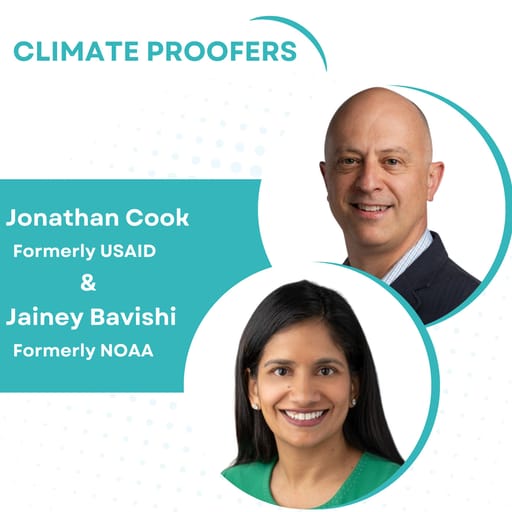
Transcript 0:00 [upbeat music] Hi, everyone, and welcome to Climate Proofers, the show all about those on the front lines of climate adaptation, finance, tech, and policy. 0:13 I'm Louis Woodall, editor of the Climate Proof newsletter, which you can read at www.climateproof.news. 0:20 I'm back from a fun few days at London Climate Action Week, and a few even more fun days after that enjoying the finest ciders in Herefordshire with my family. 0:29 Never let it be said that Louis Woodall doesn't get the importance of work/life balance, or more accurately, the importance of fine craft beverages to my own journalistic morale. 0:38 Anyway, it was wonderful meeting so many of you out and about in London. 0:41 Shout-outs especially to John Robinson of Mazarin Climate, who hosted a terrific climate adaptation tech showcase last Monday with a number of cool companies, who were, refreshingly, given some actually tough questions to answer about their businesses. 0:54 Also, thanks to Kit England, Paul Watkiss, and the folks at LSE Grantham for a top-drawer discussion on private climate adaptation finance. 1:02 It's a topic that I, and I know lots of you, are heavily engaged in, and this event was brutally honest about the reality of the current financing landscape for developing countries and the shortcomings of current so-called solutions. 1:14 There'll be more on that event to come in a future Climate Proof newsletter. Now, for today's episode, I've got something a little different for you. 1:21 Back in May, I attended the Adapt Unbound USA conference here in New York, where I moderated a spicy fireside chat on US climate adaptation with Jonathan Cook, formerly of USAID, and Janie Bavisi, formerly of the National Oceanic and Atmospheric Administration, or NOAA. 1:38 It was a matter-of-fact discussion about how the Trump administration had, within basically 100 days, gutted US adaptation initiatives overseas and hollowed out NOAA and other climate agencies that work to save lives and dollars from worsening climate shocks. 1:52 I won't lie, it got a little dark at times, but John and Janie were also defiantly optimistic about how the private sector could take on the mantle of adaptation amidst the federal government's retreat. 2:03 Hopefully, you'll find some points of light in the convo to hold onto as well. A big shout-out to the folks at Adapt Unbound for sharing the recording of the chat. 2:11 And for those of you in Europe, the conference is coming to you this October, and you can sign up today for tickets. Just head over to adaptunbound.com/europe for more information. 2:22 Right, in a minute, my conversation with John and Janie, but first, a roundup of last week's top adaptation and resilience stories. 2:29 [whooshing sound] In finance, new analysis from the Climate Policy Initiative shows that while global climate finance surged to a record $1.9 trillion in 2023, flows for adaptation slipped to just $65 billion. 2:42 That's down nearly 16% year on year. 2:45 A $20 billion drop-off in financing supplied by the China Development Bank accounted for the bulk of the yearly decrease, which was caused primarily by currency depreciation, as well as changes in how adaptation finance is classified. 2:57 This drop was partially offset by a surge in adaptation-related flows from green bond issuances. 90% of tracked adaptation finance came from public sources in 2023. 3:06 [whooshing sound] In policy, the UN climate talks in Bonn wrapped up last Thursday with a last-minute deal on a way forward for global climate adaptation indicators. 3:16 Countries agreed to task a technical expert group with whittling down a provisional list of 490 indicators to no more than 100, all of which would be globally applicable. 3:26 The final set should also include indicators for tracking adaptation finance and for so-called enabling factors, which are the actions, expertise, and technology transfers that help countries achieve their adaptation goals. 3:37 However, the text did not specify that finance indicators monitor flows from rich countries to developing countries, but simply between parties, to the disappointment of poorer nations. 3:48 The expert group must ensure all indicators are measurable and clearly adaptation relevant. 3:53 They are also instructed to develop sub-indicators tailored to different national contexts, which can be used by countries to supplement their reporting against the global indicators. 4:01 The reworked list is to be submitted to UN negotiators in August, when the decision-making over the final set will be taken up by diplomats in the run-up to COP30. 4:09 [whooshing sound] And in tech, researchers at Columbia Climate School have created a Climate-Finance Vulnerability Index, which ranks 188 countries by climate hazards and their ability to access adaptation finance. 4:21 The interactive data dashboard identifies the countries most at risk from cascading climate and economic shocks. 4:27 It spotlights 65 so-called red zone nations, which have high climate risk exposure and low access to finance. 4:34 Columbia says the index could be used by governments, development finance institutions, and public and private investors to prioritize capital flows and maximize the impact of each adaptation dollar. 4:43 [whooshing sound] Okay, that's it for this week's roundup. Now onto the conversation with John and Janie. [upbeat music] I'm here today to talk about the state of adaptation post-Biden. 4:55 And to help us with this, we have Janie Bavisi, former Deputy Administrator at the National Oceanic and Atmospheric Administration, NOAA, and John Cook, former Senior Resilience and Adaptation Advisor at USAID. 5:09 So in the 114 days since President Trump began his second term in office, we have seen the following developments. 5:16 USAID eviscerated, with reportedly 83% of its projects scrapped, and keep in mind that USAID was the largest provider of blended adaptation finance over the last few years. 5:27 The National Oceanic and Atmospheric Administration, NOAA, h- its headcount has been reduced by some 2,000 via firing and voluntary buyouts. 5:35 Its regional offices have been shuttered, and just last week, its billion-dollar weather and climate disasters dataset was frozen, which means no new updates will be made to this very important climate risk dataset. 5:47 The Federal Emergency Management Agency, FEMA, the primary disaster response agency in this country, is facing elimination, with again, just last week, its acting administrator abruptly fired. 5:58 And then there's been millions in grants from the National Science Foundation, the US Department of Agriculture, NOAA, the EPA, and others that were supporting adaptation and resilience that have been frozen or clawed back, and this is all in the last 114 daysSo my question to the two of you is how screwed are we? 6:16 [laughs] Janie, would you like to take it away? [laughs] I love being on a panel that's so upbeat. [laughs] So I think we've lost capacity, we're losing time, we've lost momentum, but I don't think we've lost the future. 6:33 And I don't wanna understate the seriousness of what's happening, right? We have the solutions, but we are dismantling the systems that we had to deliver those solutions. 6:45 As Louise already alluded to, we are seeing an erosion of capacity in federal agencies. We are seeing a disinvestment in resilience. 6:53 For example, the FEMA Building Resilient Infrastructure and Communities program, one of the key steady state programs, you know, in the absence of the Bipartisan Infrastructure Law and Inflation Reduction Act that we've had to invest in resilience and adaptation proactively has been dismantled. 7:08 We're seeing the privatization of key services that we have taken for granted as public goods, and we'll talk more about that, and we're seeing the silencing and scrubbing of science. 7:20 And we can't solve what we can't measure. 7:23 So, you know, with that, I'll just leave it at, you know, I think we're making ourselves slower, we're making ourselves more fragile, and I think we are making ourselves blinder in the face of rising risks. 7:35 And these are not just careless decisions, but the really scary part is that they are intentional decisions. Mm-hmm. I think you said at the prep call for this that the loss of expertise is very striking. 7:46 I think there was a stat you said, like a, a thousand NOAA staff that just departed. That represents over 27,000 hours of expertise, so- 27,000 years- Years... of expertise. Um- Sorry about that... 7:56 those are the thousand people who left with the early retirement and buyouts that were recently offered. 8:02 But I think that that stat alone doesn't tell the whole story, because the other stat that we need that we don't have is the 10,000 or 15,000 years of service we could have had from all those thousand people that left that we are now not able to benefit from because we show them the door early. 8:22 Mm-hmm. Yes, the loss capacity, not just institutional, but, like, human knowledge and expertise there. John, how screwed are we? 8:29 [laughs] Well, hi, everybody, and I just wanna begin by saying that this is me speaking on my personal behalf, not on behalf of the agency. 8:37 But yeah, I mean, there's no doubt that this is a massive blow to international adaptation assistance. USAID and the US government have been one of the key providers over the past few years. We... 8:50 Many of you know about the PREPARE initiative that the Biden administration, uh, put in place, which brought together all... 8:56 a lot of different agencies, including NOAA and USAID, to support many countries around the world on adaptation needs, and we were able to do some really significant things in those couple of years. 9:06 But with this kind of exit from the stage, as it were, there's a big gap that's left. I mean, I think the, the one silver lining is that we were not alone. 9:14 There are other public institutions, other donors and multilaterals and multi MDBs, et cetera, who will, uh, continue to play a role in this space. 9:24 But in the meantime, you know, it's, it's a significant departure at a time when the impacts are worsening, the needs are greater, countries are looking for help, technical, financial, et cetera. 9:35 So yeah, it's, it's not good, no doubt. And I will just add that with USAID, of course, being absolutely, uh, removed from the picture, it's not just the climate expertise. 9:45 We also had the thousands of people with a broader development foreign assistance background who were, in many cases, serving out in the field for decades, providing a much broader set of, you know, support to countries, and so this is all wrapped up in that kind of exit as well, so. 10:03 It might be worth at this juncture, actually, John, if I stick with you, if you could explain a little bit more about what you were doing at, uh, USAID in the pr- former administration, especially on the finance side, so we can kind of do a before and after here. 10:14 Yeah. I mean, you know, I was gonna talk a little bit about that work 'cause it's kind of been the, the focus for me of the last few years, and this kind of gets at the kind of where do we go next. 10:23 I mean, we've never been under the illusion that public agencies like us, governments like us, could pay for the, the adaptation challenge alone, right? 10:32 So a lot of the efforts actually have been, over the past few years, to try to drive more private capital and private investment and innovation into the market. 10:41 And so a lot of my work, we had set up something called the Adaptation Finance Window, which was a initiative to essentially provide blended finance to de-risk private investment into adaptation, particularly in countries and sectors where it wasn't flowing. 10:56 We all know this is kind of early days for the private investment into this area, but all the more reason that I think public capital, even small amounts of it, was playing a really key role. 11:06 And so we had, you know, we had put out a few grants to innovative early stage companies in sectors like insurance and water, but more importantly, I think we'd been supporting some of the new investment funds that have been starting to emerge and are trying to close and attract capital, kind of doing that through two ways. 11:25 One was actual sort of first loss grants to kinda get them started, but more importantly, I think, was the kind of the collective convening of other public actors, right? 11:35 I mean, a lot of the private investors were looking for public money, but they were also looking for a stamp of approval, right? 11:42 And the US government was able to provide that in some cases and really bring others to the table. So we were really proud of that. We got a few grants out the door. 11:48 We had a few others that unfortunately kind of died on the table back in January, which was really unfortunate. 11:55 But I'm convinced more than ever that, you know, that's part of why I came to be here today, that, you know, that's, that's the direction of travel here is to keep that focus on getting private money into the game, so. 12:05 That's interesting, the idea of the US government providing a sort of stamp of approval, like this is something you can invest in. 12:10 We're invested, so you can have trust that's happening, and you kind of lose that, not safety net or something, but I suppose a, a good signal that this is something to be invested in. 12:18 So hopefully we'll find a replacement for that US stamp of approval somewhere else. So-You both weren't super glum. 12:25 I thought you might be a little bit more [laughs] down in the dumps when I asked that question, how screwed are we? So maybe we should talk about- I can be more, I can be more glum. [laughs] Yes. 12:32 We don't wanna dwell though, so let's talk about where we need to go now, and be a bit more forward-looking. So we have reduced capacity. 12:38 There are certain resources, data sets, expertise that is lost to the US government, but perhaps we've got a clear idea of what needs to happen now globally and in the private sector to drive adaptation forward. 12:48 So, uh, Janie, maybe you can start with where we need to go. Yeah. I'm gonna pick up where John left off. 12:53 I mean, I, I think that we've known for a long time that adaptation can't just be funded with public sector federal grants, right? 13:01 There are blocks of cities, New York City included, that have been looking at opportunities to bring private investment and other kinds of finance into the mix, because, uh, federal funding is often undependable. 13:14 It's sporadic. It's reactive, right? 13:17 And so while the current situation presents I think some really tragic challenges, I think it also presents some opportunities to accelerate that transition from thinking about adaptation as something that is only subsidized with public sector grants, and starting to think about the transformation as something that can be bankable. 13:38 And, you know, let me just take the... I mentioned the FEMA BRIC program as an example. Diving into that a little bit more, you know, it represents $1.5 billion of very well-vetted projects. 13:50 We talk about wanting shovel-ready projects. These are projects with shovels in the ground that are now stranded. 13:56 So how do we use that opportunity to look at, you know, are there other ways to bring private capital, to bring other kinds of financing so that these projects can continue to move forward? 14:07 And it's interesting because, you know, I think that in some ways our reliance on federal grants has actually sort of limited our imagination in terms of how these projects could be financed. 14:20 And so it sort of takes those constraints off [laughs] for better or for worse, and allows us to think more broadly and more strategically. 14:27 I like the idea that, yes, without the limited imagination, maybe we can, like, break free from that. 14:31 I was wondering, maybe we could t- talk to some of those innovative structures that can unlock value for resilience measures in a minute. But Jonathan, do you wanna go on by saying where we need to go? 14:40 Yeah, I mean, I would agree that in some ways we're gonna now see how others step up to kind of meet some of the needs, and maybe use some different ways of achieving these goals. So it, it is a moment for creativity. 14:53 I mean, luckily as, as you said, Louis, there are other public actors that can provide some of these blended finance support that we were providing. We were not the only ones doing this. 15:03 We were working closely, for example, with some of the Nordic aid agencies. 15:07 I really believe that the Green Climate Fund's gonna become an even more important player over the next few years with new leadership, and, uh, there's a big structural reboot that's happened there over the past year. 15:18 So there are other players who can maybe provide some of that public support to help kind of catalyze investment. 15:24 But, you know, the real question I think we all have is, you know, there's reports coming out every week now on adaptation as an investment opportunity, right? 15:33 Trillions of dollars [laughs] that is waiting to be mobilized. Um, I think the latest one's this week from, uh, from Temasek and BCG, and there was one from the London School of Economics. 15:43 So lots of big numbers being floated around. But we have kind of heard this narrative before. 15:48 And so I think it will be very interesting to see, and this is kind of a preview of what I wanted to, to say to all of you really who are working in this space, you know, can we really get to scale and start to, to kind of break through this place we've been for the last decade or so of, you know, little glimmers of interest from the markets and from some of the investors. 16:08 But, you know, now we're taking away some of the ways in which the public sector was catalyzing that or mobilizing that. So how can we go from here? 16:17 I just wanna stick on this point of public sec- finance, because you mentioned the, the GCF, the Green Climate Fund could step in here, but that also gets some funding from the US that is being scrapped. 16:25 So it just feels the overall pool of capital is shrinking. 16:29 So are we gonna start seeing these institutions try to make each dollar go further, or do you think we're gonna see a shrinking of what adaptation resilience means, like certain projects that may be on the fringes of what's considered adaptation maybe get disbanded, and those that have more multiplier benefits so that not just adaptation, but mitigation, biodiversity, food security? 16:48 Will there be a doubling down on those double, triple, quadruple bottom line benefits? Yeah, it's a good question. 16:53 I mean, I've worked a lot for years on the whole area of nature-based solutions, which some of you probably follow, and, you know, I think of that as like a really good example of a whole category of opportunities that have multiple benefits, and that can be maybe attracting capital from different directions. 17:08 And so yeah, that's probably one answer to your question. 17:11 I do think there's always been this challenge too with financing adaptation of figure out the things that really are public goods that the public sector needs to pay for, and then focus the private investment on the places where it actually has a return on investment and an interest. 17:26 And it sounds so simple, but that hasn't always been the case, right? Just kind of that rationalization of the... 17:32 And, and I think in, as you say, Louis, in a context of the pie is gonna get smaller, we have to be really smart about how it's allocated. 17:40 And this is kind of where, you know, again, unfortunately one of the roles USAID was able to play because we had such a field presence, was working in countries to help figure that out with our partners, right? 17:50 We would work with the finance ministries or the environment ministries and say, "Okay, you need how much money for your adaptation priorities? 17:58 What is something that, you know, public money needs to be paying for, and what are things where we could maybe reach out to private sector actors?" 18:05 And so I think that kind of rational, strategic approach is also gonna be really important.So you can look at where there's business models, and where there are business models, maybe that's private sector. 18:13 Where there isn't a business model, that's where the public sector has to double down on. Jeannie. 18:17 Well, yeah, and I just wanted to add to that because I think that it's gonna be really important for our partners in the public sector at state and local levels to be bearing witness to what is not financialable, right? 18:27 Like, I don't want to provide any illusion that we are gonna solve the scale of the challenge with private finance alone. I think we do need to also be documenting where we need those federal grants to come back, right? 18:40 Because at some point, we don't know when, and there's a lot [laughs] that could happen between now and then, we are gonna be rebuilding these systems, and what do we want these systems to look like? 18:49 So there's re-imagination that needs to happen really at all levels, right? The status quo is gone. 18:53 Let's think about what are the opportunities for the private sector to really lean and lead, but let's also be thinking about where do we need the federal government support to be reinstated. 19:03 And beyond the federal government, though, what do you think state and local governments can do to try and incentivize adaptation, resilience investment? 19:08 There have been some interesting projects at the city level, the county level, state level. 19:12 In DC, for example, stormwater retention, stormwater management is incentivized at the neighborhood level I believe, and there are other projects that are kinda similar to that. 19:19 So I'm wondering to what degree I suppose state and local governments can kinda pick up the slack maybe, or maybe do more themselves to build resilience in their local areas. 19:26 And if you have any examples of financing structures or initiatives that kinda fit that mold, it'd be good to hear them. I think we need to be baking adaptation into every investment that we are making, right? 19:37 Whether it is a public investment or a private investment. 19:40 Before I was at NOAA, I was the director of the Mayor's Office of Climate Resilience right here in New York City, and one of my proudest achievements from my six years with the city was to pass local legislation that required the consideration of future climate risks in every capital investment that New York City makes, whether it's a buildings project, an infrastructure project across the entire $90 billion capital portfolio. 20:02 That matters, [laughs] right? 20:03 It's, it's not just about thinking of adaptation as a separate asset class, but really thinking about adaptation as a cross-cutting function that we need to be considering across every investment that we're making. Yeah. 20:15 I was talking earlier just before the panel with one of the delegates about this idea about do you classify adaptation as separate investment because it's a marketing thing, you can get people excited about a new themes, you know, people wanna know what the next big thing is, they can structure funds around, or special products around. 20:29 Or is it more important for the actual cause of adaptation for it to be integrated at, in existing functions, existing processes? 20:36 And I feel there's maybe a divide happening here, 'cause y- you mentioned those research reports that very firmly say, "Adaptation opportunity, X trillion dollars." But adaptation... 20:45 E- each of these reports kind of classifies adaptation as a very different thing, [laughs] or they're focused on a very particular investor universe. 20:51 And then there are those who are talking about resilience and adaptation in a slightly less overt way, but they are talking about engaging with corporates where they are and trying to get them to tweak their spending models, tweak their behavior. 21:02 So wh- where do you fall on this, John? Do you think, uh, adaptation should be, should be separate or embedded? 21:07 You know, my main motivation, a lot of our work for many years has been more on that integration approach, but I think I'm kind of agnostic right now. I think we need all the resources, whatever people wanna call them. 21:19 You know, some... I think there is this kind of maybe interesting... I was chatting with somebody about this yesterday. 21:25 It is interesting timing after the election and all the changes we've seen that all these reports are coming out saying adaptation and resilience is an investment priority. Well, great. 21:34 If people wanna point to it and, and label it that, that's gonna hopefully drive some capital in. 21:39 But at the same time, I mean, a lot of the, like, unseen dirty work of adaptation is more about integrating it, not necessarily calling it out, but making sure that all of the other work we're doing, I mean, in a development context, it's our, all of our ag and health and infrastructure work. 21:55 And this was a lot of our work at USAID as well. It wasn't just the adaptation programs. 21:59 It was how do we make sure all of our colleagues who work on other things are considering climate data, are thinking about where and how, uh, climate change is gonna affect the work that they're doing. 22:11 So that's a big part of it as well, and if companies and investors want to, you know, take that more integrated approach for whatever motivation or reason, I think that's also really important. Yeah. 22:22 I'll be interested to see how that sort of divide plays out in the next few years. Okay. 22:26 So we talked a little bit about public sector and a little bit about the private sector, but I do wanna go into where you think the particular gaps and opportunities are for the private sector particularly. 22:34 'Cause there are those who think that dealing with extreme heat is the number one priority, others who think agriculture and ensuring food security is the most important. 22:42 I was wondering if you have any views about where you think money needs to go quickly in order to prevent devastating losses that we have already seen in the US and elsewhere. Yeah. 22:51 Well, it's, it's hard, it's hard to rate these things, right? I mean, it depends where you're, where you're looking, and it's very country and city and other specific. 22:59 But, you know, again, I think some of it is where the commercial opportunities intersect with the climate risks. I do think extreme heat is becoming... 23:09 I mean, this probably was the single most visible issue as I was preparing to leave my job. It was popping up in a lot of our work with cities. 23:18 It's clearly an area where there's a lot of need for innovation and investment. 23:23 But I will also say that I think there's a lot of opportunity still in the, the more traditional sort of development sectors like water and agriculture. 23:30 I mean, the world, as we all know, has major issues in feeding everybody and in providing clean water for everybody. They're being compounded. 23:38 There's all kinds of challenges that can't be solved alone by innovation and technology and money, but that's a big part of it, getting the right approaches to scale and making sure they reach people. 23:49 And this is kinda going back to the importance of public and private still working together, right? I mean, I think all of this, this is a... 23:56 The private sector's so good at innovating and getting ideas out, but we still need governments and public actors who can help ensure that they reach the broadest set of, of actors, right? 24:06 So that people aren't left behind, so that people have access to these technologies. And so that's where, you know, I think there's... 24:13 I mean, the public-private partnership is a bit of aA truism, but it's still a really powerful idea that you can kind of harness the best of both to, to make sure that people benefit from the things that are coming out of the private sector. 24:26 Now, one of the hot topics or hot verticals in climate adaptation tech is data or climate intelligence, and indeed, that Temasek and BCG report you mentioned said that climate intelligence is gonna be one of the growth areas, opportunity to grow 15% year on year over the next five years. 24:41 Janie, NOAA, of course, was very important when it came to public provision of data and providing information, uh, hazard warning, et cetera, uh, and also information that was being used a lot by private companies to build their own products. 24:54 So I mentioned we've lost a billion-dollar dataset. NOAA's capacity to continue doing monitoring of, of the atmosphere, of ocean systems is diminishing, so there is gonna be like a retrenchment of public data. 25:05 So I'm wondering what can be replaced by the private sector in this space, and what do we lose if we don't have this wonderful source of open data anymore? Yeah. 25:14 I think, you know, just backing up here, the administration intends to privatize the National Weather Service, and just as, like, a moment of education, no matter what app or what source you're using to check the weather forecast to figure out what to wear in the morning, that foundational data is most likely coming from the National Weather Service right now, right? 25:33 So what does it mean for the National Weather Service to be privatized? Let's just ignore climate data for a second and just talk about weather data. 25:40 It means that there are likely gonna be communities that do not have access to data, because weather will be behind a paywall. 25:47 There will be some markets that are bigger than others, so there will be blind spots, literally, in terms of our weather forecasts. 25:53 It will mean that there will be a chill across the ecosystem when it comes to innovation, because right now that weather data is open source, and that means that the private sector, the next generation of climate innovators are taking that data and creating all kinds of different platforms, delivery apps, like, ways to engage people with that data, but it's... 26:13 the foundation of that is open source data. There could be an undermining of public trust in the data. Think about, you know, the potential for disinformation. 26:23 When in our prep call I called it the MSNBC/Fox News dynamic when it comes to weather forecasts, right? The weather will be serving commercial and political interests in a way that it does not now. 26:33 So I think that open data is a, is a strategic asset. It gives us a competitive economic edge. It makes us a leader in the global fight against climate change, and that is what is at risk right now. 26:48 Yeah, so there could be a siloing by ideology, but I also fear about the siloing by, like, capital access. You know? Like, so small communities in rural states, usually red states as well, may not have... 26:58 be able to afford, like, uh, the, whatever replaces the National Weather Service. And then richer cities, New York and LA, et cetera, they might be able to afford the, you know, high-end stuff. 27:08 So that'll be an issue there. John? Yeah, I was gonna say, I mean, the, there's a similar dynamic internationally again. 27:13 I mean, we were very involved in a lot of countries in working to provide climate data to both governments and communities and other users. 27:22 And the risk here, again, is I think there's, again, like, a legitimate value for commercial operators to come in and private data providers, but, um, there's a lot of fragmentation that happens, right? 27:34 And access issues. It's the same dynamic. Uh, are we really reaching poor farmers who, who really need that data, or is there kind of equity issues with how it's getting distributed? 27:45 So a lot of our work was through governments with their met services, the kind of equivalent of the National Weather Service, many of which need help and need capacity, and we were, along with other donors, trying to help them strengthen their work. 27:58 So I, I worry about this. 27:59 I think there's a lot that can be done to keep the data coming, but we still need it to be put into this kind of ecosystem of, like, a public framework to make sure that it reaches the people who need it most. 28:10 And, you know, some of you might have read that as with many things that we are kind of relinquishing as we back away from foreign aid, this is another area where the Chinese are coming in, right? 28:21 So the Chinese have actually been, uh, supporting, not coincidentally, right? 28:26 Like, they're coming into a lot of developing countries now, many of which they're already in for other reasons, and they're trying to help support their met services and their data centers and things like that. 28:36 And so you can... we can speculate about their motives for doing that. It's not that useful. 28:40 But the point is, like, the US has, again, kind of relinquished a, a really significant way in which we were providing help to a lot of countries, so. Yeah, it's an avenue to soft power, right? Yeah. 28:50 If you can provide these services, you can be... countries can be- become client states or become very grateful to [laughs] whoever's providing those, those resources. Okay. 28:57 Finally, then, I wanna do a little call to action, try and rally us together. 29:01 How can we keep moving forward despite the retrenchment of the, the federal government, and, and what's your closing message to the private sector? 29:08 If you were in a room with a hedge fund manager or a pension fund that said, "All right, I've got a billion dollars to allocate. What's this adaptation resilience theme? Why should I put money in there?" 29:17 I'd be interested to know what your, what your answer would be to that. Who wants to take that first? Who wants to think more? [laughs] I'll attempt. Okay. 29:22 Um, so I think the first step is to continue moving forward, right? We cannot normalize delay, despair, disinvestment. 29:30 Like, I think, I think one form of resistance is just to keep doing the work, so that's just a, a, a basic level. I'm glad we're here and having this conversation. 29:39 You know, I think that there is a level of this that's just about stopping the bleeding, right? 29:43 And NOAA is in a different place than USAID, and we have noticed that, you know, while a lot of bad things have happened, when people have spoken up, less bad things happen, right? The... 29:54 We've seen the administration go back on some of the things that they've said that they would do. 29:58 So I would just say if you're in a position to articulate the economic costs of the loss of these services, please put that out there. You know, speak to your congressperson. Write an op-ed. 30:11 You know, j- just I think that your voice matters, you know? And I'm just... I'm gonna just put that out there. But I, I think the other opportunity here is to now reframe adaptation as a core market challenge, right? 30:23 It's not just a public good. It is a core market challenge, and we have the opportunity to not only protect assets, but really align the market with the future we all want in the face of, uh, rising climate risks. 30:37 So-That's what the space we need to lean into now. Let's figure that out. Let's figure out what that looks like, recognizing that the public money that we have been relying on doesn't exist at that level anymore. 30:49 And there has been good some preempting of what the federal government is doing. 30:52 I just read the other day about McGill University in Canada is actually becoming a source for a lot of these data sets that have been put offline in the US. 30:59 They found new homes, and you've-- I'm sure you've all read about these other initiatives to bring federal data and to preserve it and to keep it going in some way or other from these nonprofits and academic, uh, spaces. 31:08 So that's positive as well. John, your call of action to the private sector? Yeah, I, I mean, I, I think again, to me, it's just continuing to push forward, but to enlarge the group, right? 31:18 I mean, it's great to see everybody here. I know there's a lot of interest in this area. 31:22 We just need to kind of broaden the circle and bring in some of the more mainstream institutions that are sitting on huge pools of capital and the potential to really help shift those markets. 31:33 And I know a lot of them are interested. I mean, again, I think these reports that are coming out, even, I mean, Morgan Stanley put something out this week. 31:40 They speak to a, a real recognition of this as a, as an emerging investment opportunity, but also societal challenge. 31:48 But it's kind of pushing to that next level of the money really starting to move and that sort of more integrated approach that basic decisions are taking climate risk into account. 31:59 It's just seen as best practice or b-business as usual. And we need, we need leaders to show the way, and I think some of them are here and are kind of showing what that looks like. 32:07 And it's kind of about enlarging the conversation and just getting more people around the table going forward. And, you know, part of why I'm at the, at the conference is really making this pivot myself. 32:17 I mean, I've, I've got twenty years working in adaptation in government and nonprofits, but I really do see the, the engine of, of change in the years to come in the private sector. 32:26 And I'm, I'm here to hopefully find some opportunities to contribute to that. So look forward to talking to some of you on the, on the breaks about that. 32:34 So the state of adaptation is strained, it's a bit bleak, but there's no despair here, it seems. There's opportunity and there's energy, which is great to see. 32:42 [upbeat music] Climate Proofers is a Climate Proof media production. It is produced and presented by me, Louis Woodall. Subscribe to the Climate Proof newsletter by going to climateproof.news/subscribe. 32:53 And to learn more about the publication, feel free to reach out directly using our LinkedIn page. Goodbye for now. [upbeat music]