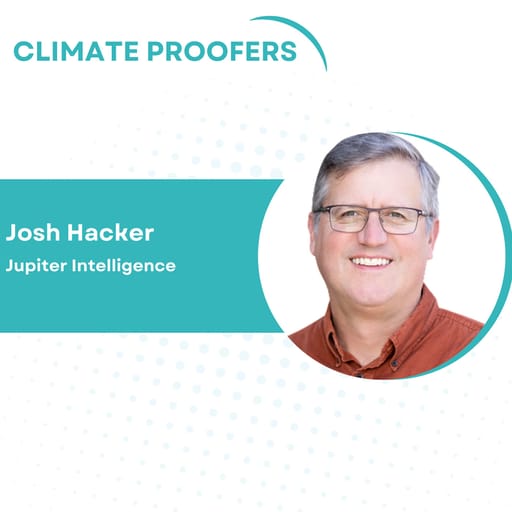
Transcript 0:00 [upbeat music] Hi everyone, and welcome to Climate Proofers, the show all about those on the front lines of climate adaptation finance, tech, and policy. 0:13 I'm Louis Woodall, editor of the Climate Proof newsletter, which you can read at www.climateproof.news. Today, I chat with Josh Hacker, Chief Science Officer and co-founder at Jupiter Intelligence. 0:25 Now, Jupiter is one of the OGs of the climate intelligence space, a vertical that's among the hottest in climate adaptation tech right now. 0:31 The company's been kicking since 2017 and raised a whopping fifty-four million dollar Series C round in 2021 to build out its offering for banks, financial institutions, real estate, and others. 0:42 The company says it works with one quarter of the world's largest financial institutions, including 20% of the Global 100. 0:48 Josh has decades of experience in atmospheric research and weather analytics, and joins today to talk about the evolution of climate models, how they are used to create risk identification and management tools, and the challenges translating uncertain climate data into actionable information for sophisticated corporates. 1:04 We also dig into transparency, trust, and why building the tools for climate adaptation is as much about systems change as it is about science. 1:11 It's a rare chance to hear from a climate scientist who also knows his way around the tech and finance space, and I'm sure lots of you will be interested in what he has to say. 1:19 Before all that, a reminder that this podcast and the Climate Proof publication writ large are supported by paying members. 1:25 All this, the pod, the newsletter, the Adaptation 10 reports on climate tech could all go away if we can't get more folks to sign up. 1:32 So if you value what Climate Proof is doing, do consider becoming a member by visiting climateproof.news/upgrade. Now, I've set a challenge of doubling the membership from 150 to 300 by end of September. 1:43 I'll let you know each week how we're getting on and give shout-outs to those who do make the leap, so do stay tuned. 1:48 Okay, in a moment my chat with Josh, but first, a roundup of the top adaptation and resilience stories. 1:53 [whooshing sound] In finance, climate adaptation and resilience financing may grow to between 0.5 to $1.3 trillion a year by 2030, a new study shows, making this a potentially lucrative opportunity for private equity. 2:05 However, the report by Singapore investment company Temasek and consultancy BCG adds that money managers, quote, "Have struggled to capitalize on adaptation opportunities because of challenges identifying suitable solutions providers." 2:17 To fix this, Temasek and BCG have introduced a climate adaptation and resilience investment opportunity map to guide investors, and particularly private equity firms, on the sectors and sub-sectors where adaptation solutions lie. 2:29 It said the most promising areas include climate adapted agricultural inputs, climate resilient building materials, and climate intelligence, meaning software and analytics. 2:37 [whooshing sound] In policy, America's top climate and weather agency will no longer track billion-dollar climate disasters, in another sign that the federal government is abandoning its role as a public source of climate risk information. 2:48 As of May 8th, the Billion-Dollar Weather and Climate Disasters webpage, which is hosted by the National Oceanic and Atmospheric Administration, or NOAA, will no longer be updated, quote, "In alignment with evolving priorities, statutory mandates, and staffing changes." 3:02 Last year, the webpage tracked 27 extreme weather and climate disasters where losses exceeded one billion dollars, including Hurricane Milton, which caused over thirty-four billion in damages, and Hurricane Helene, which inflicted some seventy-nine billion. 3:14 Janie Vivishi, a former NOAA deputy administrator, told Climate Proof, quote, "Scrapping it now is a politically convenient blackout. If we can't measure the damage, we can't hold anyone accountable. 3:24 And without data, there's no way to build true resilience." [whooshing sound] And in tech, two flood risk technology companies have launched new tools for evaluating flood-driven financial losses in the US and Canada. 3:35 UK-based Fathom released a US flood risk index, which offers state-by-state insights on current and projected future flood losses. 3:42 This covers annual average loss, or AAL, a financial metric used by insurers, plus the amount of each state's population and infrastructure at risk. 3:50 Total AAL is projected to reach thirty-eight point nine billion by 2050, around 28% higher than it is now. 3:57 Separately, US-based True Flood Risk debuted Canada's first national foundational data set for structural elevation, providing essential information on property-level flood risk. 4:07 This data set should be of value to insurers, property developers, and governments when it comes to gauging the exposure of homes and offices to flood risk. 4:14 The company published a similar foundational data set for the US in 2019. [whooshing sound] Okay, that's it for this week's roundup. Now on to my conversation with Josh. [upbeat music] Hi, Josh. 4:25 Where are you calling from today, and what do you do? Hey, Louis. Good to see you. I'm calling in from Boulder, Colorado today. And, uh, my current role is Chief Science Officer at Jupiter Intelligence. 4:37 I've been familiar with Jupiter Intelligence for many years now. You're one of the OGs of climate risk analytics, if I may say so. 4:44 And I wanna know a little bit about your own background, Josh, and how you came to be part of the Jupiter Intelligence story. Yeah. Let me see if I can cover some of the key points. 4:52 It really came through a fairly traditional, academically oriented, um, career track for a while in atmospheric science. So, um, I... 5:03 After I got my degree, I spent time at the National Center for Atmospheric Research here in Boulder, which is a National Science Foundation-funded organization, and did my postdoc here. 5:13 I was a scientist here for a while, then I spent some time on faculty at the Naval Postgraduate School teaching meteorology to graduate students and continuing my research there. 5:23 I came back to NCAR, back to Boulder, and transitioned more into managing scientific teams. I was still writing papers, but sort of over time a little bit less and less, and got more into management. 5:35 My research has always been focused pretty broadly. You know, in academics, there's-- we make choices about going the deepest and being an expert on one thing in the world, or doing a little bit of, of a broader... 5:46 Or sort of engaging in a little bit of a broader program, and that was, that was my approach. 5:50 Just trying to solve problems mostly around weather prediction, predictability, data assimilation, which is initializing the forecast models, probabilistic prediction, things like that, and a lot of focusing on near Earth surface types of predictions as opposed to, say, the stratosphere or-Details on thunderstorm formation, for example. 6:10 So pretty broad and rather applied type of research portfolio, if you will. And I met the CEO of, uh, FCO of, of Jupiter, uh, back in around 2010 when I was on faculty at the Nova postgraduate school. 6:26 I helped them out a little bit on the side with some, with a venture they were involved in then that was around sort of medium range weather forecasting. So that's how I got to know them. 6:34 We established mutual trust during that period. We kind of went our separate ways, and all of us engaged in careers sort of around where science is still... 6:43 And we came back together in 2017 to help start Jupiter, a more seasoned crew, if you will, in the broader space of Earth prediction and applications around that. 6:52 That's interesting, the idea that you all gathered together at one point in time, 2010, went your separate ways, and then came back together. 6:58 Was there something about the timing of that second meeting that it made sense for Jupiter to be born at that time? Why do you think it worked at that point rather than when you first all got together in 2010? 7:08 I think that there were two, there are two sides to that question. 7:10 One, the first one is it's just very clear that the impacts of climate change were becoming an imperative, that we weren't gonna, uh, as a global society, really do enough to eliminate the emissions to solve the greenhouse gas problem, if you will, to prevent pretty serious impacts, right? 7:28 And so our, our view was, well, let's focus on adaptation. Let's make it a money problem. Let's price risk, right? 7:35 So that we can tap into the vast corporate capital around the globe into helping solve the problem from an adaptation side. So that was one part. 7:43 There were signs that there was going to be growth in the regulatory pressure on the corporate world to lean into this problem and really both disclose, but also manage risks. 7:55 The climate risk itself, the physical climate risk that was growing, right? So there was that. 7:59 The other side of it was more technical in terms of where we thought the Earth system modeling capability were at the time fairly mature, right? 8:08 Incremental progress still goes on, and there's some newer things we can talk about later where progress is accelerating. But Earth system modeling's fairly mature. 8:17 There's the technical stack, if you will, around machine learning and AI really had grown over the, over the previous decade, sort of allowing efforts to be built on top of large data sets and then cloud computing, right? 8:29 So the entry, barrier to entry is much lower, right? We didn't have to go buy massive hardware, right, to do the problem anymore. 8:36 So those three things were kind of like three legs of a stool, if you will, to support our technical approach to then dealing with adaptation that we thought, and still believe, is just becoming more important than ever. 8:46 I want to stay on this topic of the technological maturity of climate modeling, of Earth modeling, because Jupiter's been around now for then eight years. Mm-hmm. 8:55 And you've seen climate modeling evolved and climate modeling being repurposed or downscaled for the use of financial institutions, for corporates, et cetera. 9:06 So I'm interested to know, like in your time at Jupiter, how has climate modeling evolved, and what still needs to happen in the space between academia and business to make it really useful for the private sector, to really make it drive decision-making? 9:21 That's a good question. It's a big question, and there's a lot of things we could talk about in here. Um, I, uh, just a clarification, am I allowed to you, am I allowed to ask you a question? Oh, for sure. Go ahead. 9:30 Yeah. So back to you. When you say climate modeling, can you expand a little bit on w- on what you mean, right? And I'm asking that because 9:37 people use that term in a lot of different ways now, especially in the business context. So I'm just curious to get your take on that. 9:43 I'm thinking here when I say climate modeling, I'm thinking about these big beasts that are used primarily by the scientific community for projections of future global warming and the effects thereof. 9:52 So these include the CMIPS, which are the products of the Coupled Model Intercomparison Project. These are general circulation models or GCMs that provide mathematical representations of the Earth's climate system. 10:04 And I'm also thinking about these ensemble models, right? These integrated assessment models or IAMs that are used for transition risk modeling. So when I say climate models, those are the ones I'm thinking about. Great. 10:13 Okay, that's what I think of too. I just wanted to make sure that... Uh, that's a great place to start. I'll, I'll probably stay away from the integrated assessment models a bit. 10:19 The global climate models are just closer to my expertise, easier for me to talk about. I think the big thing we've seen over, say, from... 10:26 Well, there, there, there are many, but let's start with what have the, how have the models themselves evolved, right? The obvious thing is they've sort of evolved towards more physical realism, right? 10:35 And these are, these are incremental. Um, they're, they're... Doesn't mean they're not important, but they're incremental, and they're hard. 10:41 And, and, you know, if you use the word beast, they, these are big models, right? They've taken hundreds of thousands of man-years to build. 10:47 They require many tens of man-years to sort of evolve in a meaningful way over a short time period. 10:53 So sort of evolving towards more phy- physical realism, and there's a couple of examples we can point to that are pretty important in the climate system. One is treatment of clouds, right? 11:03 Clouds have a big effect on the energy balance, and we've known for quite a while that that's been one of the sort of physical shortcomings of these models, and there's been a lot of work that's gone into that over the last decade, so... 11:14 Uh, I'm not making any claims about perfection in these, but they've certainly improved in their treatment. The other area that's important from an energy balance perspective is aerosols, right? 11:22 So other things besides greenhouse gases, right, that can affect, uh, both how moisture's transported in the atmosphere, for example, but also how heat is transported in the atmosphere and how much the sunlight goes in and out. 11:35 Both of those have big effects. They're examples. There are, there are many others, right? Every aspect almost of a climate model gets touched and, you know, this effort at improving it between sort of one generation. 11:45 If we think about the CMIP's climate model intercomparison projects as defining a generation of models, and then there's another one, you know, maybe seven years later, that's sort of a timescale of an evolution of a climate model. 11:57 It's not that things aren't always going on, but it's kinda easy to think about it on that cadence and, and so almost every part of a climate model gets touched during the, the period between these CMIPs. 12:06 So that's one area that's been evolving quite significantly, again, at a steady pace. 12:12 Another is about the transitionAnd this is really very directly in the CMIP, CMIP framework to the socioeconomic, shared socioeconomic pathway framework, SSPs. We used to think about, um, 12:26 the, the RCPs representing the concentration pathways, and these are how we get to certain energy balances. It's very physically driven, right? 12:33 And there was a desire for some time to link that to how the global economy and cooperation between countries and education level and wealth is evolving, and this is a lot of where the IAMs come in, integrated assessment models. 12:46 But what it really does here is provide an- the SSPs provide an interpretation framework for these concentrations. So things like, okay, countries aren't getting along, they're not transitioning to a green economy, 13:02 most likely means there's less wealth, and you end up throwing more greenhouse gases in, in the atmosphere. 13:09 So there's a tie between high greenhouse gases and certain evolutions of, of our sort of social, social system around the globe. 13:17 It's, it's all very approximate, so it's best thought of as we can assign consistency between these two, or we can evaluate consistency between the shared socioeconomic pathway and a, and an emissions pathway, 13:30 but you can't say there is a one-to-one relationship, right? Because we don't really have that causality worked out fully. There's just too many details. 13:36 I think one of the interesting things is that, that, that shared socioeconomic SSP framework was around before CMIP6, but it wasn't yet brought together with the RCPs. 13:46 So CMIP5 still used the RCPs to define the climate scenarios, and, and CMIP6, they, they unified it into the SSP framework, which implies some emissions pathway as well. I think what's a... 13:58 The other thing that's kind of essential to remember here, which gets into the second part of your question a little bit, is these were created for a couple of purposes that are not about understanding climate risk. 14:10 They came out of grassroots efforts, you know, way back to the early CMIPs. They came out of grassroots efforts by climate modeling centers around the world, of which there are many more than there were back then, 14:20 to, to find ways to compare the models with each other or learn from each other, thus the climate model intercomparison projects, that's what they're for. 14:30 And then ex- span ranges of plausible scenarios without saying m- anything original about what will happen, right? We can't assign a likelihood to any one of them because it's too far in the future. 14:41 We can't know what the outcome of this is. We can try to span the range of possible outcomes that then link to what we'd wanna do from a policy perspective in terms of emissions, right? 14:52 That's how the IPCC uses the output from the CMIP efforts that are going around the world. So they're very much developed for that, which is a good thing to develop them for. 15:01 And what we've done over time is think about how to use data in a risk management framework, given that they weren't really designed for that. So to me, it sounds like these GCMs, they have become 15:13 more coherent or they've coalesced with all the information they need to be as effective as possible, like bringing in the RCPs, bringing in the SSPs in the same framework. 15:22 So it does sound like there's a more comprehensive view of the climate that's available now than there was back in 2010 when you guys were first knocking back some ideas. Yeah. 15:32 I think interpretation that the SSPs enable is really, really useful to think about. We just have to be very careful to not go down the road of assuming that we're following a particular pathway at any time, right? 15:44 That's sort of one of the challenges that, that end users need to overcome. Yes. Sometimes there seems a sense like, okay, we could only be on one of these SSPs, right? [chuckles] Yeah. 15:54 There's, there's no variation, but actually we know we're on a... it's less a, a path and more like a continuum of transitions we're go- undergoing, right? So- That's right... 16:03 I do fear about the mindset being, "Okay, we belong to this category right now of S- SSP3," or whatever. Right. And actually, now we're moving to this, this, this SSP instead. I don't think that's the case. 16:14 Uh, but absolutely it's helpful that we have all the information, all the inputs in sort of one modeling framework. 16:20 But now onto the topic of how actually you make all this big data, big information, like broad brushstroke projections, how you make that useful for businesses. 16:30 So can we talk about how you kind of take this climate modeling data, input information, and make it usable for your clients? Yeah. 16:38 I think there are a number of things to do that are kinda critical and, and they get talked about a lot. One thing is we know the models aren't perfect, right? 16:46 So we, we wanna model some of those errors, and typically we think of that shorthand as bias correction, right? So that's something we need to do, and that helps us reduce some of the uncertainty, right? 16:56 It doesn't eliminate it, but it helps us reduce some of it. The other is we want to use, uh, as much information as we can from all these different GCMs, right? 17:06 There are a hundred, sort of around a hundred contributing centers. They share a lot of history, many of them, but they also contribute in independent information. 17:15 And, and, you know, a, a sort of a classic example is you can have two GCMs that have different precipitation trends in a region, right? 17:22 One might be getting wetter, one might be getting drier, and then what do you do with that? It doesn't mean one is right and one is wrong, 'cause we can't say that, but they're both useful in their own way. 17:30 We like it when they all agree, but that just doesn't happen all the time. 17:33 So using as much available GCM information as is available, and then thinking about what it means in terms of quality, which is a bit of a challenge, especially when you think about how GCMs can tell you something about impacts on the ground, right? 17:47 It's kind of a different quality question that you try to answer in- instead of the classic question that climate modelers try to ask about their models is, does it adhere to the energy balance models that we understand? 17:57 So what... If we run a model a long time with some emissions, does it end up where we think it should end up? And some are better than others at that. I think that from an impacts perspective, 18:09 it's the less relevant question to answer, if you will, and part of what you just talked about is for that reason, where we don't know where we're gonna be in this range of things, so we, we wanna use all available information, including things that-Including some of the models that we think might not adhere to some of these energy balance questions as well, because the impacts you can derive from them are still possible, right, in so- in some sense because the relationship between the model and the impacts... 18:37 Any one model and the impacts that, uh, it, it can represent in the future, they're not perfect either, right? And so you don't wanna be throwing out information, right? That's sort of it in a nutshell. 18:47 What else needs to happen? One is we wanna capture uncertainty, right? So the climate is very slow, right? What matters for impacts is all the fast stuff that happens on top of the slow-moving climate. 18:57 I tend to think of climate as all the range of things that can happen at any one time, right? So there's a lot of fast things that contribute to the full climate. 19:06 But when we think about climate change, it's sort of the mean of that, sort of the average of that, and that's very slow. But the impacts actually can change faster than the mean of that climate, which is what 19:16 part of the reason that we wanna include a lot of information. But what we do in practice then is take all that fast stuff and include it in uncertainty, right? So there are all kinds of uncertainties in this process. 19:27 One is the models themselves. We already talked a little bit about that. The range of models, right, so capturing the variability across these models. 19:34 There's also, in the climate system, there are faster things that are going than the climate, things like El Niño that we're all familiar with, but there are a bunch of other sorts of oscillations like this that happen. 19:45 We call them modes in the earth system, both the atmosphere and the ocean in particular, and those have an impact on sort of annual weather patterns, if you will, typically, or even up to decadal weather patterns. 19:56 And so that, that adds variability that we all, all have to remember is back to the question about what pathway are we on, right? Are we following some scenario? 20:05 Not really, because one year, due to this kind of variability, can be way up here or way down here in terms of impacts, and we can't predict those modes very well very far out. 20:13 So, you know, maybe a few years at most for cer- in certain cases, but mostly not even a year or two. So we wanna keep that in the uncertainty. And what does that mean? It means 20:22 we're constantly suggesting to our customers that they make sure they think about the uncertainty part of it, and it's part of the reason we supply that almost religiously, if you will. 20:32 Every data point we give a customer also includes uncertainty. So that allows a ques- a, a customer to say, "Well, okay, in 10 years, this is the slow part. This is sort of the mean of the temperature." 20:44 Just take temperature as an easy example. 20:46 But I could have a year, because of this uncertainty, that's way up here in the distribution, right, closer to the upper part of the uncertainty range, or even, even a little bit beyond it, depending on how you characterize it. 20:57 So the uncertainty's a critical piece of it. 20:58 So just to kind of come back to the core of the question, it's, you know, correct the errors you can correct, use as much information as you can, supply uncertainty, and then encourage our customers to not look at one outcome, right? 21:11 Really look at a lot of outcomes. Wonderful. 21:13 There's a lot to unpack there, but actually, what you just said at the end there, I wanna explore a little bit more because surely there's a tension when it comes to trying to sell climate data, climate modeling to institutions that are used to working with lots of numbers. 21:28 They kind of want to be told, "This is the number you need to follow. This is what you should use as your north star for reorientating your portfolio to take into account physical risks. 21:38 This is the data you need to put in place adaptation and resilience actions." 21:43 So I'm wondering if you've seen in your time at Jupiter this sort of friction between the need to provide kind of uncertainty and provide a range of outcomes and to inform your clients that, look, there are a number of things that could happen, and then also trying to sell the product so that it's useful to the end user. 21:59 Yeah, I mean, y- you're, you're absolutely right, and the answer is yes, right? I do see this. I would say for the more mature consumers of this information, uh, I see it less and less, right? 22:09 Over time, I've seen it less. A few years ago, I saw it a lot more. That's good, right? We want people to be using the amount of available information, and in a sense, it's... 22:17 it shows that transition from our natural tendency, which happens in weather forecasting too, to think about that there's some number, right, or something that's going to happen, right? 22:26 And we know that that's not how the Earth works, and we can't predict the Earth in that way, even, even for weather, right? So yeah, there is this tendency, and it still happens. 22:34 And I don't always know the cause of it, but the easy one, uh, to think about is we don't know how to use it unless we have a number, right? It's sort of the starting point. 22:43 And over time, we can evol- you know, organizations or consumers of this information learn how to use more and more information there. 22:51 There are other more pessimistic views you could take of why this isn't being used around, you know, anywhere from cognitive dissonance to I don't wanna know my worst-case scenario because then I'm gonna have to tell somebody, right? 23:01 So there's, there's sort of a maturity view on it and a skeptical view on it. Our job, we can't tell our customers how to use the data. 23:09 We can make a lot of suggestions and show them what we think are best practices, but at the end of the day, they have to make decisions. 23:13 So part of it, coming back to some of the things we've already talked about, is there's a range of possible outcomes, right? 23:19 If I'm really a betting person, right, a- and I can't even assign a likelihood to one outcome, right, what do I do? I, you know, look at the range of possible outcomes, which means looking at many, many outcomes, 23:31 and then make a decision based on my own risk tolerance what I wanna plan to, right? Do I wanna plan to something in the middle? Do I wanna hedge, right? 23:41 Uh, do I wanna look at some bad things and decide that I'm gonna put some money against that because there's some probability that could be the outcome? 23:48 So I think just moving towards that more information is something we want to keep encouraging, and we... and I do see it, right? I do see it. The climate risk analytics space has evolved over time as well, right? 23:59 I mean, Jupiter has a large amount of competition now in this space. 24:03 You have firms like ClimateX, you have First Street, you have Suss Global, you have a number of startups who are either trying to provide all-in-one climate risk analytics or trying to shave off a particular hazard, whether it's flood, whether it's storm. 24:17 And I'm wondering your experience, like how have you seen the market change, the, the demand for services, but also the competition change. 24:24 And then again, what do you think-differentiates a climate risk analytics solution that can be trusted versus one that may be nice to use, very pretty to use, but actually may not give you relevant information that is useful to your business? 24:39 I think to me the biggest change over time, and I, I don't have... 24:43 I mean, I guess I could in- come up with some sort of data-driven approach to back this up or not, but what it feels like i- to me is over the last several years, maybe the last five years in particular, 24:52 there's sort of been a j- a broad, uh, I'll use the term awakening, i-if you will, around, around risk, right? General and broadly. Not just climate risk, but risk. 25:01 It covers things like pandemics, geopolitical instability, spats and wars, these sorts of things, that all create economic friction, right? At a macro level, but also at an individual corporate level. 25:13 So, you know, I think there is a lot more awareness of this generally in the C-suite. It's not that people weren't thinking about risk before. 25:20 I think there's just a more comprehensive thinking about risk that's come online. You know, climate of course does this too, right? 25:26 The direct physical impacts are kind of easy to think about, and especially when there's perceptions among many people, which are accurate, that they're happening more frequently and are sometimes more severe, if you will, depending on how you define that. 25:38 That, that sort of increased frequency or severity is what puts a sort of additional strain on the system, right? Additional economic strain. So as people's 25:48 recognition of risk, of understanding and managing risk in a broad spectrum of risks that are out there have grown, there's been more attention on these other effects, the long-term effects that ripple through the economy, right? 26:00 A bad year, what that does, not just a one-week supply chain problem, right, but it actually drags... it puts drag on the supply chain for months possibly in some cases because supply chains are so complex. 26:11 That's just an example, but kind of an easy one to think about. Hard to solve, but easy to think about, right? 26:15 So the leading organizations on the market are recognizing this, and I would say, you know, and by organizations I mean banks and global corporates. There, th-there's, 26:27 relative to the overall economy, the number of those organizations that are that far along in their thinking about climate risk is relatively small, but they're big organizations, right? 26:36 So they have an outsized impact on the economy, if you will. They're still learning how to do it in many cases, but they're committed to doing it and then they're making real progress. 26:44 I think that's, that's sort of what I've seen. 26:47 What do you believe differentiates a credible, coherent, science-based client risk analytic solution from something that might look pretty, may provide some numbers that are useful to a financial risk modeler, but may not actually be rooted in the science? 27:02 What do you think are those differentiating factors? Right. 27:05 I mean, I'm of course biased in my view of this, and I think, you know, for me, our job, if you will, our sort of core job, is taking the best available science from the global community of, of climate scientists, 27:20 translating that and applying it to decisions, right? So what that means is, is being honest to the science, right? 27:27 There's just a few things you really need to do to extract robust and defensible information from the climate models. We didn't talk specifically about downscaling. There are many approaches to downscaling. 27:38 This is taking the large slow things that happen in climate models. An easy example is tropical cyclones, right? 27:45 You can't really see a tropical cyclone very well in a model with 100 kilometer grid spacing, in many cases not at all, and embedding within that in a sense what those tropical cyclones might look like in that climate, right? 27:57 So that's an example of downscaling. There are many ways to do it. You have to make a lot of choices along the way about how you do it. Some are better than others. 28:05 There's no one way to do it that's good for every problem, right? So you have to make, you have to make a lot of choices. To make all those choices you need 28:12 climate scientists who have done this and can read the literature and interpret and understand the issues, right? So examples are we want to make sure we maintain the climate signal, right? 28:22 Climate signal, like what are these GCMs about t-telling us about climate change? We want to make sure when we downscale, we retain that information, and not all downscaling does that. 28:30 We want to make sure that we're estimating the uncertainty in a robust way. 28:34 We want to make sure we're building up enough information to actually calculate extreme values that tell you something about return periods of events and things like that. 28:43 So all these things need to happen, and I sort of see that myself, again, I'm biased in this as a scientist, but I see that as the minimum bar to be credible in this space, in my view. 28:53 Then you feed into the questions about trust and credibility as the market views you, right? 28:58 Just all those things I just said don't always resonate in the market because a lot of it has to do with the maturity of the organization that's consuming the information, right? 29:05 The most mature customers we have, they know, they understand that. They come to us because they want the most defensible scientific methods. 29:14 What we have to attach on there f- add on there for trust is things like, you know, transparency comes up a lot, right? As an example, right? How, what does transparency mean in thinking about trust? 29:25 It doesn't mean one thing. To certain kinds of users, we can hand them the deep technical document and they can say, "Oh yeah, I understand this. I can see this. I can see exactly how you model all these things." 29:34 And, and we do that for our most technical users. There are a whole other slew of, of users, I think of them as day-to-day decision makers, who need to use the information, but they... 29:46 a lot of the, the trust for them is around perception. It's less about is it the best science, and it's more about does the information I'm using to make a decision reflect the world we're living in today, right? 29:59 One way this gets done in the media is there's a big event and somebody asks, did your model predict that event? 30:07 It's not actually a question you can answer in this space because it's not really the, the right question to ask, but understanding whether the information you're getting from, say, Jupiter's models or whoever's models would've said, "I could have expected that event to happen," right? 30:23 A-as opposed to, "No, that event can't happen," right? And that gets back to using as much available information.This point on transparency is very important, particularly in a communications context, right? 30:34 When you're trying to explain your solution and why people should trust you. And I'd like to refer to this study that the nonprofit group Carbon Plan did last year- Yeah... 30:43 where they were trying to assess or benchmark different climate risk models against each other. And they reached out to nine providers, and only two responded. One was Jupiter Intelligence, and one was XDI. 30:54 But there are a number of other big names in there, The Risk, Climate X, who either declined to respond or didn't respond. 31:00 And I think it's interesting that Jupiter and XDI in this case as well, were willing to kind of put their stuff out there and participate in this sort of civil society exercise, essentially to try and get greater understanding of climate risk modeling. 31:14 Mm-hmm. Because one thing you hear is that because the private sector is kind of leading ahead on climate risk analytics, that there's a sort of Wild West emerging. 31:23 This is a phrase used by Professor Madison Condon of Boston University. She was on Doug Parsons' America Adapts podcast recently speaking about this. 31:31 And there is a concern that the private sector could take credible science, these GCM outputs, this GCM framework, and then tinker with it and create outputs that aren't transparent and aren't credible. 31:40 So I think transparency is very important, and I wonder how you exercise transparency and display transparency to your clients. 31:46 And do you think it's also important to be transparent to civil society, to the media, et cetera? You know, it means different things to different people, right? 31:53 Being able to look at data like from multiple providers, like the Carbon Plan exercise, that's one version of transparency, right? 31:58 And I think the lesson there, which could be repeated in many different ways, is that everybody's output is gonna be somewhat different, right? This is true in weather forecasting. It's true at the GCM level. 32:09 It, you know, every model gives you something out that we're dealing with modeling complex systems. And you have... 32:14 Eric, I mentioned before, you have to make a lot of decisions, and so the results are gonna be different, okay? Does that mean they're not usable? 32:21 Not really, but it's more, it's more about how you use it, what you should and you shouldn't use it for, which is another part of transparency, is helping the consumers understand, "Hey, these are decisions that you can rationally make based on this. 32:34 Those other ones, they might give you some indications about it, but I don't know if I'd be betting money on that," right? Because the quantitative nature... 32:42 The quantitative part of the output that comes out might not quite be there where you need it to make that bet, right? So that, that's part of transparency, and I just think of that as being honest to the science, right? 32:52 There's another... There's a view out there that transparency is about, uh, writing peer-reviewed papers. And, you know, I've been... 32:59 I've written my share of peer-reviewed papers, and I've been an editor of a top atmospheric journal. I, I still am for, you know, a decade or so, and I- I've seen it all, right? 33:08 I will say that a general rule in earth system science is trying to reproduce what somebody did from a peer-reviewed paper is near impossible. 33:17 Most of the time, it is impossible, unless it's a very theoretical paper that focuses on a very narrow set of topics. That, that's sort of the old way of doing some earth system science. 33:26 We're in this world where a lot of earth system science is driven by very complex models that you just... It's, it's, in practice, very difficult to reproduce. 33:35 Everything, every detail matters to get you the result you got. So, you know, my view is, okay, that's one way to talk about transparency, and it's nice to explain that. That's fine. 33:45 We've published sometimes, not all the time, but we publish sometimes. But that feeds in- that and that feeds into kind of the general documentation question, right? 33:53 When we have customers who are operating now under an NDA, so we're not telling everybody, these are conversations we have, right? "Here's how this works. Here's what you can use it for. 34:03 Here's what you shouldn't use it for. Here's where the uncertainties are greater. Here's where it's less." 34:06 If they're capable of trying to understand, and some are, capable of trying to understand really at a detailed level how the calculations are done, we're more than happy to go into that, right? 34:15 And so that's another aspect of transparency. There are probably others. I think there's no one way to solve a transparency problem. Now, would it be nice if there was a broker out there of some kind that said, 34:30 "You know, we've reviewed this, and we've reviewed that provider or that provider, and here are the strengths and weaknesses of them from a scientific credibility standpoint"? 34:38 I would love that personally, but there isn't one, and so we, we kind of are where we are. Um, but- Well, there's, there's the argument that government should have a role here, right? 34:49 Like these agencies that have climate data and the capabilities could create a fully open model- Mm-hmm... 34:57 that could be used as a benchmark, and yes, the argument would be this model's not gonna have all the data and expertise that a private product had, but it creates a, a baseline on which to kind of orientate yourself. 35:07 That obviously does not seem to be happening in the US, and probably will not happen in the US. Yeah. 35:12 But I am interested to know what you think about, yes, a sort of a benchmark, a sort of lowest common denominator benchmark that is open source and public. Yeah, I mean, I would be supportive of that in principle. 35:22 I, I think, you know, part of the education process in the market here is you can look at more than one answer. You should be looking at more than one answer. I know that's not always practical. 35:31 So the danger is that if there's an organization, a government organization that's viewed as authoritative, that there is gonna be a tendency to think about... that that's right and everybody else is wrong, right? 35:41 Which is not the right way to think about it i- in this problem. And it also could conceivably, I'm not saying it would, but it could 35:49 slow down innovation only because it's just gonna be easy for end users to say, "Oh, well, that's right. Everybody's using it." 35:58 And then because everybody's using it, I can't gain a competitive advantage, so why would I go pay somebody? I'm not saying that would happen, and I'm not even advocating one way or another on that. 36:07 I'm just saying that there's a lot of dynamics that, that are involved in that. 36:10 [chuckles] The practicality, unfortunately, is that where we are today, you're right, it's not gonna happen, at least in the US, and I don't really see a lot of indications of other organizations doing it. 36:19 And probably the closest is in the UK, where they, for regulatory banking stress tests in particular, the Bank of England, you know, says, "Okay, 36:30 thou shall use this data," right, that comes from the Met Office and the Hadley Centre.That's fine, you can do that. 36:36 And back to a lot of things we've already talked about, now you, you aren't getting a full view of the risk, right? Because you're not... 36:42 You're only getting kind of one answer, if you will, or whatever range of answers they provide. It's complicated. 36:47 I, I, I would say in general, especially because I have a lot of confidence in what we've done, I would support something that's more publicly oriented and government driven. They... 36:57 I do believe as a global citizen, governments have a role in this, right? 37:00 There are just parts of society that aren't gonna be able to pay, and getting that information into those parts of society in particular is a critical role of government. 37:08 Anything they can do to help the credibility, not just of individual companies like us, but of the marketplace providers, helps the market, helps the market develop. 37:17 Kind of back to the idea of there are leaders that are mature, and then there's a whole bunch of other companies that aren't. 37:23 If the governments c- help move that along from a credibility standpoint, not just from a regulatory standpoint, but from a credibility standpoint, that's good for everybody. It's good for all of us providers. 37:32 It's good for everybody out there living and dealing with climate change, in my view. Mm. So. 37:37 Yes, I do think it's telling that all the climate risk model practitioners I've spoken to, Oliver Wing at Fathom, you, when I speak to Climate Hex, when I spoke to Tomorrow.io the other week, they're all saying the same thing about there is a role for government data, public data, open source data, and it shouldn't be seen as competition. 37:58 It should be seen as facilitation, and for awareness, and as helpful to the overall ecosystem. Yep. 38:05 Now I, I wanna finish by talking about taking this data that you provide and how it's translating to action on the ground in terms of adaptation resilience. Mm-hmm. So I feel like that's a gap that's still there, right? 38:15 There's a lot of companies now that are selling data and saying, "This is how you can identify your risks." Right. 38:22 But what about data and workflows that help to actually guard against that risk, prevent, protect, help build resilience? 38:29 I'm interested in how you can bridge the gap at Jupiter and what you think still needs to be done to take data into action. 38:34 Yeah, I mean, you know, ourselves and others on the market have, you know, some version of vulnerability that feeds into adaptation, right? That allows things like sensitivity testing, right? 38:45 If I, if I make this part of my portfolio more resilient, this is sort of a order of magnitude what can happen in- to my balance sheet, right? I would say, you know, I think, I, I... 38:55 Rather than talk about individual use cases, I'm gonna make m- maybe bring this up just a small level, which is... 39:00 Look, what, what we're doing as the foundation of all of this is doing a really good job in providing the physical information, right? And that's, that's where you have it. 39:07 There, there, there are many, many dynamics in this, right? One is garbage in, garbage out, right? You as- assume you have a perfect vulnerability framework, and then if you give it bad physical data, 39:19 you're gonna get a bad output, right? Okay, fine. That's easy to think about. The, the other part of it, though, in reality 39:25 is that there's so much to know about vulnerability of different kinds of structures, different parts of the world, all this stuff. It's like an infinite problem, right? 39:34 We can keep getting better at this for decades, and we'll never f- be perfect at it, right? 39:39 So I think the ability to muck around and ask questions, you know, broad questions about sensitivity, order of magnitude changes, 39:46 that we can do now, and our customers do this, and that's a super useful grounding concept. 39:52 To really get to the detailed level, you know, we're talking about vulnerability of lots of different kinds of assets in lots of different locations. And then their supply chains, right? 40:02 Tier one, two, three supply chains that they mostly don't know anything about or they know very little about, right? You c- you start to get an idea of the complexity of the problem. 40:11 This is, like, the thing we're gonna be working on for a long time and keep improving. So useful now. We have a long ways to go, right? 40:18 Yes, the idea that it's a practice adaptation, it's not like a one-and-done fix is important for corporates to grasp and financial institutions to grasp. 40:28 And I like this idea you bring up about, yes, you can always get more data, and this is something that comes up a lot. 40:32 Like, yeah, where's that line between I've got enough data to understand what I should be doing and wanting more data so you can be absolutely precise that every dollar you're putting to adaptation resilience is well spent? 40:43 It's like, well, you're probably never gonna get to that point, or you could always argue... You could always say, "Okay, can we take one more step granularity, one more step granularity?" Yeah. 40:50 And I think that's a challenge. But I really do think the next wave of climate risk analytics firms are gonna be analytics and solutions as in the true, true meaning of the term solutions. 40:58 Like, okay, we've modeled this risk for your portfolio for these assets in these locations. These are the risks. These are the actions, the kind of no regret actions you can take to mitigate that risk somewhat, right? 41:09 And I think that's the stage I'm kind of waiting to see- Mm-hmm... that ki- kind of gap traversed. 41:13 And I think then we can really see a real drive by corporations, by financial institutions, by local governments to really start investing in the analytics and also the solutions. Yeah, I totally agree. 41:23 And I, I mean, I often... I have a thing that I've started some presentations with, often in an academic setting, and I still give some at our universities from time to time, but more about the business side of it a bit. 41:34 And I think, you know, you're touching on a thing that's really important, and maybe this is a good wrap-up, is the value chain for climate risk analytics is complicated, right? 41:44 There are many pieces to that, and there's no one actor that's gonna solve all of this. So there's no one organization, one actor, one component, if you will, that really addresses the entire value chain. 41:56 And so I'm sort of back to we're all better off if we can help the market grow together, right? Well, I think that's a great place to leave it, Josh, and I'm grateful that you spent the time to talk about Jupiter. 42:07 And I think it's positive that Jupiter is in this value chain, as you say. 42:11 The fact that you are open with your, with your data, you're engaged in civil society and academia and in, and the business world, I think it helps to bring awareness of climate risk and, yeah, hopefully bring greater awareness of what we need to do to protect ourselves from the worst shocks. 42:27 So thank you for your time, Josh. I hope to have you on again soon. Thank you, Louis. I've enjoyed the conversation, and I also appreciate what you're doing in this space, so have a great day. 42:36 Climate Proofer is a Climate Proof Media production. It is produced and presented by me, Louis Woodall. Subscribe to the Climate Proof newsletter by going to climateproof.news/subscribe. 42:46 And to learn more about the publication, feel free to reach out directly using our LinkedIn page. Goodbye for now. [upbeat music]