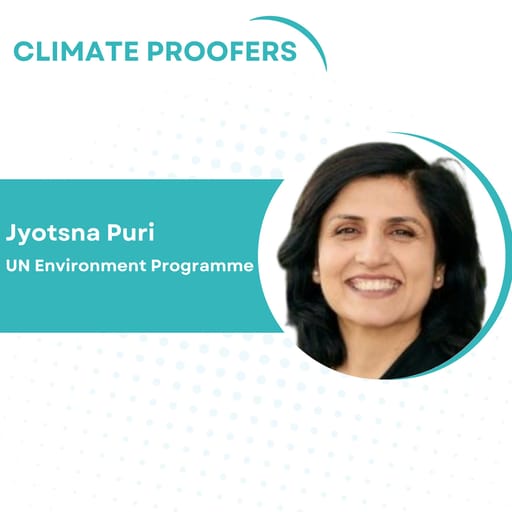
Transcript 0:00 [upbeat music] Hi, everyone, and welcome to Climate Proofers, the show all about those on the front lines of climate adaptation and resilience. 0:13 I'm Louis Woodall, editor of the Climate Proof newsletter, which you can read at climateproof.news. There's no getting around it, we are failing the Global South when it comes to climate adaptation finance. 0:24 People in the poorest nations on Earth are getting hammered by ever-worsening climate shocks and lack the means to defend against them. The gulf between supply and demand is, frankly, ridiculous. 0:34 Nonprofit group The Climate Policy Initiative estimates that average annual finance needs are $212 billion for the developing world, and actual flows last year, they were barely one-third of this amount, 76 billion. 0:47 The thing is, we can't just fill this gap with charitable donations and development finance. Other actors, including the private sector, have to get involved. But why would they if they can't get a return on investment? 0:58 Today's guest has been at the beating heart of adaptation finance since before I even knew what adaptation was. 1:04 Jyotsana Puri, known as Jo, is the incoming director of policy and programs at the United Nations Environment Program, which is responsible for coordination responses to climate and environmental issues within the UN system. 1:16 She is also an adjunct professor at Columbia University's School of International and Public Affairs, where she teaches development effectiveness, and a senior fellow at the Center for Strategic and International Studies in Washington, DC. 1:28 We talk about Jo's experiences building up adaptation finance in her earlier posting at the International Fund for Agricultural Development, or IFAD. 1:36 We also touch on her innovative work as the inaugural head of the Independent Evaluation Office of the Green Climate Fund, which is the largest multilateral climate fund out there. 1:45 We then get into the financing structures and innovations that she thinks could move the needle on adaptation finance, including the idea of resilience credits and reforms to global accounting and bank capital frameworks. 1:57 Few people have the depth and range of insights on adaptation finance like Jo. I certainly learned a lot from the conversation, and I hope you will, too. 2:04 Before we get into the conversation, though, I'd like to shout out all those folks I met at the inaugural Climate Tech Connect conference in Washington, DC, last week, and say well done in particular to Megan Kosinski, who founded the event. 2:16 It's no small task putting together any conference, let alone one focused on a niche and emerging space like climate adaptation and resilience, so hats off to her. 2:24 And of course, as always, I'd like to remind casual listeners to the podcast that Climate Proof is a subscriber-supported production, and that it'd mean the world to me if you'd sign up to become premium subscribers over at www.climateproof.news/upgrade. 2:39 Also, there's a new climate adaptation technology virtual roundtable taking place next week on April the 30th, 12:00 PM Eastern Time. 2:46 This is all about coastal erosion and flooding risk and features Christy Swan, who is CEO of the startup Our Coast. You can find more by heading to the Events page on the Climate Proof website. 2:57 I hope to see lots of you there. All right. In a moment, my conversation with Jo. But first, let's round up some of last week's adaptation and resilience stories. 3:05 [whooshing] In finance, billions of dollars of federal grants for green banks and climate resilience projects remain in limbo after a volley of US court orders last week. 3:13 On Wednesday, US District Judge Tanya Chutkan ordered Trump officials to unfreeze around $625 million of Greenhouse Gas Reduction Fund grants awarded to nonprofit groups by the Biden administration. 3:26 However, on Thursday, a US Appeals Court stayed the order, preventing access to the promised funds. 3:32 Climate United, one of the nonprofit groups challenging the Environmental Protection Agency over the funding freeze, said any efforts to undermine the judge's ruling would, quote, "jeopardize local projects already under construction and cost thousands of good-paying jobs." 3:45 Speaking to The New York Times, a spokesperson for the group said it would fight the appeal court stay. The earliest they could seek relief is this Friday. 3:53 Also last Wednesday, another US district court judge ordered five federal agencies to release climate and infrastructure grants awarded under President Biden's climate laws. 4:02 Nonprofit groups said the Trump administration had unlawfully barred access to the funds that had been properly appropriated by Congress. 4:08 [whooshing] In policy, the latest European State of the Climate report finds that more than half of European cities have dedicated adaptation plans in place, up from 26% in 2018. 4:19 However, climate-induced challenges are growing more formidable, which may require a rethink on adaptation implementation. 4:25 The report says Europe experienced its most widespread flooding since 2013 last year, affecting some 413,000 people. 4:33 The continent also sweltered for its second-highest number of heat stress days and tropical nights on record, with southeastern Europe suffering its longest ever heatwave. 4:41 To improve adaptation, the report says, quote, "tangible targets are needed to gauge progress and ensure accountability." 4:47 The most cited blockers of adaptation action are insufficient funding and the lack of sustained political commitment, while the most common enabler of action is citizen engagement. 4:55 [whooshing] And in tech, Make Sunsets, a two-person cooling tech startup, has been issued a demand for information from the Environmental Protection Agency in a sign that geoengineering firms may be the latest targets of the Trump administration. 5:08 Make Sunsets uses balloons containing sulfur dioxide to create reflective clouds in the stratosphere about 66,000 feet above the Earth. 5:16 It claims that one gram of sulfur delivered at this altitude offsets the warming effect of one ton of CO2 for an entire year. 5:23 The EPA considers sulfur dioxide a criteria pollutant that can harm human health and the environment when present in large volumes near the Earth's surface. 5:31 However, the amount released by each Make Sunsets balloon is tiny and is highly unlikely to have adverse health effects if it stays in the stratosphere. 5:39 EPA Administrator Lee Zeldin said the company's actions, quote, "show how climate extremism has overtaken common sense." 5:46 He went on to say that once the information request was answered, the EPA would look into all its authorities to, quote, "continue maintaining clear air for all Americans." 5:55 [whooshing] All right, that's it for this week's roundup. Now on to my conversation with Jo. [upbeat music]Hi, Jo. Where are you calling from today, and what do you do? Hi, Louis. Very nice to be here. 6:07 I'm currently in Rome, and I will soon be starting my position at UNEP with the United Nations Environment Programme as Director of Policy and Programs in Nairobi. Thanks for joining us today, Jo. 6:22 I had the pleasure of meeting you at a recent event on adaptation finance here in New York, and you said some very interesting things, which I wanted to get on the record in today's podcast. 6:30 Now, you have a bio that's as long as my arm. It's a long and storied bio. 6:34 Besides your upcoming position at UNEP, you are also Visiting Fellow at the Center for Strategic and International Studies and an Adjunct Professor at Columbia University, correct? Yes. 6:44 And both of those are current and will continue to be current for me for at least the foreseeable future. But you're also coming off of a four-year posting at the International Fund for Agricultural Development. 6:56 Can you tell us a little bit about your time at that agency and how your work dovetailed with climate adaptation efforts? Absolutely. Thanks, Louis. 7:04 So yes, I've been working with IFAD for almost four and a half years, and I joined as Director of Environment, Climate, Gender and Social Protection. 7:15 But very soon after, I became the Associate Vice President of Strategy and Knowledge at IFAD. 7:21 I think one of the key things that was the focus of both my director position and also the position that I took on subsequently as Associate Vice President, was the big move that we made as a team for IFAD in terms of climate and more precisely in terms of climate adaptation. 7:40 And the reason I bring that, that distinction out is that for a lot of international financing institutions and MDBs, mitigation has been the traditional route that they have chased climate goals with. 7:54 At IFAD, we realized very quickly that if the institution was to do anything additional and different for people on the ground, and especially people living in rural areas and in developing countries, which are the mandate of IFAD, the focus of IFAD had to be climate adaptation. 8:12 And so that became very much the focus of, uh, the programming as well as the policy directions that we chose when I joined in twenty twenty. 8:22 And in fact, at that time, we had approximately twenty-three or twenty-five million dollars in programming. 8:29 Current programming as well as the projected programming by the end of twenty twenty-five for IFAD will be close to nine hundred million dollars. 8:37 Most of this is really in the space of climate adaptation because, like I said, resilience building was identified as the key area that an institution like IFAD could really contribute to, given that IFAD is focused on low and low-middle income countries. 8:55 So I think the ticker really moved, uh, um, uh, for IFAD, but I like to think as well that the ticker really moved for many of the institutions and partners that we worked with, especially member countries who are working with IFAD on the ground because they realized that IFAD was one of the very, very few financing institutions on one side, but also multilateral and UN agency on the other side, which meant that it was going to focus on leaving no one behind. 9:25 And that's where adaptation sits very, very comfortably. IFAD is still burdened by reporting on leverage ratios, which is the traditional reason as to why most institutions chase mitigation goals. 9:39 But I like to think that we managed to get a range of partners involved with us, as well as we thought about adaptation on the ground. 9:49 I think IFAD represents a good case study for other multilateral institutions that want to move into adaptation, right? 9:56 'Cause I hear a lot about the challenges of getting more funding for adaptation is the institutional structure of big organizations like, like The World Bank, like the Inter-American Development Bank, et cetera, et cetera. 10:07 So I'm wondering what lessons do you take from that time at IFAD on how to get other multilateral institutions to reorientate themselves to adaptation? Is it getting the right people in place? 10:16 Is it making the business case for adaptation? What, what learnings do you bring from your experience? Great question, and thank you for phrasing it like that. You're absolutely right. 10:25 I think one of the key challenges that IFAD witnessed, and I definitely witnessed it during my tenure, was that adaptation projects tend to be extremely small, so the deal size is very small. 10:35 You don't usually have a pipeline of adaptation projects that are seen as low risk, and so for financing institutions, it's really difficult. 10:42 And third, the definition of what is adaptation is often conflated, confounded, or just challenged, and that creates an obstacle when institutions have to really deal with adaptation projects versus, say, mitigation, where you have a conversion ratio, you have-- you know exactly the amount of, or at least within ranges of confidence, you know the amount of carbon you're going to sequester. 11:08 You know the quality of that carbon that you're going to sequester. 11:11 And because it's so well defined, private sector or commercial institutions are willing to come in because they're also mostly connected with infrastructure projects, and countries are very happy to take on infrastructure borrowing. 11:27 So key lessons I think that we took on was exactly drawing from the challenges that I just mentioned. First, you've got to ex-measure extremely well. 11:37 Second, you've got to think about capacity building, but not in the traditional sense of, you know, having people who understand adaptation, although that's very important. 11:46 But capacity building and really the sensitization of also cl- vertical, uh, climate vertical funds like the GCF, although they were mandated and are mandated to do a fifty-fifty split between adaptation and mitigation, also needed to see downstream agencies and accredited entities willing to take on adaptation projects and to really work with the commercial sector.So I think the first one would definitely be measurement. 12:14 The second one is really forming an alliance or a coalition of the willing, especially amongst commercial sector actors. And third, and this is really important, be willing to take on the risk. 12:26 So very early on in my tenure, we set up what is called the IFAD Climate Facility, which required grant money, which is quite precious money, to really be providing the kind of risk capital that we required to take on the risk as we were doing the programming as well as the designing of climate ad- adaptation projects with countries. 12:49 In climate mitigation, I think you do have a lot of that, um, stretch facility, but in adaptation, we realized very quickly that the risk capital was really required. 12:59 And so within the first year of me joining IFAD, we took a proposal to the board to set up a $10 million IFAD Climate Facility that could give us that ability to essentially take on risk, but also get on some capacity within the institution, and also get on capacity for reporting, which becomes quite burdensome for a lot of small institutions. 13:22 I wanna get into some of these broad themes around adaptation finance that you mentioned a little later, especially on measurement and risk capital. 13:30 But I wanna talk about another institution you've been involved in first, the Green Climate Fund, the GCF. This is one of the big boys of climate finance world. 13:38 It has, of course, also come under its fair share of scrutiny and criticism in the past, and I'd like to hear your thoughts on GCF. 13:45 But first, can you explain what your role was as inaugural head of the Independent Evaluation Office? 13:50 And for listeners who may not be familiar, can you just give us a quick summary of what the GCF is and its importance to the climate finance fight? Sure. So let's start with that last question first, Louis. 14:01 The Green Climate Fund is a multilateral institution which was born out of the Paris Agreement. 14:07 So when the, uh, the 195 countries of the world signed on to the Paris Agreement, they decided that they would have a financing facility, not just in the global environment facility, but also as a separate facility called the Green Climate Fund. 14:23 At that time, the board, or at least the transition board, also recognized that being part of the Bretton Wood institutions or the UN institutions made multilateralism a little bit challenging because of traditional governance structures that had been set up for Bretton Wood institutions as well as the UN. 14:43 And so the GCF was placed outside of the UN system, even though it's a multilateral organization. So that's sort of the background. 14:50 It is the largest climate financing institution today, and has, I think, programmed a- approximately $50 billion and then leveraged, I think, with the ratio one is to five. 15:02 I hope I'm not misspeaking, but definitely that. 15:06 So it's really made an impact, and the key remit for the GCF was and continues to be to provide financing to developing countries for mitigation and adaptation in grant equivalent terms of one is to one. 15:19 So f- half of it going to mitigation, half of it going to adaptation. Okay, so that's essentially the background of the GCF. I came on as the first head of independent evaluation at the Green Climate Fund in 2017, 15:36 and I was one of four board-appointed officials, along with the executive director of the GCF, as well as the two other heads of the independent units, the redress mechanism, as well as the integrity unit. 15:48 And my role was really to first grow the office, but also less explicitly, but almost as importantly, to build a culture of accountability, credibility, and reporting within the institution. 16:02 That was quite challenging because my first year and a half was essentially spent just begging and borrowing funds just to set us up. 16:09 But also, rightly so, I think many people also wondered as to what the role of an independent e- evaluation office could be in an organization that was quite as nascent as GCF at that time. 16:22 And I think, and this is to the credit of the board, they very quickly realized that unless you set learning and credibility and accountability quite early on as part of the overall DNA and the fabric of an institution, it's very, very difficult to change the culture later on. 16:40 And this was something that I was really supported by many of the board members who constituted the GCF board at that time, but also many staff within GCF who I'm really privileged to know also because they-- I think we all were-- We all believed in GCF and believed in the ambition of GCF, and I still remain quite awed by how much countries, when they come together, can do, and I think the GCF reflects that. 17:08 One of the key things that we did very quickly was to actually step away from the traditional evaluation sort of accountability role, which is usually seen as a wrap on your knuckles kind of role, and really realized that we needed to build a culture where the secretariat of the GCF or the executive director's office and us work together to really think expansively and openly about what the strategic focus and pivots of the GCF could and should be. 17:37 And so literally, in I think record-breaking time, we produced what is called the str- first strategic or forward-looking performance review of the GCF. 17:47 There were two key things that came out of that forward-looking performance review. 17:51 One, we were able to take numbers to the board and say that it was still taking, at that time, and this is 2019, 1,500-- approximately 1,500 days from the first day that an agency submitted an application for accreditation to the first day that they essentially got their first dollar. 18:10 So that's about five years? That's, uh, yeah- More than that?... approximately, yeah, four and a half years. So- Mm. 18:15 And that I think was a really startling number, not just for the board, but I think also for the incoming new executive director at that time.Who I know really use the forward-looking performance review as almost a Bible. 18:28 The second big headline message that we took away was that the GCF was not focusing sufficiently on adaptation. 18:36 It was clear that the GCF at that time was not leveraging the kind of grant resources it had to both create an enabling environment where the commercial sector could come and support pipelines of adaptation projects. 18:51 It was not doing innovative stuff enough to really push the frontier in terms of both learning and understanding as to what climate adaptation projects can and should be developed, and how they could really be additional for countries. 19:07 I think both of those were taken on pretty strongly. The third one, not surprisingly, was our message with respect to country ownership. Because of the accreditation model, 19:18 we also, uh, we also emphasized that country ownership was not as strong because the GCF really has to work through, uh, accredited entities. 19:28 So at the country level, because the GCF was not focusing on building that common coordination mechanism that any sector agency that is a leader in its space should be taking on, it was not building that coordination mechanism. 19:43 So countries didn't realize that fundamentally the resources were coming from GCF, and this was leading to a neglect of the remit of GCF at the country level. 19:54 So if you look at where the GCF was when you first started and where it is now, what would you say are the main transformations, the main beneficial transformations? 20:04 And then what are the kind of headwinds you see the GCF facing? 20:08 We heard earlier this year that the US is pulling some of its pledged finance to the GCF, a considerable amount, and I understand from my sources that that's already kind of scrambling the forward planning for the institution. 20:20 So what are the positive transformations that you've seen since your time and, and what do you think the headwinds are now, and how can the GCF meet them and overcome them? Yeah. 20:30 So look, I, I think there's fundamentally really important strengths of the GCF. The fact that the GCF sees itself as 20:38 a, as one of the lead institutions, financing institutions in climate, I think it's a far more confident agency now. 20:44 You can also see it in the development of the focus on regional offices and really thinking about how the GCF can really have regional presence. I think that is really symptomatic of a confident agency. 20:57 The second is, uh, GCF, I mean, GCF used to be known for its long, fairly burdensome governance structure and board meetings especially. 21:08 Most of we- almost all b- board meetings, and especially when I was there, were definitely telecast as well. 21:13 So you can actually go back and look at those recordings, and I don't think I'd be wrong in saying, but one key attribute that the GCF used to be infamous for was its long and fairly arduous and circuitous rules and mechanisms for approving proposals. 21:30 I think that's evolved in a very positive way. 21:33 Both management as well as the board are extremely confident now and have really focused on seeing as to how the governance structure of GCF can really be supportive of developing country ambitions. 21:47 And I, I, I don't say this lightly at all. It has been a fairly long path to this moment. 21:55 I've always thought that the GCF governance structure of the board, which is 12 members from the developing side and 12 members from the developed side, and each seat only gets one vote, 22:08 really represents a movement in the right direction for the international multilateral system in the right way. 22:15 Because these things, given that these institutions are serving developing countries, really need to ensure that the voting structure is balanced between those that are contributing and those that are receiving. 22:29 You know, the designers of the system really brought on a lot of wisdom that they had seen across the international system to then ensure that the GCF board was structured in a specific way, and that has actually led to further learning. 22:43 So, for example, the framework to, uh, the Fund to respond to loss and damage, FRLV now, also has the same governance structure where there's an equal number of seats given to developing countries and developed countries, and it's one vote, one seat. 22:58 And that definitely, that's a huge step in the right direction. So I think these are all fantastic things that the GCF is doing. 23:06 I think the key challenges for the GCF that still stay are the capacity in countries, and especially the headwinds that you referred to I think have become even stronger now, given the pushback from the United States with respect to climate goals, but also as a very strong ripple effect as a consequence of that. 23:26 The pushback that we are seeing in the commercial sector with respect to ESG, you know, things that I like to call as CESG, climate, environment, social, and governance. 23:37 The pushback that we are seeing in the commercial sector is really reversing, I think, a lot of the, a lot of the advances that we had seen in this direction. 23:47 And I think that is something that the GCF will have to counter and will have to mitigate, and as such countries, that their nationally determined contributions, their national adaptation plans, and their goals with respect to climate are not coming to a naught, N-O-U-G-H-T, because that's currently the zeitgeist, unfortunately. 24:09 So I think the headwinds are the toughest part that the GCF will fail, but I think otherwise it's on a good trajectory. 24:16 The second thing I think, uh, that I would ask for the GCF to do is to focus far more on thinking about how it can provide risk capital for adaptation projects. 24:28 So it has started to do that.If you don't do the grant equivalent comparison, and if you were to look at the dollar for dollar comparison, and arguably the grant equivalent comparison is possibly r-risk-weighted on one side, but it is also a, a, a, an illustration of how much 24:49 borrowing countries are doing. 24:51 I think it's really important to see what the dollar for dollar commitment is that the GCF is making for adaptation versus mitigation, and that still remains quite skewed in favor of mitigation. 25:03 So I think that will have to change, and I think the GCF can do far more with respect to leveraging technology and AI to think far more expansively about climate adaptation. 25:15 Just to clear things up, so when you say it's still skewed towards mitigation, that's based on dollar for dollar basis rather than grant basis. Can you explain that distinction? Because I'm, I'm confused myself. 25:24 So, okay. So the grant equivalent, the way the grant equivalent works is that when you are-- as an institution, when GCF lends, right? When you lend a dollar, you know that that dollar will come back. 25:36 But when you give a dollar as a grant, that dollar doesn't come back, right? So because it's not a lending. 25:42 So what happens is that when you do grant equivalent calculations, knowing that a loan can actually leverage a whole lot more because you can... you bring the money back, and then you can re-lend it, right? 25:55 But a grant dollar does not come back to you. And so actually, a loan therefore gets a far more weight in terms of how much you're lending compared to a grant. 26:07 And so agencies have an incentive to essentially lend far more than grant because a loan looks just far better in terms of how well they are doing. 26:17 My argument is to turn it around on its head a little bit because-- and to say that, look, for the recipient, a grant is less burdensome, and a loan is far more burdensome because you have to return it. 26:30 And so for a recipient, you should really be thinking about how much indebtedness this may be causing. 26:37 And so there, there are arguments to be had on both sides, but that's why instead of sort of wading into controversial territory about who is the, is the lender right or is the borrower right? 26:49 I think a good numerator good is just to be able to say, "What's the dollar amount that you're putting out?" 26:55 And then to sort of say, "Okay, how much is going out for adaptation versus how much is going out for mitigation?" 27:00 Because otherwise, I think there are good arguments to be had on both sides there, but we wade into a very different territory. 27:07 And then I think the onus becomes on agencies like GC- GCF to put out far more in terms of, uh, dollar amounts for adaptation, because that will then act as an incentive for its managers to also think about how they can leverage every dollar far more when they are giving out grants. 27:28 So raise your leverage ratios and then think about, you know, what grants can do for you. Thank you. That's a very helpful explanation. 27:35 And yes, the kind of change in mindset that's needed to catalyze adaptation finance, I suppose you can understand why there might be resistance or inertia [chuckles] against it in some of these institutions. 27:46 But when you think about the needs that need to be fulfilled, then this kind of minds flip makes, makes perfect sense. Now, I wanna talk about adaptation and resilience finance more broadly. 27:57 You've been pioneering ways to kind of structure solutions to pump more finance into adaptation, and one idea you had a role in conceptualizing is this idea of resilience credits. 28:07 Can you talk a little about this idea and how a resilience crediting system could work and be implemented in the real world? For sure. Thanks. 28:14 So a-as I said a little bit earlier, I think the key challenges for adaptation finance have been, one, you can't measure it well, and so, you know, I don't get bragging rights. 28:24 If I were to come in as an investor, I don't get to say, "Oh, I improved adaptation by ten percent." I get to do that for mitigation, right? I sequestered carbon by ten percent or by ten units. 28:35 It doesn't matter, but I get to say that it's ten units, right? That's one. The second is that adaptation is fundamentally a very fragmented space, right? If I were working in water, 28:48 every problem that I will look for within developing countries will have its genesis in water because that's the lens I'm using. 28:55 I'll go around saying, "Well, look at groundwater, look at the droughts, look at the floods that are being caused," and that's what you need to do to improve resilience of a community. 29:04 If I'm a food economist or a food system specialist, I'm going to talk about nutrition and say, "That's what is going to improve the resilience of a community." 29:13 If I'm a financial economist, I'm gonna talk about, well, they don't have access to markets. You've got to really change that fundamental problem, and that's what will make them resilient. 29:22 But notice the word that I'm using in all of those different sectors. My final end game is resilience, right? The pathway to resilience can be many splendored. 29:34 So I can talk about financial or food systems or water or infrastructure or agricultural pathways, but the end game is resilience. 29:46 The challenge is that the international system works in a very fragmented way because we all are coming from our own disciplines. 29:54 And so I started to think far more about, well, what if we were just pathway agnostic, right? 30:01 So I didn't care about whether I'm gonna get to resilience from the food system pathway or nutrition or finance or housing or roadways or markets. 30:13 All I cared about was, well, c- is your ability as an individual or as a household or as a community improving to respond, react, and rehabilitate yourself from a crisis. 30:26 That can be both weather-driven and weather-borne, or it can be an interaction between weather/climate events on one side and economic and other events on the other. 30:38 So there could be also an interaction between, say, disease and climate.And the reason I say the second part is that people, you know, us as specialists, we continuously think that, oh, we've got to think in sectors, but the person on the ground doesn't care about where the source of vulnerability is. 30:56 Whether it's disease or flood or drought, they're just vulnerable, and they want to be able to be resilient to any one of those, right? 31:04 So the division is very artificial, or the way we think about, oh, well, what is the source of vulnerability is very, very artificial. So that's the second challenge. 31:15 And then the third challenge is, well, because this is happening, most of the vulnerability that's caused by, say, a lack of income or lack of health or lack of education or, you know, combination thereof, we see most of this vulnerability really amongst the poor because obviously the well-off have means to deal with it. 31:35 But these are also therefore areas that are risky because investors don't know as to whether they would be able to recover their lending. 31:43 So if you put all of this together, that's when we started to think about resilience credits, recognizing that, one, now with technology, we have the ability to not just measure, well, what's happening as a consequence of, say, a water investment, but how much are you over and above a counterfactual area. 32:03 So if I'm be-- I'm the person that is being treated as a consequence of a, say, a IFAD project or a UNEP project or an international organization's project, I could, using somewhat sophisticated techniques, understand as to what could be happening to a counterfactual area that was as vulnerable that I am, but just didn't get the project or the investment, right? 32:29 So that sort of works the fundamental idea behind a randomized control trial or counterfactual-driven evaluation methods, et cetera. 32:37 So we use that actually within IFAD to then understand as to what the difference was that a- an IFAD portfolio of eight and a half billion dollars was making on the market access, productivity, resilience, and overall poverty levels of people that it was targeting in 80 countries. 32:58 Having conceptualized and proven that, yes, this can work at a portfolio level, and you don't have to spend a lot of money trying to do this for the entire portfolio, but you can randomly select projects and so long as they are representative. 33:11 We then moved on to thinking, well, this is what you would be doing if you were committed to understanding what is the overall improvement being made on resilience, which brings on both individual level attributes, so how well off I am individually, but also is a function of how well engaged I am with the rest of my community, because we know that social networks play a very important role in also improving resilience. 33:37 The second problem in creating the idea of resilience credits is, can we ensure that the incentive for taking on adaptation action is also provided for that rural person who is implicitly poor and vulnerable? 33:54 To say it a little bit better, the farmer who is adopting agroforestry techniques is contributing to the overall resilience of the community and, or the local area. 34:04 But in the current system or regime, he or she are not really provided any returns on their agroforestry investment. We just presume they want to do it, and that's not fair. 34:16 So you've got to set up an incentive system where part of the benefits of this entire system, if some are generated net, then also go back to the farmer. So that's the second idea. 34:26 And then the third was finding investors who would be keen to take this on. 34:31 And we actually found that, you know, in just talking to investors, and this is still in its formulation stage, actually investors are quite keen to do that because they have the incentive to come in and invest in local areas where some of the returns do go back to the typical farmer 34:51 because that also ensures and secures their own investment. It just makes them less risky. 34:58 So the idea is really to first be able to measure the overall change that you're making in the resilience, use that as an attractive feature of the investment to bring in investors who are keen to see not just the global good of adaptation being realized, but also want to ensure that their own adaptation investment is made far more secure. 35:22 And then to create a blended finance vehicle where some of these investors come in to put in the risk capital, and then the others come in in more senior, progressively more senior tranches, but ensuring all the while that some part of the return goes back to the farmer, who is then incentivized for generations to adopt and continue and sustain the practices that adaptation is really predicated on. 35:50 Now, I love the sound of this on paper, but there are many stages to this resilience crediting scheme, and I'm wondering what technologies, new norms, education needs to be done to create a, a global financial system that embraces this sort of structure. 36:07 I think that the first obstacle is that you've got to, as a global community, really ask for a standardized measurement. 36:15 We are not going to be measuring resilience in sort of, you know, the 20,000 sectors that otherwise our investment's going to, in water and food and nutrition and infrastructure and markets and all of that, and wheat investments versus, you know, soybean investments. 36:31 That's not how you're going to measure it. You have to really say it has to be a standardized measure that is as valid for Papua New Guinea as it is for Mali, right? 36:43 And so you have to be able to say that, and I think that this is the right time. 36:47 We are at that point about technological and data revolution where we can get disaggregated real-time data extremely well.To inform just about any indicator we want, and it's easy and the marginal cost of that data collection is almost zero. 37:05 So we can ask for that. We can say, let's have a standardized measure of what it means to be resilient and what it means to be more resilient compared to, say, a counterfactual area. 37:17 Because this has been done before in REDD+ et cetera, right? Having counterfactual areas. 37:21 I think once you're able to both create the norm with respect to investments, you need to ensure that yes, they are making communities more resilient than they were before. 37:32 So it's not just that you're not harming them, you're actually making them more resilient. Then I think we've got almost everything else there. Blended finance, it's there for the taking. 37:43 It hasn't met its overall goal yet, and the promise that it provided when the idea started to be bandied about in 2015 or 2018. 37:53 But I think it's there for the taking, and if we could use resilience as a metric for blended finance and say, "Look, you can, you can customize it, but you've got to scale it at least to the level of the country." 38:03 And I've just finished a rural development report focused on transformation, on transforming financing. 38:11 One of the key ideas that we put out there is you've got to take blended finance that is customized for developing countries in one way, but is also scalable at least at the level of the country, if not more. 38:25 And I think then you've got everything else in place. Why do you say that blended finance hasn't fulfilled its promise yet? 38:32 Why has it not scaled to the degree that we might have hoped it would have to support adaptation? 38:37 Well, uh, I mean, the first part of that answer is just that the numbers are very, very modest with respect to blended finance that we are seeing, at least in developing countries. 38:45 In, I think the last number, and I may be wrong on this, but the last number I read with respect to blended finance in low-income countries was 15% of all of blended finance goes to low and low middle-income countries, which is superbly modest. 38:58 And the second, when we were looking at it in the context of the report that Mikey and I just put out, we know that blended finance actually has, is not being used as a solution in most low-income countries, primarily because the financial markets are just not mature enough there. 39:16 So blended finance, and this is just empirical evidence, I think the key challenge that blended finance is facing is that there is no standardized definition of what is blended finance, right? 39:29 And so, you know, what should be the proportion of your risk capital to your overall debt or equity? What is the kind of investment that you are required to make i-in putting together these blended finance platforms? 39:42 And the transaction costs of putting together blended finance platforms, maybe you are pulling in either commercial investors that are coming in either for debt or equity on one side, or semi commercial or philanthropic organizations on the other, or even government coming in to take on the lowest tranche of that f-blended finance platform. 40:03 The, the examples of large scale blended finance applications in low-income countries are really, really small. 40:14 So I think the challenge has been both customization for developing countries and, one, but you can't customize it too much. You've got to also think about scale. 40:23 And I think what we realized as we were writing our findings for the report is that scale, at least at the level of a country, is something that you should aspire to because that means that you can change your legislation, you can change some of the requirements that a country can, uh, uh, uh, can alter, that a government can alter while ensuring that blended finance is really catering to the needs of countries. 40:48 So that's how you would marry both of those things together. Thanks for that. Now, I wanna finish by drilling down into commercial finance, private finance, and its role here. 40:58 And one thing I'm interested in is how we can kind of change the underlying coding or the underlying sort of structure on which the private financial institutions are built to rewire it essentially to be more favorable towards adaptation. 41:11 And I'm very interested in what you said about resilience credits, about the need to be able to measure and then kind of evidence the benefits of resilience, because that feels like if you have that sort of measurement, you can kind of plug that in to bank credit models, to bank regulation like that put together by the Basel Committee on Banking Supervision, and really start to change how these projects are valued and then viewed by large private finance institutions and asset owners, et cetera. 41:37 So I'm interested in your views about how practically we can try to rewire the global financial regulatory and accounting system to really account for resilience. Yeah. 41:48 Literally, this was the big question I really wanted to try and answer as I took on the writing of the report and investigating the key causes, because I have to admit, it really does keep me awake at night. 42:01 I think what the key things that we realized is that in the global financial system, the incentives are skewed even for international public financing institutions like the World Bank, like the multilateral development banks, which can take on risk on one side and can marry proverbially sort of the public and the private together because that was their initial remit. 42:24 To leave no one behind, but also to ensure that yes, commercial capital was getting supported by. 42:31 The key reason that we found that a lot of these institutions don't take on that kind of risk is because the capital adequacy requirements that really determine the viability of banking institutions also are brought into assessing the viability and the credit rating of international financing institutions.Uh, so the same standards get applied to commercial institution-- financing institutions are applied to the international public financing institutions, which is incorrect. 43:09 So what that means is that, for example, the international financial reporting schemes are IFRS, is it? 43:16 And, and so the current system is IFRS 9, and the current environment with respect to capital adequacy is Basel III, and then it'll slowly transition to Basel IV. 43:30 But in IFRS 9, for example, in the newest legislation, institutions are supposed to compensate for expected credit loss, which means that given climate change, you would expect that, yeah, anything that you cannot really foresee with, um, probability one, but you sort of think is high probability because, well, you know, climate change is causing so many unforeseen or black swan events, you would sort of mark down with respect to the health of an institution, and that then penalizes anyone who's coming in into developing or vulnerable areas in terms of their investment. 44:11 So that's the reporting standard. And my... Our key solution for that is, well, if you are thinking about expected credit loss, then you should be thinking about expected development gain or development impact. 44:25 And this is not an original idea. It was actually, uh, put together by a few authors who wrote a, a report for CELI. We thought it was really strong, and we really want to amplify that. 44:35 But expected development impact, which is the impact that it makes on employment and equity, which are really driving, I think, some of the fundamental changes that we are seeing in the world today. 44:45 The second is with respect to Basel III and IV, which is what is the liquidity that you're required to keep when you are lending out? 44:55 Now, commercial institutions obviously are guided by these regulations, but the rating institutions, the Fitches and the Standard & Poors and the Moodys, when they come to international financing institutions like IFAD, like the World Bank, et cetera, they use the same 45:13 risk-weighted average to then assess the rating of these institutions, which means that these institutions, instead of taking on a lot more of the risk than they should be, and that they would have to take on if they were going to co- build adaptation-related pipelines, actually then end up behaving like commercial institutions, but that's not their role. 45:35 Their role is to take on some of the risk and to be far more innovative and be out there. That's one. 45:41 And two, what it also does is that it makes the public development banks that are within countries far more risk-aware. 45:48 So for example, developing country national development banks or public development banks often keep their tier one and tier two finance few percentage points over and above what is required by Basel. 46:01 And that's because they want to make up for the risk of lending to rural areas, to vulnerable areas. 46:06 If you just reduce that to what Basel requires, which is 12 and a half percent from the 15 or the 16%, that would release a lot of the liquidity out into the market and would really help a lot of the poor and the vulnerable out there. 46:22 So I think a lot of rationalization is required. And the last comment that I'm gonna make is, you know, in a lot of developing countries, and which is why I keep harping about how it's really important to think about 46:34 customizing these systems to developing countries rather than looking at the macroeconomic and the financing systems within developed countries, 46:43 is that in developing countries, a lot of people don't have rights to the land that they live on. But land is used as collateral by most banking institutions. But if you don't have land, you can't borrow. 46:55 And that's not fair. Now, with the change in digitization and tokenization, you can basically track and trace every iPhone I have, every laptop I have, every bulla- bu- cow I have, every television set I have. 47:09 So use movable assets as collateral as well. You can track and trace almost everything today. So that's why I think our institutions need to catch up. That's wonderful. 47:20 I particularly like the idea of tracking movable collateral and using that to undergird loans and other financial products. I think that could be a really interesting development in the Global South. 47:30 Jo, thank you so much for your time. Lots of food for thought there. 47:33 I do feel like some of these ideas, they get discussed, they get written about, they get circulated, and eventually they kind of make their way towards the forums where, uh, they can actually affect change into the global accounting systems and financial regulatory systems. 47:45 So I feel like continuing to air your views, air your ideas is useful for the cause of adaptation resilience more broadly, and I hope that you'll continue to make the case in your myriad roles going forward. 47:57 But for now, thank you so much for your time. Thank you so much, Louis. I really appreciate it, and thank you for putting the word out as well. [upbeat music] Climate Proofers is a Climate Proof Media production. 48:08 It is produced and presented by me, Louis Woodall. Subscribe to the Climate Proof newsletter by going to climateproof.news/subscribe. 48:15 And to learn more about the publication, feel free to reach out directly using our LinkedIn page. Goodbye for now. [upbeat music]