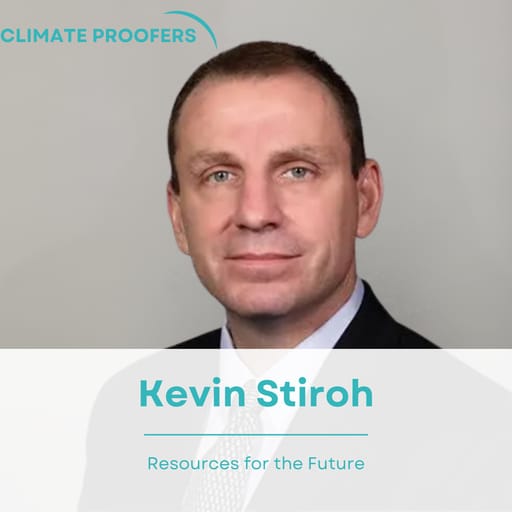
Transcript 0:00 [upbeat music] Hi, everyone, and welcome to Climate Proofers, the show all about those on the front lines of adaptation finance, tech, and policy. 0:12 I'm Louis Woodall, the editor of Climate Proof, which you can read at www.climateproof.news. 0:18 Now, those who've followed me for a while will know I started out as a financial journalist, writing about bank regulation, supervision, and risk management practices, all that nerdy stuff that may seem abstract but actually helps keep the financial system from flying off the rails, at least most of the time. 0:34 Now, around 2015, climate related risk management started coming onto banks' radar screens as central bankers, like then Bank of England Governor Mark Carney, started making noises about physical and transition risks to lenders' balance sheets. 0:47 I started writing about this new trend in 2019 and haven't stopped since. 0:51 Back then, one of the experts I most wanted to talk to was Kevin Stiroh, then Executive Vice President at the Federal Reserve Bank of New York, and later an advisor to the Board of Governors, who spearheaded the Fed's work on climate risks to the banking system. 1:05 Now finally, I get the chance to speak with him for today's episode. 1:08 Kevin shares his reflections from his time at the Fed on the rise and fall of bank climate risk supervision, and tells us all about his latest role at Resources for the Future, a nonprofit research institute based in Washington. 1:19 We also get into the current state of climate risk management across the industry, and why Kevin thinks we're at the start of a great natural experiment that could determine tomorrow's winners and losers in the banking game. 1:30 Before we get started, we're coming to the end of our March membership drive, and need your help to get us to our target of 300 paying members before April rolls around. 1:39 We're currently just 37 members short of this goal, and times are ticking. 1:43 So if you value Climate Proof and have found it makes a difference to your adaptation information diet, then please show your support by becoming a member at www.climateproof.news/upgrade. 1:53 And if you're already a member, tell your colleagues and peers about us and get them to sign up too. 1:58 Okay, in a minute, my conversation with Kevin, but first, a roundup of last week's top adaptation and resilience stories. 2:04 [whooshing] In finance, new research from the MSCI Institute claims the climate adaptation economy is larger and more commercially accessible than investors have recognized. 2:13 The research arm for the International Financial Intelligence Company found that 89% of listed companies belonging to the MSCI ACWI Index, which covers both developing and developed countries, show evidence of at least one hazard-specific operational resilience activity. 2:28 Meanwhile, nearly half of companies generate revenues from resilience-enabling products and services, suggesting a wealth of opportunities for adaptation investors to allocate their capital. 2:38 The findings span every major physical hazard category and every industrial sector. 2:42 [whooshing] In policy, the Federal Emergency Management Agency, FEMA, announced last Wednesday it would reinstate the Building Resilient Infrastructure and Communities grant program after scrapping it last April, months after a federal court found the cancellation to be illegal. 2:56 The program had channeled roughly $4.5 billion into pre-disaster mitigation projects, including sea walls, drainage systems, and public building hardening since its creation during President Trump's first term. 3:08 Twenty-two states that sued to reinstate the program argued that those investments, alongside similar predecessor efforts, had prevented an estimated $150 billion in disaster damage over two decades. 3:19 [whooshing] And in tech, Insure, a Boston-based nonprofit, has tapped nine companies to join its second Creation Labs cohort, aiming to grow products targeting flood analytics, wildfire detection, and battery storage underwriting. 3:32 The Insure tech companies selected are Seven Analytics, Illium, Delos, EvStar, FastHazard, Location Health, Orbital Sentry, 10X AI, and XyloPlan. 3:44 They gain access to Insure's launch and growth platform, which connects startups to capital, insurers, and climate stress communities facing coverage gaps. [whooshing] Right, that's it for this week's roundup. 3:54 Now onto my conversation with Kevin. [upbeat music] Hi, Kevin. Where are you calling from today, and what do you do? Hi, Louis. Thanks for having me. 4:03 I'm calling in from New York City, and I am a senior fellow at Resources for the Future. 4:09 It's wonderful to have you on the podcast today, Kevin, and you've had a long and exciting career in climate risk management, and I want to get into all that and also what you're doing with Resources for the Future. 4:21 But first, you served at the Federal Reserve Bank of New York, heading up the supervision group and running point on climate related financial risk matters. 4:29 I was wondering if you could tell us a little bit about your work at the Fed and what it entailed. That's right. 4:33 I had a, a long career at the Federal Reserve in the research group, the markets group, and the supervision group. 4:39 And I spent the last four years at the Board of Governors leading the Fed's work on the microprudential risks from climate change. 4:48 Before going into the details of the work, let me make one foundational point that I think is, is useful, and that is the framing of climate change is not necessarily as a new risk, but as a driver of traditional prudential risks that are part of any risk management framework. 5:07 So the physical and transition risks of climate change can impact credit risk or market risk or operational risk from the banks. 5:16 And in my view, both banks and supervisors need to be aware of these risks and how they could impact the performance of the fin-financial institutions and the financial system. 5:29 So all the work we did at the Federal Reserve was from this very traditional risk management perspective. There was nothing about new mandates or different supervisory goals. 5:40 And that's an important point because there has been some disagreement or healthy debate, you could say, on the role of central banks and the supervision or monitoring of climate risk in the financial system. 5:52 So the Federal Reserve had its own approach. The European Central Bank had its own approach. The Bank of England. 5:57 And I would be interested to know, in your view, what the role of central banks and climate related risks should be. Yeah, I think the mandate is exactly the right place to start. 6:06 It's the foundational point toThe whole effort. 6:10 So if I step back and think about a central bank generally, they have many responsibilities, including those related to monetary policy, bank supervision and regulation, or financial stability. 6:23 And I think you can make a case that climate change is relevant for each of those. I'll drill down on the bank supervision piece, 'cause that was my focus. 6:33 And if you think about the role of the financial system and bank supervision and regulation, supervisors generally expect banks to effectively manage all material risks, whether they come from a business cycle, or a cyber event, or a climate-related shock. 6:51 So to do this, banks need to understand the different drivers. 6:55 They need to understand the impact on their businesses, and that will allow them to continue to provide the critical financial services that drive an economy. And that risk management is core to any banking system. 7:11 The challenge at this point is that these climate-related risks are growing, and they have very distinctive attributes that likely require additional focus and expertise from both banks and their supervisors. 7:27 And I'll focus on these distinctive attributes. First, the impact of climate change is likely to be wide-reaching and likely to be a secular increase rather than narrow and cyclical. 7:41 So the physical risks, for example, are not a business cycle frequency. 7:46 These are long-term trends in how the climate is changing, and that has potential implications for things like a bank business model and how they work with their communities. 7:58 A second attribute is that there's just deep uncertainty, not about the direction of travel, but about the specific timing and impact across sectors or regions. 8:09 So that suggests banks need more robust strategies for managing these risks. 8:15 And then third, because of, of those two factors, the future is unlikely to look like the past, so backward-looking tools are likely insufficient, and we need new tools, new data, new expertise to effectively manage these risks. 8:31 And all of that, to me, makes the compelling conceptual case for why banks should worry about the impact of climate change through their very traditional risk management framework. 8:44 There's nothing there about corporate social responsibility goals or promoting a transition to a low carbon economy. 8:53 This is about the potential material impact, and if climate-related risk drivers are material to the economy or to the financial system, then I think it's relevant for a central bank or a supervisory authority to care about them. 9:08 So your approach, your understanding of climate-related financial risk is very much grounded in that risk management, that kind of tangible impact that climate can have on, on banks, on their loan portfolios, on their operations, rather than as a social impact endeavor. 9:25 And I do feel in the past, in the early stages of certain alliances between central banks and between commercial banks themselves, I'm thinking here about the Network for Greening the Financial System and then the Net-Zero Banking Alliance, there was a focus on, on risk, yes, but also on, like, orienting capital towards certain outcomes, mainly the transition to a net zero economy. 9:45 And I think the conflation of those two ideas created some conflict and might be why those alliances have not been as effective as they could've been, and why indeed you're finding some banks moving away from those networks because of concerns about antitrust and, and collaboration, et cetera. 10:01 So I, I understand why your view is firmly rooted in the, the risk management side of things, and I am wondering if you kind of agree what I just said in terms of the confusion between risk management and social responsibility and impact. 10:15 Do you see that as, as, as a barrier to successful implementation of climate-related risk management across industry? I completely agree with you, and I think that has been part of the discussion over the last few years. 10:27 My point of departure has always been that any activity from a central bank or from a supervisory authority needs to be firmly embedded in its statutory mandates and responsibilities, what- whatever they may be. 10:42 And one of the challenges has been that different central banks do have different statutory mandates and different responsibilities. 10:50 But maintaining a clear and transparent link between the mandate and the activity that's actually undertaken is just critical for the independence and for the legitimacy of the institution. 11:04 So start with the mandate, do the analysis, and if it's relevant for that mandate, then it makes sense to me to build the expertise, to build the experience to understand the potential impact. 11:20 There is a much deeper question about what those mandates and responsibilities of a central bank might be, but from a supervisor's perspective, you take the mandate as given. 11:32 And so in your time at the Fed, how did you see commercial banks' climate-related risk management capabilities evolve, or maybe not evolve, or go forward and then go backward in, in your time? 11:43 And from where you started focusing on this at the Fed to when you left the institution, how would you kind of rate the kind of maturity of the US banking industry here? 11:52 Yeah, I think that's a really important question, and you definitely saw an evolution over the last decade or so, and I think you can break that down into three pieces. 12:04 So the first piece, say, date it to Mark Carney's famous speech in 2015 through about 2020, I would say there was an early reluctance. You saw some central banks being engaged on these topics. 12:19 The NGFS that you mentioned was created in 2018. US banks were beginning to become involved.In this largely pushed by European regulators. 12:30 And then in the early twenty-twenties, say from twenty-twenty-one through twenty-twenty-four, I would call that a period of focused and narrow engagement. You saw some fundamental changes in the US financial system. 12:44 The Fed joined the NGFS. The Basel Committee on Banking Supervision started its work. The Fed, the OCC, and the FDIC issued risk management guidance for large banks. 12:58 So there were very tangible steps that were being taken. You saw the financial firms themselves making big investments. And then in twenty-twenty-five, there was a quicksil. The US official sector pulled back. 13:12 Federal banking regulators exited the NGFS. They rescinded the guidance. You see banks talking about financial risks of climate change less. The SEC dropped its work on disclosure. 13:27 The Financial Stability Oversight Council stopped its work on the financial risks of climate change. 13:34 So I think now we're, like, in this period of tension, where on the one hand, the economic and financial risks of climate change are growing, and there's, as we've discussed, a pretty good compelling argument for why a traditional risk management perspective is appropriate. 13:53 At the same time, the sector seems to be pulling back. 13:57 So I think I would describe this period right now in early twenty-twenty-six almost like a natural experiment, in the sense that there was a lot of activity in the last few years, supervisory pressure, regulatory pressure, investor pressure, and good business decisions were all the driving forces for the activity over the last few years. 14:20 But with no supervisory pressure, less investor pressure, what's left is whether or not banks think investing in understanding the financial risks of climate change is good business or not. So we'll see. 14:34 Will large banks, will small banks continue to invest to build the people, the data, the expertise, the models, so that they can better understand these risks? 14:46 And you can see that change in the macro environment, the political environment, the regulatory environment, in how banks themselves are talking about climate risk, but also actually how vendors of climate risk solutions to banks have changed their language, right? 14:58 So I'm familiar with a number of the vendors, I'm sure you are too, ClimateX, Jupiter Intelligence, First Street, Watershed, all these great companies that started to help financial institutions and corporates deal with climate risks. 15:10 They used to always talk about, "Okay, we're gonna help you comply with the SEC rule that's gonna come into place," or, "We will help you with climate scenario analysis," which was rolled out in the, in Europe and also in the, in the US briefly. 15:21 And that was the language. It was kind of a regulatory compliance exercise. 15:24 And now all these vendors are talking about, "Okay, you're a bank, you're a lender, you need to understand, like, where to allocate capital most efficiently, where you can capture deals in certain places which you might not otherwise have gone to because you didn't have granular climate risk understanding." 15:38 So now the focus very much from these tool providers is on, yes, adding shareholder value, and also interestingly, to bring this conversation to adaptation resilience, finding ways to kind of provide new services, new products to your clients to make them more resilient, so that first of all, you capture that revenue stream, but also you improve potentially the credit worthiness of your own assets because your, your borrowers are, are more inured to, to climate risk. 16:03 So is... 16:04 The language has changed a lot in the last few years, and I think we are seeing the difference between those banks who really did capture some value in those early stages of climate related financial risk management and those who kind of did it mainly for box ticking exercises and to make regulators happy. 16:19 And you have seen some teams getting absolutely decimated at some banks. 16:22 You've seen other banks who've kept their teams, but kind of moved them around to give them different titles, and I think your real-- there's a real heterogeneity in the, in the market right now. Yeah. 16:29 Com-completely agree, and I think that's the natural experiment that I was talking about. Is this good business or not to make these investments in understanding the financial risks of climate change? 16:42 I agree that the language has shifted from compliance to more of a, a business perspective, and I think it's also shifted from a purely risk focus to a risk and opportunity focus with a greater f- desire to work with clients to help them develop opportunities and enhance their own resilience in a way that wasn't as much of the conversation a few years ago. 17:12 One of the challenges, though, c-certainly now as someone outside of the official sector, is a third shift has been from, you know, what The Economist has called the shift from greenwashing to greenhushing. 17:27 So I think it's true, and when I talk to financial institutions, I get the sense that they are continuing to do this work because they think it's good business, but they're talking about it less, and that's a hard thing to be able to quantify. 17:44 That's a hard thing to be able to understand. But I think that's part of what we're seeing in response to the current environment. Yes. As I was saying, some of the job titles have changed at these banks. 17:54 So people who used to be called risk officers or climate risk professionals, they've got different titles, so it's kind of hard to understand. 17:59 They're, they s- tell me they're still doing climate stuff, but it's kind of like merged with, like, geopolitical risk or some other areas of credit risk or something. 18:07 So I think that, that is greenhushing in, in some form. Okay. 18:11 I, I wanna move on shortly to, to what you're doing now, but my final question about your time at the Fed is over the climate scenario analysis exercise that took place in twenty-twenty-four, and I was wondering, like, what you think that exercise yielded in terms of information and insight to, to you, to the, to the regulators, but also to the banks and to the public about the climate risks facing the US banking system.So in 2023, the Federal Reserve announced a pilot climate scenario analysis exercise with six large banks, and that work was completed and published in 2024. 18:47 It was a big undertaking, and I think it's fair to say that both Federal Reserve staff and the banking system learned a tremendous amount from, from this exercise. 18:59 And the basic idea was to ask these large banks to estimate the credit impact of different types of physical and transition shocks on their balance sheets, specifically the credit quality of certain loan portfolios. 19:14 It's important to emphasize what the goal of that exercise was, and the stated goal was to learn about large bank practices, and then second, to enhance the ability for both banks and supervisors to understand these risks. 19:31 So that design or that objective informed all of the design choices and the types of work that were included in the exercise. In terms of what was learned, a couple interesting things that I'll highlight. 19:46 So, first was that banks are interested in the idea of large-scale scenario analysis to better understand the range of potential risks, the potential impacts on their balance sheets. 19:59 Second, the empirical estimates that were reported were generally not viewed as large, and this is consistent with other large-scale exercises done by the Bank of England or the ECB. 20:16 In part, that was due to the design of the exercise, and we can talk about that. A third very interesting finding that got a lot of publicity was the significance of data gaps. 20:28 And these were the largest, most sophisticated banks, and they reported widespread gaps in their data around things like the specific characteristics of real estate exposures, the details of their insurance coverage, how their counterparties, their obligors, are actually managing the transition risk. 20:49 So that's an open question for the rest of the industry, whom you might infer has the same sort of, of data gaps. 20:58 And then a final point that I found interesting was the difference between direct effects and indirect effects, and the ability to model those. 21:09 And by direct effects I mean a hurricane hits, a property is destroyed, and that has an impact on the borrower's ability to repay a loan. That was relatively straightforward to estimate. 21:23 Indirect effects, thinking about feedback effects, nonlinear tipping points, things like migration or broad pricing impacts, insurance dynamics, uh, destruction of infrastructure, those sorts of things that could have broader impacts on the economy and spill back to the banks. 21:42 That was, the participants reported, much harder to estimate. 21:48 And I think there's some sense, at least it's a plausible hypothesis, that those indirect effects will turn out to be more meaningful over time as the spillover effects materialize. 22:01 Maybe one last point about that large-scale exercise. 22:05 Everything there was about large banks, and in some ways I think you could make the case that smaller banks are more exposed, particularly on the physical risk side, to climate risk drivers. 22:21 These smaller firms are concentrated. They have less diversification across sectors and regions. They have fewer resources in terms of data and models and expertise. 22:33 So it's an open question to me how the impact would play out for that part of the financial system. Yes. 22:41 The second order and third order effects on the financial system are definitely in focus for the kind of new wave of it, and the analytic providers and tech vendors that I'm unfamiliar with, and it is a concern still, I know, of the European Central Bank, Bank of England, that other, other institutions are still looking at these. 22:59 I want to come back to the results. What you said about the finding that there was only a mild impact to the, the loan books and to the capital position of the banks included in the analysis. 23:10 There are two points of view here. 23:11 One is that, okay, that shows that large banks are resilient, and actually we should therefore be encouraging them to invest maybe even more into, into green technology and to, and to, to resilience because we have to worry so much about their own safety and soundness, right? 23:24 I mean, stress tests, this wasn't a stress test, this was a scenario exercise, but stress tests are designed to find out if banks are... can weather certain shocks, right? 23:31 And the argument here is that, okay, banks seem to be able to weather climate shocks as they exist right now, so we don't have to do any additional supervision of them. 23:38 Then the other view is that, oh, because of the data gaps and because of the design of this test itself, we didn't really get the full picture. 23:45 So on the physical risk model, for example, the banks were stressed against, I believe it was a hurricane, different calibrations of hurricane risk, and then they were asked to do their own idiosyncratic risk, um, scenario, right? 23:55 And there were some arguments made that, okay, this is not comprehensive enough. You're not taking into account compound hazards like a flood plus a wildfire plus convective storms. 24:04 And so some folks would say that this did not give a complete picture of large U.S. banks' vulnerability. So I'm wondering what you think of those two arguments- Yeah... 24:12 and, and what you think we should take away from them, from them. I think there are good arguments for why the results from these types of exercise tend to understate the potential impact. 24:24 So a list would include things like these shocks, these scenarios were relatively orderly. They didn't have large scale-Disruptions of the economy. 24:38 We did focus on large diversified, or the Federal Reserve did focus on large diversified banks, and they have a much stronger ability to weather these shocks than smaller firms. 24:51 As we've discussed, there was relatively little on indirect effects, spillovers, feedback effects, and the exercise themselves are typically designed to be focused and not comprehensive. 25:05 So look at a specific loan portfolio, don't necessarily look at revenues and market risk or operational risk. So there's lots of reasons that might cause these large scale e- exercises to understate the risk. 25:22 On the other side, I think good arguments are around the adaptive capacity of the financial system, particularly for the longer term transition risk scenarios where it is implausible that banks' balance sheets wouldn't adjust. 25:37 They would adjust in a dynamic way in response to emerging risks and relative price changes. So you have forces on both sides. 25:46 But for me, for my weigh- weighing of the evidence, I would tend to believe that these exercises understate the impact rather than overstate. 25:56 Yes, and that kind of makes it disappointing that we're probably not gonna see a climate scenario analysis follow-up from this Federal Reserve under this administration. 26:04 And I am curious to know from talking to my sources what banks are still doing internally, uh, if they're doing some s- similar exercises or, or pare down exercises. 26:14 From my understanding, there's much more targeted analysis of climate risk, mainly to like residential and commercial real estate portfolios in certain high-risk regions like Florida, Texas, wildfire prone areas in California and Colorado, but not the sort of comprehensive analysis that the Fed did. 26:31 So it'd be interesting to see how banks themselves, as you said, this natural experiment, how it kind of plays out. Yeah. Okay. I'd like to move on now from your time at the Fed. 26:40 I'm sure we could talk about it till the cows come home, but I want to talk about your, your new post seen at Resources for, for the Future. 26:45 Can you tell us a little bit about how you came to the organization and what it's all about? So Resources for the Future is a independent nonprofit research institute in Washington. 26:57 They focus on environmental energy and natural resource policy, and really known for their intellectual balance, rigor, and independence. 27:08 Uh, technically I'm, I'm a senior fellow at Resources for the Future, and I'm also the director of the Climate Related Financial and Macroeconomic Risk Initiative. That's a mouthful, but it's- Quite a mouthful. 27:23 [chuckles] Yeah. It is a, uh, research collaboration between Resources for the Future and the Salata Institute for Climate and Sustainability at Harvard University. 27:34 For RFF, I was always impressed with the integrity, with the, with the independence of their work, and they lead policy conversations forward in, I think, a very productive way because of this independence and intellectual rigor. 27:52 So all of that seemed very valuable for my work, which is still focused on the financial risks of climate change and how they can impact the real economy and how they can impact the financial sector. 28:05 But I think that work will be better, will be more informed by working with this broader set of economists and, and analysts interested in the, the full suite of climate related topics. Yeah. 28:19 I wanted to drill down into your motivation. 28:21 One would imagine you could have worked at a large bank yourself or one of these many innovative climate technology companies, climate risk analysis companies out there, stayed in the private sector, gone to a startup, you know. 28:32 So I was kind of interested in why you chose this route rather than the kind of commercial space. Yeah. 28:37 So it was largely driven by this initiative, the Climate Related Financial and Macro Risk Initiative, which has just a great foundational core leadership team. 28:49 So it includes Billy Pizer from Resources for the Future, Jim Stock at Harvard University, and Bob Litterman, who are just deep, deep experts in these issues. 29:00 So the chance to work with folks like that and then the, the effort itself, what we're trying to do is fill a gap that's been created in the US by assembling a network of experts from multiple perspectives, so academics, private sector, market participants, the scientific community, the nonprofit world. 29:24 And we want to bring all these perspectives together to try to better understand how climate risk drivers will impact the real economy and the financial system. 29:35 We're gonna do that in a way that will hopefully leverage the multiple perspectives to understand these really complex problems. 29:43 We're gonna do this through a range of activities, different sorts of research efforts, collaborations and partnerships, convenings, et cetera. 29:52 So we're just finalizing our twenty twenty-six twenty-seven work plan right now, so s- stay tuned for more. Absolutely. 30:02 Perhaps I could, uh, come along for a few of those convenings as well, off the record [chuckles] if necessary, but I'd love to be a fly on the wall. 30:09 And I was interested in this new body you're a part of because I remember back under the first Trump administration when I was first covering climate risk at financial institutions, and it seemed that there were groups like CERES is the one that comes to mind, that was almost like a regulatory sandbox in exile, right? 30:25 They were coming out with all these interesting papers about how you could regulate the financial industry so that they would incorporate climate related risks. 30:31 And it felt like when the Biden administration came in, then a lot of those ideas were implemented. 30:36 So it feels almost like you're a regulatory group in exile, [chuckles] and I was wondering if you, if you see yourself as that, and also whether you do see potential under a different administration forSome of your ideas to be actually implemented on the regulatory s-scale again, or coming back to what we started talking about, do you see your efforts more about convincing banks themselves that this is for your own benefit, for your own capital optimization, for your own business flourishing? 31:01 So the, the way we're, we're thinking about the CFMRI is really as a research collaboration, and we've identified three mutually reinforcing goals. 31:12 So first, economic and financial research to deepen our fundamental understanding of the risks. Second, to use that, those deeper insights to make more, to promote more informed policy responses over time. 31:29 And then third, to grow the research community and try to outline a policy relevant research agenda so that junior scholars, younger academics who are entering the field can have a better sense of what the policy relevant questions are. 31:47 We're gonna do that by this collaboration across academia, the financial system, nonprofits, et cetera. 31:56 And, you know, in, in my experience, for really complex issues like this one, you will do better and come up with more informed options, more robust options, when you can bring together these multiple perspectives, right? 32:11 The financial system has a different set of objectives and different set of constraints than the official sector does. They have a different set of objectives than nonprofits might. 32:23 But by bringing them all together, then hopefully we can identify and promote more robust and more durable policy solutions. 32:33 Yes, I hear you, 'cause I think that was one of the complaints about the first wave of climate related financial risk regulation supervision is that it did seem to be something that wasn't organically growing within banks. 32:44 It was something that was being imposed upon them. 32:46 And over time, I think that has changed because as, as we said, there's been some recognition, at least on the, on the margins, that understanding how especially extreme weather events in the short term could affect the profitability of companies and the, and the asset values of, of physical property. 33:01 There's real understanding that that is something that needs to be factored in to capital allocation decisions, to modeling decisions. 33:07 But it feels like if this time around, if there is a kind of more from the beginning, a real kind of combination of perspectives, we could have the creation of ideas, frameworks, tools that kind of last the test of time and don't get knocked around by the political winds. 33:24 Ab-absolutely. And it has been my experience that you will end up with more robust and more durable solutions if they're built up in a way that includes these multiple perspectives from the beginning. 33:39 So I'm really excited about this, this new effort with RFF SLATA. I think it has the potential to add value in a way that, you know, we haven't seen in the past, so I'm excited about the work going forward. 33:52 And now I was wondering if you could provide maybe an international perspective too, because as part of your, your role at the Fed, you were interacting with regulators from around the world, the Basel Committee, Bankers' Division. 34:04 I'm sure you talked to your opposite numbers at the ECB and Bank of England plenty of times. 34:08 And, you know, climate risk work is still going on at the ECB, at some other central banks, es-es-especially in Asia, interestingly, there, where there's a lot of focus on coastal risks, for example. 34:18 So I'm just wondering if you could give me a little survey about how you see your international counterparts, how they're doing on climate related financial risk, and actually if, you know, the RFF SLATA initiative, whether you're trying to understand how other countries are advancing their climate related risk work, or whether you're trying to take a very in-interior US only look. 34:37 Yeah. 34:38 So o-o-one of the most exciting parts of my opportunities when I was working on this, uh, through the Federal Reserve was the privilege to co-chair the Basel Committee's task force on climate related financial risks with Frank Elderson of the ECB, and that included representatives from all the, all the BIS related jurisdictions. 35:02 And we were tasked to think about how climate change can impact the safety and soundness of indi-individual banks, and how that can impact financial stability over time. 35:14 So a very traditional micro and macroprudential perspective. 35:19 That group did a lot of excellent work on all three pillars of the Basel framework, so that was work around regulation and supervision and disclosure that was published over the last few years by the Basel Committee. 35:33 That work going forward from what has been released in the public domain is now focusing more on physical risks, the impact of extreme weather events, and I think that is indicative of this broader shift of what we're seeing in the financial system right now and potentially within the official sector as well, that the focus is much more on physical risks that are being realized today and how to build resilience to them. 36:04 And there seems to be less focus on the, the transition risks that were identified early on. 36:10 Yes, that's my understanding too, and even amongst the kind of banking alliances, asset management alliances, there's been some recognition that climate resilience, both in terms of extreme weather risk, chronic climate change risks, and then kind of energy resilience, these things all kind of belong together, and that's kind of, I think, helped to, to move, move along conversations that were kind of getting stuck in the mud about, okay, we need to align our portfolios to a certain net zero pathway, or we need to very carefully check out the energy mix of our various different corporates and, and track scope three emissions and all that jazz. 36:43 So I do feel the conversation has clarified somewhat, and we've brought together multiple themes into a more coherent and hopefully manageable whole for, for institutions. 36:53 This is a, a little speculative, but I think there were two related drivers of that shift. 36:58 One, the world around us is-So obviously changing and we're seeing these instances of realized events that cause damage, and particularly in the insurance sector, we're seeing real financial changes in terms of the pricing and availability of insurance. 37:16 And that is a today problem. That is not a hypothetical twenty fifty or twenty one hundred problem. 37:23 And then second, I think there's a political economy aspect to that where physical risks are, from a bank's perspective, an exogenous shock that needs to be managed, and a different flavor than transition risk, which naturally has winners and losers and gets caught up with the reallocation of credit and favorable industries or unfavorable industries in a way that just seems more fraught than the physical risk analysis. 37:56 I always went back and forth on this, on transition risk when I used to write about it, because I understand the arguments that, like, banks follow the economy. 38:02 Like, you know, they are shaped by the environment in which they operate, and that, that shaping is done by policymakers largely. 38:08 The argument was always like, policymakers have to provide the signals, and in some countries you've really seen that, right? 38:13 Whereas the extreme weather events, it's like, yes, it's not a government legislates to, for, for storms or wildfires to happen. 38:17 They're happening because of climate change and because of how we've built our society and, and where we've positioned resources and supply chains in very vulnerable areas. 38:25 So I understand the distinction there, but I always wonder whether banks, are they really as passive as sometimes we make them out to be? 38:31 And I think in extreme weather risk, you are seeing investment in interesting startups and technologies to kind of create more, more resilient economy, and some banks are leading the way on, on, in that, which they didn't do to the same extent for transition risk. 38:44 So that is a difference I'm seeing as well. 38:46 I think part of that too is we will see over time incentives matter, and I'm an economist by training, so I believe that incentives will win over time, and we will continue to see, based on what the science tells us, continued technological progress in alternative energy sources, relative price changes, adaptation investments, shifts among mix of energy in response to those relative price changes, and that is, like any economic reallocation, something a provider of credit or a financial institution will, will need to manage. 39:23 And on the transition side, I think that will be the driving force as much as any policy changes. 39:31 Now finally, I wanted to ask your impressions of the health of the climate risk management profession in the bank industry today. 39:37 So we mentioned earlier that there has been an exodus of professionals focused on climate risk at, in the bank industry, or the, a renaming of, of, of these folks or reorganization of teams. 39:47 But I'm s- wondering how, how you see where we are now versus where we were when you, we s- first started and, and what's your hopes and fears for the climate risk management profession in the bank industry going forward. 39:59 My observations are, are similar to yours. It seems that banks are talking about climate-related risks less. It seems like the financial system is pulling back. 40:13 But we really don't know what's going on underneath the hood. I'm doing some research to try to better understand what steps banks are taking to manage their risks. 40:23 But as we've discussed, my underlying hypothesis is that a risk is a risk, and financial firms which choose to invest to understand how climate-related risk drivers and climate-related opportunities materialize will ultimately have a comparative advantage. 40:45 So I think we'll see banks continue to invest to make better decisions, to better manage their risks, to better serve their clients in a way that incorporates these risk drivers. 40:57 Ultimately, I think it will prove out that these investments in new data, new people, new models related to climate change will just prove to be good business. 41:06 In the same way we have expertise and risk managers have expertise in credit risk modeling related to business cycles or expertise around cyber events, this will just become another driver of risks, and it will be hopefully more insulated from some of the other social policy objectives around transition to a low-carbon economy. 41:32 And it was never exactly clear to me why the financial system itself was asked to be the lever to shift the real economy to a different low-carbon footprint. Okay. 41:47 Well, listeners can learn more about Kevin's reflections on climate-related financial risks by heading over to the resources for the future website resources.org. 41:56 There's a great blog you did in December, "The Evolving View of Climate-Related Financial Risks in the US Financial Sector." Do you have any other publications in the pipeline that we can look forward to? 42:05 Lots of work in the pipeline, and hopefully work that will be published in the not-too-distant future. Wonderful, and Climate Proof will be sure to cover it. 42:13 Thank you very much for your, for your work, for staying in this sector, Kevin, and I look forward to seeing what you and your team put out in the near future. 42:21 For now, thank you so much for your time and have a great rest of your week. Thanks very much for having me. Climate Proofers is a Climate Proof media production. It is produced and presented by me, Louis Woodall. 42:30 Subscribe to the Climate Proof newsletter by going to climateproof.news/subscribe. And to learn more about the publication, feel free to reach out directly using our LinkedIn page. Goodbye for now. [outro music]