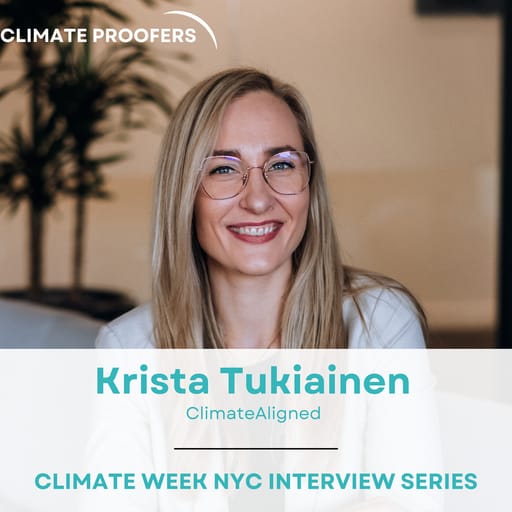
Transcript 0:00 [upbeat music] Hi, everyone. Welcome back to the Climate Proofer's Podcast and the continuation of our epic series of New York Climate Week interviews. 0:13 I'm Louis Woodhill, editor of the Climate Proof newsletter, which you can read at www.climateproof.news. Thanks to all of you who have listened to the first four interviews in this series. 0:24 Together, they've garnered hundreds of downloads, and I've been really pleased to hear directly from folks via email and LinkedIn saying how much they've enjoyed the talks so far. 0:32 If you wanna take your support further, please do give us a star rating on Spotify or Apple Podcasts. And if you really wanna get into my good books, why not leave a review too? 0:41 For today's interview, I'm joined with Krista Tukiainen, the co-founder of Climate Aligned, an AI-driven sustainability data startup that uses the power of LLMs to automate assessments of company disclosures, bond documentation, and the like, and check their alignment with regulatory frameworks or industry standards. 0:58 With their tech, users can track and analyze over 30,000 green, social, sustainability, and transition bonds, or run anyone's public filings for a customized assessment workflow. 1:08 I'm actually a paying customer of one of Climate Aligned's products called Brief.green, which is their self-serve app, and have been impressed with the results so far. 1:16 Now, I personally blow hot and cold on generative AI. On the one hand, I find it very useful for speeding up the editing process, especially for this podcast. 1:23 But on the other hand, when it comes to detailed structured assessments or writing, LLM's tendency to hallucinate, oversimplify, or simply produce low quality outputs often has me rolling my eyes with exasperation. 1:35 But with Brief.green, Krista and team have added a layer of stability and quality assurance on top of the LLM layer, which seems to have done a lot to starch out these negative qualities. 1:44 To give you a peek behind the curtain, I've been using the tool to assess the disclosures of the world's top 50 banks by assets, excluding China, and seen how well they align with 15 adaptation indicators I created myself out of a raft of papers issued by groups like UNEP FI and The Network for Greening the Financial System. 2:01 A final report with the findings of the assessment will be released by Climate Proof a little later this year. Back to today's conversation. 2:07 You'll hear Krista's reflections on Climate Week, her explanation of what Climate Aligned is, and how it's already helping further the cause of adaptation finance, and our back and forth on how generative AI is transforming the business models of software startups aiming to help the climate fight. 2:20 Now, tomorrow on Wednesday, I'll publish the last episode in our series of New York Climate Week interviews, this one with Hunter Mattes of Resilience Investments, and then next Tuesday we'll be back to our regular podcast service with new guests. 2:32 And yes, the weekly news roundup will be back too. Thanks again for listening. Now, onto my conversation with Krista. [upbeat music] So Krista, what are your reflections on Climate Week so far? 2:44 Thanks for the question, Louis, and good to be here. Mm-hmm. 2:46 I think so far I've been sort of positively surprised by how uplifting the mood is, despite all of the headwinds around climate and ESG and sustainability work, especially in the financial services industry. 2:58 A lot of the events that I've gone to are still... 3:01 The, the kind of overall headline message from the folks that we work with predominantly has been to continue doing effectively the same work that they've been doing so far, but just talking about it maybe a little bit less publicly. 3:11 [chuckles] So that has some interesting implications, but it doesn't mean that the work isn't happening, which is great, and it feels energizing to be here. So that's always good. 3:20 And what are the key themes, trends, concerns that you're- Mm.... hearing from the panels you've been on, from the networking events- Yeah... you've, uh, attended? 3:27 Well, in a way that's sort of, you know, business as usual, but don't talk about it is one key concern. Mm-hmm. 3:33 Which is to say, you know, how do we build business as a bank or an asset manager around this if we can't really advertise our offerings? 3:40 And then the other side of that is, especially for the asset managers that we work with, there's just a lot less happening in the US and generally North American market on things like green bonds or even sort of finding green equity investment opportunities and so on, whether that's across mitigation or the broader ANR themes and other things as well. 3:58 So there's a kind of... It feels like there's a bit of a moment of trying to work out where to put more resources. 4:04 Most people have been looking at sort of Europe and Asia Pacific and other regions to try to lead the way a little bit. 4:10 And the other thing I'm seeing, which I'm sure you've heard and will hear from other podcast gue- guests in the events that you're going to, is resilience is on everybody's lips this year- Mm... which is great. 4:20 I'm very happy to see that. 4:22 I think the, the other kind of element of not being able to call things in the same nomenclature that we were used to calling them is that there need to be new terms that e- evolve and that emerge out of the woodwork. 4:34 And definitely resilience in its broadest sense is one that I'm hearing a lot in, in both looking at climate resilience, but also social and societal resilience around those topics. 4:45 And then definitely still energy and the energy transition, which is, I think, always continuing to be pertinent to the US market in particular. 4:52 So we're kind of trying to work around maybe that type of wording and labeling- Mm... rather than calling things green or sustainable or ESG. Mm. Yes. 5:01 I'm in two minds about the use of language here, because on the one hand, I think it's right. 5:06 If we can use a different language and still do what we're doing in terms of adapting our economies, pushing forward the climate transition, that's great. Mm. 5:14 But I am a bit worried that by kind of disassociating language of climate from adaptation resilience, we're kind of allowing ourselves to forget the bigger picture. 5:21 Like, w- the best way to adapt is to actually to mitigate [chuckles] climate change- Yes... right? To reduce emissions. 5:26 And talking about extreme wea- weather risk is all well and good, but actually if we don't know what's driving extreme weather and not being open about the effects of climate change on extreme weather events, then we're kind of missing part of the picture there. 5:37 So I'm in two minds about that. Maybe 'cause as a journalist, I like to use the language which actually explains what's going on- Mm-hmm... rather than the language that we're comfortable using. Yeah. 5:44 So I'm still kind of in my own head trying to figure out how I feel about that. [chuckles] Yeah. I'm, I'm kind of with you there. 5:49 I think there's, um-It would just remove a lot of the inefficiency if we could talk about the terminology as the terminology. 5:56 But I also empathize with the folks that are trying to, you know, push forward with the good work that they've been doing here especially in the US market and maybe broadly North America, to, to have to sort of live within the constraints of what the system looks like right now, and hopefully that will get better over time. 6:10 I will say though that yesterday night I was at an event organized by a, a large institutional investor, and they were saying effectively that they're finding that the usual names that they invest in are continuing to push forward on their efforts to both mitigate and adapt to the impact of climate change. 6:25 They're just the labeling and the kind of how you communicate around it looks different. 6:29 So I think that emphasizes even further the need for, it doesn't have to happen at Climate Week, but, you know, just kind of bilateral engagement, like people talking to people and figuring out what's going on is quite valuable [chuckles] Mm. 6:40 Rather than losing hope by looking at the bad news stories in the media- Mm.... all the time. There's being right and there's being effective, and being effective right now may be, yes, using different language- Yeah. 6:49 ... keeping your head down, but do the work. Yeah. You know, so I, I'm in favor of that. Okay, now I wanna turn to Climate Aligned- Yes.... your company. 6:55 Can you tell us where it started, how it started, and where you fit in the crowded AI space? Oh, yes, absolutely. My favorite topic. 7:03 So we started in late 2022, and before starting Climate Aligned, I'm obviously one of the two co-founders, I have spent close to a decade in sustainable finance in different roles, and immediately preceding, I was leading up what we called the market intelligence team at an NGO called the Climate Bonds Initiative, standard setter for the green bonds and broader sort of fixed income for climate solution space. 7:25 And it was really there that I became, and still am, convinced that we're sort of in a moment of some futile efforts around trying to standardize things, and that means that it's really complicated for investors and bankers and issuers in the middle to try to get and provide the information that they need to make decisions effectively because everybody has a slightly different view on what sustainability or green or transition or climate adaptation investment means. 7:53 Mm. 7:53 So the usual flow of information is something like an analyst goes to insert your favorite search platform, or it goes to internal file systems and finds a couple of PDFs, maybe some spreadsheets, maybe looks at a couple of websites and tries to pattern match information to their internal set of rules, maybe some policy guidelines, and extract that information and put it into a spreadsheet or into a slide deck so that that can inform an investment decision either for a new security or something that they already own or would like to own, and then have to report back on. 8:25 And so we set out to automate that flow. And we've now been building this for three years. We have effectively a platform that consists of a couple of different products. 8:36 One is for the labeled bond market, so green, social sustainability, all the various flavors, and then a couple of other things. 8:43 One is a self-serve sustainability assessment platform that we've just launched this summer called Brief.Green, which is being used by, you know, everybody from journalists to academia to NGOs. 8:55 Effectively, folks that are already active users of AI in this space but cannot necessarily afford to spin up those capabilities that will scale and continue to be accurate and sort of repeatable. 9:08 And then we also do custom data deliveries. 9:11 Often if there's, um, you know, a specific market segment, for example, we just worked with a large multilateral development bank doing a very bespoke transition pathway analysis and mapping oil and gas companies in the Middle Eastern and North African markets to look at how well they're doing and how they, how well or closely they would align to some of the, the guidelines that are out there in the market for issuing sustainable finance instruments. 9:36 So all of this to say our job as we see it is to, A, bring down the cost of total ownership of data in this space, so really try to push for the democratization angle because a lot of this is public information, so trying to bring it together in a way that people can access and use it in the right way. 9:55 And then, B, to offer this customization at scale so we can, and I think we should, have differing opinions about w- how these transformations in our economies are going to shake out in light of climate and other, other me- mega trends, if you will. 10:10 So we try to offer that at speed and low cost using AI. So how are you and how are your clients using your tools to understand adaptation better- Mm.... in the finance space? Yeah, that's a good question. 10:20 So there's a couple of ways. Maybe I'll start with the fixed income side. So these are big institutional investors, sometimes also the banks that try to help bring more of these deals to the market. 10:29 The way that we've set up that product, in particular the Climate Aligned app, app as we call it, is we've collected close to 100,000 documents related to sustainable bonds into- Mm-hmm.... 10:39 one place, and then we've run hundreds of different AI pipelines across those documents to extract and process relevant information out of them, and that happens at the point of something coming to market. 10:50 That could also be in the case of an equity investment, or it could be for a government bond. 10:54 So looking at the sort of right set of documents, extracting the right or relevant information from it, and then making that available on an ongoing basis, including when the issuer of the bond, so company, country, city, otherwise, will start to report on what they've actually spent the money on. 11:10 Mm. And there are... We kind of map to some of the categories that some of these market makers like ICMA, the International Capital Markets Association- Yeah.... 11:19 will specify that something is adaptation at the high level, but then we also offer the project level detail and the sort of impact performance metrics that issuers choose to report. 11:28 And because we've made the platform quite, or tried to make it as flexible as we can, you can search through it and actually see examples of, uh, all the way down to the project level of what is being financed. 11:39 This is definitely, we're actually in conversation with an, uh, a US asset manager right now about them using this data to try to see if they can create an adaptation-focused fixed income fund- Ooh.... 11:49 in public markets. It's brand new and, you know, it's early days, but this is the kind of thing that I'm hoping to see much more of. 11:56 And then on the bank side-It's obviously using the same base data of what has happened in the past and what's constantly happening, we update the data every week, to help guide customers that they help to bring new bonds to market to say, "Well, these are the kinds of examples of A&R projects that have been financed by, let's say, similar entities or in similar markets." 12:15 And then make sure that they're doing kind of what they can to meet the very quickly and rapidly [chuckles] evolving best practice guidance around adaptation. Mm. 12:24 Yes, I really like how you study the documentation of a green bond, but then track afterwards as well. Mm-hmm. So it's... 12:28 There's sometimes a mismatch, and sometimes it's not very clear from the language of a bond prospectus. 12:33 Definitely not clear from the marketing language around [chuckles] bonds I've found, what the money's actually going towards. Yeah. 12:38 And actually being able to do that audibility, that tracing, is so important and very, very helpful for journalists like myself, but I suppose also, yes, for indeed asset managers and people who are trying to... 12:48 corporates that are trying to issue bonds themselves that kind of align with these themes of adaptation, resilience, mitigation, blue economy- Mm-hmm... whatever you wanna call it. Yeah, absolutely. Thank you. 12:56 We agree, and it's exactly that point that you mentioned around a lot of promises get made effectively. And it's not with a negative connotation necessarily. 13:05 I get it from the point of view of if you're trying to make a sort of investment commitment, and then you're trying to collect all the possible pools of capital or asset types or project types together to have enough investable volume to keep issuing these bonds. 13:18 You don't really wanna tap the market just once and say, "I've done the green label one time and now I'm gonna never do it again." So it's really a sort of transformational thing. 13:25 So of course you're wanting to collect them or collate them all together, but then, in reality, often only one or two things get financed with one deal. 13:32 So it is the sort of reality check that we're trying to, to offer at very low cost as well to the users to say, "Well, this is where the market is actually at, and here's where some of the potential innovation is," also based on what is in those frameworks. 13:44 And then you can engage directly with those issuers, and you can engage with the bankers with... 13:48 that help them, and with the investors that are, as per this example of a potential adaptation fund, who are trying to work out what other kinds of mandates could, could one, um, create financial products for. Mm-hmm. 14:00 Now finally, I wanna talk about how AI's changing business, changing business models. Yeah. I mean, I'm a one-man band, right, with Climate Proof. 14:06 [chuckles] I, I know I wouldn't be able to do what I'm doing without the assistance of AI. I have AI tools to help edit the podcast. Yeah. I write everything myself. I use AI for research, for summarizing, et cetera. 14:15 And that gives me more time to do the kind of direct outreach, interviewing people- Yep... doing special projects like we're doing together. 14:21 Um, and one thing I've heard is that with AI you can build cool products that five years ago would've taken teams of dozens of people and millions of dollars. 14:30 And I actually worked at a climate tech company that did similar to what Climate Align does, kind of analysis of documents with AI and a kind of structuring, taking unstructured data and turning it into structured data, right? 14:40 Yeah. That's been the big theme of AI. And what, five years ago, that company I was with, uh, you know, raised a bunch of money, had a big team. Yeah. 14:47 And now you're doing it [chuckles] at a much lower price point, smaller team. Yeah. 14:50 And do you see that being how businesses, startups continue to grow in the future as, as in smaller teams, and they can leverage AI to do bigger, better things? 14:58 Or do you actually see this other side, which is, like, the large incumbents really s- scaling up on the AI side and kind of, you know, tearing you down. So I think about Bloomberg, the biggest boy in the playground. 15:09 Yeah. Loads of data, getting very involved in AI. But there still seems to be room for companies like yours. Yeah. But how do you see the competitive landscape evolving- Mm... because of AI? Yeah. 15:16 I think I'm, I'm more definitely, if you look at overall the kind of evolution of, of AI first companies now, and even in the last, let's say, 12, even six to 12 months, it is clear and very obvious that you can have incredibly outsized outcomes- Mm-hmm. 15:35 .. compared to what you could have in the past. Like, you know, making your first million in, in annual revenue, your first 10, 20, whatever, with very, very small teams. So this is definitely going to continue. 15:46 I don't think anyone would for, just for the sake of it, go and hire a very large team around a product proposition until they really have to. Mm. 15:54 Like, a great case study of this is the Swedish vibe coding app company Lovable. Yeah. That's the largest Series A round in the history of startups in Europe. Yeah. 16:02 I think it's only still a team of some tens of people, now obviously growing rapidly, but they did this with a very, very small team, and now they're scaling because they're going after enterprise clients. 16:12 So I think that's gonna sort of continue to be the way forward. 16:16 And with regards to the competitive landscape or the implications of that for our specific competitive landscape, I'm glad to see the incumbents are embracing AI, and it's great. 16:25 It pushes all of us forward, 'cause it helps to build trust among the shared, you know, potential client base and the existing client base. 16:32 I do still think that we have the usual innovators dilemma, large company issues, where we're hearing from the larger data providers in this space, and especially the kind of just not tech companies, but data providers specifically, and service providers, that most of their time right now is still being used on figuring out what data they even have and what goes where, and kind of trying to figure out how the nuts and bolts all fit together, and then you can start to really use this technology on top of that. 16:57 Whereas with specialists like us, and there's many more amazing companies out there doing similar things and, and sort of adjacent things, there is n- room for these, for these niches to say, "I'm gonna build one type of offering or one data set or one specific service for a very specific use case first really well." 17:17 Mm-hmm. And then the sort of big uncertainty after that is, is what happens next. 17:21 So I think for us right now, we're really focused on making sure that we can keep our, obviously, our pricing super competitive and really live up to that sort of thesis of democratizing access to the information. Mm. 17:32 But also honing in on what I think will be the foundation of any startup moat in the future, which is distribution and community. 17:40 Because the tech gets so commoditized and so easy to build, it's still hard, but it's not that hard. You really, as you said, need a ta- team of two to 10 people- Mm... 17:49 who are very skilled, and some really good engineers to make it work, and pretty much anybody can then do it. 17:55 So how you're gonna win, in my opinion, is making sure that you're really fostering, not just keeping existing com- customers happy. Everybody wants to do that, but really trying to understand where is your... 18:05 what does your funnel look like? How do you get these products into the hands of people faster? And don't let yourself be disillusioned by the conventional sort of SaaS long sales cycles in- Mm... 18:16 in finance in particular. So we're starting to see some really interesting movement around that front, and hence obviously the launch of, uh, brief.green, for example. Mm. Yes, I really like your approach. 18:24 It is different from what others are doing. Mm. And it kind of challenges the status quo in SaaS. But- Yeah... for me as a user, I think it's great that I can very quickly sign up. 18:33 It's very cheap at the moment, but I'm getting great results from it. 18:35 And when it comes to distribution, yes, I can quickly use your data to put together reports, articles, et cetera, data, products of my own and put them out there. 18:44 And that's good for you, that's good for me, and I think it helps to show the real value of AI, which sometimes people are still not entirely sure about. Yeah. 18:51 But I think we can show the value by collaborating together using your tools, my knowledge, and other companies doing the same. Absolutely. So really excited to be working with you, Krista. 18:59 Thank you so much for coming in today. Thank you for having me. [upbeat music] Climate Proofers is a Climate Proof media production. It is produced and presented by me, Louis Woodall. 19:10 Subscribe to the Climate Proof newsletter by going to climateproof.news/subscribe. And to learn more about the publication, feel free to reach out directly using our LinkedIn page. Goodbye for now. [upbeat music]