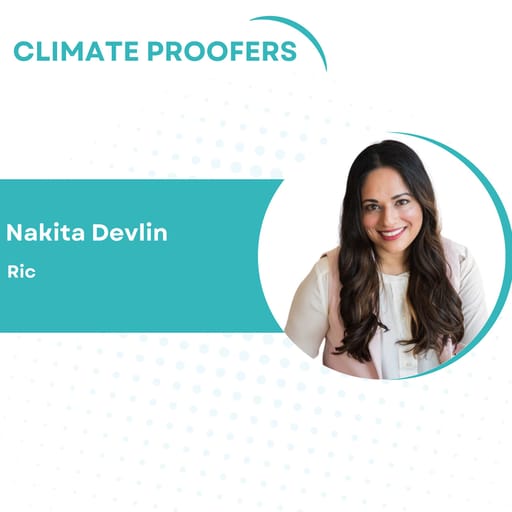
Transcript 0:00 [upbeat music] Hi everyone, and welcome to Climate Proofers, the show all about those on the front lines of climate adaptation and resilience. 0:12 I'm Louis Woodall, editor of the Climate Proof newsletter, which you can read at climateproof.news. Parametric insurance is the hot trend in climate resilience world. 0:22 This type of insurance pays out to policyholders if and when certain conditions are triggered, for example, after a certain amount of rain falls in a predefined area, or if temperatures exceed a certain threshold for a designated period of time. 0:35 It's a way to get cash in the hands of those affected by climate related natural disasters fast. RIC, R-I-C, is a new parametric insurance startup founded by today's guest, Nikita Devlin. 0:47 We chat about the rise of the parametric insurance model, where RIC sees opportunities in this space, and how insurance writ large is being reshaped by the advent of climate risks. 0:57 Nikita also talks about the importance of community-based resilience and how RIC and parametric insurers can tie into this. 1:03 Before we get to the conversation, a reminder that Climate Proofers and the Climate Proof newsletter are subscriber supported productions. 1:09 Listeners like you can help support my coverage by heading over to climateproof.news/upgrade and becoming premium subscribers for the low price of $5 a month or $50 a year. 1:20 Okay, in a moment my chat with Nikita, but first, let's round up some of last week's adaptation and resilience stories. 1:26 [swoosh] In finance, a new report from the UN reveals that the adaptation finance gap is around $187 billion to $387 billion a year. 1:36 This gap is the difference between the modeled finance needs of developing countries and the actual adaptation finance flows directed to them. 1:43 UN Secretary General António Guterres said rich nations need to double adaptation finance to at least $40 billion a year by 2025. 1:50 In order to close the adaptation gap, the report recommends more investment in capacity building and technology transfer from rich nations to their poorer counterparts. 1:59 It also cites a trio of enabling factors that could drive more private and public sector finance. One, new financial instruments like debt for adaptation swaps. Two, more public backed funds and dedicated budgeting. 2:11 And three, the spread of climate risk disclosure frameworks and adaptation taxonomies. [swoosh] In policy, COP29 is underway in Baku, Azerbaijan, and delegates have much to discuss on the adaptation and resilience front. 2:23 The summit could yield important results on adaptation planning, target setting, and progress tracking. 2:28 High on the agenda is advancing the global goal on adaptation, which was written into the Paris Agreement nine years ago, but has yet to be fully fleshed out after successive rounds of negotiations. 2:38 The GGA is supposed to strengthen countries' climate resilience and reduce their vulnerability to climate shocks while boosting their adaptive capacity and supporting sustainable development. 2:48 There's also progress to be made on national adaptation plans, or NAPs. These are countries' blueprints for addressing adaptation needs through dedicated strategies and programs. 2:57 As of November the 11th, 59 countries had submitted NAPs to the UN, while around 140 had started the drafting process. 3:05 At COP29, delegates will conclude their first assessment of NAPs with an eye on refining and strengthening these plans and teasing out best practices for countries to learn from. 3:15 [swoosh] And in tech, engineers at Arizona State University are working on green desalination technology to optimize water recovery in inland cities like Arizona's own Phoenix. 3:23 Their approach combines nanofiltration with reverse osmosis, which is effective at removing dissolved salts and minerals from liquids. 3:31 This hybrid method aims to maximize the volume of desalinated water and cut down on waste brines. It's powered by a high efficiency heat pump and special fiber-based crystallizer to lower the system's carbon footprint. 3:42 [swoosh] Right, that's it for this week's roundup. Now on to my conversation with Nikita. [upbeat music] Hi, Nikita. Where are you calling from today, and what do you do? 3:53 Hi, I'm calling from Lower Manhattan, and I co-founded a micro parametric insurance technology company. And the company's name is RIC, R-I-C. Can you tell us where that name came from? Sure, absolutely. 4:07 The name for RIC really came about very simply. The letters R-I-C are in parametric, and that's the type of insurance that we specialize in. 4:15 Originally, when we were developing the company and who we wanted to serve, we knew that we wanted to work with the mass market in the US, and we felt that the opportunity to use RIC as a persona of someone who's friendly and helpful post extreme weather event, um, it just paired really nicely with, with RIC being in parametric because the average American has never heard the word parametric, but, you know, RIC sounds like a friendly person who can be there for you after you experience a, a mass, uh, a, an extreme weather event. 4:47 Yes, RIC. I get it. Your buddy who you're gonna have a beer with, who looks after you when things go wrong. I can see where you're coming from there. 4:54 Now, Nikita, can you tell us a little bit more about yourself and your journey into the insurance tech space? 4:59 So I was a broker for almost 15 years, and I've worked really deeply in the insurance space, starting off working for an agency and then really finding a love of passion for data and extreme weather and catastrophe-type risks, some of the more complicated insurance risk to, to place. 5:20 And I had the opportunity to work with a really great broking team, and I did that for many years. And it really... 5:27 You know, a lot of when you're looking at these large insurance placements, they become data-driven really quickly. 5:33 And I was actually part of the team that spearheaded us using RMS modeling, uh, software on the broking side, which it's so commonplace today. 5:43 But, you know, a decade ago, not every brokerage team was using RMS to look at risk. And because it's catastrophe risk, it tends to be concentrated in a single, in a single area. 5:54 So being able to look at accumulation and manage, you know, heavy concentrated risk in a single area, even as a broker, is really important and informs how you're going to place the business in the insurance industry.So I did that for a few years, but I got really excited about the technology that was moving into the insurance space, and I left day-to-day broking to go work for a Willis Towers Watson backed startup. 6:20 And that was an incredible experience. 6:23 You know, startup life is fast-paced and moving, and being able to be backed by one of the biggest players in the industry meant that we had access to a lot of good, uh, engineers and people to build technology. 6:34 So that's actually where I met my co-founder. 6:36 We helped the company build and develop IP with their tech platform, and we also had the ability to launch multiple MGAs off of their, their tech platform and really see what it's like to bring a new MGA to market. 6:51 And while we were doing that work, my co-founder also has a background in catastrophe insurance. 6:57 While we were doing that work, we never forgot about our love and passion for catastrophe insurance and what it can do for, for the world. 7:05 And we started toying around with the idea of like, okay, well, we have this really good understanding of the technology that's out there and how to streamline and use technology to make insurance underwriting and placement more efficient. 7:18 So if we have this technology, what would a product look like that could be very helpful for people experiencing the effects of climate change? And that's how we sort of came together to form Rick. 7:30 We see the real benefits of parametric insurance in terms of being able to lower the cost curve post-catastrophe, and we have been able to do it in the com- the commercial sector because that's who our customers were when we were broker and underwriter. 7:46 And now we're using technology to streamline it, to make it a mass market product in hopes that increasing the amount of parametric insurance aimed at extreme weather events in a community can help lower the cost curve for the community post-catastrophe. 8:01 Perhaps this is a good time to explain for our listeners how parametric insurance works and why it may be attracted to households and businesses that are grappling with climate risks. 8:10 How do you explain it to customers or potential investors in Rick? Sure. 8:13 So specifically for customers, what we tend to tell them is that parametric insurance is unique in that it doesn't rely on a lengthy claims process to help policyholders. 8:23 Instead, a payout is triggered when specific conditions, like a certain amount of rainfall, are met, and Rick is measuring the rainfall for our rainfall flood product. 8:34 The model is really appealing when you're looking at climate risk because it's fast, it's transparent, and it's adaptable. 8:40 Households and businesses don't have to deal with the unpredictability of the traditional claims process. 8:45 So with parametric insurance, if, you know, you agree ahead of time what the, the threshold is, if that's reached, you get your funds almost immediately. 8:54 So for a household, for a business, whether you're a small business or a global conglomerate, the ability to get capital quickly post any kind of extreme weather event is paramount to a faster recovery. 9:05 And what we've seen is that, you know, there's a cost curve associated with these, with these catastrophes. And if you can add capital into the, the policyholder, what are... 9:17 who are that policyholder is, early on, you can help lower the cost curve of their rebuilding experience. So it's really important for everyone in the value chain to have access to these parametric products. 9:29 Traditionally, like I said, I was a broker. I've sold parametric products to larger corporations. 9:34 What we're really looking to do is leverage technology to bring these products more into households and into communities at a, at a wider scale. 9:42 And can you tell us a little bit more about your first product, this rainfall product? 9:47 Our first product with Rick is a micro parametric rainfall product, and it's currently structured as fourteen dollars a month, a fixed payout of ten thousand, and what we calculate is a unique policy activation trigger for each customer. 10:02 So this is really a product that's aimed at some of the larger scale events that we see. So think, you know, a hundred-year event in terms of a storm rolling through your community. 10:14 And there's a lot of really good data points around property and financial loss that happens in a community at that level of event. So that's where we're starting. 10:23 Our roadmap includes also developing an extreme heat product and a wind speed product, and then eventually a wildfire product. 10:32 So we-- our technology platform supports our ability to house and operate these micro parametric, uh, products all on our tech platform. Our goal is to go really wide across the catastrophe network. 10:46 We're not looking to go deep into, into each vertical because we think that in order to address consumer needs the best, we think that we're going to need to offer a suite of products that are affordable for people to, to purchase, because climate change is going to make it so that these extreme weather events are happening more frequently. 11:04 And when you look at rainfall, it's so obvious that the next tie-in is extreme heat, because with extreme heat, you have larger and larger evaporation, which leads to the extreme rainfall. So these all go hand-in-hand. 11:17 They're all tied together. So when you're developing a solution, you have to really look at it holistically, and that's what we're, we're hoping to do with Rick. 11:25 Now, that word community has come up several times already in what you said, Nikita. 11:29 I know you're an advocate of community-based resilience, the phrase is, and I was wondering if you could explain what that is and how Rick ties into that. Sure. 11:36 So community-based insurance is when a group, likely a municipality, is looking to purchase insurance on behalf of the residents or the, the community members. 11:48 And it's really, it's emerging as a market trend as a result of climate change. 11:53 As we're looking at abysmally low insurance penetration in communities, you know, the problem has bubbled up so much that it's now at the, at the municipal level. 12:03 But community-based insurance is similar to group, the group insurance model, where the head organization, the municipalityCan purchase a policy and give access to that policy to all of the individuals living in the community. 12:17 So whether you're a renter, a homeowner, or a small business, you'll have access to, to buy into it. 12:23 And parametric programs in general have been very appealing to these municipalities because you can work with them to set the event threshold to, to their needs, what, you know, what will be important to, to that community. 12:37 And Rick has done a deep amount of work there over the last eight months in working with different community organizations, whether it's a nonprofit or whether it's the government body, to help them explore, uh, what parametric programs can look like, leveraging our product. 12:52 And we've heard some really interesting things come out of those conversations. Some communities are looking to understand if they can levy a tax on the residents to fund the insurance, um, premium. 13:03 And other communities are looking to figure out, you know, how they can embed a potential Rick product into a, a local bill. So think a utility bill or some other bill that goes out in mass into the community. 13:18 And there's always a financial component here, right? Like, you know, what we're really seeing is this trend emerging. We understand that the taxpayer is the one that foots the bill post-catastrophe. 13:29 But when that happens too frequently in a community, the, the economic standing of the community starts being, you know, eroded. It becomes more and more difficult for them to recover after multiple catastrophes. 13:43 And increasing insurance is a really efficient way to increase the financial viability of a community. 13:50 And what we've seen is that some communities are nervous about a potential credit downgrade with S&P and Moody's, and that will impact the future potential mitigation projects that they have planned. 14:03 So if you need to borrow two billion dollars to build, you know, new storm drains or a levee or a sea wall, the cost of that just got more expensive if you're also not managing the low insurance penetration in your community. 14:17 And that's why we've had a lot of success recently talking at the community level with municipal folks about parametric programs, leveraging Rick products for parametric programs aimed at the entire community. 14:32 That's really interesting to me, this community-based resilience, the idea of collective spending on insurance to benefit the town, the utilities, but also the individuals. 14:43 And I think it's interesting because the way Rick is framed, at least in my mind, yes, you have this community-based resilience aspect, but you're also focusing on the individuals. 14:51 And it's interesting to me that you focus on this customer base for the individual, the household, because your experience as an insurance broker means that you were dealing with large corporates, large companies, and that might have been a more lucrative opportunity for you to explore. 15:03 But instead, you chose this micro-insurance space, and I'd like you to explain why you think this is the area to invest in and why this is an area you wanted to work in. Absolutely. 15:11 I mean, for us, we see the demand for insurance products is incredibly high right now. 15:17 We're seeing insurance company leave spaces that are experiencing climate change, and, you know, it's twofold in the sense that they can no longer operate there efficiently. 15:28 But at the same time, it's creating an even bigger problem for the folks there. So when we were looking to build our solution, we started off with the idea of like, well, where's the biggest problem? 15:39 We have all of this expertise about how to build insurance products because we grew up in the insurance world, and we also see that there's this mass market massive problem that needs to be addressed for people experiencing climate change. 15:54 And we really looked to blend the practicality of building a new insurance product aimed at the mass market because it is so underserved. 16:03 The company I was a broker at is one of the top five global insurance brokerages, but they still lack the ability to get into mass market in, in the US. 16:14 It's still very much insurance that's sold by single broker to single customer, and that means that, you know, insurance penetration in communities are really low because the process is very slow. 16:27 If you're going customer to customer, increasing insurance in that community, that's gonna be very slow-paced. 16:32 So part of what Rick was looking to do was just like, well, we have a really deep understanding of the insurance value chain. 16:39 What are other levers or what are, what are other links in this value chain that we can leverage to increase insurance? 16:47 And how can we bring a product to market that's new, that's helpful to, to the average American, but also fold really nicely into that insurance value chain? 16:55 And that's how we landed on micro parametric solutions because we felt like we would able to really address a market need and create this new distribution pathway in the insurance industry that wasn't competitive with what's out there. 17:11 And one of the things that we're doing differently is that we're packaging these micro products as an employee benefit. 17:19 Because in order to scale these products and increase the insurance in a community, going individually, you know, single broker to single customer, that's gonna take a long time. 17:29 But how do we get access to a large consumer base? And working with employers has been very positive for us. 17:37 Um, their workforce is often impacted as a result of these extreme weather events, and we really found that we were early on able to identify the stakeholders in the community that are looking to play a role in helping communities become more climate resilient. 17:54 So it is part passion, but part, like, we're insurance nerds. 17:58 We think insurance is fantastic, and we were really excited about, well, how do we increase insurance in a community to make it more resilient because it's, it's critical.It's critical right now for these communities to have access. 18:10 And you said you identified these stakeholders, communities who had a vested interest in building resilience. So who do you mean here? 18:17 Do you mean those companies that realize that their workforce had vulnerabilities and therefore would appreciate this sort of product? Do you mean local governments? Can you, can you expand on that a little bit? Sure. 18:27 So early on when we were founding Rick, we were... You know, you do a capital raise as a, as a startup, and we were really just excited to talk to folks who had the problem. So we found ourselves talking to nonprofits. 18:39 So we were able to raise our seed round with non-dilutive funding through, as a grant through a nonprofit, um, in, in Virginia. Rise Resilience, shout out to them. 18:49 And what we were also looking to prove out is that there's capital in these communities that they're looking to deploy towards these solutions. 18:59 And if you go where the folks have the problem, they're the most willing to work with you in, in getting the problem solved. Right. 19:07 So the parametric model, it means you have to have a great confidence in your data, i- in the climate models you're using, the weather models you're using in order to price these products correctly, right? 19:18 And to make sure that the product is affordable to, to end clients, but is also not so likely to be triggered that the reinsurer who's backing you runs out of money or runs out of patience with your product range. 19:28 So I wonder, what, what is it that gives you confidence in how Rick is, is measuring rainfall risk and, you know, how, how has that shaped your kind of go-to market strategy? So we're looking at rainfall, right? 19:40 So we are looking at just weather data when we created our product and our pricing structure. 19:46 And what's really unique about that is that with just weather data, you don't have to take into account individual risk characteristics of a home or, you know, a commercial building. 19:56 So we think that there's an opportunity to leverage weather data, which we have a ton of, and there's a lot of really good reliable sources out there. You know, for example, NOAA, we have over 300 years of rainfall data. 20:09 Um, and that's a little different than, you know, traditional flood data because when you're building a flood model, you need to have a lot of information on individual risk characteristics for a household or for the community around it to really understand how that individual or that household is going to react to a flooding event. 20:27 But with rainfall data, we're reducing the amount of data points that you need to collect in order to, to run the model. 20:36 And what we've seen with climate change is that some of our more frequent events are, you know, a little outside of the model. 20:44 And what you can do when you're looking at just rainfall versus flood is you can adjust that model more efficiently because you're just looking at weather data points versus characteristics tied to homeowners and the various resiliency measures that they might have in place. 21:00 So you can think of our product as a, a flood proxy, especially the way we've built it and how we're looking to work in communities. We're not... Our product doesn't activate every time someone's building might flood. 21:13 The goal is for it to activate when a larger extreme weather event rolls through the community. Think Asheville, what happened in, in Asheville. 21:22 And that's another really important point there that I wanna highlight, is that, you know, Asheville was-- They're not a coastal community. 21:29 For a long time, we say flood, and we think just coastal community, but rainfall is truly a part of flood, and it's becoming more and more prevalent as something that we need to be looking at as an individual peril and pricing accordingly. 21:45 So we have a lot of confidence in our rainfall model, just given how many years of data we've had around rainfall and the ability to adjust that model more confidently to climate change versus flooding. 21:57 When you look at flooding as, as the peril, you have to account for, well, does the city have up-to-date storm drains? Is there a sea wall in place? 22:05 Like, there's all these other additional data points that you need to collect in order to run a really efficient flood model for, for a location. But we circumvent all of that by looking at rainfall alone. 22:17 So you have fewer variables to kind of keep track on, and because you've got this wealth of historical data and you have greater confidence in forward-looking projections for rainfall in particular, that gives you confidence in, in how you kind of put together your parametric policies and price them for customers. 22:32 Yes, absolutely. And we've also found a lot of alignment in working with communities to make sure that... So our goal is to be complementary to the industry. 22:42 We're not-- We do not believe that anyone who has an existing flood policy should replace it with our product. 22:47 If you have-- If you're part of the five percent of Americans who has a flood insurance policy, there's a lot of gaps. Our product helps you fill those gaps. 22:55 But if you're part of the 95% of Americans who doesn't have flood insurance, it's really important for you to have access to some type of, um, flood insurance, and we think rainfall flood is a great first step for 95% of Americans. 23:11 And how we've been able to work with communities to validate how our product works has been really beneficial to us, not just because it validates our product, but it validates the viability of our product back to the reinsurers, 'cause ultimately they're the ones who are going to give us the capacity for our product. 23:29 So being able to say that not only have we built this product, but we're building a product that is going to fill that gap between an existing flood insurance policy and not overpay someone or, you know, but really address the needs that's happening in that community, and that's sort of the art underwriting that that's or that, that comes in, is how do we create something that's affordable but also meeting the need of the community? 23:55 And we believe that we've built that artistry into how we've developed our products at, at Rick. Yes. 24:02 I'm wondering, to what extent is it a challenging pitch saying, "Okay, we're providing this product that provides a fast influx of cash when there's a, a rainfall event of a certain magnitude." 24:12 That can be very helpful for short-term wage coverage or to buy a new car if your car gets washed away or something. Um, but you're also saying like that this is not replacement for comprehensive flood insurance. 24:23 And you know, I wonder in our world of-We want one solution for, for everything, right? One place to go to, to get all our insurance needs. 24:30 I mean, I feel like climate resilience is one of these themes where actually you do need a range of solutions covering a, a broad array of eventualities. So I see how Rick fits in there. 24:40 But it does make me wonder whether climate resilience as, as a theme, as, as a market is, is kind of challenged by that because it, it's not like, you know, go with Rick, we solve all your problems. 24:49 You have to see Rick solutions in a, in as part of a spectrum, right? As part of a, of a package. 24:54 So I'm wondering how you're trying to navigate this, this evolving ecosystem of climate resilience products, finance, financial products and technologies, and how you see linking up with other players in this space to provide people with a more comprehensive coverage and protection. 25:07 Yeah, absolutely. So to start, I think that's why we have positioned our product as an employee benefit. There's this immediate tie-in there where your employer... 25:19 You trust that your employer is looking to help you, right? 25:23 You're already purchasing your health insurance through them, and you believe that there's an economy of scale here in that they're getting you the best deal for these types of products. 25:32 You're also more apt to believe that, hey, if my employer says that I'm at risk for rainfall, flooding, or from extreme, an extreme weather event, you're, you're likely to, to believe them. 25:44 Um, especially when we look at the voluntary benefits space. So the voluntary benefits space is anything that's outside of healthcare. So think pet insurance, cyber, lawyer coverage if [laughs] 25:55 you know, they, they offer that too in the voluntary benefits space. And you look at the take-up rate of those products if they're sold through an employer, and it's fifty percent. 26:05 And then you look at the take-up rate of flood insurance in the US, is five percent, right? 26:09 There's this inefficiency of distribution that's happening in, in the US, and I think that's because we haven't figured out what the best aggregation point is to work in selling these products. 26:22 I think that why we've seen some parametric products that have come to market not necessarily do as well as they could have, is because they were coming to market through agencies that were selling that bigger product. 26:34 It's really difficult when you're sitting down with a homeowner and you're saying, "Well, your flood insurance was fifteen hundred dollars last year, but because of everything that's happened in the market, it's now thirty-five hundred dollars." 26:45 And then you're also talking to them about potentially offering a parametric product. 26:50 I think that five percent of Americans are seeing steep increases in their insurance costs, and it's the wrong time to talk to them about the benefits of parametric insurance. 26:59 One of the angles that we're looking to do is, are we having the conversation at the right time with the customer? 27:05 And I think that bundling it and selling it to them when they're looking at this huge bill is not necessarily the right time. 27:12 But shifting that conversation to happen when they're already looking at medical insurance and how they're going to protect their family and offering them this financial resiliency tool, right? 27:23 It's not necessarily flood insurance for your home, but it's a financial resiliency tool. 27:28 I think that shifting the conversation to happen during open enrollment, we will see folks actually act in their best interest in that moment because the product is affordable and they're in the right mindset to have this type of, this type of conversation. 27:44 Right. I wanna ask how insurance companies can also partner with technology companies to create a virtuous cycle of resilience. 27:52 So on the podcast recently, we had the co-founder of Fora, which does climate risk assessments for properties, and their idea is, we'll help households gather data which they can tell to their insurer, and their insurer can then tailor their policy or tailor their pricing of the policy as appropriate. 28:07 So I'm wondering how, how you see, you know, Rick partnering or, or, or making use of other developments and technologies that are InsurTech or InsurTech related. Sure, absolutely. 28:18 And it's so funny that you bring up Fora. We are actually looking to work with them. We think that the data that they provide is really interesting. 28:26 Although I do think that we're looking to leverage it maybe a little differently than how the rest of the industry is looking to leverage it. 28:33 We think that their consumer data can help us make sure that we're setting our payouts at the right level. 28:40 So depending on where your community is, it might be that a five thousand dollar payout might be beneficial for your community, or rather than a ten thousand dollar payout. 28:50 So we're using some of Fora's data to help us establish what payout amounts are helpful for, for which community. 28:58 So there's a lot of data in the industry, and there's a lot of opportunity to, I think, think creatively and look at the data and look at it through a fresh lens to see how we can use that data to increase insurance, increase the selling of insurance, and increase the types of products that we, that we build. 29:17 And I do wanna say that one of the folks that we work with deeply on this idea is Insure. They're a nonprofit working at the intersection of climate, technology, and insurance. 29:29 And the truth is, the insurance industry's had for a very long time, like just a wealth of data, and it's really about bringing in folks like Fora and like some new eyes on how to, you know, look at this data in-- through a different lens to sort of start addressing the needs of customers more, more deeply. 29:48 Yes, I'm familiar with Insure, and there does seem to be a, a kind of a real mushrooming of nonprofits, groups, collaborations to try and really accelerate the insurance industry's evolution for a climate changed world, right? 30:03 And I think this is a positive development, and I'm almost kind of thinking and hoping that all this innovation in the insurance space will kind of cascade back down to the real estate development space, to banking and financial industry, because it still feels to me like the insurance space is kind of out in front by quite a way, and everyone else is kind of ha- hanging back. 30:23 Is, is that your perception? 30:24 Why do you think it is that the insurance industry seems far and further ahead on climate resilience and adaptation than the rest of the world?So I think that the insurance industry, a lot of what we use are, are climate models, and we're always trying to predict the future to figure out how to price risk and make it profitable to make sure that we're still operational. 30:44 So I do think that the insurance industry has gotten really good at that, like, at that future forecasting. 30:50 I will say that loss ratios [laughs] for insurtech companies have been a bit rough over the last few years, so maybe they're not feeling that way. 30:58 But I think when you look at other commercial sectors, you know, you look at the real estate sector, they really struggle to even understand how much climate change is going to impact their portfolio. 31:07 But the insurance industry for a long time has been really good at being able to understand not just at the individual household level, but really at the, the macro level when you look at how reinsurance operates, and they've always had a view of pooling risk as a way to be able to afford these unaffordable events that happen in life. 31:28 So I think built into the insurance sector is this ability to be resilient and to be forward-facing, to meet the future head-on. And 31:38 I think the opportunity that we're seeing right now in the industry is we're really trying to figure out, well, what data sets are gonna help us do that? What companies are gonna help us do that? 31:48 You know, when you look at the next hundred years of jobs, they're all going to be green, climate-focused jobs. 31:54 That's gonna be the biggest sector that we see because we live in a climate change world right now, but the future is becoming a little bit more uncertain. 32:01 But the insurance industry has always dealt with uncertainty really well, and I think when we gather our forces together and, you know, these nonprofits that are looking to do that, they're doing it in a clever way. 32:12 They're bringing other stakeholders to the table. 32:15 They're bringing communities, municipalities, the econ- you know, the, the workforce with what RIC is doing, and we're also bringing the insurance industry, who has a wealth of information. 32:26 And if we bring them all to the table, I think there is an opportunity for us to learn from each other and build that new future together, and I think it's, it's really important that, that we do that. Wonderful. 32:40 You've kind of laid out already what the kind of tailwinds are backing the, the parametric insurance model, but I'm wondering if you could wave the magic wand. 32:47 Like, what policy change, what data set, what technological shift would you like to see happen or see accelerate to kind of really help turbocharge your growth? 32:58 For, for RIC in particular, I know that the, the wave of wand for us, what it would be, it would be that we... 33:06 You know, when you look at catastrophe insurance products, working with reinsurers is, is a hurdle for an insurtech to get over because they've, over the last few years, they've really weathered a lot of losses by working with companies that had untested flood models or untested wildfire models, and they're ultimately the ones who've been paying those losses and seeing terrible loss ratios. 33:30 So if I could wave my magic wand, it would put us five years in the future so we could show to our reinsurers that our product works the way that we're saying it's, it's going to work, and hopefully encourage them to continue to work with more startups that have-- that view risk through a different lens and, 'cause they've been burned. 33:51 [laughs] So I would... I hope to be part of changing that story for them. Yeah, it sounds like all you need is time, actually. Mm-hmm. So it's not like waving a magic wand. You just need time to prove yourself. Yes. 34:02 Mm-hmm. And so looking ahead at the RIC roadmap and the evolution of the parametric market, what do you think is your secret sauce? What do you think is going to help you stand out from the crowd here? 34:15 One of the things I've touched upon it before is that when you're looking at how to bring your product to market, it's particularly for us, it's about getting your product in front of new eyes in a new way, and we really think that working with the employee benefit angle and the employee, the group distribution model will be game-changing for the industry is in giving them an opportunity to sell climate products in, in a new rev- revenue stream, and ultimately with our goal of widening that pool. 34:48 Because if we can widen the pool of policy holders, it's even better for the reinsurers to get them more comfortable to begin working again in markets that they might have exited. 34:58 So that's, that's where we're hoping to, to head with RIC. 35:02 We wanna build products for consumers that are actually helpful, and we wanna show the industry that there is a massive amount of opportunity here, and you're very, very much needed in, in these spaces. 35:16 And when do you hope the first product, uh, to hit the market and fly off the shelves, so to speak? Well, we're hoping, uh, to launch in twenty twenty-five for open enrollment period in certain key states. Excellent. 35:28 That's coming up then. 35:29 And so my final question, I suppose, is as, as a founder, as somebody who's trying to build this business and build a, a real, really a new mar-market segment, like, what, what is gonna be preoccupying your time for the next-- for the rest of this year and into the early part of twenty twenty-five before, before that product hits the streets? 35:44 Sure. 35:45 The-- What's really occupying our time is working with the insurance industry, which has been fantastic because there's just a wealth of knowledge there as well, like getting to talk to reinsurers and capacity providers. 35:57 So that's really what's occupying our time. Because when you look at catastrophe risk, it's not going to be a single company that you work with. 36:05 You're going to have to develop a panel of relationships of companies because that's the best way to manage catastrophe risk, is cede it to as many parties as possible and widen, and widen that pool. 36:17 Uh, so that's gonna be pretty... You know, we're gonna be preoccupied doing that, and we're gonna continue to do our work that we do with nonprofits and communities. 36:26 We're out there engaging with them, talking to them, and really understanding deeply where they see the, the problem so that when we build our solutions, that it's a multi-stakeholder opportunity, that we're taking their pain points into the solution building as well. 36:42 Yes. It's interesting to me. 36:43 It seems like climate resilience space is all about making new connections or uncovering connections that other people haven't thought of between different industries or different parts of the same industry, right, when it comes to, to insurance. 36:54 So there does seem to be a l- a great need for this connection building, community building, and sort of marshaling of, of energies and resources towards climate resilience amongst existing industries, finance, insurance, development, real estate. 37:08 Uh, and it-- that's why I th- I think so many of the people I interview for Climate Proofers, uh, a lot of their time is, you know, going to conferences, starting events, you know, being part, trying to g- just get out there and get the message out. 37:20 And Nikita, you're definitely one of the ones I feel who's done a brilliant job of, of spreading the gospel of resilience and explaining the virtues of parametric insurance. 37:27 So we're glad you're part of the, of the climate-proof fight, and we'll let you crack on with that effort. Thanks for being here, Nikita. Thanks for having me. 37:37 [upbeat music] Climate Proofer is a Climate Proof Media production. It is produced and presented by me, Louis Woodall. Subscribe to the Climate Proof newsletter by going to climateproof.news/subscribe. 37:47 And to learn more about the publication, feel free to reach out directly using our LinkedIn page. Goodbye for now. [upbeat music]