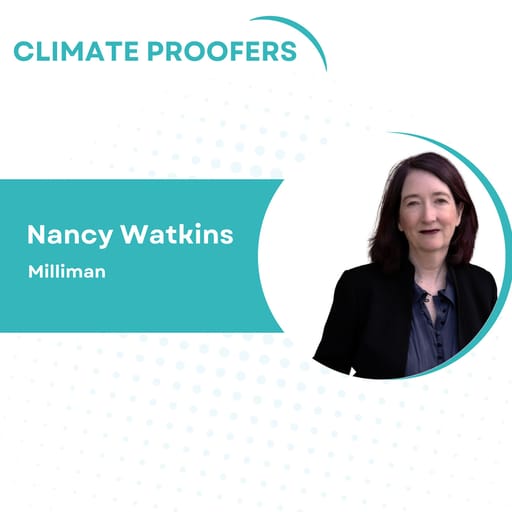
Transcript 0:00 [upbeat music] Hi, everyone, and welcome to Climate Proofers, the show all about those on the front lines of climate adaptation and resilience. 0:13 I'm Louis Woodall, editor of the Climate Proof newsletter, which you can read at climateproof.news. 0:19 This week, I interviewed Nancy Watkins, principal and consulting actuary at Milliman, a risk management consultancy and intelligence firm. 0:27 Nancy heads up an actuarial consulting practice that specializes in climate resilience, insurtech, and catastrophic property risk. 0:34 We get into the climate threat to the US insurance market and discuss the policy and business interventions that could make a difference. 0:41 We also weighed into the debate on the use and evolution of catastrophe models, also known as cat models, which are used by the insurance industry to estimate how natural disasters, like climate-driven storms and floods, could impact insurable assets. 0:55 Before we get started, a reminder that Climate Proofers and the Climate Proof newsletter are subscriber-supported productions. 1:01 Listeners like you can help support my coverage of the adaptation and resilience space for just five dollars a month by heading over to climateproof.news/upgrade. Thank you for the support. 1:11 In a minute, my conversation with Nancy, but first, let's round up some of last week's adaptation and resilience stories. 1:17 [whooshing sound] In finance, US Treasury Secretary Janet Yellen said at least three trillion dollars of fresh climate finance is needed every year from now to twenty fifty to support the low carbon transition and build climate resilience. 1:30 In a speech in Brazil following a meeting of G-twenty finance ministers, Yellen said that this capital should, quote, "Be leveraged to support pathways to sustainable and inclusive growth, including for countries that have historically received less investment." 1:44 She also recalled US efforts to overhaul multilateral development banks to better incorporate climate considerations, saying they are now working toward aligning all projects with Paris Climate Agreement goals and screening for climate adaptation. 1:57 Yellen's three trillion dollar marker exceeds the one to one point three trillion dollars referenced as the annual amount needed for climate at the Bonn conference held earlier this year. 2:06 However, her speech did not go into specifics on how the US and other rich nations could do their part to increase their annual contributions from the one hundred and sixteen billion dollars achieved in twenty twenty-two. 2:16 [whooshing sound] In policy, the White House released a climate resilience game changes assessment in a bid to channel more investment into adaptation and resilience. 2:24 The assessment highlights twenty-eight technologies, activities, and practices that should help harden the US against escalating climate shocks and create new well-paid jobs in the process. 2:34 The twenty-eight game changers are organized across eight sector-specific categories and four cross-cutting innovation groups. These are nature-based solutions, information and tools, infrastructure, and financing. 2:47 Through this assessment, the White House aims to motivate, quote, "Thoughtful, targeted investments that prepare the US for current and future climate shocks." 2:55 [whooshing sound] And in tech, researchers with Google have published a paper showcasing an AI infused weather and climate prediction model, which they claim can generate projections on a par with established climate models faster and using less computational resources. 3:07 Their NeuralGCM model combines AI components with aspects of traditional general circulation models, which are used to simulate how the Earth's physical processes may change under different greenhouse gas emission scenarios. 3:19 The authors claim NeuralGCM is the first machine learning-based model to make accurate ensemble weather forecasts. 3:26 Not everyone was enamored with the model, though, with climate scientist Andrew Pitman arguing on LinkedIn that while AI could be helpful when it comes to near-term extreme weather forecasting, for longer term climate projections, there's questions whether AI can add much. 3:38 [whooshing sound] Right, that's it for this week's roundup. Now on to my conversation with Nancy. [upbeat music] Hello, Nancy. Thanks for joining us today. Where are you calling from, and what do you do? Hi, Louis. 3:51 Thanks for having me. I am calling from Orinda, California, which is in the San Francisco Bay Area. I am an actuary. 4:00 I'm a principal with Milliman in San Francisco, and I manage, um, a group of people that specializes in climate and catastrophic risk. Thank you, Nancy. It's wonderful to have you here today. 4:13 I think I found you via LinkedIn, like I found many of my climate proofers, and we were discussing a post about insurance risk and catastrophe risk, and so I'm thrilled to have you on to talk about this in more detail. 4:25 I was wondering if you could tell us how climate change is disrupting the US insurance market, and what policy solutions are being discussed to try and prevent the whole system from keeling over in the wake of climate shocks. 4:35 Well, I'd tell you, uh, what is happening in the US market right now is partially attributable to climate change exacerbating other risk factors that are occurring at the same time. 4:48 So, so some of the other risk factors are the buildup of exposures in high-risk areas. 4:53 People are still continuing to build along the coast or in the wild and urban interface, which we call the WUI, where there's a higher risk of wildfire. 5:04 And so basically, there's more properties now than ever in harm's way. There's also increased repair costs due to inflation and supply chain issues over the last few years. 5:16 And at the same time, we are seeing a much greater incidence of severe convective storms, wildfires, floods, all the things that we used to call secondary perils as opposed to hurricane and earthquake. 5:31 And those are very much related to climate change. 5:35 So when you've got several different things going on at the same time, it's hard to tease out any one of them, but certainly all three of them happening together have made a significant increase in risk. Wonderful. 5:49 So you're saying that climate change is one factor, but the buildup of properties in this path of these climate perils is also a factor. And also, I suppose, the buildup of more expensive properties. 6:00 It, it does seem to strike me that a lot of the most desirable locations to build in the US are also some of the most fraught with risk, right? 6:07 You think about California and wildfire-prone areas, and of course, the classic example of, of Florida and the coastal properties there. 6:13 So it's, it's kind of a function of human behavior as well as climatic behavior.Yes. 6:18 I mean, where I grew up in North Carolina, there's a chain of islands called the Outer Banks, and there was one area that w- when I was a teenager had absolutely nothing there, dunes and, and, and water on both sides. 6:33 And now they have these enormous houses that you can go with all twenty-six of your closest friends and, and stay there in these giant, giant places, and somehow they all have to have insurance. 6:47 These islands are very, very susceptible to hurricanes and floods, and, you know, the, the demand for those kinds of places just keeps going up. 6:58 So one of the issues I'm interested in is whether the government and regulators should get involved in, in regulating these markets more and preventing people from buying properties that are susceptible to climate risks, and I was wondering what your view on, on this was. 7:11 There's been a bunch of articles about insurers pulling out of certain states, of state-based insurance companies having to step in, uh, where the private market has stepped out. 7:20 So can you tell me from your experience what you feel the policy solutions are and what, wh- which ones are effective? 7:27 Well, I guess I'd like to make a distinction between preventing someone from buying a, in a high-risk area and not financing their purchases and backing them up through artificially cheap insurance. 7:39 So just starting with development, there are ways to restrict land use in certain areas and not have development happen if the properties are just going to put more people and, and homes in harm's way. 7:55 But at the very least, you would want the developers to be on the hook for the costs of the, uh, infrastructure to make the community as safe as possible. So beef up building codes. 8:10 In some places, if, if you do improve building codes, you really can build safely in high-risk areas. 8:17 So, so that's, that's one government solution that I really believe in, is, is sensible building codes and sensible land use planning that, that really reflect the risk. 8:29 With respect to insurance, most people don't actually understand how insurance is priced, and they shouldn't have to. They're not actuaries. They probably don't even know what actuaries do, and that's just fine. 8:39 But they do expect that the cost of insurance is somewhat known and predictable when they make a, a decision to... for example, to build in a, in a certain area or to buy a house in a certain area. 8:53 And so that's the thing that's been somewhat controversial in the past few years is the cost of insurance coverage has increased drastically in some areas, and the availability of insurance, which is also assumed to be a constant, has, has gone away in some areas. 9:13 And so once people start being surprised by insurance cost and availability, that's where all the problems start. 9:21 If you actually build in realistic costs of insurance, which means tying the insurance pricing to the actual risk, then as long as the risk doesn't change dramatically, then the insurance premiums would tend to rise up with the cost of construction. 9:40 What's, what's happening now is somewhat a ref- of a reflection of costs that really weren't based on the risk in the first place and then failed to rise fast enough. 9:51 So we, we have a lot of regulatory restraints on pricing, especially for residential insurance as opposed to commercial. We have, in the US, prohibitions on use of certain models in certain places. 10:05 In terms of government programs, it's... can get very political how much premiums can be charged for those programs. And so there are various mechanisms that are designed to keep insurance premiums affordable. 10:22 Unfortunately, what happens in a situation of rising risk is that with respect to the private industry, they see losses and increased reinsurance costs, which erode their surplus, and then they're less able to continue writing at the same level, much less growing. 10:42 So they have to pull out of markets in order to de-leverage themselves and not go into re-regulatory supervision or, or lose their ratings so that mortgage lenders will recognize them. 10:54 So there's a reason that insurance has to be priced to reflect the actual underlying risk, and that is because the system has to stay solvent in order to function properly. 11:08 So it sounds to me like the insurance market could be providing a useful pricing signal to dissuade certain individuals from buying properties in, in really risky areas. 11:18 But they are almost constrained by certain regulations and norms, et cetera. 11:24 So are you saying actually that maybe less government intervention and a more free market approach could create a better distribution of, of risks and insurance around the country? 11:32 Uh, um, I'm not a, a hundred percent everything should be, you know, zero government intervention, but I'd say yes to the answer of less government intervention. 11:44 I, I guess I'd say that regulators can see their job in a more sophisticated light, that it's, it's their job to keep insurance available in their states, and they cannot... 11:56 they can't fulfill that job if they force insurers to cut prices below the bone and start losing money chronically to the point where it's really not worth it to do business in their state. 12:10 There can be ways for government to promote affordable insurance while letting the price signal flow through, and there it gets a lot more towards the things that I was talking about, which would be building codes, land use planning-And communication, and then also helping with mitigation. 12:31 Like, the only way to really benefit everyone in this ecosystem is to drive the risk down, and that is difficult because right now there's a disconnect between who owns the risk, who understands the risk, who understands how to reduce the risk. 12:51 I mean, there are lots of discontinuities in that process, and sometimes when you do something to reduce your risk, it might cost more than whatever premium benefit you're going to have, but maybe instead of n- not being quoted by any insurance companies, you might get price quotes from four or five insurance companies. 13:12 So it's, it... People do tend to think that they have to get paid back by their insurance policy to do something that reduces their risk, but that's not exactly how it works. 13:23 It's more that the system itself needs to be set up to discourage risk-seeking behavior and- Mm... 13:32 to start enabling more risk-informed decision-making, and that really has a lot to do with climate change because even though we have things that could be temporary, which is build-up of exposure in high-risk areas, and, you know, inflationary effects, those, those could go back the other way. 13:51 But the risks associated with climate change don't seem to be going any way but in one direction, which is more uncertain and worse in the future. 14:01 I find that perspective quite refreshing actually, because we often talk about insurance in the context of climate resilience, right? 14:07 Your insurance company pays out a claim that helps you to get back up on your feet, rebuild your property, your business, whatever. 14:13 But actually, we need insurance to be part of the kind of managed retreat aspect of adaptation, right, whereby you actually tell people either through a market pricing mechanism or for regulation, "Look, this is a dangerous place. 14:26 Only those who have sufficient wealth resources should consider occupying this area, and everybody else should f- rethink their choice and maybe go into areas which are less climate vulnerable." 14:38 Uh, so I think that's quite interesting, the idea that a- insurance is not only a mechanism for resilience, but also for adaptation and managed retreat. 14:44 And it sounds like at the moment we're kind of focused on the resilience and, and availability of insurance to, to individuals and businesses and not thinking about actually pricing risks appropriately, which may actually result in fewer people being in very dangerous positions and experiencing massive losses. 15:01 That, that is definitely true for certain perils, but I will say, Louis, there are other less drastic options than picking up and moving away. 15:09 I guess I'd say for, for flood risk, for sea level rise, yes, there are certain areas that are going to just get worse and worse, and no matter how high you raise your home up, if you can't get out of your driveway and drive down the street or get into a store that's not flooded or go to a job that's not flooded, it, that community may not be able to survive. 15:38 But putting flood hazards aside, what climate resilience measures should insurers, communities, and governments be pursuing to harden themselves against other types of climate shock? 15:48 With other kinds of perils like hurricane or severe convective storm, there might be ways to harden your buildings and stay in place. 16:00 It might cost more money to build, but some of the numbers I've seen just don't make it seem as though it really is that much more expensive to harden your home, so that when there is a hurricane or there is a, a tornado, that your, your roof is less likely to, to blow off and your, the rest of your house could, could stay intact. 16:22 When it comes to wildfire, things are a lot more complicated. You, you, you can't just wildfire-proof your house. 16:30 And, and here I'm talking about urban conflagration risk, not the h- the cabin in the middle of the woods kind of thing, but the, the entire community on the edge of grasslands or, or a forest. 16:42 To demonstrate resilience against that kind of urban conflagration, it can't happen at the h- har- at the home level or what we call the parcel level. That has to happen at the community level. 16:55 So the good news is there are certain things that can be done to disrupt fire pathways, which means to slow the fire spread before it gets to a community, that don't cost as much as building an entire ring around a community or, or relocating everybody. 17:13 They do require, you know, some advanced fire science and an understanding of how fire spreads. 17:21 They require a lot of coordination of permissions from different public and private landowners and, you know, you have to consider environmental restrictions. 17:31 Those kinds of things are complicated, but they're doable, and mitigating the homes beyond that so that when the fire does get into the community, it doesn't spread as fast or as far, and fire suppression can get a, a hold of it before it, it takes hold of the, of the town. 17:48 A lot of the things that, that, that are really effective are not very popular, like clearing what we call zone zero, the five feet directly around your house so that there's nothing burnable there. 18:00 Um, that's something that is, is being talked about as a statewide requirement in high-risk communities in California. Hasn't taken place yet. 18:12 I, I believe it's the right way to go, even though it means that I personally am going to have to do a bunch of work. [laughs] Okay. Um, well, plus my family. Mm-hmm. 18:20 But w- we, we, we don't want our house to burn down, and we want the people around us to do the same thing so that their houses won't catch our house on fire. 18:29 That's the, where the science is telling us that that is the kind of-Building change that can really make a difference so that when the fires burn through, our community will stand after that. 18:44 That's, to me, a much more desirable option than managed retreat. Yes. There seems to be a broader appreciation that this sort of community-based resilience is necessary. 18:54 I wanna move on to talk about insurers themselves. You said that they're the ones who understand the risk, and I wanna get into the mechanisms by which they understand the risks. 19:03 People in the business know that insurers use so-called catastrophe models to understand weather-related hazards and the exposure and vulnerability of different areas to these hazards, and there's been a lively debate about how these catastrophe or cat models should change in light of climate change, and I was wondering if you could talk a little bit about this debate a- and where you stand on it. 19:22 The first thing that would help with respect to catastrophe models is better education on what they do and what they don't do, and how to kick the tires of a cat model and see if it's suited for your particular purpose. 19:37 I think the first thing as an industry that needs to happen between the insurance industry, the actuarial profession, there are a lot of government users of catastrophe models, they all need better education. 19:48 There's very little formalized education and training on how to properly use cat models. So we have a situation like, like if you went up in an airplane and they had 20:02 very, very well-designed software that helps kind of provide expert support for the pilot, that's, that's a good thing, right? But it's not a good thing if the pilot doesn't know how to fly a plane. 20:16 And that's the problem is when, when you have these models being used by people who don't understand the principles of what it is they're doing, then 20:27 that's where we get into the dangerous situations where poor decision-making can happen based on the models. So, uh, models are just descriptions of the risk. 20:40 They're always a simplification of whatever it is they're trying to describe. And so just think about descriptions. If I asked you to describe yourself, you would tell me something. 20:53 If I gave you 10 minutes, y- I'd get a lot of information from you. And then if I talk to your mom, I'd get a different description. If I talk to your best friend, I'd get another description. 21:04 If I talk to your boss, I'd get another description. And all those descriptions would be different. 21:09 There might be common themes, they might disagree on some points, but they would all be different, and everybody would know you, and everybody would be telling the truth. That's how cat models work, too. 21:20 They're all just describing what the modeler sees as the most important things about the risk. And the context of the description, what they were built for, what, what data they were built off of, that matters, too. 21:33 Like, if I ask your boss about you, your boss is gonna tell me certain things. If I ask your mom, I bet she's gonna tell me something else. 21:40 [laughs] But that's because they know you in different ways and, and, and so when you're thinking about models, you have to think about them in that way as descriptions and not as the truth or the answer or the prediction. 21:56 They're just meant to be explanatory. They can be used to make predictions and to, to try to assess the truth, but that's not the same thing. 22:06 Are you suggesting that there are those in the industry who are using cat models in a very simplistic way? 22:11 They're just looking for a loss number and then plugging that into their own financial models and not really taking into account the vagaries and ambiguities you mentioned? 22:20 Based on my discussions and presentations and, and work over the past few years, I do think there is a tendency for quants, 22:31 uh, uh, if, if that's still the same word I, I don't know if people call themselves that anymore. Quantitative, quantitative analysts, right? Yeah. 22:37 Pe- people who think of themselves as quants to want the answer and to want a, a model that allows them to just keep going with whatever it was they were doing. 22:49 W- you know, economic forecasting or, or what- whatever w- it was they were doing, uh, to, to build in the answer from a cat model, which frequently c- catastrophe models or downscale climate models are capable of providing very granular information, like all, all... 23:09 Even down to the property level. 23:12 But is that information useful or pr- or properly used for the purpose that you are putting it to is the question, and I, I have heard people outside the insurance industry talk about using climate models and saying, "I just want the easy button. 23:31 I just want the answer." Now that's- Mm... you know, not, not everybody, for sure. But the point is if you give more nuanced training, more robust training about the concepts of risk... Well, for one thing, 23:46 climate change is kind of by definition unprecedented in our human, you know, record. 23:54 So we really don't know what's going to happen, and the climate scientists who put together the macro models that are feeding climate-informed catastrophe models are having to make some very difficult assumptions and decisions in terms of making that big simplification that I talked y- to you about. 24:14 And when they do it, they do it for their purposes as scientists. They didn't necessarily mean for it to be decomposed and plugged into an insurance framework or an economic modeling framework. 24:26 Now, it's possible that someone who does that will do it right, or it's possible that they will do something that doesn't really make any sense at all with respect to how the original model was built. 24:37 And so it takes a- an awful lot of expertiseTo put everything together and make sure it all makes sense These models weren't supposed to work together initially. Is that what you're saying? 24:50 Well, they, they weren't initially built from start to finish typically for that purpose. 24:57 So I've, I've seen models that, that purport to give very, very granular estimates of what's gonna happen in 10 years, in 30 years, in 50 years, and that's all well and good, but when you check what they're saying about today, it doesn't make any sense at all. 25:12 So then you wonder, well, did they get it right in 10 years, in 30 years, in 50 years, and s- they're so clearly not reasonable in certain areas today. That's where testing at least raises the right questions. 25:28 And as you intimated there, there has been an effort to kind of blend climate models with cat models to create future projections of how storms like hurricanes could mature, and I'm aware of, of government initiatives by the NOAA, uh, double-A, for example, by NOAA- Yeah... 25:44 to enhance cat models so that they take better account of hail damage, for example, from severe convective storms, which we know has been a, a big cost to the insurance industry in recent years. 25:55 But there's a question of course, as you kinda mentioned, like whether these models should work together and how they should work together, and I was just wondering if you could give us your view of the kind of state of play and, and what's missing from this debate, and are we seeing some providers of cat models buddying up with climate model providers and creating credible solutions, or are we still in the kind of like working things out stage and we need to actually go back into the lab, get the academics together, and figure out how to actually merge these two disciplines together? 26:22 Well, I, I, I don't think I'm actually qualified to second guess, to second guess scientists and cat modelers. Not really from a technical perspective. But from a practitioner's perspective, what I can say is 26:35 one of the main uses for climate science right now, which we've just talked about, is forecasting 10, 30, 50 years into the future. 26:45 And that, that will help with forward-looking planning and u- and understanding where different areas do need to for- perhaps look at manage or treat. But another related area is to true up today's cat models. 26:59 Uh, a- and the insurance context, these, these models simulate, you know, tens of thousands of versions of next year. 27:06 So they don't have to think about what's going to happen in 10 or 30 or 50 years, but they do have to think about all the different possible or probable or 27:17 re- really l- reasonably possible outcomes for next year, and that's difficult when the risk is changing. 27:24 It's not so hard when you can go back 100 years and look at all the different earthquakes, for example, and just say, "Well, you know, there's more people in this area, and so if the same earthquake happened 27:38 next year, it would be a lot more expensive because there'd be much more property and damage to, to pay for." 27:46 But if, if you've got a situation like wildfire where we don't only have this exposure problem, but we also have houses as fuel burning each other down a- and we also have a change in the number of hot, dry days where the fire season is one or two months longer now than it was, you know, decades ago. 28:11 Or we have many, many more dead trees. Like, those are things that are associated with climate change and really do change the nature of the peril. 28:21 So figuring out what next year looks like is a lot harder because even if you can go back 100 years, the, the geography a- and the physical drivers of that hazard in 2024 and 2025 are not the same. 28:37 So that's where climate science can really inform the today's use cases of cat models. That's one major area that I think better explanation would do. I'm not saying, uh, that the cat modelers need to do a better job. 28:53 I think that it would h- be helpful to users if that information were better explained in general. I'm not saying nobody does it, just across the board that question comes up a lot. 29:04 Another use case that's somewhat related is the one that I'm talking about with respect to mitigation. If it was just good enough to say, "I know what the risk is," then we'd, we'd have less work to do. 29:19 But as a society, we can't really afford the rising risk that we have, and so we have to do something to change it. Th- the catastrophe models are the best way of doing cost benefit analysis and what if scenario testing. 29:36 But they were typically not designed to just output new fire spread if you've done any combination of mitigations inside and outside the community, or to change the flood loss outcomes because you've redesigned your community to channel water in a different place. 30:01 There's ways to engineer at a macro level and right now it's... These models are not easily built to, to handle those kinds of mitigations. 30:13 There's some that are, that are quite well handled by models, like replacing your old roof with a roof that's, you know, IBHS certified to be the most resilient against hurricanes. 30:27 I mean, that's a, that's a pretty easy thing to be able to answer using current models. It's just the more complex types of mitigations that are less easy. 30:35 And that, that's not just a modeling problem, it's a modeling and science problem. 30:40 You have to have a better connection between the science of what, what will help and how our current conditions are and, and how the model can be recalibrated-To reflect better future conditions. Mm. 30:53 Does that answer the question? Absolutely. It comes back to this wonderful idea of translation, right? 30:59 Like, there's climate models, the climate scientists, and a lot of their knowledge and projections have to be reconstituted to make sense in a insurance world, in a catastrophe modeling world. 31:11 And you do need a, a sequence of technologies and experts to help facilitate that. 31:15 Otherwise you have the situation of, yes, climate models maybe being used in ways that don't provide the actual outcome that insurers and other users of cat models need. 31:25 And I think that's why you're seeing such a, an upspring of climate tech companies that kind of try to bridge that gap and provide services to the financial industry so that they can get a better handle on their, on their climate risks in the short term, informed by longer term climate projections. 31:41 The question is, though, of course, is there's a lot of these companies, some are probably going about the science and the down scaling of climate models the right way. Some are probably taking shortcuts. 31:51 [laughs] And I wonder over the next few years we'll probably see some, some shakeout in this, in this, what I think is quite a crowded industry as people kind of converge on best practices and as the science and then the research builds up in favor of certain modalities when it comes to using cat models a- and climate models. 32:07 But I definitely have seen financial industry be in the area where there's been a lot of activity in, in the climate risk tech and lo- climate risk analysis space. 32:14 I'm not sure if that's been your experience as well, Nancy. Oh, yes. Very much. I mean, it's demand will breed supply. Mm-hmm. 32:22 And I, I, I think it's great to have lots of competition and lots of innovation in that space. 32:26 I just want better testing that is, that does have some useful information put out in the public eye so that people could actually understand the difference between different models and some high level information about how they're performing. 32:45 So that- that's a tricky, uh, thing to ask. There's no one entity that's w- well-suited to do that. Possibly the, the, in the US, the Casualty Actuarial Society. 32:58 It's difficult, and I, and I would say that insurance regulators are not in a great position to do that in the States, just because they don't have the proper resources. Yes. 33:07 I wanted to get into this now, actually, about how regulators and the kind of the broader financial system can assist insurers in, in making them more climate resilience, getting them the data and expertise they need. 33:20 I've been covering via the Client Proof newsletter, a number of developments out of the National Association of Insurance Commissioners, the NAIC. 33:29 They've been working on, on ways to facilitate better climate risk management by insurers, and there's been a lot of data sharing, a lot of data gathering, and also at the federal level, there have been efforts by US Treasury and the Federal Insurance Office to kind of get a better handle on the scale of the challenge facing the insurance industry. 33:48 And I'm kind of wondering from your perspective, if these have been [laughs] uh, of any use or are actually moving the debate in a useful way. 33:53 So what are your reflections on, on what state and federal authorities are doing right now to help the insurance industry? I think they're trying to do a very difficult thing. 34:02 I'm, I'm sure that the data requests that I've seen so far will be producing some useful insights. I'm not sure that they will answer the questions that the surveyors want to answer, but they're a start. 34:21 What they really want to know is where should we be worried about? What are the problems? What are the causes of the problems? How bad is it gonna get? 34:29 I'm generalizing, putting myself in their heads, which isn't really very fair. 34:35 I think looking backwards at non-renewals by zip codes and all that kind of thing, it gives you some information, but if I were gonna start with a survey, I would start with asking insurance companies not about where they're writing and where they're not writing. 34:52 I would probably give them a sample data set and say, "What's premium that you're allowed to charge for this data set across the country, and what's your actuarially sound premium for the same data set?" 35:06 And compare what's the gap between what companies think is the cost of risk transfer and what they're actually being able to charge right now. 35:14 If they were able to do that, then that would tell them how far in the hole the industry is. The hole got very, very deep in the past few years because of the cost of reinsurance and 35:27 rebuilding, like the, the inflation and some of the regulatory restrictions that I mentioned to you. 35:34 So getting prices up to current is one step that would help with insurance availability, and then using some of these catastrophe models to, to game out different scenarios with different models, having that be part of the study. 35:52 To me, that's, that's how I would design a study like that to figure out where do we see the model losses going up and where are we already behind. 36:04 It seems to me that the NAIC's data gathering is looking at insurance availability first and foremost, though, because I suppose their concern is for the end customer. 36:13 But what you're saying makes sense because if you have a true vision of the delta between what's actually being charged to cover risk and what the risk actually costs to cover, you then can perhaps create space for financial innovation and more intermediaries to come in and help to, you know, intermediate that risk, right? 36:32 Like, we have reinsurers, of course, are a massive part of the insurance infrastructure, but there has been the development in recent years of the cat- catastrophe bond market and insurance-linked securities, ILS, and I'm wondering if maybe if we had a better picture of the delta between real and actual risk price, there might be more incentive for these financial players to get more involved.I will say a lot of the availability crisis in the country has been driven by a few states. 37:01 California had a pricing problem, and it was really due to the regulatory regime which has been in place for decades. 37:09 There was an extremely entrenched way of doing business here, which did not allow insurance companies to increase prices in any, I guess I'd say, predictable way, or certainly when the risk went up very quickly to respond to that. 37:27 And so companies got way behind, and they stayed way behind for really at least a decade, and lost a lot of money in California. All of this is being dealt with. 37:38 The commissioner has got what is called the Sustainable Insurance Strategy to, to reform and modernize the regulatory regime in California, which it, it will help with availability. I feel very, very confident of that. 37:53 Florida had a fraud problem, and that doesn't have anything to do with climate change. 37:59 They certainly have a huge amount of catastrophe risk, but they have extremely s- strong and cyclical fraud waves that happen probably every eight years or so. I didn't know that. Um, oh yeah, yeah. They... 38:14 It was sinkhole at one time, and then it was mold, and they've got a really entrepreneurial and well-organized fraud culture in Florida. [laughs] What happens is 10 or 12 insurance companies... 38:26 Like, companies get asked for change. It doesn't happen in any significant way, and then after you've got 10 or 12 companies who go insolvent, the legislature acts. 38:39 That has happened, and I believe it will drive the losses down. Will it be permanent? I'm not sure. 38:47 But their premiums are high, and their, their insurance market got so shaky really because of that statewide kind of systemic culture. There's only so much any one 39:02 government official can do until the political will is there, and that seems to be triggered by insolvencies and, and insurance companies leaving the market. 39:12 The different states driving the narrative in the media really have i- in many cases different things going on, and the solution for these different maladies can often be quite different from place to place. Absolutely. 39:30 You're correct that in many ways the US is, is 50 different countries when it comes to insurance because there are different insurance regulators. Each state has its own commissioner, et cetera, their own market. 39:40 And I didn't know about the fraud component to the Florida market, but of course that is, as you said, not climate related, but does affect insurance availability and pricing. 39:49 However, The New York Times has done some great coverage of this and has found insurance coverage being revoked or prices increase very greatly in places like Iowa, for example, Colorado. 40:00 So there does seem to be some sort of systemic issue as well here, which probably relates to those factors you spoke about at the top about, you know, building in dangerous places, inflation, et cetera. 40:12 But it sounds what you're saying is that maybe the solutions aren't the same for every state. There are special solutions that might be more pertinent to certain areas. 40:19 Well, certainly the price increases that took place across the board, many of them have to do with inflation and the cost of reinsurance, which will certainly be felt everywhere. 40:34 The, the reinsurance market prices increased significantly over the past few years and, and that has really been felt across the country. 40:45 Then we did have major events in different places, wildfires here, hurricanes there, severe convective storms in between. And so yes, many different states have been hammered in many different ways. 41:01 In fact, the, the one that really gets me is severe convective storms. Nobody really thought about tornadoes as being a big deal until just a few years ago. 41:11 But last year, Swiss Re reported that out of 108 billion total global insured losses from national catastrophes or na- natural catastrophes, 64 billion was from severe convective storm in the US. Wow. 41:29 That is crazy. W- it, it used to be just a blip in a company's annual results that, "Oh yes, we had some tornadoes in April." But there'd be good years and then there'd be bad years. 41:43 But there just seems to be terrible years for severe convective storm. I'm, I'm not a scientist. I don't know how that all interplays with climate change. 41:54 A- a- and I have heard that exposures are increasing in those areas as well. But I, I haven't read anything outside of Florida and California or... 42:03 and Louisiana, I think, where just massive defections from the market happened and companies just stopped- It's been more price increases, I believe. It's been more price increases- Right... 42:15 that certain householders can't pay. That's just a different situation. I mean, they're both important. They're just not the same. 42:22 That's true, and I want to finish by posing a question about the tension that may be inherent between the, the insurance market and the political and social imperatives of insurance regulators and, and politicians writ large, right? 42:36 Because a lot of what you're saying makes sense, but of course there's a danger if we have true risk pricing of, of climate in, in the US. 42:46 You might have situations where whole populations get sorted into affordable areas, uh, and less affordable areas, and that can create social tensions, which of course politicians are sensitive to and wish to act upon. 42:59 So there is this real tension. Insurance is a heavily regulated market for this exact reason, right? Because it is so integral to-... 43:05 individuals and businesses' ability to, to live the lives they want and to pursue the opportunities they want. 43:11 So I'm wondering, you're aware of that tension obviously, and I'm wondering if you see, see ways through it at all, 'cause at the moment I [laughs] I cannot. 43:17 Well, I do have lots of opinions about that, and I, I have seen what you're talking about, Louis. The... 43:23 W- what I see in, in the political sense is often a knee-jerk reaction to try to control insurers and get them to do things differently, 43:33 which would be things like prohibiting using catastrophe models in pricing or prohibiting using certain kinds of information in underwriting, or mandating discounts, or requiring them to underwrite in certain areas, or even expanding government-backed programs to s- to just give up on the insurance market altogether. 43:59 I, I'm willing to believe that all of the solutions are well-meaning and well-intended. 44:06 The problem is in every case th- they, they tend to only act or, or, or take effect by breaking the price risk signal, by, by making it less direct that when a person, a policyholder drives up risk in certain ways or fails to reduce risk in certain ways, that they don't feel it. 44:28 Somebody else pays for it. A- and that's difficult because who's supposed to pay for the risk in California wildfire? People in other states? Like, why, why, why do they want their costs to be increased? Mm-hmm. 44:42 Why do I want m- my costs to be increased by, you know, fraud risk in Florida? Mm-hmm. I don't. 44:49 And I, I, I think that finding someone who wants to pay for, to subsidize other people who have made certain choices is difficult. And so what happens is they don't ask. 45:04 They often create solutions where the risk disappears. [laughs] It's not transparent. Mm-hmm. 45:11 Like, whatever the policy solution is, it's not based on a transparent accounting of the risk and then say, "Okay, we're going to subsidize these people for this reason." 45:22 They're much simpler than that, which can be politically popular, but they, they don't change the underlying dynamic, which is that the risk is too high. 45:34 And that means that people and families' investments are in harm's way. Mm-hmm. But they are less likely to know it or do anything to fix it. So I, I personally don't believe in disguising risk. 45:49 I do believe in subsidization for people who cannot afford to do what they need to do, but usually these subsidization kind of policies tend to throw everybody in the bucket. Rich people 46:04 get subsidized, often even more than people of low-income households. 46:12 And I, I guess I don't see the benefit to society of someone else paying for a wealthy household to, to live in a high-risk area and have low insurance premiums. 46:24 I think a better thing to do would be to be fairly ruthless in understanding where risk goes and how much it is, using the best catastrophe modeling, the best science, and, and understanding that risk by definition is something where you might not know how it's gonna come out, that if the models are disagreeing with each other, then that, that might not be because they're wrong. 46:49 It might be because it's really hard to estimate. And so that makes it more important to make an investment in understanding it and addressing it sooner rather than later. 47:02 But that means bringing in money that typically has not been allocated for that purpose to start bending down the risk curve. That's the hard thing to do, but I think it's the right thing to do. That's wonderful, Nancy. 47:17 I appreciate you laying out your thinking like that, and I find insurance such a fascinating market because you have this kind of concept of, of socialized losses in the private market, and then you have the idea of spillover losses that have to be dealt with by the public sector. 47:30 And I absolutely hear what you're saying about, yes, if we are doing quick fixes or subsidizations, uh, by the public sector into certain insurance markets, eventually we all end up picking the tab, right? 47:41 When you think about how much the Federal Emergency Management Agency has to pay out to kind of help communities recover from disasters, you know, eventually all this risk never gets destroyed, just gets moved around and eventually comes and hits the public sector anyway. 47:54 So, so why engage in short-term fixes which end up foisting the losses onto the public sector in the long run anyway? But it's a challenge, 'cause I absolutely understand the opinion of elected officials as well. 48:04 They have their electoral cycles to deal with. Commissioners that are sometimes elected or appointed have their own cycles to deal with. 48:10 So there is this kind of tension between the kind of elected and public sector versus the kind of private insurance sector, and I think the r- the, the way that they navigate that tension is gonna be so important for the future of, of climate risk management in this country. 48:23 Yes. They just have to listen to the actuaries. And with that, Nancy, I think we'll close the conversation. Thank you so much for your time. 48:30 I really appreciate your insights, and I think we had a, quite a interesting wide-ranging discussion. We went into the weeds of c- CAT models, and we kind of went into the broader societal questions as well. 48:38 So I really appreciate your, your breadth and depth of thinking, and I'm sure our listeners will appreciate it too. Thank you. So thank you so much for your time. Thanks, Louis. I enjoyed it. 48:51 [upbeat music] Climate Proofers is a Climate Proof Media production. It is produced and presented by me, Louis Woodhill. Subscribe to the Climate Proof newsletter by going to climateproof.news/subscribe. 49:01 And to learn more about the publication, feel free to reach out directly using our LinkedIn page. Goodbye for now. [upbeat music]