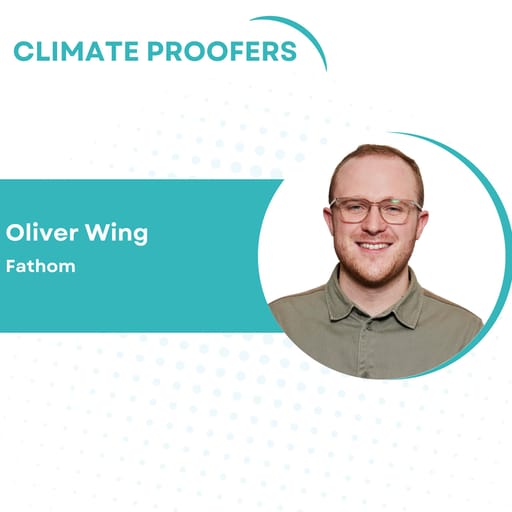
Transcript 0:00 [upbeat music] Hi, everyone, and welcome to Climate Proofers, the show all about those on the front lines of climate adaptation and resilience. 0:13 I'm Louis Woodall, editor of the Climate Proof newsletter, which you can read at climateproof.news. Flood risk is the climate risk keeping financial institutions up at night. 0:23 In the US alone, federally backed mortgages cover properties exposed to about $190 billion in flood damage over the next 30 years. 0:32 Meanwhile, in the UK, a recent study by financial services comparison platform confused.com revealed that insurance claims for flood damage surged 218% over five years, hitting over £11 million in 2024. 0:47 With numbers like these, it's little wonder that a hoard of climate intelligence companies are flocking to provide insurers, banks, and asset owners with advanced flood models and data that they can use to gauge their exposures and manage their risks. 1:00 One such company is Fathom, a UK-based firm founded in 2013 that claims to have the most scientifically robust tools and intelligence for understanding the climate's impact on water risk. 1:11 In late 2023, the company was acquired by major reinsurer Swiss Re, a company for which getting flood risk right is an existential question. In today's episode, I sit down with Dr. Oliver Wing, chief scientist at Fathom. 1:25 Oliver, or Ollie, opens up about how Fathom evolved from a university spinout to a global leader in flood risk intelligence and explains why scientific transparency is its not-so-secret source. 1:37 We get into the weeds of the company's flagship product, the Global Flood Cat Model, and discuss its relevance to financial institutions that could use it to better manage their flood risk. 1:46 Then we explore the intersection of public climate risk data providers, like America's National Oceanic and Atmospheric Administration, or NOAA, and private climate risk companies. 1:56 It's a nerdy episode for the real flood risk propeller heads out there, though there's plenty for everyone to enjoy. 2:02 Before we get to the conversation, a reminder that Climate Proofers and the Climate Proof newsletter are subscriber supported productions. 2:09 You can back my coverage and help the publication to grow by heading over to climateproof.news/upgrade and becoming premium subscribers. 2:17 If you're feeling really generous, please consider a super proofer membership, which comes with additional goodies like free gift subscriptions, access to monthly roundtables on adaptation technology and more. All right. 2:28 In a moment, my conversation with Ollie, but first, let's round up some of last week's adaptation and resilience stories. 2:34 [swoosh] In finance, a new report suggests that investment migration could be harnessed to unlock billions in resilience financing for the world's most climate-vulnerable states. 2:42 Investment migration, which is the practice of wealthy individuals obtaining citizenship in return for a large financial commitment to a country, could act as an alternative to sovereign debt and loans from development finance institutions. 2:54 The report, written by investment migration specialists Henley & Partners and the Climate Vulnerable Forum, calls for the creation of Investment Migration Resilience Funds, or IMRFs, which could pool capital from wealthy migrants for climate adaptation, disaster recovery, and economic improvement. 3:09 These funds could help bridge adaptation finance gaps in small island developing states and other climate-vulnerable nations, although the report does not say how much money could be raised this way. 3:18 [swoosh] In policy, President Trump ordered the creation of a national resilience strategy that, quote, "articulates the priorities, means, and ways to advance the resilience of the nation." 3:28 This is part of a broader executive order that says it is now US policy for states, local governments, and individuals to, quote, "play a more active and significant role," end quote, preparing for wildfires, hurricanes, and other disasters. 3:41 The order also says the federal government would be streamlining its own preparedness operations by scrapping or amending existing policies, shifting more of the burden for dealing with climate-related disasters to subnational governments, some of which may not have the resources necessary to suitably prepare. 3:57 [swoosh] And in tech, AI-based decision-making methods could lower the costs and increase the effectiveness of climate adaptation for cities like New York. 4:05 Research by academics at Princeton and Rutgers use reinforcement learning, or RL, an approach for training AI, to generate potential responses to sea level rise around Manhattan. 4:16 Adaptation decisions were simulated in 10-year intervals out to 2100 and compared with existing methods to protect against encroaching waters. 4:24 The researchers found that the RL methods, including adaptive seawall construction and strategies like retrofitting at-risk structures, were more cost-effective than static solutions. 4:35 For example, a dynamic seawall that is adapted over time in response to sea level rise reduces the expected net cost to NYC by 6% to 36% under a moderate climate scenario, and 9% to 77% under a high emission scenario relative to conventional adaptation methods. 4:52 [swoosh] All right. That's it for this week's roundup. Now on to my conversation with Ollie. [upbeat music] Hi, Ollie. Where are you calling from today, and what do you do? Hi, Louis. I'm Ollie Wing. 5:04 I'm calling you from Bristol, UK, and I'm the chief scientist at flood risk intelligence company Fathom. So, Ollie, can you talk us through how Fathom got started and what your role is at the company? 5:15 So Fathom spun out of the University of Bristol just over 10 years ago from the hydrology research group there. 5:20 So the group at the time were figuring out how to scale up local scale engineering grade flood models and figure out how to simulate those on every river in the world. 5:30 And they decided that actually there was quite a lot of demand for this information, particularly in the insurance industry, where they're much more interested in these, in these larger scale questions rather than the very local scale engineering detail in which these models are, are often deployed. 5:45 I joined in around 2016, and I'm now the chief scientist here. So my job has essentially been figuring out how to make these models better, more functional for a greater variety of end users. 5:57 So not just insurers, but how can engineers make use of-... spatially complete pictures of flood hazard and risk, how can financial institutions such as banks and asset managers figure this out. 6:09 Two of the really important things that I've tried to lead while I'm here is figuring out how to understand future flood risks, so how we can take locally precise understandings of flood hazard, but also project those into a future where the climate will be different to that of today and that of history. 6:24 And also how we can translate all of that physics of how floods occur and where and how intense they are, and translate that to, to risk, to impacts. 6:34 And very importantly, how we can do that in a spatially coherent way so we can understand the correlation between locations. 6:41 This is what insurance catastrophe models do, and I'm sure we'll dig into that later in the session. That's excellent. And you've spent nine years at Fathom, you said? Nine years, yeah. 6:51 I can't believe it's been that long, really. Yeah. I covered the climate tech space for a while, and there's usually quite a lot of movement and churn and, and companies rising and falling and being acquired. 7:00 And Fathom, of course, got acquired by Swiss Re, uh, was it two years ago now? 2023. Yeah, just over a year ago, actually. Yeah. 7:07 So the longevity you've got on the team at Fathom, I'm, I'm wondering if that is a rarity in this space. I think it is. We've retained, even throughout the acquisition with Swiss Re, our, our core science team. 7:18 I think it's always testament to a good company when you can look through the staff list and see the majority of the company are, are scientists with relevant PhDs rather than business developers. 7:29 No dissing business developers who do important and, and a great job. But we've managed to retain that science focus throughout the entirety of our lifetime. 7:37 We were founded by scientists, and so we could essentially make the calls that matter to us as scientists, rather than needing any external funding or other voices to guide us in a different direction. 7:48 That leads nicely to my next question, which is how does Fathom differentiate itself in what I think is quite a crowded space? 7:54 I'd classify Fathom as a climate intelligence company or climate risk company, and there are numerous companies that talk about their scientific bonafides, that talk about their coverage, the granularity of their models, and it's a competitive space. 8:08 I, I, I'm sure you'll agree. But what do you think is, first of all, Fathom's sort of secret sauce, and what do you think also explains the kind of upsurge of startups in this area? Yeah. 8:17 I guess the secret sauce is there is no secret sauce, which is probably what's, what's unusual about Fathom. Um, we're... 8:24 One, one of our kind of founding tenets in many ways is the fact that we are ruthlessly and radically transparent about the methods, the data, the models that we build. 8:32 We don't just say we're science-led, but don't really have anything to back that up. 8:37 Everything that we sell to people, you can find an academic peer-reviewed paper describing that in, in a top hydrology journal or a top general science journal, publicly accessible, scrutinized by independent scientists that will be working at universities or whatever it is that they may be doing. 8:54 So I think that level of transparency is pretty unprecedented, and it's something that, that as Fathom's chief scientist, it's my responsibility to nurture. 9:03 It's very easy to get relentlessly pulled into the constant stream of product development, but actually carving out the time to, to write these papers up for general audiences or even for expert science audiences and get them peer reviewed takes a lot of time, but it's something that we're willing to put the time into. 9:20 So that's, that's pretty unique. And I think, like you say, everybody says they're scientifically rigorous, but who can actually prove it? We've got the backlog of papers that describe everything that we do. 9:30 We can demonstrate that the models have scale and the things that we say they're useful for, and we can demonstrate that projections of risk that we make using these tools 9:41 match up with sort of real experience o- in o- over recent decades. 9:46 And I think that's a really crucial step before you can start projecting future impacts that you can actually demonstrate you have something to say about current impacts. 9:53 Yes, that's a good point, because there is a lot of concern or ambiguity around future projections. And yes, we can... 10:00 We have an understanding of how the physics of the world are changing, the climatology of the world is changing, hydrology of the world is changing. 10:07 But yes, it gives you a little bit of a step up if you can say we can actually model accurately what's happening today, and then we can incorporate forward-looking climate science to give you confidence of our projections tomorrow. 10:17 And I think some people miss out that, that first step. Can I ask you as part of a follow-up to that, I have noticed a number of European startups trying to break America. I'm based here in New York. 10:27 Is there a reason why everyone's coming west? Good question. I mean, for us it's a fairly simple answer, is, is the quality of models that we can produce in America and the demand for it. 10:38 People are interested in what's gonna happen where all of the assets, whereof the, where all of the wealth is. 10:43 And the fact that we can make much, much better, much more accurate, much more reliable, um, projections of flood risk today and in the future in those areas is a very compelling prospect for modelers like us that it's all about the data, right? 10:58 We need quality data on terrain. We need quality observations of rainfall, of river flows, all of the things that make a good flood model. It's especially good in the United States. 11:06 So we can really create good models there and also use that country, that continent as a bit of a sandbox for how we want to see models of the rest of the world built as well. Yeah, that's interesting. 11:18 So it's where the assets are, but it's also where there's a, a wealth of data, there's a wealth of capacity, I guess, for you to build out these models so they can be useful, not just for the US, but worldwide. Yeah. 11:29 So last year you launched a global flood cat model, and I'm interested to know what scientific and tech advances contribute to this product to make it, as Fathom says, the most complete and customizable flood-related financial loss tool available on the market. 11:43 Big words. I'm wondering what kind of underpin that, that model. Yeah. Well, it's, it's a big claim, but we can back it up, right? 11:49 The release of this global flood cat model, and for s- some of your listeners that might not be aware what a cat or catastrophe model is, it can differ from other sorts of models which try to project current or future risk. 12:00 The very unique thing about a cat model is it's all about events. So-It's a synthetic series of possible flood events that could occur in different climate states. 12:10 So that allows us to really understand the correlated tail risk between locations, so we can understand if you've got a, an asset in New York, and you've got an asset in Boston, what's the joint likelihood of them being impacted at the same time? 12:23 If you don't have a cat model, you can't understand that. You can only treat each location in isolation. So this is the bread and butter of how, how insurers manage their risks. 12:32 Obviously, they insure portfolios of locations, and the really big losses are the, the losses where a lot gets hit at once. So that's why they need catastrophe models to understand that risk. 12:43 So we've essentially built the first global scale flood catastrophe model that represents all major sources of flooding. 12:49 So your kind of classical river flooding, your surface water flooding that can be particularly problematic in urban areas, as well as storm surge flooding from tropical cyclones and other sorts of events. 13:00 And I guess the scope of this model is so enormous, the fact that we can make these predictions at a thirty-meter resolution, so think of a grid box thirty meters by thirty meters. 13:10 We predicted the flood depth there, the relationship between probability and flood depth at those locations anywhere in the world for any of those major flood perils for any climate scenario that is likely to occur within this century. 13:23 So I think it's, it's really just from a standpoint of the scope of the model, nothing like this exists elsewhere in the market. And who's the product for then? Who are your key clients for this global flood cat model? 13:36 The typical consumer of flood cat models, as I've said, is the insurance sector. 13:40 You know, they want to understand how to price risk, and they want to understand how to manage exposure so that they're not too over-accumulated in certain areas that would be really sensitive to big loss events. 13:49 But we're seeing a lot of interest from asset managers, from banks, from large corporates with global supply chains and global assets, uh, are really starting to see interest in how climate risk is, is affecting asset valuation, and companies that have this global infrastructure network better understand what they need to do to protect it and safeguard operations and so on. 14:12 And banks as well, they, they're a little like insurers in terms of, in terms of how mortgages work, but mortgages are a lot more long-term. 14:19 You know, insurers can adjust what's going on year by year, which they would argue makes them a little more resilient to some of the longer term projections of climate risk. 14:27 But banks can be locked into mortgages for multiple decades, and so they are much more interested in capturing how risk is changing moving out to the future. 14:37 We also see that the organizations like governments and non-governmental organizations, especially in the developing world, where flood data is often quite scarce, are really seeing interest where exposure is growing. 14:49 In many ways, this is thought... This is where we thought the company would be most focused is the developing world. 14:54 It's places where there's no flood information whatsoever, and we're kind of that first, first line in the sand. 14:59 And indeed, we are seeing some of our data through work with the World Bank start to set emerging insurance rates in some of these developing countries, principally so they can avoid the mistakes that the developed world has made in the past in terms of where we're building our cities and where we're expanding and so on. 15:17 Um, so we've tried to make this model as diverse and user-friendly as possible, so it can answer these typical insurance questions, but we can also bring other less traditional cat model users into the fold and really help them to understand how it might support their business decisions. 15:34 Yes, the global in global flood cat model is interesting because reinsurers operate globally, so they want a comprehensive coverage. But that does open up the opportunity for other sort of players to, to use your data. 15:45 As you said, the World Bank is making use of Fathom data for projects that they're running in the developing world, and presumably local governments and smaller businesses, parametric insurers in the developing world could make use of your data to promote resilience in those regions of the world that might not be covered by the large reinsurers and large insurers in the Global North. 16:03 So it does feel like there are multiple ways for this flood model to be used. But it seems to me you're saying that the reinsurance industry is the prime driver here. It is, yes. 16:12 But we're really keen to ensure that we're bringing particularly the financial sector along here. 16:17 You know, there's a lot of, as we mentioned at the start, a lot of new players in this field offering solutions to this space, and I think there's a lot of reinventing of the wheel going on here. 16:26 Nobody knows how to manage and model and, and capture these physical risks quite like the insurance industry has because they've had to. 16:34 They've been stung by it from huge hurricane events in, in the nineties that have spurred this whole field of catastrophe modeling into existence. There's really no need to invent a, a new solution from the bottom up. 16:45 All we have to do is enhance the existing catastrophe models that we already have to be a little more forward-looking. And there's no reason why a catastrophe model can't do that. 16:54 If it can tell us the distribution of possible loss events today, it can do it under different climate states as well, and that's what this product tries to demonstrate. 17:03 I take your point about insurers needing this information more than anyone else because, because it is existential for them being able to quantify their flood risks, their climate risks, so they continue to do business. 17:15 I'm wondering what you make of the maturity of the rest of the financial sector, right? 17:18 You made the good point about banks and mortgage portfolios, and one thing I hear is that, well, banks need very finely grained data at the asset level, right? 17:25 Because they may be writing mortgages in a town, and a bunch of those mortgages might be to properties that are on top of a hill, which is unlikely to get flooded. 17:33 Some of them might be at the bottom of a hill, which are likely to get flooded, but they need to understand the difference between the exposures of those properties on the top of the hill or the bottom of the hill. 17:40 So broad brush risk models aren't helpful, and I'm guessing your thirty meter by thirty meter grid helps with that. 17:46 But I'm also interested in how asset managers and asset owners are thinking about flood risk and climate risk and, and what's your impressions about the maturity of the industry? Yeah. I think it's a mixed picture. 17:56 A-as you say, insurers and reinsurers, uh, uh, uh, are quite advanced. They've been modeling and managing this risk for decades now, and I think that's just through necessity. 18:05 They've had to engage with models like this because that kind of translation from-The flood hazard and its impact onto the actual balance sheet of somebody working in the insurance sector is a very direct link. 18:18 I think when it comes to managing assets and managing books of mortgages, it's a little more indirect, and it makes that connection between climate risk to business impact a little more convoluted. 18:29 And I think that might be why we're only now seeing some of the major players in the financial sector start to wake up to this. I, I think mortgage lenders vary widely. 18:38 Some of the big ones are embedding climate risk into their underwriting and portfolio risk management and, and others are at an early stage. 18:46 And many are just ticking boxes because that's what the regulator requires them to do rather than recognizing that there is a requirement for deep engagement to understand, you know, their exposure to these physical risks. 18:59 I think asset managers are starting to understand that asset valuations can and should be dependent on climate risk. 19:06 If you have places that are repeatedly flooding, where that might get worse, where insurance might not even then be available to such locations, that that absolutely will and has to have an impact on its valuation, and they can start to make decisions about the, at an asset level, what they are or aren't investing in. 19:23 But like I say, I think we're at a very formative stage here. I do wonder about the seriousness with which the financial industry takes climate risk. 19:31 I've been covering this area for about six years, and there was initially hope that regulation would force pricing of climate risks, right? 19:39 The idea that if you have climate-related disclosures, investors will get a better understanding of the vulnerabilities, the hazards that could affect certain companies and reprice equities and debt and project finance accordingly. 19:50 And we have had this rollout of climate disclosures, and maybe it has changed valuations on the margin, but then you see these massive climate-related extreme weather events in Eu-Europe, in the US, elsewhere, and you hear about billions in losses, and you think, surely if all this disclosure was making a difference, investors would have reorientated their portfolios to be less vulnerable or have invested in adaptation measures to protect their assets. 20:12 And maybe that's happened on the margins, but I don't see it happening at a large scale. So we've been told that maybe we need better, more reliable climate data that investors can trust and really take action on. 20:23 But I'm not sure if actually more and more data is necessary. It feels like there might have to be some behavioral change going on. How do you see it? 20:29 What else is needed to make financial institutions really start pricing climate risk improperly? Yeah. I think everybody always says better data, and who doesn't want better data, right? 20:38 But it's only a small part of the story really. It's, it's part of the solution. 20:42 Our industry, particularly new players in the kind of climate risk space, need to demonstrate credibility, and I think many haven't done that yet. 20:51 We have to demonstrate that we have cost-effective tools that can actually allow you to make better decisions, and I think many climate risk firms aren't credible. 21:00 They build glossy interfaces, but what underlies that is pretty weak, pretty black box, and overclaim on the use cases of these sorts of tools. 21:09 And I think as the financial sector skills up, not least from people that are quite experienced in catastrophe risk management and insurance moving into banking and into asset management, this veil is lifting somewhat, and I think we're long overdue a shakeout there. 21:24 But I think better data is always important. We need to demonstrate that we actually have credible solutions to the problems that the financial sector's facing. 21:33 I think regulation does play an important role, and this isn't just artificial, "Oh, the regulator says I need to do it, so I should do it." 21:40 We're talking about regulators really trying to educate this sector on not just what they should do but why they're doing it. It's the same in insurance really. 21:49 That it's only because of regulation that we have insurers and reinsurers actually considering longer term tail risks so that they're not too overexposed for bigger risks. 21:59 We have Solvency II here in the UK where insurers have to demonstrate that they can withstand extreme loss events. And I think 22:06 it's the same sort of thing in the financial sector that, that the regulator does need to push these sorts of companies and institutions to demonstrate that there isn't a, a credible and systemic risk to their business operations. 22:19 I think there's a communication angle as well. 22:22 It can feel a little, a little abstract in the financial sector what, what a climate loss might look like, how we connect the warming world, the extreme weather that is the result of it, the financial impact of that, and how that links to specific use cases for banks, for asset managers, for ILS funds, whoever it might be. 22:42 I think really refining the use cases for climate risk information within this sector and not pretending it's gonna answer every single question that an end user might have, but really hone in on what it's useful for will be important. 22:56 And I think there needs to be some sort of market incentive as well. We need to see that there is a correlation in climate risk or flood risk and asset valuation. We need insurance costs to reflect the real risk. 23:09 We see, for instance, historically in the US, we only have some of our very high-risk properties in the US because of pretty perverse incentives for people to live there because their insurance would be subsidized. 23:21 Until we can start to see these locations actually reflect the true risk and their valuations to reflect that true risk, we're not gonna get to where we need to be. 23:29 That is starting to happen, but not at the scale and speed we need to see it. 23:34 You touched on a good point about the need for insurers to get an understanding of the risk of their portfolio and be able to withstand these extreme tail events, right? 23:42 But the flip side of this that I hear sometimes is that with better climate data, with insurers and banks actually having a better understanding of how climate risks can materialize, they can actually write more business or take advantage of certain opportunities as well. 23:56 So think of these areas in the US West which are prone to wildfires, right? A lot of insurers, of course, have pulled out. 24:03 But some small niche insurers, they are, like, picking spots within those wildfire zones where actually there are good risks, right? 24:10 Where, yes, wildfire is still a threat, but not as much of a threat because of the characteristics of the land, the characteristics of the home or property that's been insured. 24:17 So I'm wondering, do you hear much on the opportunity side as well? Are insurers, reinsurers saying, "Aha, now we've got this..."Comprehensive flood data, we realize actually that we can. 24:26 We don't have to pull out of this entire state or type, this entire region, we can actually be a bit more refined in our underwriting approach and actually maybe grow our businesses rather than having to shrink it. Yeah. 24:36 It's a, it's a good point. It almost seems crude and unethical to call it an opportunity, but it is. You know, there's this adage in the insurance industry that there's no such thing as a bad risk, but a bad price. 24:46 A lot of what we're working with here is trust and faith. 24:49 Do we have trusted providers of information, and do I have faith that the information that they're giving me is gonna allow me to really differentiate the risk of one location to another and really allow me to be very specific in the risk that I'm picking, and making sure that when these big events happen, you're not too overexposed for them. 25:08 But you can still offer coverage to these very risky locations at a competitive rate. 25:14 I talk about climate tech a lot, talk about tech solutions, and then yes, you say, like, faith and trust is still very important in relationships, right? 25:20 And in, in order to convince a financial institution to use your product, to use your flood model, they have to understand the scientists behind it, and they really need to scrutinize the model itself and the data inputs. 25:31 And I feel like that, again, gives an advantage maybe to those firms who do have a strong stable of scientists to back them up. I think so. 25:39 I think when it comes to understanding extremes, there's a lot more subjectivity to it than many people realize, and a lot of what you're working on is, is faith. 25:48 If you can demonstrate that your model is working well, where you have observations of events and that you can capture the kind of typical high-frequency average losses of the past years and decades and so on, that only really tells you the bottom end of that loss frequency curve, not what some of these really, really enormous loss-driving events might be. 26:09 And we have to convince ourselves as scientists that the value judgments we're making when we're building these models are suitable, such that we can have faith that these extreme predictions are likely. 26:21 And that faith needs to translate to the end user as well, because it's only with understanding of the model and realizing that it is just a metaphor, this proxy for reality, that they can use it safely, that they aren't just running the numbers and treating them as gospel, that they're interrogating and they're skeptical of the results, and that they, on balance, are happy to make a decision or not make a decision off the back of what the model's saying because they can see the research pedigree, they can see the transparency with which we've made certain decisions and which data we've used and which assumptions there are, so that they can safely use the model. 26:55 And now turning to the data and analytics that underpin Fathom. 26:58 I've been caught up in this discussion about the importance of public climate and weather services like the EU's Copernicus program and the US National Oceanic and Atmospheric Administration, NOAA. 27:10 These public services have been generating and gathering data on climate and weather for, for decades. A lot of it is accessible, freely accessible, or at least easily accessible. 27:22 And on top of this foundational layer of data provided by these public services, you've been able to see a, an upsurge in climate and weather data companies, and Fathom, I believe, has benefited from that too. 27:33 So I'm interested to... I'd be interested if you could characterize the relationship between private and public providers and what cutbacks to these public services could actually mean for the climate intelligence space. 27:42 Yeah. That relationship, as you say, is one of symbiosis, and it's absolutely essential that we keep it. Many private firms, including us, build upon the data produced by the likes of NOAA, NASA, European Space Agency. 27:56 They provide that kind of raw climate and weather data and, and other data like terrain information or observations of river flows. 28:02 Whatever it might be, it's public data and it's private companies like us or even public research groups at universities where we used to be a part of, they, they are building on that. 28:11 They're refining, enhancing it, tailoring it for specific applications. And so I think cutbacks at these organizations are a real concern. 28:21 If public investment in climate science in general declines, it weakens the entire ecosystem, both public and private. 28:28 We can innovate, but we can't replace the fundamental research, the extremely expensive satellite missions, the large scale observational infrastructure, and the kind of massive planetary scale modeling efforts that the public sector provides. 28:42 You know, that is the bedrock from which we build our models, and without it, our industry will provide worse information and our customers will make worse business decisions as a result. 28:52 There are already stories here in the US of certain private companies who are sending up weather balloons to replace those that NOAA is now no longer launching into the lower atmosphere, right? 29:01 So I think on one hand, there is the sense that private companies maybe can replicate some of this, but it's for profit, right? 29:07 So therefore, the cost of using this data is gonna go up, and that doesn't just affect private citizens who wanna be able to get access to extreme weather data on their phone for free so they can take actions to protect themselves. 29:19 But also companies that use that data, say, data that used to be free or at least very cheap to obtain and filter might be more expensive, and that raises everyone's costs, right? Absolutely. 29:28 You know, we only exist because that bedrock of data from which we can start to build on is freely available. And how the hell is a company like us gonna access global elevation data? 29:39 How are we going to access global climate models, real-time weather observations? 29:44 These are multimillion, multi-billion dollar efforts to collect this data, and if we're gonna ask the private sector to fill that gap, what on earth are they gonna charge us? Not a number we can afford, put it that way. 29:58 So that's one challenge to the climate and weather data space. 30:01 I'm interested what other potential hurdles or roadblocks there are to the growth in cat models like the ones that Fathom is producing, and what is needed to make them even more reactive to changing climate science. 30:14 One of the things I hear is that, you know, we have thousands of scientists working on climate. 30:18 We have these very extensive computer models, and every few months it seems like there's a new story saying, "Oh, actually what we thought was happening with climate is actually slightly different." 30:27 Usually for the worse. And I'm wondering, like, that need to do new research, digest the results, kind of weight them in your models, that must be a, a hell of a task. 30:35 So how do you ensure your model is up to date with the latest climate science, and what are the challenges of incorporating changing climate science into your models?Yeah, it's a really huge area, huge question that you asked there, 'cause I think fundamentally the only reason that, that Fathom and indeed many other companies exist is because the government hasn't provided the services that many would expect of it. 30:56 If you think to FEMA's flood mapping program, for example, only covers one-third of rivers across the United States. 31:02 It, it should cover every river, and then we wouldn't be doing as much business in the United States by providing comprehensive coverage of river floods, for example. 31:10 I do think to some extent there's been a dereliction of duty from the public sector to provide those actual insights. 31:17 Like we've talked about, they provide that excellent bedrock of data and more academic modeling, but that translation to impacts, I think has really been missing, and I do think it's on governments to provide that. 31:27 But while they're not, here we are, we exist, and that's what we're trying to do. But unless we can really start to guide the conversations that are being had by climate modelers, for example, who... 31:38 Let's take the IPCC, for example, where you have this huge variety of modeling expertise. Some people are building these models to understand what the climate was like when, when dinosaurs were walking the Earth. 31:49 Some of them are trying to understand nutrient cycles. Very few of them are actually trying to understand extremes. 31:55 And so we have to take this massive sort of conversion leap to take very core scale climate information and try and make it relevant for extremes. So one example being, 32:08 generally climate models are run by trying to understand the uncertainty inherent in how they're set up. 32:14 So, you know, the various parameters and choices that you make when you're building a climate model, you have a huge variety of those, and you run them in an ensemble. 32:22 That's where this climate ensemble term comes from, so that you can understand the uncertainty in future changes. 32:28 But what I would like to see greater emphasis on is actually leveraging that computer power and having an ensemble of one model that's configured the same way, but the initial conditions are varied just a little bit so that you allow kind of chaos to ensue, and that gives you a huge variability in possible outcomes come 2100 or come 2050. 32:48 And that's really what allows you to understand extremes, where you actually have a single model but run with slightly different initial conditions, in the same way that weather forecasts are run, for example. 32:58 And there are a few of these, but not many of them. 33:01 And so until the climate risk industry, and particularly the deep-pocketed end users of all of this information can start to have a bit more influence about the climate science that's done, we're gonna continue to see models that are a little too generic and require a lot of bias correction, a lot of downscaling, a, a lot of additional work needs to be done on our side before they're useful for understanding risk. 33:25 So that's just one example. A- another one being simulating at, at higher resolutions. It's easier said than done, right? 'Cause it requires a huge amount of computer power to do so. 33:34 But we really struggle to make robust and reliable projections of future flood risk when all the climate models are outputting is the average rainfall across a, a hundred-mile grid box. 33:45 That's not capturing the local intensities that actually cause floods. So we have to do a whole load of extra modeling on top of that to, to de-bias these results, for example. 33:55 So I think I want to see a lot more convergence from, from the kind of climate risk end user use case all the way through to, I guess, the climate science community so that we actually have a proper academic discipline of, of modeling climate risks, of understanding catastrophe risks. 34:11 I think those links are, are somewhat missing. 34:13 What's interesting about what you say on altering climate models to inject a little bit more chaos and create some more far-out results, it mirrors how the financial industry generally does do risk management when it comes to portfolio risk, right? 34:27 So you'll generate thousands of scenarios to understand what your maximum risk of losses or your average risk of loss would be at the one percentile most extreme scenario, right? That's your ultimate tail risk. 34:38 And financial capital regulations have been built on these models, and prudent risk management is based on these masses of scenarios that some are, some are crazy, some are much more sensible, and eventually you get a distribution and you either hedge yourself or orientate your business around those numbers you're given. 34:54 And it feels like we need the same sort of variety in climate outputs to create the sort of distribution that would be useful for risk management in the climate and flood context. That's right. 35:05 The current breed of climate models can tell us very robust things about the 50th percentile event or maybe the 10th percentile event, but we're not really getting into the tails of the distribution that matter to us, our end users. 35:17 And so I think ensuring that user needs are continuing to be fed into the way climate models are being developed. 35:23 And to be clear, this is happening probably not quickly enough and not enough money is being thrown at it, but in the UK, for example, we are starting to use kind of weather forecasting models to project climate change so that we actually have events within these climate models that we can have faith, back to that point of faith, obviously through rigorous scientific validation, but we can have faith that the events within these models that are occurring in 2080, 2100 are realistic and can tell us something about the risk at that time in that warming world. 35:56 Now, looking back at your nine years at Fathom, if you go back nine years, what developments in flood risk in terms of the intensity, frequency, how it manifests, what's taken you by surprise, let's say, because of either climate or because of how we've built our cities? 36:11 Just interested if you could go back nine years and say, "Hey, Ollie, guess what? Guess what? All your f- This is what you thought then, now guess what's happening now?" 36:18 I'm just interested to know what surprised you as a scientist and as a risk modeler. Yeah. Well, I guess at the very beginning of all this, we were just throwing the models together to see what would happen. 36:27 We're taking these models that are traditionally built by engineers at the sort of river reach scale, but just automating it so that we can do it everywhere with globally available data from satellites. 36:37 And I think what's taken me by surprise is actually how accurate a picture of flood hazard and risk you can get from doing that. 36:44 I thought I would pick this profession of geography and hydrology to-Get out of an office and get my waders on and go and survey some river catchments, but it turns out I don't need to leave my office. 36:53 I can just let the massive computer in the room over there and the ones we use up in the cloud do all the work for us. 37:00 And so when we first started to validate these models, I was astounded at how, how well they performed relative to local scale models, relative to observations. 37:10 I think one of the really big advances has been in terrain data. You know, we like to talk about all the complexity of science and climate science and hydraulic modeling, but water flows downhill. 37:20 That's all there is to it, and we need to know where downhill is. We started out with a very poor view of where downhill is from the shuttle radar topography mission, so that was mounted on, on the shuttle in, in 2000. 37:31 And we were using that data and various corrections of it right up until about 2020 or so globally, which is crazy. 37:38 The fact that the European Space Agency through Copernicus has released a much more up-to-date elevation data set and the methods by which we're correcting it, particularly with emergent machine learning techniques, are giving us really high resolution pictures of what the Earth's terrain is. 37:55 And we're actually seeing this convergence in skill between our very detailed models, for instance, in, in Europe and the US, and we're seeing models with comparable skill being built in Southeast Asia and Africa and South America, and I don't think I was expecting that to converge quite, quite so quickly. 38:11 You make it sound like there was a, a patchy view of the world in terms of what's going on in the atmosphere and what's going on on the ground in different regions, and now that picture's coming into sharper focus. 38:21 I think so. Yeah, absolutely. Okay. Now finally, looking ahead, what's on the docket for you this year, Ollie, and what's Fathom's plan for this year? Where do they hope to be by the end of 2025? 38:31 Yeah, there's a lot on the agenda. I think now we've, we've released our, our global flood cap model last year, and now that it represents any possible climate state. 38:40 It's essentially a product that if you ask it a question related to flood risk, it has the answer to you, and if it doesn't, then we haven't built it right. But I'm absolutely sure it does. 38:48 So I'm really looking forward to sitting down in front of clients and prospects and explaining what this tool can do. 38:54 And doing so, I think, with the humility that is required of a model of this scale, not over claiming on what it can do, that it's gonna answer your, your every need, but it's gonna produce useful outputs that are gonna lead to better business decisions. 39:07 I've also got quite an exciting year lined up in terms of our collaborations with Swiss Re. 39:12 One of the, the main reasons for the partnership and the acquisition, at least from my perspective as a scientist, is how we can join forces and each organization put their strongest foot forward in terms of how we go about building models to better represent risk. 39:26 We've got excellent pedigree in the kind of physics of flooding and climate change and things like that, but Swiss Re have all of this data, all of this experience to actually understand what the impact is, and they're gonna have a lot of deep knowledge on how you calibrate these models, what sorts of data is fed into vulnerability functions, things like that. 39:44 And so we're forging a joint roadmap with them in order to ensure that we're gonna bring an even more enhanced offering to market in the coming years. 39:54 So it sounds like a lot of nice meetings in wood paneled offices, less putting your waders on and going to rivers. 40:00 But it's important work if we can better price climate risk and better inform businesses, governments, communities how to manage their flood vulnerability. 40:10 So good luck with all that work, Ollie, and thank you so much for being on the podcast today. Thank you very much. Anytime. [upbeat music] Climate Proovers is a Climate Proof media production. 40:20 It is produced and presented by me, Louis Woodall. Subscribe to the Climate Proof newsletter by going to climateproof.news/subscribe. 40:28 And to learn more about the publication, feel free to reach out directly using our LinkedIn page. Goodbye for now. [upbeat music]