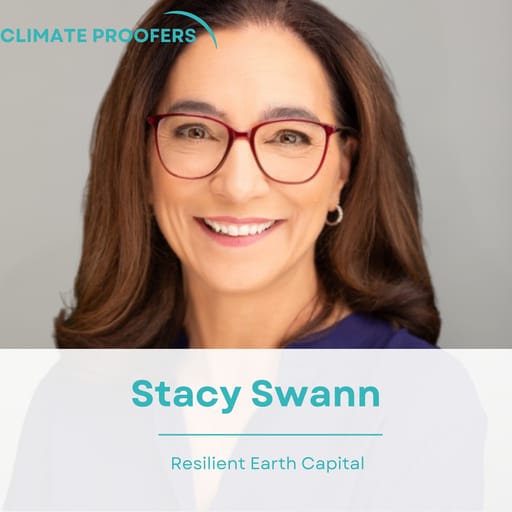
Transcript 0:00 [upbeat music] Hi, everyone, and welcome to Climate Proovers, the show all about those on the front lines of adaptation finance, tech, and policy. 0:13 I'm Louis Woodhill, the editor of Climate Proof, which you can read at www.climateproof.news. 0:19 Today, you'll hear my conversation with Stacy Swann, a true veteran of the climate finance world, who is now turning her formidable expertise to investing in early-stage climate resilience startups. 0:30 She is a co-founder of Resilient Earth Capital, or REC, a community of angel investors making early-stage bets in startups tackling the climate crisis. 0:39 Think Shark Tank, but with considerably more climate expertise in the room. 0:43 In our chat, we dig into what it's really like on the front lines of climate entrepreneurship right now, how founders adapted their pitches and their business models since the political wind shifted in Washington, what does Stacy look for when companies come knocking, and what mistakes do entrepreneurs keep making. 0:58 We'll also look at where she sees the most exciting opportunities emerging in 2026. 1:03 If you're a founder looking for capital, an investor trying to make sense of this market, or simply someone who wants to understand where climate adaptation money is flowing, this is the episode for you. 1:12 Remember, if you want more climate adaptation finance, tech, and policy news and insights, make sure to become a Climate Proof member by heading over to www.climateproof.news/upgrade and get access to all the good stuff behind the paywall, including our Thursday in-depth features, data dashboards, and special reports. 1:30 Okay, in a minute, my conversation with Stacy, but first, a roundup of last week's top adaptation and resilience stories. 1:36 [swoosh] In finance, the Global Innovation Lab for Climate Finance has selected eight early-stage climate finance instruments, many with a clear adaptation tilt, for its vaunted innovation incubator. 1:48 The cohort was drawn from a record 1,172 applications, nearly double the typical cycle, and span nature restoration, resilient agriculture, and industrial decarbonization. 1:59 The instruments range from a $90 million satellite-enabled credit facility for Indian smallholder farmers to a $200 million SME lending program in Brazil. 2:08 Selected solutions target geographies stretching from the Andean Amazon to Vietnam and Madagascar. 2:14 Since inception, the lab has launched 87 instruments that have collectively mobilized nearly $4.5 billion in public and private investment. 2:22 [swoosh] In policy, Prime Minister Mark Carney of Canada announced more than $35 billion in Arctic spending, framing the package as a direct response to accelerating climate change and deteriorating geopolitical conditions in the region. 2:34 The plan concentrates heavily on dual use military and civilian infrastructure. 2:38 There's $32 billion for forward operating location upgrades in northern latitudes, nearly 3 billion for four new operational support hubs, and 294 million for Arctic airport modernization to enable year-round large aircraft access to remote communities. 2:54 In the announcement, the Prime Minister's office explained that climate change is causing Canada's Arctic region to warm nearly three times faster than the global average, a shift that great powers are actively looking to exploit. 3:04 [swoosh] And in tech, Google Research has built what may be the largest global flash flood data set ever assembled by running news articles in 80 languages through its Gemini AI model. 3:14 The methodology, called Ground Source, converts unstructured news coverage into structured, geolocated flood event data, and Google is already using it to power 24-hour advanced urban flood forecasts through its Flood Hub platform. 3:27 [swoosh] Right, that's it for this week's news roundup. Now onto my conversation with Stacy. [upbeat music] Hi, Stacy. Where are you calling from today, and what do you do? Hi, Louis. 3:38 I am calling from my home office outside of Washington, D.C. I'm an investor and, um, a climate change person. 3:47 Uh, I've been an investor and an executive working at the nexus of climate and investment for more than 25 years across all different types of investing. 3:55 "Climate change person" is a wonderful description for you- [laughs]... 3:58 because you have this incredible resume stretching back decades in climate finance and climate advisory, and I got to know you over the last, gosh, I think six years now since my... 4:09 had my first newsletter on, on climate financial risk management, and it's been great to, to kind of grow in this space with you and, and see how you've moved from, from role to role. 4:19 And I want to speak today with you about one of the hats you wear in kind of angel investing community. 4:25 But before we get to that, maybe you can give us a quick overview of your climate career to date and, and perhaps describe some of the other hats you wear in this, in this landscape. 4:33 So I've been working at the nexus of climate investment for more than 25 years. I started at that nexus after finding myself without a job. In 2001, I lost my job. 4:45 I was working in Asia, in India, and then Singapore for a big multinational company, and the company went bankrupt. I found myself back here in Washington, D.C. 4:53 at the International Finance Corporation, which is the private sector arm of the World Bank Group. And there I... 5:00 The first thing I did when I stepped in was I took over a portfolio of what one might call experiments that one of my colleagues had been doing for a couple of years, where he was taking money from donors who acted like impact investors and investing in things that had a climate positive outcome, mostly in renewable energy or clean technologies, things like fuel cells or off-grid solar. 5:23 And at the time, those things were considered quite innovative. 5:26 That portfolio was really taking the dollars from those donors and structuring them in different ways that could fill a financing gap because those projects were deemed too risky by mainstream investors. 5:38 So I took over that portfolio, and I found myself kind of hooked. I was hooked on the climate agenda and the energy transition agenda. 5:45 I was also hooked on the ability for finance to make a difference in pushing greater development impact, greater returns, and really leaning in to take more risks to be able to, you know, realize the, those impacts and those returns. 5:59 So I took this little portfolio of, of, I guess, kind of innovative experiments, and that, those became the seeds of what was later, about three to five years later, what became the Blended Finance Department at IFC. 6:12 So I was its first head, and we grew that workFrom the time I started until 2015 when I left, really building out the donors that were giving us funding to do this, but also really perfecting the practice of blending different types of capital for impact. 6:29 After IFC, I started my own financial advisory and consulting firm called Climate Finance Advisors, and we worked at the nexus of climate and investment for a number of different types of investors. 6:40 Some of them impact funds, some of them pension funds, definitely banks, big banks in emerging markets, and also small banks here in the United States. 6:50 And we helped those different types of investors think about how climate change was both an opportunity set, and in particular in 2015, 2016, 2017 when we started, investors were very keen to go into these markets and figure out how they could build a pipeline and business lines around the renewable energy boom that, that was on the horizon. 7:12 But we also helped investors, um, think about how climate change was a financial risk, and a lot of that work was driven after 2017 when the Task Force on Climate-related Financial Disclosures released its report on how investors should be thinking about climate-related financial risks. 7:31 After that happened, the floodgates opened in terms of folks trying to get our insights on how to diligence investments better to be able to structure around climate-related financial risks that they saw, and those risks were both from physical impacts of climate change, but also the expected changes in policies and regulations that would, um, have spurred the, the energy transition in many markets. 7:57 Climate Finance Advisors was acquired. We grew, and grew, and grew, and then in 2022 we were acquired by a multinational firm in Canada, and that chapter of my career wrapped up. 8:08 So you've got experience in helping to steer vast amounts of capital at large institutions, but you're also more recently been engaged in moving small amounts of very impactful money towards climate adaptation, resilience, and mitigation startups through this group Resilient Earth Capital, or REC. 8:28 So can you explain to the listeners what REC is all about and how it came to be? 8:32 Um, having been an entrepreneur of sorts, having built a company and sold a company, myself, one of my partners, and our COO started Resilient Earth Capital. 8:42 And Resilient Earth Capital is really a community of angel investors here in Washington, D.C., and New York, and California, and, and other parts of the country that are looking to focus on making early stage investments in companies that are addressing or responding to the climate crisis. 8:59 We operate Resilient Earth Capital as a community. We are not a fund, but we do organize one pitch day a month that's much like Shark Tank. So companies submit into our portal. 9:11 We have an internal screening and vetting process with some of our members and our interns, and then once a month we have an hour and a half pitch day where two companies will pitch their ideas into our membership. 9:24 Out of that, members collect themselves, and we organize that into further diligence into a company. And then if everybody is okay with the investment, an investment is made. We're rounding the corner on our third year. 9:38 We've been around about two and a half years, and it's been a really great both enterprise as in terms of build- building and bringing the community of angels together, but also in terms of the types of investments we're seeing and the types of startups that are coming and making- Yes... 9:54 their pitch to us. 9:55 Yes, I want to get into that because Resilient Earth Capital, presumably you're attracting those in the vertical of adaptation resilience, but because this is such a new market, right, there's lots of different ideas about what that actually means. 10:07 So I'll be really- Yes... interested to hear about some of those companies that have submitted to your portal and, and how they kind of align or misalign with your own view on what an ad- adaptation startup should be. 10:19 Well, that's a good point. So at Resilient Earth Capital, we will accept submissions from startup companies across all types of climate action, so not just adaptation and resilience, but also mitigation. 10:30 We believe that resilient Earth requires resilient capital, and vice versa. Resilient capital requires a resilient Earth, and that includes the mitigation and energy transition agenda as well. 10:40 So but what's interesting in terms of breaking down how that portfolio looks, we definitely have had more companies in the early... 10:49 in the first year and the early part of the second year in the energy space, more the energy transition space, not just renewables. 10:56 In fact, we have very few, you know, bread and butter renewables companies submitting to us, but things like companies that are looking for new and innovative ways to do electric batteries without critical minerals, or companies that are thinking about how to make distributed sources of energy cheaper and more, you know, widgetized, I guess, or smaller in order to be kind of cost-effective for scale. 11:21 So we've had a lot of those. But we've also had companies that, you know, are in data and analytics thinking about supply chains and how climate change is gonna affect supply chains. 11:32 Companies that are, you know, really looking to adaptation and resilience in agriculture and agritech, making water kind of efficiency and delivery and monitoring kind of more cheaper and effective. Looking at... 11:47 We've had a number of companies that have been what I would call materials companies, so companies that are looking to make materials lighter or more effective in what they do. So that's all been very, very interesting. 11:58 And has there been a shift over time since you started REC two and a half, nearly three years ago now, in terms of the story that these entrepreneurs are trying to tell? 12:08 And I'm thinking here obviously in the context of the changing political environment in the US. Yeah. 12:13 There was a time under the Biden administration with the in- Inflation Reduction Act enforced, lots of subsidies, lots of tax credits, a lot of innovation in-Climate financing companies, data companies, decarbonization companies, and now of course, climate is verboten, as a word, [laughs] at the federal level at least. 12:30 Yeah. And so we need to know how that's fed into the different stories you're seeing from pitches. So up until November of 2025, we were tracking 188 submissions into our portal. 12:41 Those companies were raising a cumulative amount of about 740 million, with the average raise being about 3.5 million. So we're talking very small companies at a startup stage. 12:53 We're mostly focused on pre-seed and seed companies that have a little bit of revenue, so they've proven their price point, and they've proven that kind of they can sell a widget or sell a product into the market. 13:05 Um, and I would say in year one, um, so in our first year, we had 62 companies in the pipeline, so we had almost twice as many, two X, in the second year. 13:18 While the distribution in the first year was more towards the energy transition types of startups, the distribution in the last half of year two has been more ag and water and heat. 13:32 We've had a number of companies pitching us that have solutions to extreme heat or wildfire, and so that's been really nice to see. 13:41 In the first half of last year when there was that jolt of uncertainty around the policy environment, particularly here in the United States, we did see a number of companies getting their pitches into us because they had lost capital. 13:54 They had some grants that they might have been awarded from, let's say, DOE or, or, you know, other different types of funding programs and those, those funds kind of went away, you know, overnight. 14:06 But that seems to have died down by the end of the summer. We seem to have found our, um, you know, a bit more of a steady stream of a more diversified set of companies coming to us. 14:17 We still see companies that are in the tech space, in the clean tech space, or the energy space that you would have thought a year ago or two years ago would have been the beneficiaries of some of those government programs. 14:28 We still see some of them coming to us, and they're doing just fine, relatively speaking, in terms of getting their prototypes done and their R&D done and getting kind of some of their proof of concepts in the market. 14:41 Of course, it would have been better if they'd had those grant fundings, but, but, you know, we do see maybe the kind of balance of those companies that are still around at the end of 2025 being the ones that have some good products to put out into the market. 14:53 So there's a sense initially with the change in administration of folks rushing for a, a lifeboat, any lifeboat they could find, and now there's a bit more settling down in, in this market and a realization that you have to pick your spots as an entrepreneur, try and find the right capital for the job. 15:09 And how do you go out to the world saying, like, what you're looking for from, from entrepreneurs? 15:14 So do you provide much guidance in terms of what your pitch should look like, what markets you're f- interested in, or is it because you're a whole angel community, you kind of try and keep an open mind? Well, we do... 15:24 We definitely keep an open mind, but we do signal to those who submit to us. 15:28 So first of all, because we're a US-based a- um, set of angels, we only invest in entities that are based in the US, and that's partly because we're... You know, this is mostly a kind of social enterprise. 15:40 We don't, we don't have any revenue. We're all volunteers. We, we kind of self-fund kind of the operations, for lack of a better word. 15:47 And our angels are investing relatively small tickets individually and collectively, so it doesn't make any sense for us to do cross-border investing. 15:56 That is a much more complicated and higher transaction cost kind of enterprise. So the first thing is we- we're investing in entities that have a US... 16:04 Uh, either based in the US or have a US-based kind of thing that we can invest in. And then we initially set out without any idea of where our members, let's call it risk appetite, was. 16:20 Over the first year, so it became pretty clear through the pitches and where, when, and how our members had interest, it became pretty clear that most of the members in our community seek to invest in entities that have a little bit of revenue, so they can be pre-seed or they can be seed series A, but having a little bit of revenue seems to be the, the kind of tipping point for many of our angels. 16:42 Entities that are kind of pre-seed or earlier but don't have any revenue streams or haven't kind of sold something, our angels seem a little bit more nervous to kind of invest in those companies. 16:54 And so we see a lot of people say, "Well, come back to us when you've made a sale," or, "Come back to us when you have a pilot that someone's paying you for." 17:01 And we've had some companies pitch us two and three times because we've had a lot of interest, but the company quite- hasn't quite been at the point where they can, um, they can say, "I've had, I've had pilot revenue," or, "I've sold something." 17:14 Uh, that's nice to know that you don't close the door entirely if you get the first no, right? And you're trying to- Yeah... fo- foster and nurture entrepreneurs in this space. 17:23 And I think that's important because, as I've discussed with multiple people on this podcast, the adaptation market is still evolving, and there are certain sectors where there seems to be obviously an acceleration of interest, where the kind of, the market is clearer, so like in ag, like in wildfire prevention here in the US particularly. 17:40 But we know every sector is gonna be affected or, and is being affected by climate risks, and there will need to be adaptation solutions for all of these. 17:47 But I suppose it's still a case of understanding how, as a, as a startup, you could see demand growing because of climate risks and fit- factoring that into your story, into your pitch deck, right? 17:59 And I'm interested to know, 'cause I, and I'm sure a lot of the listeners are interested to know, because I know for a fact there are a lot of startups or wanna-be startups listening, like, what are the, the things you see in pitch decks or you hear from entrepreneurs that get you excited, you personally- Yeah... 18:11 and which, which mistakes do you see being made that you're like, "Oh, I wish people knew not to do this, not to say this"? 18:16 Well, just I wanna make a point on the adaptation and resilience question because I think in our climate community, we talk about those words, but I think for entrepreneurs who are trying to solve a problem, maybe because it's a problem they've experienced in, you know, in their business or kind of in their everyday life, but they don't see it... 18:34 They see it as a climate connection, but they don't talk about it with the same words, adaptation and resilience. 18:39 We've had a number of companies come to us, particularly in, I would say, things like battery storage and efficiency-Processes where it's pretty clear when they pitch us that it's a resilience play. 18:53 It is an energy play or it's an efficiency play, but it's also a resilience play. 18:57 It's also about solving a problem because of, you know, downtime or business interruption or something that has to do with the kind of productivity degradation that might be happening because of things in, that are out there in a warmer planet. 19:13 So we are also trying to make sure that people who pitch us understand that climate is not, not just these labels, it's, it can be... You could think of just about anything through the climate lens. 19:24 Um, but in terms of best practices, I will say some of the best, um, pitches that we've had at Resilient Earth Capital have come from groups that they know what they're selling, they know their addressable market, they have a plan. 19:38 The, the marketing and sales and scaling plan is something that not a lot of entrepreneurs think about in the first instance. 19:47 They think about making their widget, but they don't think about how to sell their widget, at what price point, to whom, or who the competition is out there. 19:54 And then, you know, the very sophisticated entrepreneurs have a very clear ask, and not just of the dollar amount or the valuation, but also kind of how this fits into the larger growth picture of their, of them building and growing a business. 20:08 Um, we have... There is an interesting split among entrepreneurs. We tend to ask them always, "What's your exit plan?" 20:15 And some entrepreneurs are, you know, uh, if you're building a company, it's very close to your heart, right? 20:20 So some entrepreneurs are not thinking about an exit, they're thinking about their baby that they would grow and nurture, right? 20:26 And then there's some entrepreneurs that have done this two or three times and they're like, "Oh yeah, this is how we would exit in this circumstance or that circumstance." 20:34 There's no right or wrong answer, but we definitely find that entrepreneurs who've been through an exit before, who've thought through this exit question, have a broader option set in mind than maybe a c- somebody who's building a company that's, you know, their baby. 20:50 If that makes sense. Yes. 20:51 I understand that myself, having started my second publication now and finding ways to grow, thinking about ways to scale and, yeah, you need to understand where you wanna be yourself, what you wanna achieve from, from a business. 21:06 And a lot of, I suppose, entrepreneurs initially think, "Oh, okay, this is gonna scale to be the next, the next Tesla, the next Amazon," or, you know, "It's gonna be such an obvious acquisition target that I really don't need to think too much about it 'cause the, the path is clear." 21:18 But it's easy to forget that the people giving you money want to find, figure out ways how they're gonna get their money back. Even though they know early-stage investing's a risky game, it's- Yeah... 21:28 it's easier to bet your money if you think the person you're betting on has a clear plan. 21:31 I think, you know, one of the things we've been talking about at the end of 2025 among the members and, and our founders has really been kind of what is the new thing on the landscape in '26 that we're thinking about. 21:43 And, you know, interestingly enough, everybody has to operate with a little uncertainty if you're a startup. It's by definition the nature of the game. 21:51 And answering some of these questions in the context of uncertainty has always been, you know, part of how startups have to think through, um, building their companies. 22:02 But the legal and regulatory and policy uncertainty in some parts of the world, I won't focus only on the United States 'cause I think this is happening everywhere, is pretty high right now. 22:14 And depending on which sector or segment you're in, we're starting to ask companies, you know, "Okay, what does... What's that larger landscape look like for you over your growth trajectory? 22:25 The next six months, one year, two years, three years, five years and on," because that's really important context that most entrepreneurs would not have normally thought about. 22:35 I mean, normally you can think about the market and the addressable market, but you don't think, "Oh, is the policy environment gonna go for me or against me this year? 22:44 Is the policy environment gonna switch at a point where I'm kind of growing rapidly that undermines how I can price or sell?" 22:52 The biggest thing, of course, this past year in 2025 was the impact of tariffs in terms of uncertainty of, you know, inputs to the widgets that people needed to build the things they wanted to build. 23:02 I don't think we've seen the end of that story yet. I think that's still to, to be determined in terms of what the full impact of it is. 23:10 But it put on the table a level of uncertainty that if you're a startup and you're making a widget and you're subject to any kind of input from a country where there might be a tariff implication, you had to model that in a way that you wouldn't have thought about kind of in '24 or '23. 23:27 And now today, I think things are settled a little bit, but people are still a little worried about is, is it really settled? 23:33 Are we really ready to kind of start planning around the rules of the game, or are the rules still gonna change? Yes. 23:38 It's been fascinating for me in the course of the last two years seeing how many adaptation and actually mitigation companies have pivoted hard to AI, for example. 23:47 Uh, how many companies that may have been called decarbonization companies or mitigation companies are now using the words resilience. 23:55 And I do, I do hear what you're saying about microgrids, battery storage being a resilient play as well as a renewable energy play. Yeah. 24:02 But I find it interesting that the code switching that we've seen happen amongst the mitigation companies trying to kind of get in with the, the crowd investors who are maybe a bit nervous about anything climate terms right now. 24:13 And another important thing is that besides as an entrepreneur thinking about how you want to grow and exit your company, it's also important to think about the different types of capital that might be available to build your business. 24:23 So you're, you're an angel community, that's one way to get money, and there are many other ways in which resilience and adaptation companies can raise money, can access capital. 24:32 Can you talk a little to those alternative mechanisms that may be available?Yeah, I, I mean, I think as a startup, you're, you're looking at obviously your own capital, your sweat equity plus your own capital. 24:43 You should be looking at small business funds. Um, you should be looking at friends and family, or you should be looking at angel investors, and then venture investors as you grow. 24:53 I would not recommend anyone take out loans, although there's a lot of small business loans out there, unless you have a revenue stream that can support that, because I think you get stuck kind of basically at the point in time where you start having to pay debt service, and new investors see that as a, as a potential issue if you're not big enough, right? 25:13 Obviously, if you're growing and growing and growing, you wanna leverage doing... Leveraging off of debt investment at a certain point in your growth cycle is really smart. 25:22 But we've seen a lot of early stage companies that have pulled together different types of capital, and some of them, particularly the ones that are more debt in nature, have been, let's call it a, a kind of a heavier weight around [laughs] the growth of the company. 25:39 It's not easy to build a company, it's not easy to grow a company, and you have to get to a critical mass to then do that kind of leverage. 25:45 I would start first with the kind of equity investments, grants, cap- grant type capital. 25:51 Uh, there's a lot of philanthropies out there also that are looking to invest in some companies for different reasons, not necessarily for the kind of multiple exits that they might get, but because they wanna back something that's very important for the sector or very important for the climate agenda. 26:06 Yes, it's a case of knowing what financing model matches your company. There needs to be some matchmaking done there. That's right. 26:12 And I mean, myself having gone through this process, like you, you learn from talking to people which route you should go down. I think one of the disadvantages though is that you can get analysis paralysis, right? 26:22 And there's also, I think the, the framing around entrepreneurship in, in the States is elsewhere is like, yeah, get that venture capital money, scale massively, flip the company, IPO it, and, and live happily ever after. 26:35 And you having grown a business very, very [laughs] slowly, you know, month by month, day by day to get successfully acquired, you have experience of how businesses grow very differently depending on the market environment, your financing, and yeah, your client base. 26:49 Yeah. No, and I don't think the exits are certain any longer, right? I mean, you, you brought up AI a moment ago and the pivot that a lot of climate, particularly climate data and analytics companies have made into AI. 27:01 And in one way, that's been amazing. 27:03 The data and analytics space around climate and climate-related financial risks and assessing different risks and, and having tools that investors or anyone can use to make, um, decisions about, you know, what they invest in or where they buy their house or, or, or the like, has been really transformative since 20... 27:23 call it 2016, 2017. The pivot to AI in that space will be very transformative from an, a cost efficiency perspective, but you still need to get people to buy your service, and that's where the price point... 27:36 I mean, it's all about kind of how can you sell something at what price point, and can you kind of cover your costs and make a profit? 27:43 It's just that simple and, and from the, from the perspective of all of the data and analytics and AI, you know, there's a lot of big companies out there obviously doing a lot of AI, but the revenue model is still a little unclear. 27:58 I do think the data and analytics space around climate is, it's something that's, the world needs, investors need. 28:04 And by the way, I don't think investors, even if they're quieter now about investing around climate, I don't think that they're doing less. 28:12 I actually think they're using a lot of the, the data and analytics that are out there to help them make their better investment decisions. 28:19 But, you know, you have a thousand flowers blooming, and not everybody is gonna be successful. 28:25 And now at this point in the growth of this particular segment of the market, it's about product market fit, price point, and scale. Yes. 28:33 And those, I suppose, are evergreen objectives, but I am interested to know, to close out the conversation, how you see this year, 2026, progressing for climate adaptation companies and investors like yourself, and how you wanna see REC grow, uh, and increase its influence o- over the course of the year as well. 28:53 So I'll start with that last question. So REC is not a growth enterprise. We invite new members all the time, but we're not looking to be... 29:00 You know, it is a social enterprise and a collection of volunteers that put the work of REC together, and we do that. It's a labor of love. For me personally, it's a way I give back. 29:10 I like to be my, an angel investor in this space, partly because I learn a lot, and I also want to give back in this way. I feel like I can give back and support startups in this way. But it's not something that... 29:22 We're not looking to make X investments a year or have Y members kind of growth, uh, a year. 29:28 It's a no pressure organization, and the members who come, come because they're interested in the space and believe that the collective wisdom and knowledge of our members is helpful for them as they also make their climate investments. 29:41 But I do think kind of '26, you know, is gonna see... I don't think we're gonna see a retreat in terms of climate investment that is linked to the physical impacts of climate change. 29:51 I think we're gonna see more of that, particularly around extreme heat, wildfire, water management, extreme water management, and flooding. I think we're gonna see a lot more of that. 30:03 I think, you know, we're starting to see things that are kind of connected, like I said, materials earlier, but materials that are lighter and able to kind of make people kind of feel more comfortable in extreme heat environments. 30:15 We're seeing a lot of extreme heat tech, wearables and the like for being outside in extreme heat, and widgets that can cool you wherever you are. 30:24 That, because of the way the planet is warming, is just gonna grow, grow, grow, and you're gonna see those widgets for personal use and all the way up to kind of big, big, big commercial use. 30:34 I think the AI data center connection means that energy useIs obviously gonna be on the rise, and just from the cost perspective, I believe we're gonna see a sustained momentum around things that are more efficient and more effective and hopefully greener than business as usual and, you know, in the, in the grid. 30:57 A lot of data centers need redundancy. A lot of that is batteries. There's a lot of great battery technology on the horizon that is reducing the, the dependence on critical minerals. 31:09 Obviously, a lot of batteries still need critical minerals, but I've been blown away by some of the presentations that we've seen at REC for new processes and ways to make batteries that depend less and less and less on some of those critical minerals. 31:22 And that's also a security issue, right? 31:24 If you can make a battery that doesn't depend on that supply chain or those geopolitics, you might actually have something that people would wanna buy because it's more predictable in terms of when you can buy it and how you can buy it and those kinds of things. 31:37 Hmm. Yes, you make me think that adaptation startups actually have multiple flavors of VC or angels to approach, right? 31:45 You know, pure play climate folks like yourself, but also, yes, VCs who focus on materials and efficiency optimization, security. 31:55 We have this theme that was popularized last year, American dynamism, which focuses on how to increase the kind of power influence and efficiency of American heavy machinery and, and defense, et cetera. 32:07 So I think there are lots of options available to adaptation and resilience entrepreneurs. And the question is, yes, do they find investors that align with their values and what they wanna do? 32:17 That's, that's still the key, right? Because- Yeah... you have a vision for your company, but if you find the right investor, they share that vision, they'll help you get there. 32:23 From the wrong investor, they can take you down a whole other path, and then you might- Right... might wish you never raised money in the first place. Right, right. Okay. 32:30 Well, Stacy, I really appreciate you taking the time. 32:32 As I said at the beginning, I've learned a lot from you over our, our six years of collaborations and communications, and I think it's wonderful that you could share some of your wisdom for the Climate Proofers Podcast today. 32:42 I'll be keeping an eye on, on what you're doing at REC and in your various other roles. And I do encourage other folks to follow you on LinkedIn and keep up to date with what you're doing. For now, thanks so much, Stacy. 32:53 Thanks so much, Louis. Always a pleasure. Climate Proofers is a Climate Proof Media production. It is produced and presented by me, Louis Woodall. 33:00 Subscribe to the Climate Proof newsletter by going to climateproof.news/subscribe. And to learn more about the publication, feel free to reach out directly using our LinkedIn page. Goodbye for now. [outro music]