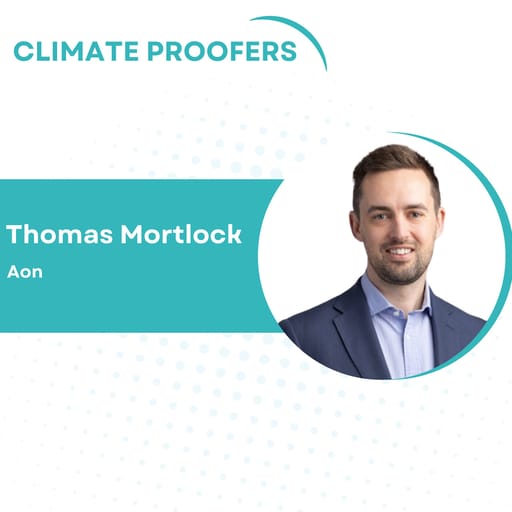
Transcript 0:00 [upbeat music] Hi everyone, and welcome to Climate Proofers, the show all about those on the front lines of climate adaptation and resilience. 0:13 I'm Louis Woodall, editor of the Climate Proof newsletter, which you can read at climateproof.news. 0:19 Our interviewee today is Thomas Mortlock, head of climate analytics for APAC at Aon, the insurance broker and risk solutions company. 0:27 Tom is a fountain of wisdom on the intersection of climate change and financial risk, with particular expertise on insurance, catastrophe modeling or cat modeling, and climate related credit risk. 0:37 He recently co-authored a report on why climate change is important to financial institutions and another on rapid sea level rise risks. 0:45 Together, we go deep on the uses and abuses of cat modeling in forecasting climate related risk, and unpack the dueling pressures of housing affordability and insurance affordability, which is bedeviling policy makers across the developed world. 0:58 Tom also offers us his insights on the financial threat of rapid sea level rise. But first, a reminder that Climate Proofers and the Climate Proof newsletter are subscriber supported productions. 1:09 Listeners like you can help support my coverage by heading over to climateproof.news/upgrade and becoming premium subscribers. 1:16 Okay, in a moment my chat with Tom, but first, let's round up some of last week's adaptation and resilience stories. 1:22 [whooshing] In finance, the Climate Policy Initiative is redoubling its efforts to track adaptation capital mobilized by the private sector. 1:29 Previous reporting by the nonprofit group suggested private adaptation finance made up just two percent of the sixty-three billion dollars of total adaptation finance distributed in twenty twenty-one, twenty twenty-two. 1:40 However, in its latest report, the nonprofit group showcases a new approach to identifying and tagging adaptation finance. 1:47 This concludes that in reality, four point seven billion dollars in adaptation finance was likely invested by the private sector over twenty twenty-one, twenty twenty-two on an average annual basis. 1:56 The criteria used to determine the adaptation relevance of private finance borrows from existing taxonomies produced by Tailwind Climate and the Climate Bonds Initiative. 2:05 The CPI then rates different financing based on the likelihood that it supports adaptation goals. 2:10 Of the four point seven billion identified through this approach, around sixteen percent was considered to have a low likelihood of being adaptation relevant. 2:18 Moreover, twenty-seven percent of flows were tagged as having a potential for maladaptation or causing significant harm to other social and environmental objectives. 2:27 [whooshing] In policy, the UN General Assembly last week recommitted to pursuing climate mitigation and adaptation goals by adopting the Pact for the Future, a series of measures designed to reform the UN and strengthen multilateral efforts to tackle global issues. 2:41 The pact references the need to double adaptation finance and also calls on multilateral development banks to mobilize additional financing. 2:48 The UN assembly played out against the backdrop of increasing mistrust between countries and concerns about how the upcoming US election could upset climate progress made under the Biden administration. 2:57 [whooshing] And in tech, Climate Week NYC showcased a variety of adaptation tech companies designed to tackle extreme heat impacts. 3:05 At an event hosted by Tailwind Climate, the audience heard from the founders of CryoGenics, a startup working on portable body cooling tech that could be used to combat heatstroke. 3:13 And also Rick, a parametric insurance provider dedicated to bringing affordable, fast paid insurance policies to communities and businesses. 3:21 You can learn more about these companies by checking out the September thirteenth edition of Climate Proof. [whooshing] Right, that's it for this week's roundup. Now on to my conversation with Tom. 3:29 [gentle music] Hi, Tom. Where are you calling from today and what do you do? Hi, Louis. Thanks for having me. 3:37 Um, so I'm calling from Sydney i-in Australia, and I work for Aon, a global reinsurance broker, and my role within Aon is head of climate analytics for APAC. Brilliant to have you on the pod today, Tom. 3:50 I've been following your LinkedIn for, goodness knows, what? 3:52 Five, six years now, and you've always been posting very refreshing, interesting, insightful commentary, and I know you've been doing a lot of great work at Aon, and so great to have you here. 4:02 My first question to you, Tom, is can you give us a sense of the current state of play when it comes to discerning the influence of climate change on elevated losses to the insurance industry? Sure. 4:12 So start with an easy one. [chuckles] This one takes quite a bit of unpacking. It's a really interesting topic. 4:19 I probably before I, I get into unpacking it, I, I will preface it with just a bit of brief context on where I'm coming from here. 4:26 And the reason that I'm gonna do that is because often when I've commented on this kind of stuff before, it can quite easily become misconstrued as me sitting on one side of the fence or the other as to whether climate change exists or not. 4:39 That's absolutely not the case. And I will give you an example of a, a famous climate scientist who I won't name, who said to me once that when he started in, in this world twenty, thirty years ago, 4:50 he began receiving, let's call it hate mail, from climate deniers saying that, "You've got this all wrong. How can you be saying all of this?" Et cetera, et cetera. 5:00 But he said twenty, thirty years on, he actually gets more disagreement with, uh, climate activists than climate deniers nowadays. So, uh, the, the only reason that I mention that is because this is a very polemic issue. 5:14 It's a very divisive issue, and the angle that I come at it from or try to come at it from always is from an objective scientific position. I have a background in climate science. 5:24 That's my angle that I'm coming at from this. 5:26 So w-with that said, we probably just wanna say also that it's pretty much a scientific certainty that, that climate change is happening and that climate change is anthropogenically driven. 5:36 In fact, that has been put to bed- Mm-hmm... as a topic of conversation in the scientific community for the past decade plus. 5:42 But the reason why small shifts in temperature are important for weather extremes, a-and this is the link through to insurance, is that a small shift in the mean, uh, if... 5:53 With anyone that's familiar with, with Gaussian or, or, or bell curve normal distributions, is that you get a outsized shift in the tails. So you're getting a small shift in the mean, outsized shift in the tails. 6:06 Uh, a-and also at the same time we get an increase in the variance, so the spread of that distribution is increasing. 6:12 So what's happening at the tails is that we're getting increased frequencyOf extreme weather events, but we're also getting an increase in the variability of extreme weather events. 6:22 Now, that's super important for insurance because insurers price based on cat frequency and volatility. 6:29 The whole reason an insurer will buy reinsurance is to cream off that volatility off the top and to keep their business afloat, essentially. 6:37 I mean, the reason that insurers will actually buy reinsurance is because most individual insurers, they're big enough to be able to cover losses from individual events like, for example, if your car gets stolen or if your house burns down due to house fire. 6:52 But with nat cat events, lots of people claim at once, and insurers often don't have the capital to, to pay those claims at once. And so they purchase reinsurance to spread that risk on a global market. 7:02 And it's been working for centuries. It's a very effective tool. 7:06 I, I call it the kind of the, the cog in the wheels of, of economic growth because it provides investors with confidence to lend, and it essentially functions, uh, as a way of increasing GDP. 7:19 Over the past seven or eight years, we have seen above average global insured and economic losses from natural catastrophe events. 7:28 In some jurisdictions like in Australia and also in the US, we have really good records of insured losses from a market perspective going back several decades. 7:39 So if I just take the Australian example, we've got a really good record back to nineteen sixty-seven. 7:44 If we take that record with no normalization, with no adjustment for inflation, there's a clear increase in losses through time. Now, a quick and dirty way of normalizing would be just to account for inflation. 7:58 So if we just take inflation into account, there is still a significant residual upward trend in losses. 8:04 However, there, there have been some studies in Australia where the Insurance Council Australia have commissioned an outfit called Risk Frontiers to properly normalize the loss record, i.e., they account for exposure growth through time. 8:18 They account for how and where the bull's-eye is getting bigger through time. And when you account for exposure growth in that way, there is very little residual trend left. 8:30 Similar studies have been done in the US, and we see very similar things. So, so what does that tell us? It tells us that the losses experienced over the past several decades, the majority of that trend can be explained 8:42 because of exposure growth, because we're building more things in the way, essentially. That's the majority of the signal. Now, what it doesn't say is that climate change doesn't exist. 8:54 However, a loss record would be the last place you'd look for evidence of climate change. 9:00 And the reason for that is that firstly, loss is a conflation of not only the hazard but also the exposure and the vulnerability, and so the signal gets lost in that. 9:10 And secondly, a insured loss record is the tail of the tail. It's a, a high signal-to-noise ratio. They're generally quite short in length, but very high in variability or noisiness. 9:24 And so there's been some interesting academic studies done out of the US that suggest that a climate change signal would only emerge in a insurance loss record after hundreds and hundreds of years, statistically speaking, just because of that high signal-to-noise ratio. 9:40 So it certainly doesn't refute the fact that climate change exists, that climate change is impacting the, the background state that is conducive for these natural hazard events. 9:50 But the, the loss record, the upward trend in losses is not driven by that at the moment, and you wouldn't look for a loss record as evidence of climate change anyway. That's my take on it. That's really interesting. 10:02 I think we've heard before on the Climate Proofer's podcast about the rising exposures, the growth of urban areas in natural disaster zones, especially here in the US, being the cause of insured loss increases in recent years. 10:16 But this idea that actually the last place you'd look for evidence of climate change is in the insured loss record is interesting. 10:22 Can you double click on that and explain what you actually mean by insured losses being a bad place to search for evidence of climate change? Yeah. 10:30 So cat events or catastrophe events are often named events where the market loss exceeds a given threshold, and there's no particular one universal definition for that. 10:41 There'll be a def-definition in Australia, one in the US, one in other jurisdictions. But it's essentially where a loss exceeds a certain threshold, so it's very big. 10:49 And so that loss record doesn't include smaller events in the record. And so as a result, you get very big year-to-year swings. And as a result, from a statistical perspective, that means that there's a high variance. 11:02 And when you get a short record with a high variance, there's not gonna be any real statistically significant trend that emerges for a very long period of time. 11:11 That's actually the basis of why we do stochastic loss modeling with catastrophe loss models, essentially. 11:16 Certainly what we are seeing though, if we just isolate the hazard, if we just have a look at observations of climate records, we certainly are seeing significant upward trends, particularly in heat-related and rain-related extremes over the past several decades. 11:32 So again, uh, Australia example, over the past twenty or thirty years, there is a clear, uh, upward trend in the number of extreme bushfire, severe fire weather days through time. 11:46 There is also, interestingly, a very clear upward trend in the magnitude of sub-daily rain extremes that are related to flash flooding and surface water flooding. 12:00 And, and that actually scales much, much higher than something called the Clausius-Clapeyron relation, which says that the capacity of the atmosphere scales at a certain rate with temperature increases. 12:11 So my point being that we certainly are seeing this signal in the hazard, but for a bunch of conflating reasons, we're not seeing it in losses, and the loss record is primarily driven by exposure growth.So I think this is an important realization to spread out there, and I think it's a message that's often lost in some of the media coverage of climate-related disasters, extreme weather events, however you want to term it. 12:35 And one thing I want to ask you is there has been this increase in the use of attribution science to ascertain or predict how much worse a certain event was, whether it was a heat wave, a hurricane, a flood event, how much worse it was because of anthropogenic climate change. 12:51 And I think that messaging, that kind of branch of science has-- I've seen a lot in media reports. I reported on it myself. I do think it's very interesting. 12:59 It is very useful for people to try to understand how extreme weather events are affected by climate change. But what do you think of this? What do you think about the growth in attribution science? 13:10 And do you think some commentators are kind of misconstruing it or, or misinterpreting what it's trying to say? Yeah. 13:17 It's a really good question, and it's a really interesting area of climate science at the moment, attribution science. I'd probably put it into two camps. 13:24 I think we're, we're doing pretty well, and we, we've got some pretty good capacity in looking at chronic climate hazards. And by that I mean things that are stationary in the climate system for long periods of time. 13:35 So European heatwave in twenty-nineteen, for example, or any kind of heatwave event, is generally a high-pressure-- a stationary high-pressure kind of system that sits around for multiple days to weeks, to sometimes even months. 13:49 Um, and for those events, attribution science is quite good at saying 13:55 how much more probable that event would have been with anthropogenic global warming, or actually the corollary of that, how much less probable would it have been if we hadn't have experienced this warming trend over the past hundred, hundred and fifty years. 14:11 And there's some really, really interesting results coming out of that. 14:15 In fact, what attribution scientists are now doing, uh, uh, interestingly, they're coupling operational weather prediction models with global climate models to be able to push this further. 14:26 So that's quite good at the moment. What we're still not very good at is for the acute weather perils. 14:32 So for things like tropical cyclones, for thin-things like flood, certainly for hail events, severe convective thunderstorm, extratropical storms, really all of those what we call cat perils that incur an insurance loss, the attribution science just is not there yet to have any kind of confidence as to say this event was X percent more probable because of climate change. 14:57 Very difficult to be able to say that. Now i-it's difficult to be able to say that because a lot of these events are not in the climate models in the first place, right? For a global climate model, there are no cyclones. 15:07 Cyclones are sub-grid scale phenomena for global models. Uh, even for regional climate models that are dynamically downscaled, hail events, severe convective thunderstorms, they're not in there. 15:19 Floods, they're not in there. There's certainly the rain that produces flood events are in there, but the hydrological and the hydrodynamic component to flooding is not in a climate model. 15:28 Bushfires, wildfires, they're not in climate models either. The large-scale climate conditions that are conducive for wildfire spread certainly are. 15:37 But again, in the Australian case, most ignitions of, of what we call bushfires here, they're fifty percent lightning strikes and fifty percent human-caused. Nothing to do with climate change. 15:47 My point is that there still needs to be a lot of work done between going from a climate model to getting any kind of useful information on natural weather perils that incur a loss, um, a lot. 16:02 And for that reason, we're not there yet with being able, able to attribute the difference in frequency associated with events with and without climate change. 16:11 I want to get deeper on this question of, of catastrophe risk models, cat models, and climate models, their interrelation. We talked about this a little bit with Nancy Watkins from Milliman a few weeks back. 16:23 But I'm interested in your take about the, this symbiosis of these two tools because insurance is a source of climate resilience, as you said, it's a way to drive GDP forwards, but its effectiveness depends on the industry's continued ability to price and cover risk. 16:37 And if exposure grows, if hazard grows, vulnerability grows in any combination that can cause insurers to struggle to, to price that risk at the quantity that society needs. 16:48 So I'm interested in w-what your take is on the efficacy of, of cat models at projecting insured losses in a world where it-- weather events are becoming more variable as a result of climate change, and to get your take on how you think climate and cat models should be interacting. 17:00 Yeah. My, my background is actually in cat model development prior to joining Aon, so I find them quite fascinating. 17:06 I think they're, they're probably misunderstood beasts, but they are certainly a big, uh, important unknown that can be coupled to a climate model and translate climate model results into financial risk estimates, so they're an important cog in the wheel. 17:22 But just to be clear, cat models don't produce a forecast. I think that's probably one, one thing that we need to straighten out to begin with. 17:28 Um, i-they provide a, a probability distribution of next year's risk profile for a given set of input assets. 17:36 So we need a, a set of geolocated assets, and they provide a bunch of curves out the other end, which are probability distributions. 17:43 Now, they're, they're complex probabilistic models, and they have a lot of inherent uncertainties in there. Uncertainties in the data that you feed it, but also uncertainties in terms of the way the models work. 17:54 They're also data hungry, so they're bottom-up models. They calculate risk at the location level, and then they aggregate it up to portfolio level. 18:02 Almost the opposite to the way that an IM would work, right, for macroeconomic models, which is a top-down approach. And so the models are only as good as the data you feed it. 18:11 You, you basically need quite a lot of information on where your assets are, what they're made up of, and how much they're worth to you. 18:19 And insurers are pretty good at that, but I'd probably suggest that a lot of potential users of cat models outside of the insurance industry wouldn't have that kind of information at their fingertips, so that's problem number one. 18:31 The other issue is that all, all the modelsBecause they are complex, they give you different answers. 18:36 So if you survey a group of vendor, high-highly used market vendor cat models, the spread of views of, let's say, the hundred-year market loss due to US hurricane would be in the billions, and that's the spread would be in the billions. 18:50 So this is uncertainty. A-and this is fine, but we need to understand that there is a big spread in views. 18:57 And a lot of insurers, brokers, Aon themselves, are able to harness this thing called wisdom of the crowd, uh, which is an interesting kind of philosophy that the mean of an ensemble of a bunch of uncorrelated models is always a better view of risk than hanging your hat on any one model within that group. 19:16 So there's a big spread, there's a whole bunch of uncertainty. Now, with regard to climate change, there, there are two considerations for cat modelers here. 19:25 So the first one is, let's make sure that we're including climate change that has already happened or that is happening. 19:32 And the next one is, how do we include the effects of climate change and project that out into the future? 19:38 So the first one is really consideration around, let's make sure we're not using old climate here, because cat models are built off observational records. 19:47 And the further you go back in time, the less relevant the climate setting is to present day. 19:54 So if we're taking observations from the first half of, of last century, then we're gonna be in a world that is half to one degree cooler than it is today. 20:04 And so the distribution of extreme weather perils is actually very different to what it is today. So we don't wanna be incorporating that into a cat model event set. 20:14 A lot of time and a lot of effort by vendors of cat models goes into constructing event sets, and these are large groups of very smart people that know what they're doing. 20:23 And so that is something that is caked into the model to make sure we're not using old climate. There are detrending methods that go on, so on and so forth. 20:33 In terms of how we actually project out climate into the future of cat models, that-that's called something called climate conditioning, which is quite an interesting area in itself. 20:41 It's being used increasingly by financial institutions, by governments, by real estate investment trusts that are looking at, you know, when I'm caked into a long-term investment of the order of decades, how is my risk profile gonna change over that period of time? 20:57 And there's two ways of doing it, essentially. So you can either adjust the frequencies that are attached to each event within the event set in the model, which is the simplest way of doing it. 21:08 And then the much more difficult but much better way of doing it is dynamically coupling these models to, to global climate models. 21:16 And Aon's, uh, catastrophe loss modeling arm, Impact Forecasting, have, uh, a headline collaboration going on with Columbia University in the US, um, where they're doing just this. 21:28 So they're, they're feeding information directly from climate models, and they're producing brand new event sets that are reflective of future climate conditions. 21:40 And you can start sampling probability distributions of tropical cyclone risk, let's say, for a given climate scenario and time horizon into the future. 21:49 And that's an incredibly powerful way of responding to regulatory stress tests, for example, or disclosure requirements, or just looking at, uh, capital, uh, planning requirements on time frames of ten years plus. 22:04 But within all of this, cat models in the media have got a lot of stick recently, and I think perhaps unfairly in not capturing the, the recent upward tick in global losses. 22:17 And as a result, there being perhaps a, a-an underpricing of, of that risk and then a price adjustment as a result. And some commentators putting this down to the models not including the effects of climate change. 22:30 Firstly, it hasn't, as I've said, been, in the majority, climate change driving that upward tick in losses over the past seven or eight years. Certainly not excluding it, but it's not the lion's share. 22:44 And secondly, the effects of climate change certainly are included in pretty much all of the main vendor cat models. And I think the confusion probably arises from the fact that cat models are not making predictions. 22:57 So the losses have been within the range of what models output. Models are giving you a statistical central estimate of risk. They're not pinning the tail on the donkey, it's a probability distribution. 23:09 We have these things called average annual losses, and an average annual loss through time, given stationary climate conditions, over a long period of time, should actually remain stable. 23:20 But we always get the question, when we go into a period of high flood losses, people say, "Well, yeah, your flood AAL is too low." 23:27 And then when you go through a quiescent period of no flood losses, let's say, people say, "Well, your, your, your flood AAL is too high." That's actually not, that's actually not the case. It's just... 23:35 This is just reflective of human nature more than anything else. What we are commentating on here is the variability. It's the variance, it's the noise, it's the volatility. 23:45 The AAL is the median that goes through the middle of all of that. And then even out of the tail, all of these losses that we're providing probabilities for, they're distributed. 23:56 It's called a Poisson distribution, which I won't get into now, but there is variance around that as well. So it's a highly complex topic. It's never... 24:06 None of that is, is, you know, in its entirety gonna get, uh, communicated through to the, the popular media and the public. 24:13 But I do think that is the core reason for confusion here around projections and forecasts and, and what cat models do and what they don't. 24:23 But one issue here then is this elision of probability distributions with the idea of forecasts, I suppose, does create incentives amongst policymakers and regulators toTake actions or to decide to hammer down on insurers and other financial institutions and maybe even produce policies that are skewed because they're treating those cat model outputs as forecasts rather than actual, as you said, probabilities. 24:52 So I'm wondering, have you seen or, or do you have any worries about improper or ill, ill-tailored regulation for the financial industry being based on this elision of or misunderstanding of cat model outputs? 25:06 So I just wonder what you think about that, if you see that's a, a problem or if it's something that's, uh, more of a storm in a teacup. 25:11 Yeah, I think probably on a, on a very high policy level, we do react to the most recent natural disaster. I think again, that is human nature. 25:20 I wrote a really interesting paper actually with a local academic here called Ben Newell, which was about how we actually perceive risk, uh, and how it is so heavily weighted to the last disaster in living memory. 25:34 And this kind of plays out in terms of how much funding we spend on cleanup post-event, and how much we spend on resilience pre-event. 25:45 And it has always been weighted in the order of eighty to ninety percent on cleanup costs rather than mitigation resilience. Unfortunately, I don't know if that's ever gonna change. 25:55 That is just the way that humans are hardwired to perceive risk, and there have been some Nobel laureates that have written very interesting books on this. 26:06 But I think that some of the people that, that are close to these models, not only within the insurance industry, but now also within the finan-financial institutions, they certainly are comprehending the models for what they are. 26:19 In my experience, it does take quite a long period of communication to-- for everyone to get on the same page, but it's important that we spend that time to do so, so the models are used as they are fit for purpose. 26:32 But if I just give a couple of examples of how some financial institutions are using these kind of tools, it, it's really because of this worry around insurance affordability. 26:42 Um, and I think, uh, banks, lenders in general to date have had this assumption that climate risk doesn't need to be quantified on their books because insurance is there to pick up the pieces. 26:54 Now, with large pockets of communities now under acute insurance affordability stress, when you take out a home loan, it's often a condition of the contract that you have home and contents insurance in place. 27:08 However, very few lenders actually have the capacity to check up year on year on the certificate of currency. 27:16 So it can eventuate that a homeowner ditches their insurance policy because it becomes too expensive through time, or they cut back on the sum insured, or they carve out policy exclusions to the extent that it's not-- property is not well insured. 27:33 The bank would have no oversight on that, so they don't know. 27:36 If a cat event comes along, a big flood, uh, the property can, um, incur some severe damage, which the homeowner could then not repair because there's no insurance in place. There's a hit on the property value. 27:49 Um, there's a hit on the desirability of the suburb, even if the property's not been impacted. So at the very, you know, best case outcome, um, the-there's a hit on the LVR for the bank. 27:59 In the worst case outcome, there's an increase in the probability of default. Neither is a good outcome for the bank. 28:06 And so banks are now beginning to use more insurance-based analytics to really understand where the pockets of climate risk and insurance affordability stress may be in their lending portfolio, uh, and incorporate that into their own risk appetite decisions, uh, and their own, uh, uh, point of loan decision making as well. 28:26 So it's a fascinating time to be involved in this space because there are use cases opening up left, right, and center for cat models that for decades just weren't there. 28:36 Obviously, disclosure's another one, but, but credit risk is a big one for the banks. 28:40 That's really interesting, the idea that this presumed shield of insurance may be disappearing from certain properties that banks thought they had, and that could be like a hidden risk that slowly emerges or maybe emerges all at once following a, a particularly bad calamity. 28:54 Yeah, absolutely. And you need a cat model to really quantify that kind of thing because the hundred-year flood event doesn't happen everywhere at the same time. 29:03 And so you need to have a stochastic approach to really quantify that tail risk and where the pockets of that may be. 29:09 Some are even using it to optimize portfolios with regard to client risk, to make sure that they're not overly exposed to accumulation of risk in a particular location. 29:18 But I think as financial institutions individually are beginning to use these more complex tools, there, there is a role for the regulator to really oversee what then happens. 29:29 Because if they are, through time, these tier ones, these big banks, if they're weeding out the client risks from their lending portfolio, someone else is, is gonna pick that up. 29:40 And does it then mean that we are essentially underwriting or lending on areas that have become too risky to really build and live on? Um, are we eroding the risk signal? 29:54 Essentially, insurance affordability stress or, or a rise in premium is a signal that place becomes too risky through time. Are we masking that signal? And if so, what do we do about it? 30:04 Does, does the bank become the insurer of last resort? Should it? So I think there, there's a role for the regulator here to bring all of that together, to have a market oversight. 30:15 But also, especially in the Australian context, insurance affordability is at fundamental loggerheads with housing affordability. Housing affordability is a supply side issue. 30:25 You squeeze supply further, you're not doing anyone any favors in terms of housing affordability. But insurance affordability, you essentially need to squeeze supply. 30:33 You need to have better controls on development, especially in floodplain areas, in areas that are too risky to live.And I don't think anyone has really tackled these two intergenerational issues that are at loggerheads at the moment. 30:46 And, and the first step really is for the financial institutions, the insurers, government, regulator, to all sit around the same table, acknowledge the problem and then go from there. 30:57 It's not an easy one by any stretch of the imagination. 31:00 Okay, just one last question on insurance then, because I am interested in innovations in the insurance industry itself to make households, businesses, communities more climate resilient. 31:11 Uh, and here I'm thinking about the way that insurance policies are structured, insurance coverage is structured, but also innovations that could help insurers themselves better price risk at a, a more granular level, perhaps, um, via the use of interesting geospatial tech, drone technology, et cetera, and measures like wildfire mitigation, vegetation management, flood defenses, et cetera. 31:33 So just wondering from, from the top of your head what insurers innovations on both the kind of financial structuring side, but also on the kind of surveillance and monitoring side could be useful here. Yeah. 31:43 Well, you, you absolutely hit on one there, Louis, which is location level analytics, granular analytics, being able to price at the building level rather than just the postcode, zip code level. 31:55 Certainly that's very important for some perils. So things like flood, for example, where it is very location specific. 32:01 With more granular hazard information being integrated into the underwriting process, insurers in certain jurisdictions now do have the capability to rate risk at the building level. And, and that's really important. 32:15 Now, not every jurisdiction insurers will risk rate. In Australia, they do. So what that means is they calculate the average annual loss at a location level. That's their breakeven cost. 32:30 That's how much they should charge at the particular location to cover expected losses from weather perils in any given year. And then they load that up with a whole bunch of other layers, including taxation levy. 32:41 And so the underlying risk actually reflects the market premium quite well. 32:46 In some other areas, in parts of the US for example, there, there's a cap on, on the premium that insurers are able to charge, and so that may not necessarily be reflective. 32:54 But insurers in general are moving towards risk-based pricing as more granular data and analytics becomes available to do that. And, and that is a good thing, I think for, uh, consumers in general. 33:09 And that in itself, I think will help build resilience in that it, it provides us with a much more granular, uh, signal as to where is risky and, and where it's not. 33:19 But I think that the general problem that we have is that an increased frequency of cat events drives up the demand for insurance, but it also drives up the cost. 33:29 This is the, the seeds of the insurance affordability issues that we're seeing in many locations. So we need to find new ways of plugging what we call the pr-protection gap. 33:39 Um, so w-- there was a, a report that came out from, from Aon last year that showed that seventy-five percent of all economic losses globally in twenty twenty-three were not covered by insurance. 33:52 Now, as I mentioned before, insurance, insurance is there to kind of all the cogs on economic growth. It provides confidence to invest and, and to provide credit to grow GDP 34:02 despite the fact that we get these big natural catastrophe events occurring. If you have good risk transfer in place, you're able to build back better. 34:11 You're able to build a more resilient built environment through time. If you don't have that safety net there, then you can't. And climate change has been described as an inequality amplifier before. 34:24 I think certainly through the lens of insurance affordability, it is even more so in that those jurisdictions that are unable to, to afford adequate insurance cover would have a net negative hit on GDP growth through time. 34:39 Because each time a cat event comes along, they're not able to build back better and therefore they are, uh, more vulnerable to the next one that comes on. So it's really important plugging this protection gap. 34:49 Unfortunately, through time, the protection gap has not got that much smaller. In fact, in some areas it's widening. 34:56 The heart, I think, of probably as an, as an industry, what we should be trying to do here, um, trying to plug that gap in the face of climate change, but also in the face of, of these affordability pressures that, that, that we see. 35:09 Parametric insurance is often touted as an innovative solution to address this. 35:15 Although it has actually been around for quite some time, it certainly can provide an option where traditional indemnity kind of style insurance is no longer available or affordable. 35:25 It's, uh, a really interesting flexible concept in that you don't actually need to incur loss to trigger the product, so the event just needs to happen. So you can structure it for anything. 35:35 And if I give you an example, there may be a European river tour operator that knows that when the river level gets to a certain height, their boat can't pass under a bridge and they can't complete their tour. 35:53 That impacts their revenue. It's on one particular bridge. How do you find an insurance policy for that? 36:00 Parametric's your solution because you can work out the probability of the river level exceeding a certain level at that particular location. You can structure and price a product around it. 36:10 They can buy it, uh, and then when the event actually occurs, whether or not they're able to pass through that bridge or whether or not they actually lose every revenue because of it, there is a payout and there is a payout quickly. 36:22 There's no loss adjuster that comes around. And so especially for SMEs, parametric insurance is being taken up alongside traditional indemnity insurance as a business interruption stopgap. It provides cash quickly. 36:38 They're very interpretable and they're very flexible products. 36:41 So certainly we're seeing more demand in that space as, as time goes on.And what do you think about the relationship between reinsurers and then capital market solutions like catastrophe bonds and insurance and securities? 36:53 I'm not sure if this is in, in your wheelhouse, and I don't know much about the rate of developments, but there has been some media reports like cat bonds are a growing market, but they are not... 37:03 Their triggers are not set at a, a level at which they can actually provide capital to communities that are hit by natural catastrophes, and that's creating some controversy there. 37:12 So just wondering about your thoughts about cat bonds and reinsurance here. Yeah. I could probably talk a little bit more about reinsurance rather than the cat bonds. 37:19 Well, it's probably a little bit outside my area of, uh, understanding. 37:23 With regard to, let's say, losses over the past seven or eight years, which have been quite significant above average, it's been interesting to see what has driven that loss growth in terms of what perils we're talking about. 37:35 So traditionally, in the insurance industry, we talk about primary and secondary perils, which is a very bad way for basically saying primary perils are earthquake and cyclone, and secondary perils are everything else. 37:46 Secondary perils have been driving the upward trend in losses over the past decade. So things like storms, severe convective thunderstorm, hail in the US, flood events pretty much everywhere. 38:02 They've been the things that have been contributing to the total aggregate and losses each year. 38:07 And that is a problem for primary insurers more so than reinsurers because there's an increase in frequency in relatively smaller scale events. So events that don't always punch through to reinsurance layers. 38:25 And so insurers take the hit. They've been the ones that are having to pay out the majority of these losses, whereas only some of those really big events go through to those reinsurance layers. 38:35 And that's why we've seen in certain areas, you know, California, for example, for wildfire, some insurers just pulling out the market because they've incurred too much of the loss. 38:43 They've retained a lot of that risk and, and they've had to pay it out, and they haven't been able to obtain the ins- the reinsurance at the low levels that they require. So just flagging that 38:55 it, it, it certainly is a worry for, for primary insurers and regulators in general as to the ongoing capacity of local insurance markets to provide insurance as to what's actually driving that, that loss. 39:08 When it is a accumulation of relatively small scale but high-frequency events, that's not good news for insurance affordability. That's really interesting. Yes, I was trying to understand that kind of relationship there. 39:21 There has been a lot of talk from Swiss Re, from Munich Re about the accumulation of secondary perils or the idea that there's no such thing as secondary perils anymore, though this kind of helps put that in context. 39:31 Okay, we've talked a lot about acute risks, extreme weather events, and insurance, but I know also at Aon, Tom, you've also been working on slow onset events or chronic risks, and I wanted to ask about your research here. 39:42 There was a recent paper on sea level rise risk. 39:44 So I'd like you to talk about this risk in particular, and also, I suppose, whether you think there should be more attention paid to these chronic slow onset events or whether it's right that we're kind of focusing more on acute risks right now. 39:56 Do you think the balance is right, or do you think we need to shift our focus a little? Yeah. 39:59 Well, certainly within the insurance industry, we often always focus on acute weather peril events because they're the insurance loss-producing events. 40:07 But there are these chronic climate hazards, and we often split them out into chronic and acute. 40:13 One chronic climate hazard would be sea level rise, something that is a bit of a, a silent risk that goes under the radar, or that's the way that it's portrayed. Yeah, we wrote this piece with... 40:24 in collaboration with Dr. Felicity McCormack from Monash University in Australia, really around the unknowns around sea level rise projections. 40:32 So a, a lot of planning for, uh, critical coastal infrastructure, uh, and development in the coastal zone, coastal defenses and so on and so forth, uh, are planning for medium projections three times. 40:45 That's about point four to point eight meters of sea level rise by, by twenty one hundred. That, that is actually accelerating. 40:53 But we just really wanted to highlight that there is a whole bunch of uncertainty that sits behind that, particularly around those high-end sea level rise projections. 41:01 So plus one meter, even plus two meters sea level rise by twenty one hundred. That is really difficult to include in risk management across the board. 41:12 It's difficult to include because we have no idea as to the timeframe or the probability attached with those high-end sea level rise projections. What do we do at this stage? 41:23 The reason that we have that big uncertainty there is because it really all depends about tipping points. What kind of thresholds are passed, particularly with Antarctic and Greenland. 41:33 If we get a whole big kind of ice shelf that shelves in... that, that carves into the sea, then we suddenly jump to a sea level rise projection that we weren't previously on. So how do we plan for that? 41:45 So it was really kind of a discourse around that. 41:47 A-and also-- perhaps also to point out, again, this is the same kind of conversation with temperatures, but it runs with sea level rise as well, the small changes in sea level rise can have big impacts on the coast in terms of coastal erosion risk and coastal flooding risk. 42:02 And there's a famous kind of back of the envelope rule called the Brin rule, which says that for a one centimeter rise in sea level, you will get a one-meter retreat in the coast. 42:13 Now, that's highly dependent on local sediment transport conditions, but it's a rule of thumb. 42:19 Likewise, coastal engineers often use the rule of thumb that ten centimeter rise in sea level increases the frequency of coastal flooding by a factor of three. There's actually exponential, uh, relationship behind that. 42:31 But that basically means that with ten centimeter sea level rise, a one in fifty-year coastal flood event today becomes like a one in fifteen-year event with ten centimeters only. 42:42 So small changes in the mean, big changes in the extreme. And sea level rise often gets spoken about as ahazard in itself. It's not in most cases. 42:52 In, you know, very small cases like Miami, for example, where you can get a very high tide that has been made higher because of sea level rise, you get what's called sunny day on nuisance flooding. 43:05 But in most cases, it's how sea level rise conflates pre-existing coastal risk, things like coastal erosion and coastal flooding. So it really is a conflation of an acute risk. 43:18 And what we found in Australia is that just under half a million properties are within the one percent coastal flood zone. So this is important because it's... 43:29 The way that we actually communicate risk, I think is, is really important. I've been banging on about this topic quite, quite some time now. 43:36 A one percent chance of flooding over thirty years is the same as a one in four chance of flooding over that period of time. 43:45 So instead of saying to someone that you live in the hundred-year flood zone, why not say to them that you're taking on this mortgage for thirty years, you've got a one in four chance of getting flooded over that period of time. 43:55 Now, the bet that the homeowner takes on that is even more acute with coastal risk, because in Australia and pretty much everywhere else in the world, insurers don't include what's called actions of the sea in an insurance premium coverage. 44:11 So coastal erosion, coastal flooding, generally excluded just because the loss associated with that is just too high. 44:17 So homeowners are taking a bet on if you're in that one percent area, they're taking a bet on a one in four chance of flooding. And if you're impacted, you have to pick up the bill yourself. 44:28 And I have to say, lenders don't have much of an oversight on this either. 44:31 So it was really just highlighting some of those points, some of those, again, misconceptions around sea level rise and, and trying to bring it to light a little bit. 44:39 That's really interesting, and I think it's important research from homeowner point of view, uh, a kind of risk assessment point of view, and the way that you're translating, yes, one in a hundred year flood events into, into probabilities over a timescale, I think is important. 44:54 And communicating that risk to those who might be thinking of taking out property or, or do own property in these risk areas, I think is very important. 45:02 So just finally then, Tom, I'm interested to know what sort of research you'll be pursuing in, in the months to come, whether it will be more focused on these other risks to sea level rise risk and the effects on, on financial institutions or, or on home-homeowners. 45:15 Like what's your area of focus going forward? I guess it really depends on who's willing to [chuckles] collaborate with me. 45:21 There's a really interesting piece that we've got bubbling away at the moment, which is integrating paleoclimate observations into cat models. And I've dabbled in this area before, but I, I find it fascinating. 45:33 But, uh, you look out in the tail, let's say for flood, we have this concept of the PMF, which is the Probable Maximum Flood. 45:40 No one really knows what it is or how big it is, but it's incredibly important for flood frequency analysis. It's incredibly important for land zone planning. 45:49 Turns out it's very important also for cat modeling and, and reinsurance pricing, but huge uncertainties because basically no one's ever experienced it before. 45:59 But paleoclimate observations, looking into the distant past and looking for evidence of bigger floods that have been experienced than over the historical period, provides these really valuable dot points, validation points on a frequency curve, where you can basically say that actually the PMF that we're modeling to has been exceeded twice before over the past five thousand years. 46:21 And I think that's incredibly powerful. 46:23 And I often find that these kind of interesting, let's call them obvious research questions, have never really been taken on board before just because there is this siloed divide between backgrounds. 46:40 My own background is a kind of confluence between engineering and science, and I have to say the two rarely, um, they collide all the time. 46:49 They rarely agree on a particular view just because that's the discipline that they've been brought up in. Coastal engineers would firmly only ever use observations in the observational record alone. 46:59 Whereas paleo climate scientists may say, "Well, that's ridiculous because you need to put it in the context of the longer term envelope of climate variability." And so fascinated about these overlap areas. 47:10 Where can we break down these silos? Where can we actually leverage pieces of information that people may not have considered before? 47:18 And al-always with the aim of improving our understanding of what risk is, pricing it, and essentially ensuring that we make better kind of resilience decisions through time. 47:31 Well, I, for one, am glad that you are putting so much effort into asking these questions and trying to provide some useful answers to the industry. 47:38 And I'm sure many others who follow you, Tom, and work with you are grateful too. And I'm sure our Climate Proofer listeners have, have learned a lot today. I certainly have. 47:47 Thank you very much for your time, Tom, and we hope to hear from you soon. Thanks, Louis. It's been great. [upbeat music] Climate Proofers is a Climate Proof media production. 47:56 It is produced and presented by me, Louis Woodall. Subscribe to the Climate Proof newsletter by going to climateproof.news/subscribe. 48:03 And to learn more about the publication, feel free to reach out directly using our LinkedIn page. Goodbye for now. [upbeat music]