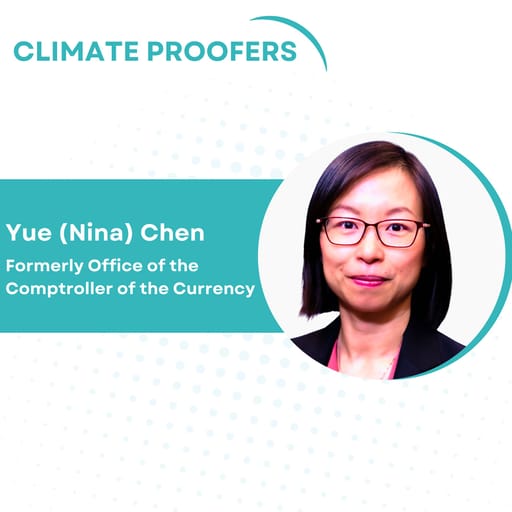
Transcript 0:00 [upbeat music] Hi, everyone, and welcome to Climate Proofers, the show all about those on the front lines of climate adaptation finance, tech, and policy. 0:13 I'm Louis Woodall, editor of the Climate Proof newsletter, which you can read at climateproof.news. Today I'm joined by Yue Chen, also known as Nina. 0:21 Until recently, she served as chief climate officer at the Office of the Comptroller of the Currency, or OCC. 0:28 That's the federal regulator responsible for overseeing the safety and soundness of national banks and savings associations. 0:34 During her time at OCC, Nina was instrumental in drafting and implementing the first ever principles for climate related financial risk management for large financial institutions. 0:44 These were designed to help major US banks identify and manage climate related financial risks and marked a significant step towards strengthening the climate resilience of the US financial system. 0:54 But that progress has since come under threat. After leaving the OCC in January, Nina watched as the Trump White House moved quickly to dismantle key pieces of the federal climate risk policy framework. 1:04 And on March 31st, the OCC formally withdrew the principles that she and her team had worked so hard to put in place. In our conversation, we dig into Nina's work at the OCC and the legacy of her climate efforts. 1:16 She also shares her thoughts on the state of climate resilience and adaptation investment across the banking sector, highlighting where gaps in risk management persist and where today's climate risk analytics still falls short. 1:27 We also talk about her current role as a senior visiting fellow at the London School of Economics, and her hopes for continued private sector leadership on climate risk. 1:35 It's a rare chance to hear a senior banking regulator reflect on the federal government's climate risk efforts and hear her unvarnished thoughts on the climate resilience of this most critical of industries. 1:45 Before we get to the conversation, here's the latest on Climate Proof's membership drive. Remember, we're trying to hit three hundred paying subscribers by September 30th. That's only a hundred and twelve days away. 1:55 As of the time of recording, we have a hundred and sixty paid members, so have a hundred and forty still to go. If you value Climate Proof and want to help out, please upgrade by heading to climateproof.news/upgrade. 2:06 Today's new member shout-out goes to Dimitar Vlahov, a senior consultant at S Hub, the Norwegian Community for Sustainable Business and Leadership. Thanks for joining us, Dimitar. 2:16 Okay, in a moment my chat with Nina, but first a roundup of the top adaptation and resilience stories from last week. 2:22 [whooshing sound] In finance, new research by the nonprofit World Resources Institute claims that for every one dollar invested in adaptation, around ten dollars fifty in economic benefits will result over a 10-year period. 2:33 The researchers used a triple dividend of resilience framework to arrive at their return on investment figure, which takes into account avoided losses, induced economic benefits, and social and environmental benefits too. 2:45 They argue that the high ROI they came up with should be used to tempt private finance into the adaptation space. 2:51 However, that analysis is not based on private investment in adaptation, but on more than three hundred investments made by multilateral development banks and public finance institutions, raising questions as to its applicability to the private sector. 3:03 [whooshing sound] In policy, scientists have urged governments to boost coastal resilience efforts and strengthen ocean observing and modeling capabilities in the run-up to the UN Ocean Conference, which is taking place this week in Nice, France. 3:15 The International Scientific Committee of the One Ocean Science Congress published 10 recommendations for governments and heads of state last week, including enabling, quote, "ocean-based approaches for meeting the Paris Agreement's decarbonization and adaptation goals." 3:28 Governments should invest in ocean observing systems and run assessments of the impacts and risks of slow onset ocean changes in support of this goal. 3:36 They should also develop, quote, "holistic approaches to bolstering coastal resilience." The hope is that this UN Ocean Conference will help build momentum behind a global pledge to conserve the world's oceans. 3:47 Currently, only about nine percent of the ocean is protected or conserved, and just two point seven percent is assessed as being effectively protected, according to the Marine Conservation Institute. 3:56 Countries have committed to conserving 30% of land and sea from harmful activities by twenty-thirty, a goal that this conference aims to advance. 4:04 [whooshing sound] And in tech, Latvian startup Aerones has secured sixty-two million dollars in fresh funding to expand its fleet of AI-enabled wind turbine maintenance robots, which promise to cut costly turbine downtime as global wind power scales up. 4:18 These robots can maintain and service wind turbine blades in half the time it takes humans to do so, according to the company's CEO. 4:25 Demand for them is likely to grow as global wind energy capacity surges and extreme weather events become more frequent and severe, increasing the risk of damage to turbines. 4:34 Already, around five point four percent of turbine blades are hit by lightning every year, with these strikes responsible for 60% of operational blade losses and 20% of operational wind losses, according to one study. 4:45 [whooshing sound] All right, that's it for this week's roundup. Now on to my chat with Nina. [upbeat music] Hi, Nina. Where are you calling from today, and what do you do? Yeah. 4:55 So I'm calling from the West Village in New York City, and I'm doing a senior visiting fellowship at the London School of Economics. Wonderful to have you here, Nina. 5:04 I've been following your career for a while because until recently you were the chief climate risk officer at the Office of the Comptroller of the Currency, or OCC, which is one of the three primary federal financial regulators here in the US. 5:17 So first and foremost, I think listeners will be interested to know how that job went, what that job entailed, and what were you kind of doing day to day? 5:23 What sort of conversations were you having with regulated institutions, with other agencies, and with your counterparts at the other large banking institutions? Yeah, happy to share. 5:33 I'm not sure if every member of yours would know what OCC is. I actually didn't know it, um, until I was approached for that role. So the OCC is the federal banking regulator. 5:44 It regulates and supervises national banks, including the largest ones in the world, like JP Morgan, Citi, as well as almost a thousand community banks, totaling about sixteen trillion in asset under supervision. 5:58 Um, so my work at OCC is very much aligned with n- its mission, which is to make sure banks operate in a safe and sound manner so that depositors are protected, and also make sure that all the depositors, all the citizens, have fair access to financial services. 6:18 So as the chief climate risk officer, my work was to make sure our largest banks, so banks over a hundred billionReally understand, manage, and, uh, control the financial risk from climate change. 6:33 So it was all risk focused. It was not about getting them to set any targets or go to net zero. It was not about telling them who they can do business with or cannot. Definitely not about directing capital flow. 6:46 But really make sure they understand how climate change is affecting their own operations, their clients, the market environment they're operating, and to manage that risk appropriately. 6:59 In terms of the day-to-day, really evolved over the two and a half years I was there. 7:04 At the beginning, when I first went to the OCC, I pretty much talked to everyone who was willing to talk to me up and down the hierarchy. 7:12 And I, I quickly came to realize that while my colleagues had a general sense of, yes, the climate is changing and there's more natural disasters, that the linkage to the financial regulator's mission was not always clear, or it was not intuitive. 7:30 So for the first six months or so, I spent a lot of time just making that connection, talking about how climate change is affecting the economy, affecting the financial market, how it's affecting them today versus, like, 50 years from now. 7:47 Just really making the case of why this work makes sense and how it's tied to the mission. So I gave a lot of presentations, traveled around the country. 7:57 My first week on the job was actually accompanying the acting controller back then to mid, um, Midland, Texas, which is a key oil and gas producing area. That was a really fun trip. 8:10 I went on the drilling platform and learned about how horizontal drilling worked. And I also talked to the staff, uh, in Midland whose bank's very much in the oil and gas business. 8:23 So the first six months is really about making the case, um, and I think after just a lot of conversations, people started to see that there was a connection, and, uh, climate change, both from the natural disasters, increasing frequency and the severity of natural disasters and the insurance challenges, they could affect bank's clients as well as, uh, their own operations. 8:47 Unfortunately, [chuckles] the case has become more easier and easier to make. People see the, in the news, the devastation these natural disasters have brought to society. 8:58 And now obviously, there's also the transition risk aspect. 9:02 Most of the banks that the office focused on, the largest ones, have either global presence or their clients have global presence and are exposed to the changing economy globally. 9:16 So it's not just what's happening in the US, but also what's happening globally. 9:22 So then I think once I have that foundation for my colleagues to have that basic understanding, then it's a lot about, uh, like I was saying, building the team. I just had one person when I joined. I grew the team, 9:36 did the hiring, and then also created the process and procedures internally in terms of how to supervise, how to engage with the largest banks, what are the questions to ask, what are the questions not to ask. 9:49 So it's, for the remaining, like, two years, it's very much thinking about how I could integrate the climate risk considerations into the, the agency's day-to-day practice. The education aspect is really ongoing. 10:04 So the Office of Climate Risk had a, obviously, dedicated team, but the supervision of climate risk of the largest banks are really relying on the bank examiners in the field. 10:18 We help train the examiners to get them to understand the linkage, and then it's just so many aspects, like, when you think about climate risk, like supervision of climate risk management from the bank's perspective. 10:30 There's, uh, what the board needs to understand, what they need to do, as well as, like, the internal processes, procedures the banks need to stand up, as well as their own internal training, and then data acquisition, how do you think about data scenario analysis. 10:45 So there is a lot of internal work, education work, and then there's also the aspect of engaging domestically as well as internationally with my peers. 10:57 And I also joined a lot of the climate risk reviews and just directly engaging with banks on that. I want to talk about one of the big outputs from the federal agencies under the Biden administration. 11:09 These are the principles for climate related financial risk management. So these are jointly issued by the Federal Reserve, FDIC, and OCC. 11:17 They have been withdrawn by the OCC, but they were in place for a number of years, and I'm interested to know, like, how did that come about? 11:24 What was the purpose of those principles, and how did you see them being implemented by banks? Yeah. 11:29 So when acting controller Mike Hsu was leading the OCC, he had a vision that the climate risk management principles need to be a inter-agency effort to build that dur- to, to create that consensus in the federal agency and then build the durability. 11:47 So I would just-- I want to emphasize, these are principles or guidance. 11:51 These are not laws or regulations, so they are really the good practices that banks should be looking at, so they don't have enforcement power, unlike anti-money laundering, for example. So obviously, the, given the 12:06 Office of Climate Risk work is about furthering the OCC's mission, it's ultimately about safety and soundness, about sound risk management. 12:17 We thought that it's helpful for banks-To see more in a central place how climate change related financial risk could impact the risk management, how these sound practices could be integrated into the traditional risk management aspects. 12:34 So if you look at the principles, they're very consistent with existing guidance. It's really elaboration of how climate related financial risk considerations make sense in those traditional risk management practices. 12:48 So they, they're broadly welcomed by the industry, and think they provided the clarity for the industry of how to think about how to structure their work, and, uh, I... 12:59 This is one thing that I only started to appreciate after I become a regulator, um, it's that a, a big part of what regulators do is not holding a stick over, over the regulated entities ahead, but really it's education, it's showing what good practice look like, showing what their peers are doing, and really just talk about why it makes sense for them to understand this risk. 13:28 Yes. 13:29 That's interesting what you say about supervision being about convening and educating and acclimatizing banks to climate risk management and making sure that climate risk management is considered within their own existing processes and policies, right? 13:45 So it's not something totally alien that has to be- Mm-hmm. That's right... you know, imposed on top, it's actually embedded within all their practices. 13:51 And I'm wondering if that approach means that even though we've seen this regulatory rollback, as I said, the OCC withdrew their climate related principles under this current administration, but because that effort took place where you're trying to embed this in banks' business as usual operations, perhaps they will continue to do good work on evaluating their climate risks and investing with a climate lens going forwards. 14:16 Is that your understanding or hope for what happens next? Yeah. So I know, uh, the work is still ongoing at these largest banks. Just last week I was invited to join lunch by the Climate Risk Forum of the largest banks. 14:32 Some are OCC banks, some are not. They have come together supported by industry group to share the, share the practices. So I know the work is still ongoing. 14:41 Obviously, with regulators' focus on the, the work could go faster. 14:47 At the same time, I think a lot of the banks, or should say the largest banks, also realizing this climate change is happening, the impacts it's having is staying and become, become more severe. 15:00 I think in the US there's generally more focus on physical risk and a bit less focus on transition risk. But again, we're exposed to a global market, so what's happening outside the US still matters for the US, uh, 15:15 US market. So I think the... it's also really a spectrum in terms of where the largest banks are. 15:22 There are some very sophisticated, they're still growing their climate risk team, but others have slowed down the work or let people go. 15:30 So it's really a spectrum, and, uh, I think the more sophisticated ones are also realizing by having very good understanding of the risks, they can really help to drive business decisions. 15:42 They can use that information to help shape the portfolio and better understand where they might want to grow their business versus shrink and, um, make sure they have, for example, diverse exposure to insurers in the higher physical risk areas. 15:58 I'm sure you have seen reporting of insurance companies pulling out of California or Florida. There's a concentration. Some banks are looking at it like, do they have a concentration to certain insurers? 16:10 The climate is changing and leading to more disasters, and it is making that case for us in terms of why banks need to focus on this. Yes. 16:19 It seems to me that some banks were prioritizing climate when it felt like there was going to be regulatory sanctions or regular climate stress tests, right? 16:29 We did have the Federal Reserve come out with a climate scenario analysis exercise under the Biden administration, and I know there was upskilling and hiring that took place at US banks to accommodate that. 16:39 But then once that kind of regulatory pressure receded, some banks then got rid of their teams. 16:45 But it seems like those banks that understand there could be competitive advantage in having a better grasp on physical risks throughout the US, 16:54 they realize having granular understanding of climate risks means they could maybe continue underwriting mortgages in certain places that others might be scared of, continue to fund corporates that are in at-risk areas. 17:06 So they see it as an opportunity to kind of grow business, as you said, but there does seem to be those banks who only saw it as a regulatory practice. 17:13 And I'm kind of interested to know from your time at OCC and now in the private sector, in the world of academia, how do you think banks have become more climate resilient? What actions have they taken? 17:24 What policies are they putting in place? What technologies are they using that makes you think they are better prepared now than they were, let's say, five years ago? So I joined OCC, like, two and a half years ago. 17:34 When I engaged with some banks, they were talking, they were sharing information on, like, ESG or corporate sustainability of, like, the commitments they make, which is not OCC's focus, or was not OCC focus. 17:48 So OCC was already just focusing on the risk aspect. 17:51 But over the past two and a half years, I did see a change into, for more looking at just what's the risk that the changing climate is creating on the business, on their clients, on their operations. 18:04 So I think from that perspective, it shows the improvement of their understanding. You could see that also from the data acquisition, the climate analytics acquisition, the, that banks have made, or at least some banks. 18:19 Quite a few largest banks have acquired data, acquired analytics, and some of them, after having used the externalVendors also realized they want to build something in-house, so they also have hired teams to do that. 18:35 So that's another sign of progress. 18:37 And then there are also banks who have just over time, more banks have started to do more granular client-level analysis, how their clients are understanding or managing the climate-related risk and opportunities. 18:54 So some of them have like hundreds of clients that they have gone through that kind of analysis. I would say some analysis are good, some are still more [chuckles] to be desired in terms of the quality. 19:05 But I think ultimately it's, uh, like, so credit risk is the biggest risk for banks, actually one of the biggest risk area for banks. 19:13 So really understanding all the factors, all the risk drivers that could affect a client is, um, is essential. 19:21 So I think it's a good development to see banks developing these very detailed client questionnaire and the collecting the data, increasing the coverage of the sectors as well as geography, the asset classes. 19:34 So these are all welcoming signs of banks' progress in this area. 19:39 What are your impressions about how other countries around the world are dealing with climate-related financial risks, so the Bank of England, the European Central Bank, China, Japan? 19:49 How would you compare or contrast their work versus what's going on in the US? So for example, China has had a growing fiscal policy or monetary policy support for a long time. 20:01 Their central banks give a lower interest rate to their banks when they make loans to green projects, so it's a monetary incentive. 20:09 I think it's something that the ECB had explored, but obviously it's not happening right now. In China, that has been in place for many years. 20:16 They have had a green taxonomy, and the central banks have been focusing on supporting the transition for the past few decades. 20:25 The early participants of the Network for Greening the Financial System traditionally have been very active in contributing to that space. 20:32 And obviously for Europe, for Bank of England, they've really been leaders in the space. NGFS is housed above the France, and just in terms of Bank of England led the climate scenario analysis work stream at NGFS. 20:48 I would say I really learned a tremendous lot from these international regulators in terms of how to carry out work, and especially on scenario analysis. And the- they... 20:58 I think just politically it's much less challenging compared to the US in this space, so there is more societal consensus on the need to manage the risk from climate change. 21:11 But not to say that the US also in the past few years have done a lot of work and on the private sector side continued to work in the space. 21:19 And have you seen banks proactively investing in adaptation to improve the risk profile of existing clients or potentially future clients? 21:29 Because it seems like the first wave of climate-related financial risk management was focused on, yes, assessing the risk, you know, sizing the risk, maybe putting in place risk limits or processes whereby difficulties encountered by a client could be escalated up. 21:44 But I don't see much about investing in adaptive measures that could actually enhance the credit worthiness or the resilience of certain assets. 21:52 And I'm wondering, did you see much of that in your time at OCC, and do you see more of that happening now? Yeah, definitely. 21:59 I think there is a lot, a lot of opportunities and needs to invest in adaptation and the resilience. When I was at the OCC, I didn't see much of that discussion yet. I think the... 22:11 Ha- being a regulator, banks are also very hesitant to show anything that's not already well fleshed out. So I think adaptation and resilience are newer areas than before. 22:22 They feel ready, they probably just wasn't sharing that with, with their regulators. And, uh, it's also from different business areas. The advisory area of the bank is not their risk management area. 22:35 I think banks now seeing opportunities in adaptation and resilience like they, they have seen that in the mitigation, climate mitigation, the low carbon transition pa- a few years ago. 22:45 So I think it takes time, you know, internally for these kind of knowledge and awareness to be spread out through the, through the organization, that I am excited to see more 22:57 institutions paying attention to adaptation and the resilience. And what gaps do you see still in how banks and financial institutions are approaching climate risk? So we kind of mentioned one just there, right? 23:09 That maybe they haven't been as proactive about adaptation investing in the past, maybe that's changing. But you've been at the, uh, the same conferences I've been. 23:16 You're hitting the road and talking to lots of interesting people in the adaptation space and in the climate risk space. 23:22 So I'm interested from your takeaways are from your experiences in terms of where the gaps still are. Yeah, definitely there's still a lot more to do. 23:29 I think there are certain assumptions that people have need to be tested. 23:34 So for example, there have been research papers, including from the Fed, talking about how a past natural disasters in the US have not created major losses for banks and some, in many cases, even spurred local loan growth, um, because there has traditionally been very robust, um, post-disaster federal assistance. 23:57 The federal assistance is now in question, and also what's even more important is, barring the great financial crisis, we haven't seen necessarily a home price drop much in post disasters. 24:11 And, um, and, uh, like people are still moving to Texas, Florida because of the low cost of living. The home prices there have, in general, been increasing. 24:21 So, so people are willing to rebuild or people don't want to lose their equity in the homes. 24:26 But Bloomberg came out with reporting that Florida's median home price dropped to three point one percent in April from a year earlier, the biggest drop-Of any state due to the high insurance rates and condo fees stemming from extreme weather. 24:41 And this year, again, it- this hurricane season is also forecasted to be a very active one. So I think the assumption that home price would not change post-disaster need to be reconsidered. Um, 24:56 so, mm, my former colleagues at the OCC, Ding Du and, and Steven Karoly, had analyzed the Hurricanes Harvey and Hurricane Irma and Maria for Texas and Puerto Rico's housing market. 25:10 And post-hurricane, the, the Texas market didn't have much change because economy was doing well, but for Hurricane Maria, it, it hit at a time when Puerto Rico's economy was already not, not doing well. 25:22 So post-hurricane, the, it, it really, the housing price and the default rates, housing price went down, default rates went up. 25:30 So, so it's, um, I mean, people have traditionally very much think about climate risk as a standalone risk. Climate change is really a risk amplifier and, uh, we, and what's, 25:44 what get us worried about climate change is not that it, it created just one very bad hurricane. If our financial system breaks after one very bad hurricane, we have a lot more to worry about. 25:55 [laughs] But it's not one disaster that's making us concerned about climate change, it's really the, the systemic change, the global impact, and the, the... 26:07 It's also not a one-time shock, which is how our banks, how our financial institution used to think about risk. With climate change, the baseline is changing, and it's only getting worse. 26:18 This also makes it much harder to model. The traditional economic models need to be adapted to capture this trend shift as well as the compound effect. Moving to think about the compound risk is a major gap. 26:31 And then the other aspect is to go from thinking about the change in the average to really change in the extreme. 26:39 So that's one point, the first report that came from JP Morgan, for the author is the former chief scientist at NOAA. She also emphasized the importance of thinking about the extremes. 26:51 If you look at the largest losses from past natural disasters, it's really the largest events that led to disproportional losses. It's not the immediate events. 27:01 Uh, and clime- with the changing climate, the, even though the, you could say the mean didn't change, like one point five versus two is point five degrees, like, why, why does it matter? But it's really the extremes. 27:13 It used to be as a one percent chance of this event could happen, but now it could be, like, 10 times more likely that it could happen. It's really thinking about extremes. 27:23 So I think that's another one that banks need to do more work on. 27:27 And I would say one additional one is that in just staying in the physical risk side is on the type of hazard to think about, like flooding and hurricanes and wildfires most on top of mind when people do analysis. 27:41 But with, uh, warming climate, heat waves are going to already become more frequent and severe, last longer. 27:49 And heat waves actually kill the most people among all natural disasters compared to hurricanes, floods, wildfires, earthquakes combined. 27:58 So it's the most deadly one, and it's, uh, and the increase of heat waves is also exponential with the warming climate, and that's going to affect a lot of sectors that have other work, as well as factories which are not built for warm climate, and they will lead to water stress. 28:17 We're now all excited about data centers, and most of them are built in very dry areas that potentially have water stress, and right now they're using a lot of water to cool those data centers. 28:30 So banks also need to expand the hazards they think about. 28:34 Yes, I like this idea of w- we- how we're measuring climate risks may not be telling the whole story, and the importance of the tails, I suppose, especially when it comes to physical risks. 28:43 This idea of compounding risks like, uh, a prolonged period of drought which dries up the soil and then followed by a sudden rainstorm that then creates even greater flooding because the, the land is so hard. 28:55 Or indeed, yes, heat waves taking place at multiple parts of the US at once, right, and causing stress to various different parts of the US infrastructure and, and US supply chain. 29:05 So those are risks that definitely are coming into the foreground, and I know there are a number of sophisticated modeling companies out there and internal teams who are looking at this more deeply. 29:12 So I think there is... That, that realization is coming for sure. 29:16 But I do want to talk a little bit about beyond just sort of the top tier of banks because before OCC, you had a climate risk role at the New York Department of Financial Services, and you're focusing there. 29:26 There are a number of large banks, of course, that are regulated in New York, but also a lot of smaller banks. 29:30 The US still has many community banks, state-based banks that serve smaller communities and don't have the big investment banking businesses of a Goldman Sachs or JP Morgan, so to say, but they still have climate risks that they're facing. 29:45 So I'm interested to know, how is it different educating these smaller banks on climate risk? 29:48 And what are the difference in capabilities and understanding between the top tier, the Wall Street behemoths, and the smaller state-based and community banks? Yeah. 29:56 So I think a big difference is just the capacity and resources that are available to community banks, to smaller banks. 30:05 I want to give kudos to New York DFS, which issued their detailed climate risk guidance tool for their banks, which has no c- asset cutoff. 30:16 And so their guidance covers the international ones as well as these very small community banks and the credit unions. 30:23 I think the challenge there is, like, these community banks are-Already facing intense competition, high cost of compliance, IT upgrades, and so on. 30:35 They also don't have the benefit of diversification compared to the large banks. 30:40 And so they're very much tied to certain areas, and that's also where their value add is, is really understanding the community and they provide the needed service to the communities. 30:51 So when I was at the DFS, a lot of the work I did with the smaller institutions was really engaging them in terms of education. 30:59 I hosted multiple webinars to just help them understand how climate change is changing the weather, the systems in New York, and what other resources in New York that they can turn to. 31:10 And when I first went to the DFS, there was a lot of hesitation or misunderstanding of, like, what my role was or what the work was entailed, and the, the Community Bank Association was very suspicious. 31:27 And after the engagement, after all this education, I think they were much more open to that, to that work. So in the US, the insurance is regulated at the state level. 31:38 So actually a lot of my work, I would say at, at the New York DFS was actually on insurance. 31:43 And so I issued the nation's first climate risk management guidance for both banks and insurers when I was there, including a very detailed one 31:52 for insurance companies, and also can talk a lot more on the insurance perspective as well. Yes, I did want to touch on insurance. So you mentioned it already. 32:02 There's this very important nexus, right, between insurers and banks because 32:07 banks underwrite mortgages, homes are insured, and the idea is that banks' losses from defaults that are related to climate risks could be covered by the insurers that pay out their claims, right? 32:21 So there is this understanding that banks have this safety net to a degree from the insurance industry, and that might be why there has been less focus in the climate adaptation world on banks relative to insurers, where we see a lot of energy, a lot of technology, many initiatives working on 32:40 improving the ability of insurers to write business even in areas where climate risks are very prevalent, right? 32:47 So I'm wondering, I'm interested in your thoughts on that insurance banking linkage and your sense of how the US insurance industry, small insurers, large insurers, how they can adapt to a hotter and wilder America, which we're seeing today. 33:02 Yeah. And so when we talk about insurance, we also have the... 33:05 I know most people think about property and casualty or P&C insurance, but, uh, there are also life insurance as well as health insurance, which DFS all regulated. And they face very different exposures. 33:19 So going back to the P&C side, so providing natural disaster insurance is very much the bread and butter for property insurance, and they have invested a lot of technology manpower into better understand that. 33:34 I would say traditionally insurance, the natural catastrophe or nat cat insurance, had been driven by historical occurrence and the insurance industry is now more and more realizing that there's not a stable baseline. 33:51 They are kind of retrofitting climate models onto the traditional nat cat modeling approach. 33:58 There are also startups that start with climate models and then add the natural disaster sampling Monte Carlo simulations on top of that. Uh, I just want to highlight one, 34:11 one major disconnection I observed between banks and insurers. Banks make 30-year mortgages. Oftentimes they don't hold the mortgages on their book. 34:21 They sell them to Fannie and Freddie or some they hold on the book, but the duration of these mortgages is still five, seven, ten years, depending on how they're structured. 34:31 So you do have a long-term exposure, versus insurance is underwritten on an annual basis, and the insurer can decide not to insure a place or area, 34:45 and they can decide to increase the price or increase the deductibles and so on. So there is a mismatch in terms of duration of the assets that banks want to protect versus the protection they get from insurance. 34:58 And we have seen insurance premium going up in the past years, not just driven by the increase in natural disasters, increasing loss from natural disasters, but also just inflation more, but broadly, the increase in property values and so on. 35:14 So I think that's also what had driven some of the more sophisticated banks to think about their insurance exposure. 35:23 And then if I think about life insurers, which have very long duration liabilities, they also have very long duration assets that they invest in. 35:33 And you could say on the asset side, they are exposed to climate-related financial risk from the investments. 35:40 So for property in-insurers, it's more the liability side that's exposed, but for life insurers, it's on the asset side. Yes. 35:47 I don't think it's a coincidence that some of the largest asset managers, investment managers that were part of climate alliances, right, like the institutional investors group in climate change, that they are also insurers, right? 35:59 So AXA, Allianz, MetLife, they all have a, a vested interest in ensuring their assets, which are long dated, as you say, are resilient to climate risk. 36:10 So that is certainly true that we shouldn't forget the life insurance side, even though a lot of the focus is on the P&C side. Okay, I want to ask about the tech space now. 36:19 Got a lot of listeners who are very interested in climate tech, and there's been a big rush of companies into the climate risk analytics or climate intelligence space. 36:27 And you spoke yourself about how a number of banks have upskilled and built up their analytical capabilities. 36:32 Now, there are some big name companies like Jupiter Intelligence and ClimateX who have been in the space and catering to banks in Europe and the US. You've also got more bespoke companies coming in, I've noticed. 36:41 So you have companies that are focusing just on flood risk or wildfire risk, and they're all trying to sell to banks and insurers. 36:48 And I find this interesting because, of course, that-Competition suggests that this is a lucrative area for companies to be involved in. 36:54 But I'm also interested in whether we're building the right technology for banks, like whether they need more than just analytics, what other... 37:00 Going back to gaps, what other innovations they need to be able to be resilient in a climate future. So I think the, um, this is kind of like still the Wild West of climate analytics. 37:16 And there has already been some consolidation, and I see that will evolve even more. I do s-see that, uh, increasing sophistication is very helpful for the market. I think there are a few challenges that 37:32 these technology firms need to keep in mind as they develop their products and, uh, as they think about who are their clients and how they team up for partnerships or even, uh, ultimate acquisition. 37:45 One is, despite the large number of this analytic providers, 37:51 forecasting future is still very hard, and we are seeing, so multiple firms have done this kind of analysis, looking at just dispersion of the outputs from the different climate analytics providers. 38:06 I've seen that, I know some banks have done, some trade associations or consulting firms have done that, and you do see a pretty wide dispersion, especially for the natural disasters that are less well modeled. 38:17 I think hurricane is better modeled, but the wildfire or flood, you'll see large dispersion. And the people are, like when I went to the Climate Risk Forum that was held by this trade association, they show the results. 38:30 So I think one question that this cl- analytics firm need to be able to answer is, given this large uncertainty, how do you differentiate yourself and how can you help your user, which oftentimes is the risk management folks, make the case to business that they can make sound business decision or risk management decisions given the uncertainty in the data. 38:56 What's the right type of decision that can be made given this uncertainty? Can you really making decisions at the property level? I know some analytics firms will say yes. I will caution [chuckles] against that. 39:10 I think it's more at the portfolio level. It's more about portfolio tilting. 39:15 I think you can also use, given the uncertainty, to think about, like what's your portfolio composition or your risk management practice that will give you confidence given this range, given this uncertainty. 39:28 So from the analytics firm's perspective, be able to guide your users through that decision-making under uncertainty, I think will be important. 39:38 And then the other aspect is just think about the sales or the procurement cycle from the banks or the insurers or asset managers perspective. 39:48 Do they want a dozen different providers or do they want one provider that has, like eighty percent of what they want? 39:57 Selling to any financial institutions is hard and takes a long time, especially if you want the models or the analytics to be used in the actual decision-making business processes. 40:08 Especially for banks, there's a huge lift in terms of model validation and so on. So thinking about reducing that barrier of adoption is also very important. 40:20 So think from that perspective, thinking about how do you partner with ex- providers, established providers that may lower that entrance, uh, cost could also make sense, but that's more a business decision, I would say. 40:37 Yes. 40:37 It does feel like a number of financial institution targeted climate risk modeling companies, they enter this valley of death pretty quickly where they may get one or two clients onboarded, and they're small contracts, and it's taking a long time to negotiate, and they hope that those contracts will lead them to bigger things. 40:54 And then, yes, they come up against the army of lawyers and procurement specialists- [chuckles]... at the Wall Street banks. 40:59 And yeah, sometimes those contracts can be multi-year, and they can be m-millions of dollars, and that's brilliant. 41:04 But for small companies, the question is, can you actually get through that process to get the, the prize at the end? And that's definitely a challenge. Yeah. 41:11 I've seen some analytics firm just decided not to pursue banks because it's just not worth time they would need to spend. So, and there are other, others that have faster sales cycles that they can pursue. Mm-hmm. Okay. 41:23 I'd like to finish by talking about your next moves in the climate space. 41:27 Maybe you could talk a little bit about this visiting fellowship at LSE, but also interested to learn where you think the opportunities are for folks who have exited public service recently in climate risk, where you think your energies and expertise are needed. 41:41 Yeah. So I'm very excited with the visiting fellowship at LSE. It's, uh, I'll be working with the Grantham Research Institute on climate change and the environment. 41:50 They recently set up a center for economic, uh, transition expertise, Ctex, and it's led by Robert Pattnello, who has been with the Bank of England, with the Fed, is highly respected, and Dr. 42:05 Simon Dachau, who was a key member in the NGFS research consortium, as well as former colleagues, uh, like Sydney from... Who I work with at the Financial Stability Oversight Council. 42:17 So there I will, the area that I'm very interested is climate and also nature related financial risk. 42:23 I didn't get to work on nature when I was a financial regulator, but I hope to [clears throat] do more work on that space, and then also in developing countries. So I grew up in China. My husband is from India. 42:34 More broadly, just developing countries in general are going to, are already experiencing more impacts from climate change, and they don't have as a resilient and robust and diversified financial system as the US or Europe. 42:47 So I think to help their [clears throat] central banks and the financial regulators manage climate related financial risk is going to be very important. So that's the part I'm very excited about. 42:58 I think for former federal colleagues in the climate space, obviously, it, it's a very challenging time and, at the same time, there's a tremendous work that's still happening at the state and local level, and even internationally. 43:12 It's funny that now on LinkedIn, I always get ads from the EU trying to recruiting for climate scientistical researchers. 43:21 I'm actually going to London in early June for some strategic workshops with LSE, but also going to a conference there. 43:29 And just, yeah, there's still tremendous amount of work happening globally at the private sector as well. 43:35 So I'd definitely encourage people to keep the spirit up and try to make things happen in this challenging environment. That's a wonderful message to leave on, Nina. 43:45 Thank you so much for your time today, for your public service, and also for continuing to stay in the climate space, and I look forward to keeping track of your work going forward. Thank you for now. 43:54 Have a great rest of your week. Yeah, thank you. Climate Proofers is a Climate Proof Media production. It is produced and presented by me, Louis Woodall. 44:02 Subscribe to the Climate Proof newsletter by going to climateproof.news/subscribe. And to learn more about the publication, feel free to reach out directly using our LinkedIn page. Goodbye for now. [outro music]